
11th November 2025 “Modern Railway Signalling” by Clive Feather
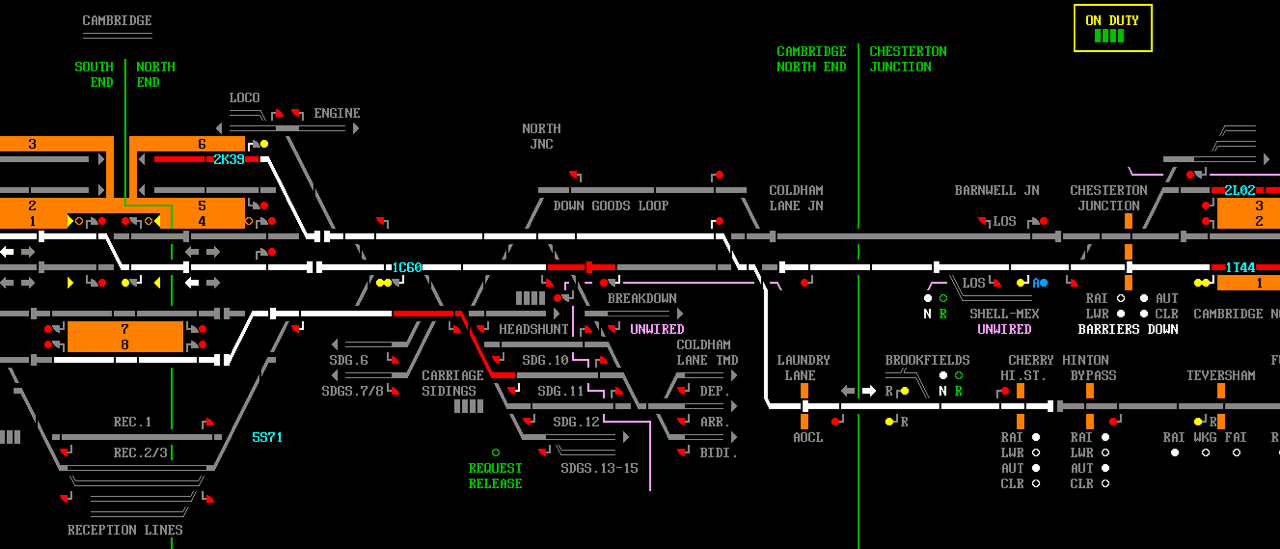
On Tuesday November 11th we were delighted to welcome Clive Feather who gave us a fascinating insight into modern railway signalling. Clive, a native of Leigh-on-Sea, is a computer programme by profession and has been a lifelong signalling enthusiast.
The evening began with a review of signal types, starting with lower quadrant slotted types and the infamous Abbots Ripton accident of 1876 which led to the Somersault signal. We covered the general layout of signals, including distants, starters, advanced starters and clearing points, and also looked at development of the three aspect semaphore signal.
Colour light signals were next – both searchlight and multiple aspect – and the introduction of a second yellow to provide a preliminary warning of a need to stop. This was necessary as line speeds were generally increased and a single yellow gave insufficient braking distance at higher speeds. Clive then covered more modern technologies such as Light Emitting Diodes (LEDs), where the filament bulb has been replaced by an array of LEDs which in some cases were two-colour (red/green or yellow/green), allowing signals to be replaced with fewer aspects. The use of flashing aspects was described, such as a flashing green to indicate a clear route where a train may exceed 125 mph. We also covered routing indications, including ‘Theatre’ indicators where a particular route is indicated by a letter, or a particular platform by its number, and ‘Feather’ indicators, where a row of white lights at an angle to the signal head indicates the selected route. The maximum number of Feathers allowed on a signal is six (an arrangement known as the ‘Admiral’s Hat’), but Clive did allow that he had never seen such an arrangement.
Clive then described the main methods of tracking the progress of trains, including track circuits and axle counters, and how these are deployed across the network at junctions and on significant lengths of line, including the use of automatic block sections (illustrated on signals by a white rectangular plate with a horizontal black bar though the middle). These methods allow significant lengths of line to be controlled from a single location – for example the whole of the East Coast Main Line from London to Edinburgh being controlled from only seven power boxes.
To bring us right up-to-date, Clive concluded the evening by taking us into the digital era of Solid State Interlocking and the new European Train Control System (ETCS). Here he carefully explained the complexities of interlocking and digital communications by trackside data links and by the GSM mobile phone network where ‘Movement Authority’ is now sent as a telephone-like signal directly into the driver’s cab. This system has been implemented on the Cambrian line, the Moorgate line and is in the process of being introduced on the East Coast Main Line.
The evening closed at 10.05 pm with the audience showing their appreciation to Clive for taking us through a very complex area of railway operation and giving us insights that are seldom seen from outside the industry.