
13th January 2026 “Bilston and Wolverhampton from Steam Days to Tramway” by Mike Page and Michael Smyth
2026 opened with a double-header from Branch members Mike Page and Michael Smyth after a chance discovery that both once worked at the same factory (GKN Sankey, in Wolverhampton) in the 60s and 70s respectively.
Mike Page opened with a map of the geology of the area, showing how coal, iron ore and limestone deposits led to the numerous iron works, foundries, rolling mills and brickworks that gave rise to the ‘Black Country’. Following this Mike described the early railways in the area, including the Grand Junction (later the London & North Western), the Great Western (including the Oxford, Worcester & Wolverhampton) and the Midland line from Walsall.
Various views then followed which illustrated the different railways in the heavy industrial landscape, including Fowler Class 3 2-6-2T No. 40049 at Ettingshall Road and Bilston on a Wolverhampton High Level to Birmingham New Street local and Crewe North’s Stanier Class 5 No. 45254 with the 12.15 Lime Street to Birmingham in October 1961. Mike vividly illustrated the extent to which the railway served all local industries such as Stewarts & Lloyds, GKN’s Bankfield and Albert Street works, Perry’s, Patent Shaft, John Thompson’s works and many more.
A remarkably decrepit Bilston West station was seen as Mike entertained us with the shenanigans between the Shrewsbury and Wolverhampton Railway and the LNWR, leading to an alliance between the S&WR, the GWR and the Midland, all of which culminated in the building of Wolverhampton Low Level. Various GWR views were then seen, including 6005 ‘King George II’ passing the site of Bradley & Moxley station with a Paddington to Birkenhead express in October 1960, ‘Hall’ Class 4-6-0 No. 6923 (formerly ‘Croxteth Hall’) on the Summer Saturdays 09.45 Wolverhampton LL to Margate in July 1965 and Old Oak Common’s brand new Class 52 ‘Western’ No. D1008 ‘Western Harrier’ heading the 11.35 Wolverhampton LL to Paddington, South of Wednesbury Central in October 1962.
Mike brought his part of the presentation to a close by focusing on both of Wolverhampton’s stations. This included some fascinating views of the High Level’s rebuilding and electrification, such as English Electric Class 40 No. D269 arriving in the partially rebuilt station with the 11.20 New Street to Glasgow Central and then at Low Level station, D378 arriving with the Southbound ‘Pines Express’ to Bournemouth West on October 6th 1962, which it handed over to Castle Class 4-6-0 No. 5026 ‘Criccieth Castle’.
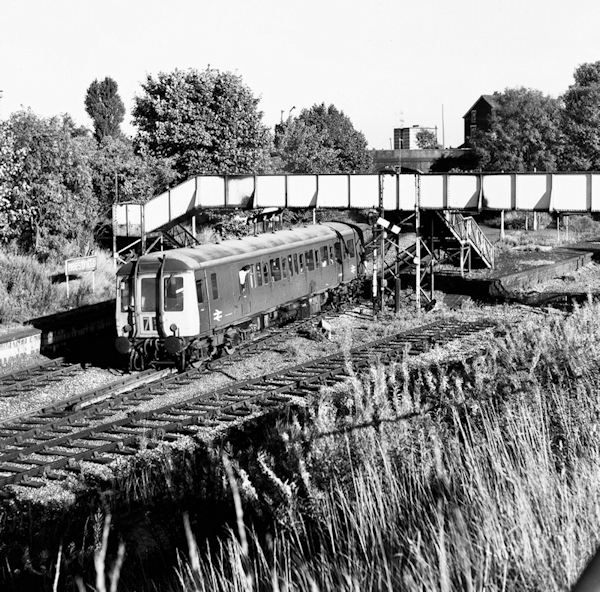
Following a break, Michael Smyth took over and presented views of the area from his time there which began in the early 1970s. We focused initially on the reversing spur at Cannock Road Junction and merry-go-round workings to Ironbridge power station, after which we moved down the Great Western to Bilston Central and Priestfield to see views of Gloucester RCW single car units on the final Snow Hill to Wolverhampton Low Level services.
Michael covered the last day of the Wolverhampton to Snow Hill service, 4th March 1972, with views at these stations and also at Wednesbury and Handsworth Junction.
We then moved onto the LNW line, by now fully electrified, with scenes including 83005 and a brand new 87024 at Tipton in 1974, 87101 ‘Stephenson’ at Wolverhampton and views of the recently opened curve from Bushbury Junction to Stafford Road Junction.
The re-opening of Snow Hill station was seen on October 4th 1987, followed by several steam-hauled excursions including BR Standard Class 4 2-6-4T No. 80079 at Smethwick in April 1995 and two 5700 Class Pannier Tanks locos, Nos. 7760 and 9600 arriving at Wolverhampton from the Midland line.
Michael brought the evening to a close with views of the GKN Sankey factory and its Heavy Press shop, the new office-type buildings that now replace it and of trams at Bilston on the former Great Western Main Line.
The meeting closed at 9.50 pm with much applause from the audience for Mike and Michael’s first class presentation of an age of industry, and railways, which have passed completely from the national landscape.