
Ex Main Line Locomotives used as ETS mobile generation units – top page
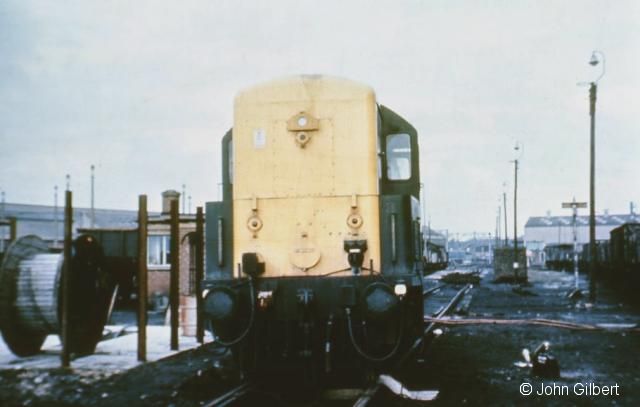
DB968002 at Darnall, Sheffield on 19th April 1975 during its short stay in connection with the introduction of air-conditioned Mark 2 coaching stock to St.Pancras-Sheffield trains. John Gilbert – Class 15 Preservation Society
Converted to ETS generating unit in 1969. Although very much associated with the GN & GE areas this locomotive first saw use at Bradford. During early 1973 it spent some time at Swansea and appears to have been ‘too and thro’ between there and Finsbury Park several times. The RO (p.123 4/73)reports that it was due to be moved in freight trains from Temple Mills to Landore during February 1973. Sightings and information about its movements at this time are particularly sought. During 1975 it was again away from familiar territory when it saw use at Sheffield. During late 1981 it moved to Derby, then onto Toton, where it became a source of spares for DB968000. In 1985 it again moved to Sheffield, but on this occasion for scrap.
| Loco | Location | Date | Seen by |
| DB968002 | Doncaster Works | 21/08/1969 | Tom Dovey |
| DB968002 | Bradford | 12/10/1969 | Philip Cartwright |
| DB968002 | Bradford | 19/10/1969 | Peter Martin |
| DB968002 | Hammerton Street Depot, Bradford | 05/11/1969 | Archive (Class 15 Preservation Society) |
| DB968002 | Bradford | 31/01/1970 | Peter Martin |
| DB968002 | Bradford Exchange Station | 23/09/1970 | John Wade |
| DB968002 | Bradford Exchange Station | 01/10/1970 | Andrew Dodgson |
| DB968002 | Bradford | 12/04/1971 | Robert Mullins |
| DB968002 | Bradford | 21/08/1971 | Philip Cartwright |
| DB968002 | Finsbury Park Depot | 05/02/1972 | Alan Ledwick |
| DB968002 | Finsbury Park Depot | 07/05/1972 | Keith Gunner |
| DB968002 | Finbury Park Depot | 28/08/1972 | Bob Stone |
| DB968002 | FinsburyPark Depot | 02/09/1972 | Paul Green |
| DB968002 | Finsbury Park Depot | 13/09/1972 | p.437 12/72 RO |
| DB968002 | Stratford Depot | 18/11/1972 | Paul Green |
| DB968002 | Stratford Depot | 17/12/1972 | Keith Gunner |
| DB968002 | Stratford Depot | 31/12/1972 | p.57 2/73 RO |
| DB968002 | Stratford Depot | 10/02/1973 | Phil Hawkins |
| DB968002 | Swansea Maliphant Carriage Sidings | 28/03/1973 | Nick Pullen |
| DB968002 | Earley Nr Reading 9V81- westbound (photo) | 05/04/1973 | RM Page 483 Sept 73 |
| DB968002 | Landore Parcels Depot, Swansea | 12/04/1973 | Lawrie Bowles |
| DB968002 | Cardiff Canton Depot | 00/09/1973 | p.103 2/74 RM |
| DB968002 | Holloway Carriage Sidings | 20/10/1973 | Alan Ledwick |
| DB968002 | Swansea Maliphant Carriage Sidings | 30/03/1974? [possibly 30/9/73] | Nick Lawford |
| DB968002 | Finsbury Park Depot | 16/08/1974 | Bob Stone |
| DB968002 | Stratford Depot | 26/08/1974 | Guy Tritton |
| DB968002 | Finsbury Park Depot | 05/10/1974 | Stewart Hookins |
| DB968002 | Tinsley Depot | 18/02/1975 | Peter Hall |
| DB968002 | Tinsley Depot | 21/02/1975 | Peter Hall |
| DB968002 | Tinsley Depot | 15/03/1975 | Peter Hall |
| DB968002 | Darnall Depot | 15/04/1975 | Kevin Watson |
| DB968002 | Darnall Depot | 16/04/1975 | Kevin Watson |
| DB968002 | Darnall Depot | 17/04/1975 | Kevin Watson |
| DB968002 | Darnall Depot | 19/04/1975 | John Gilbert (Class 15 Preservation Society) |
| DB968002 | Darnall Depot | 19/04/1975 | Kevin Watson |
| DB968002 | Darnall Depot | 27/04/1975 | Ian Prince |
| DB968002 | Darnall Depot | 13/06/1975 | Bob Stone |
| DB968002 | Finsbury Park Depot | 29/06/1975 | Peter Hall |
| DB968002 | Stratford Depot | 28/09/1975 | Peter Hall |
| DB968002 | Stratford Depot | 27/10/1975 | Derek Woodridge |
| DB968002 | Holloway Carriage Sidings | 28/01/1976 | Mister C |
| DB968002 | Holloway Carriage Sidings | 30/04/1976 | Alan Ledwick |
| DB968002 | Entered Stratford DRS | 02/06/1976 | Great Eastern Railway Society |
| DB968002 | Departed Stratford DRS | 18/06/1976 | Great Eastern Railway Society |
| DB968002 | Finsbury Park Depot | 29/08/1976 | Stewart Hookins |
| DB968002 | Finsbury Park Depot | 02/10/1976 | Keith Gunner |
| DB968002 | Finsbury Park Depot | 30/10/1976 | Peter Hall |
| DB968002 | Finsbury Park Depot | 06/11/1976 | Peter Hall |
| DB968002 | Finsbury Park Depot | 17/11/1976 | Peter Hall |
| DB968002 | Finsbury Park Depot | 21/11/1976 | Graham Mortimore (Class 15 Preservation Society) |
| DB968002 | Finsbury Park Depot | 27/11/1976 | Peter Hall |
| DB968002 | Finsbury Park Depot | 23/08/1977 | Peter Hall |
| DB968002 | Finsbury Park Depot | 15/09/1977 | Edward Barnes |
| DB968002 | Finsbury Park Depot | 19/11/1977 | p.69 2/78 RO |
| DB968002 | Holloway Carriage Sidings | 28/12/1977 | Paul Green |
| DB968002 | Finsbury Park Depot | 10/02/1978 | eastwestdivide |
| DB968002 | Holloway Carriage Sidings | 19/02/1978 | Paul Green |
| DB968002 | Holloway Carriage Sidings | 22/04/1978 | Paul Green |
| DB968002 | Stratford Depot | 17/07/1978 | David Smallwood |
| DB968002 | Bounds Green Depot | 04/11/1978 | David Morris |
| DB968002 | Finsbury Park Depot | 17/11/1978 | Paul Green |
| DB968002 | Finsbury Park Depot | 20/01/1979 | Kevin Law |
| DB968002 | Finsbury Park Depot | 27/01/1979 | Steve Burgess |
| DB968002 | Finsbury Park Depot | 11/02/1979 | p.205 5/79 RO |
| DB968002 | Colchester Depot | 14/07/1979 | Brian Cuttell |
| DB968002 | Colchester Depot | 14/08/1979 | Alan Ledwick |
| DB968002 | Colchester Depot | 15/08/1979 | Rail-Online (photo) |
| DB968002 | Colchester Depot | 19/08/1979 | Brian Cuttell |
| DB968002 | Colchester Depot | 31/08/1979 | Brian Cuttell |
| DB968002 | Colchester Depot | 08/09/1979 | Brian Cuttell |
| DB968002 | Colchester Depot | 11/10/1979 | Malcolm Walker |
| DB968002 | Colchester Depot | 17/11/1979 | Paul Green |
| DB968002 | Colchester Depot | 11/01/1980 | Andrew Dodgson |
| DB968002 | Colchester Depot | 29/03/1980 | Kevin Law |
| DB968002 | Colchester Depot | 28/04/1980 | RM Page 400 Aug 1980 |
| DB968002 | Colchester Depot | 03/05/1980 | Kevin Watson |
| DB968002 | Colchester Depot | 10/05/1980 | Chris Tolley |
| DB968002 | Colchester Depot | 22/05/1980 | Andrew Dodgson |
| DB968002 | Colchester Depot | 25/09/1980 | Brian Cuttell |
| DB968002 | Colchester Depot | 27/09/1980 | Paul Green |
| DB968002 | Stratford Depot | 13/12/1980 | Kevin Law |
| DB968002 | Stratford Depot | 31/01/1981 | Kevin Watson |
| DB968002 | Stratford Depot | 04/04/1981 | Kevin Law |
| DB968002 | Stratford Depot | 24/05/1981 | Martin Barnsdall |
| DB968002 | Stratford Depot | 11/07/1981 | Archive (Class 15 Preservation Society) |
| DB968002 | Stratford Works (open Day) | 11/07/1981 | Edward Barnes |
| DB968002 | Stratford Depot | 14/07/1981 | Archive (Class 15 Preservation Society) |
| DB968002 | Stratford Depot | 27/07/1981 | Ed Mann |
| DB968002 | Stratford Depot | 19/09/1981 | K. Cooke |
| DB968002 | Stratford Depot | 20/09/1981 | Chris Larkin |
| DB968002 | Stratford Depot | 11/10/1981 | Archive (Class 15 Preservation Society) |
| DB968002 | Etches Park Depot, Derby | 06/11/1981 | Rail Nov/Dec 81 page 50 |
| DB968002 | Litchurch Lane Works, Derby | 12/11/1981 | Tony Kelly |
| DB968002 | Litchurch Lane Works, Derby | 14/11/1981 | Paul Green |
| ADB968002 | Toton Depot | 19/12/1981 | RO 02/82 |
| ADB968002 | Toton Depot | 05/02/1982 | Steve Webster |
| ADB968002 | Toton Depot | 08/03/1982 | Roy Hennefer |
| ADB968002 | Toton Depot | 18/03/1982 | Stewart Hookins |
| ADB968002 | Toton Depot | 18/03/1982 | Stewart Hookins |
| ADB968002 | Toton Depot | 09/04/1982 | Carl Watson |
| ADB968002 | Toton Depot | 17/04/1982 | Brian Cuttell |
| ADB968002 | Toton Depot | 01/05/1982 | Mark Cook |
| ADB968002 | Toton Depot | 17/05/1982 | Brian Cuttell |
| ADB968002 | Toton Depot | 31/05/1982 | Steve Webster |
| ADB968002 | Toton Depot | 13/06/1982 | Kevin Allen |
| ADB968002 | Toton Depot | 28/08/1982 | Jerry Glover |
| ADB968002 | Toton Depot | 29/08/1982 | Simon Dagnell |
| ADB968002 | Toton Depot | 01/09/1982 | Brian Cuttell |
| ADB968002 | Toton Depot | 03/10/1982 | Brian Cuttell |
| ADB968002 | Toton Depot | 06/11/1982 | Edward Irvine (8441) |
| ADB968002 | Toton Depot | 05/12/1982 | Rail Mar 83 Page 51 |
| ADB968002 | Toton Depot (photo) | 26/02/1983 | Ian McDonald |
| ADB968002 | Toton Depot | 05/03/1983 | Roy Hennefer |
| ADB968002 | Toton Depot | 07/05/1983 | Brian Cuttell |
| ADB968002 | Toton Depot | 13/08/1983 | K. Cooke |
| ADB968002 | Toton Depot | 16/10/1983 | Rail Mar 1984 page 17 |
| ADB968002 | Toton Depot | 30/10/1983 | Brian Cuttell |
| ADB968002 | Toton Depot | 31/12/1983 | Peter Cheshire |
| ADB968002 | Toton Depot | 03/03/1984 | Brian Cuttell |
| ADB968002 | Toton Depot | 25/03/1984 | Simeon Gaskell |
| ADB968002 | Toton Depot | 21/04/1984 | Peter Hall |
| ADB968002 | Toton Depot | 28/05/1984 | Rail Sep 1984 Page 29 |
| ADB968002 | Toton Depot | 01/06/1984 | Mark Cook |
| ADB968002 | Toton Depot | 28/07/1984 | Alan Ledwick |
| ADB968002 | Toton Depot | 23/08/1984 | I. Hudson |
| ADB968002 | Toton Depot | 16/09/1984 | Stewart Hookins |
| ADB968002 | Toton Depot | 29/09/1984 | Edward Irvine (8441) |
| ADB968002 | Toton Depot | 27/10/1984 | Paul Green |
| ADB968002 | Toton Depot | 01/11/1984 | Paul Johnson |
| ADB968002 | Toton Depot | 24/11/1984 | Simeon Gaskell |
| ADB968002 | Toton Depot | 20/01/1985 | Paul Green |
| ADB968002 | Toton Depot | 16/02/1985 | Archive (Class 15 Preservation Society) |
| ADB968002 | 9X40 Toton-Tinsley | 01/03/1985 | RO Page 205 May 85 |
| ADB968002 | Marple & Gillott (scrap yard), Attercliffe, Sheffield | 04/03/1985 | RO Page 205 May 85 |
| ADB968002 | Marple & Gillott (scrap yard), Attercliffe | 13/03/1985 | Brian Cuttell |
| ADB968002 | Marple & Gillott (scrap yard), Attercliffe, Sheffield | 19/03/1985 | Adrian J. Booth (IRS) |
| ADB968002 | Marple & Gillott (scrap yard), Attercliffe, Sheffield | 30/03/1985 | Adrian J. Booth (IRS) |
This page is maintained by Peter Hall.