
The Atlantic Railway – the Campbeltown & Machrihanish
Thursday 13th November 2025
Gordon Casely, from near Banchory in Aberdeenshire, enlightened and educated our attendees on the “The Atlantic Railway – a look back at the Campbeltown & Machrihanish Light Railway”, known locally as the “Wee Train”.
Some years ago, his viewing of vintage Ordnance Survey maps inspired Gordon to research the C&MLR, making his first visit in 1999. A mixture of maps, drawings, sketches, postcards and photographs conveyed the line’s history, including the canal originally utilised to transport the coal deposits in the Drumlemble district to a location above Campbeltown from where horse-drawn carts then had to complete the journey down to the waiting ships. To overcome this, in 1877 the Campbeltown Coal Company constructed a 2’ 3” gauge line, of which very little survives. Two locomotives, Princess and Chevalier, were employed to haul the coal around five miles from the mine directly to the harbour.
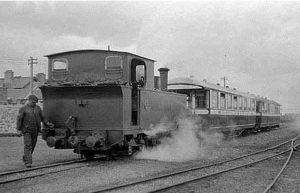
A C&MLR train gets ready for service
Around the turn of the 20th century, the operators were looking to diversify to provide additional summer season income. The line was extended from the colliery to Machrihanish and two new locomotives, Argyll and Atlantic plus six carriages were acquired, enabling passenger services on the extended route to begin in 1906 with the train running down the centre of Hall Street in Campbeltown. The new turbine steamers on the Clyde brought 22,000 visitors to Campbeltown in the first two seasons, many of whom transferred to the railway.
Gordon showed fascinating images of the locomotives, carriages, wagons and vans used over the years which readily showed the audience the day to day operation of the line. However, after WW1 the easy availability of ex-War Department vehicles converted into buses severely impacted the railways’ profitability. The line ceased operating around 1932 or 1933, being demolished in 1934. The locomotive Argyll assisted with the demolition, subsequently being scrapped, while the coaches initially survived as holiday homes, becoming troop accommodation during WW2. Sadly, subsequent deterioration led to their remains being removed by 1960, taking away almost the last sightings of anything to do with the C&MLR. However, Gordon has found that the long cutting which originally took the line from the sea front up to the contour level of the mine is now a pleasant footpath called 'The Cutting'!
A number of proposals to build railways in Argyll, including developments in the Kintyre peninsula by the Glasgow & South Western Railway came to nothing due to increasing road traffic from 1919. More recent photographs in the presentation illustrated locations that had formed part of the line, nothing of substance now remaining but there is now no-one remaining in Campbeltown who would have known the railway when it was operational.
This was an excellent comprehensive presentation incorporating a lot of material despite 90 plus years having elapsed since its closure.
The following question and answer session covered a number of topics and was much appreciated by the attendees.
During his time with us, Gordon also admitted to his other interest in Scottish heraldry and that he has published three books about this subject. He revealed that he was very friendly with one of the King's current Heralds in Scotland, Professor Gillian Black, who just happens to be our Chairman's niece. It's a small world!