
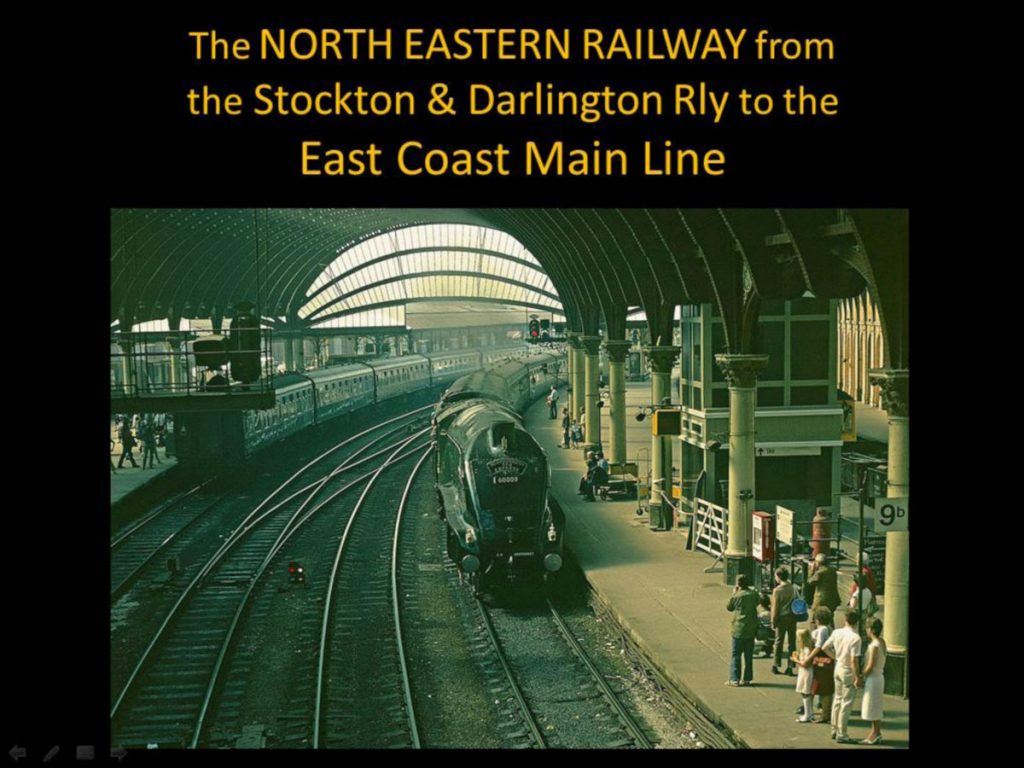
Our 2026/27 season opened with a fascinating historical view from Ray Schofield of the former North Eastern Railway from the earliest days of the Stockton and Darlington Railway, through to the East Coast Main Line as known today.
Ray described the early years of railway development in the North East, with York being connected to London Euston by 1840 and then in 1850 to Maiden Lane with the opening of the Great Northern line via Lincoln. The North Eastern Railway itself was formed in 1854 and absorbed the Stockton and Darlington Railway in 1863.
The North East contained many of the world’s earliest lines, including the Tanfield Railway, the Bowes Railway (formerly the Pontop and Jarrow Railway), the Middleton Railway and the Duke of Clarance’s Railway, running from Simpasture Junction (near Newton Aycliffe) to Samphire Batts (later renamed Port Clarence, after the Duke). The NER’s electrification of the Clarence Railway at 1500V DC was far ahead of its time and set the standard used by the LNER, most notably for the Woodhead line.
We took a look at the 1835 Stanhope and Tyne Railway (later the Pontop and South Shields Railway) and some of the 9Fs allocated to Tyne Dock shed to work iron ore trains to Consett. A trip over the line to Carlisle then followed, followed by the 1834 Leeds and Selby Railway, which later connected to the Selby and Hull Railway.
Ray then very helpfully summarised the four variations on the East Coast Main Line, being (i) the original route from York to Altofts Juncton, then (ii) Burton Salmon to Knottingley, (iii) the 1871 opening of the NER’s direct route from York to Shaftholme Junction and (iv) British Rail’s 1883 Selby diversion.
The final section of Ray’s talk then began with a close look at the railway infrastructure at York, including the original 1841 station, later replaced in 1877 by the current station. We headed North to Darlington to see A3 class No. 60065 ‘Knight of the Thistle’ on the flat crossing over the Stockton & Darlington line. A delightful view of a J38 on a Durham Miners’ Gala special was seen at Washington before views of the High Level Bridge (1849) and King Edward VII Bridge (1906) at Newcastle.
Afterviews from the Castle we headed further North with K1 No. 62011 on the Alnwick branch train at Alnmouth, concluding the evening with V2 No. 60962 on shed at Tweedmouth and the NER’s crossing of the River Tweed on the Royal border Bridge in 1850.
The meeting closed at 9.55 pm with great appreciation from the audience for Ray’s magnificently-researched and scholarly presentation on the North Eastern Railway.