Gallery-KetteringLine
-
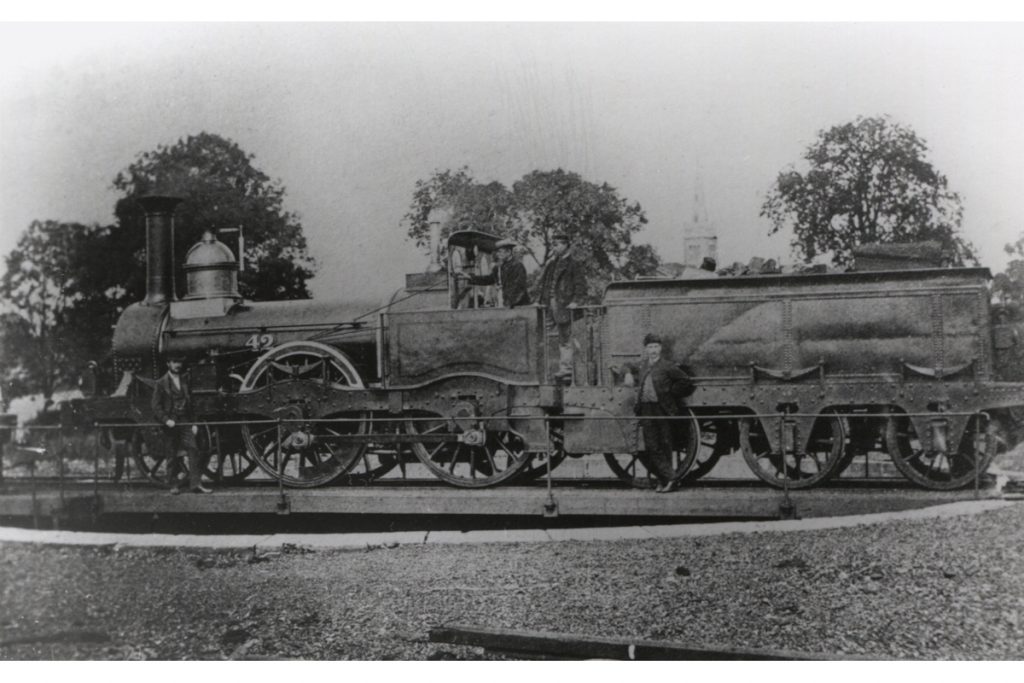
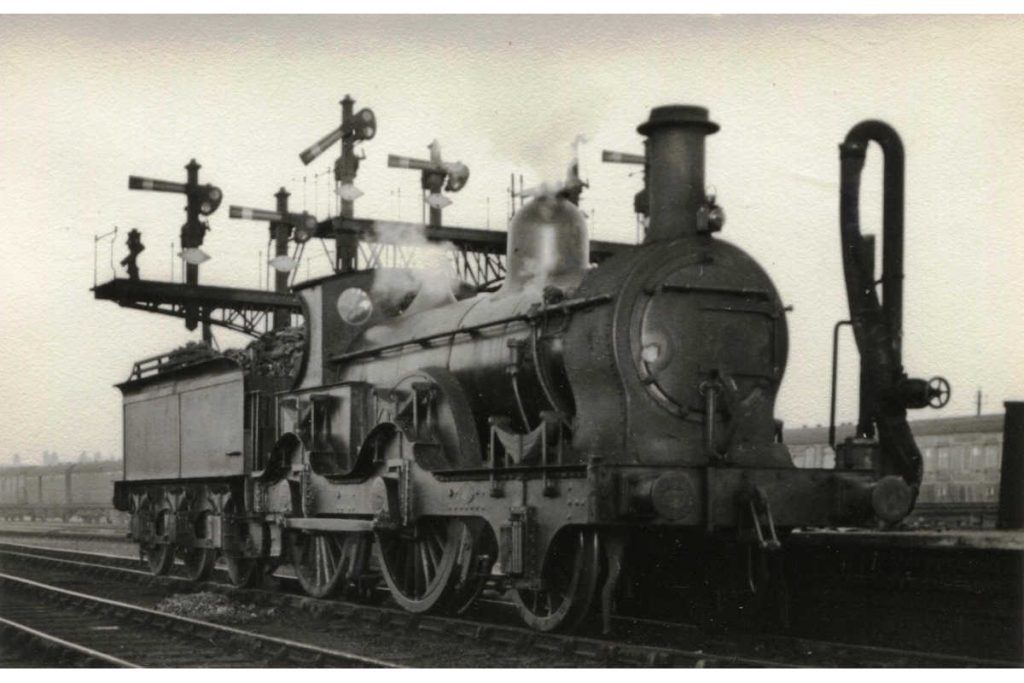
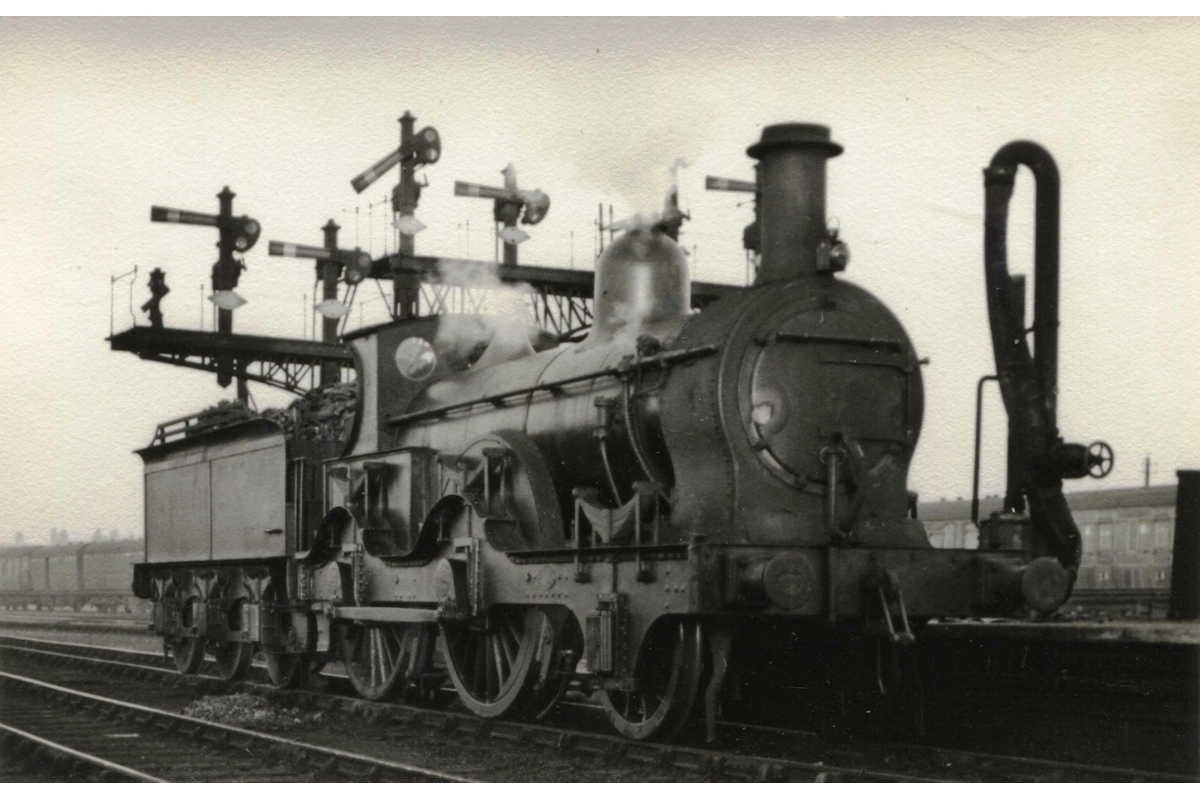
- Midland Railway 2-4-0 No. 42 on Kettering Shed, circa 1870. Photo: Robin Cullup Collection.

-
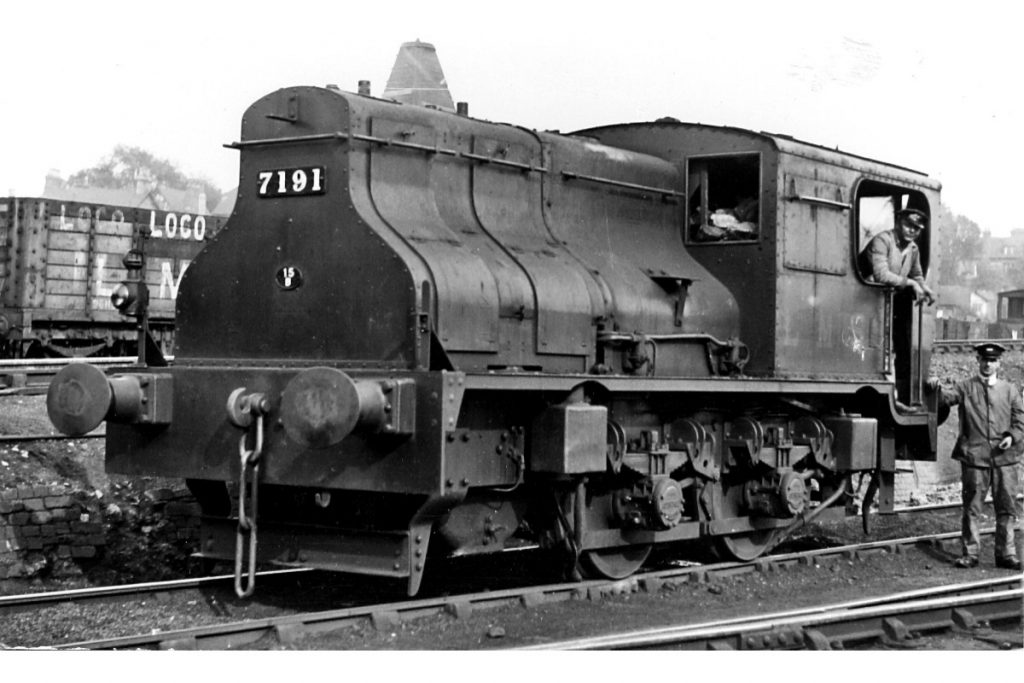
- Sentinel 7191 is here sporting a Kettering shed plate (15B). This was during its stay in Northamptonshire, 1932 to 1935. For the rest of its time it was posted to Radstock where its low profile enabled it to pass under the 10′ 5″ Marble Arch bridge at the start of the Tyning colliery incline. Although the Sentinel had the power to move heavy ironstone wagons, with its four cylinders and a boiler pressure of 275 lbs per square inch, it was not liked in Kettering. Photo: Robin Cullup Collection.

-
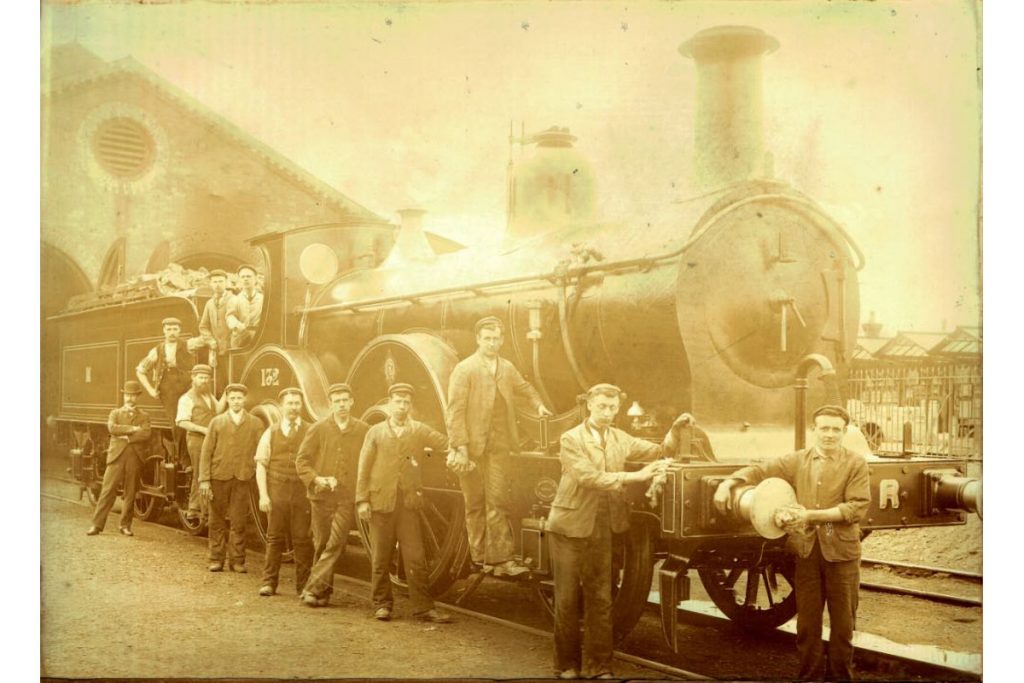
- Typical Cambridge Branch motive power in the Midland era is seen on Kettering Shed in the form of Kirtley 156 Class No. 132. Photo: Robin Cullup Collection.

-
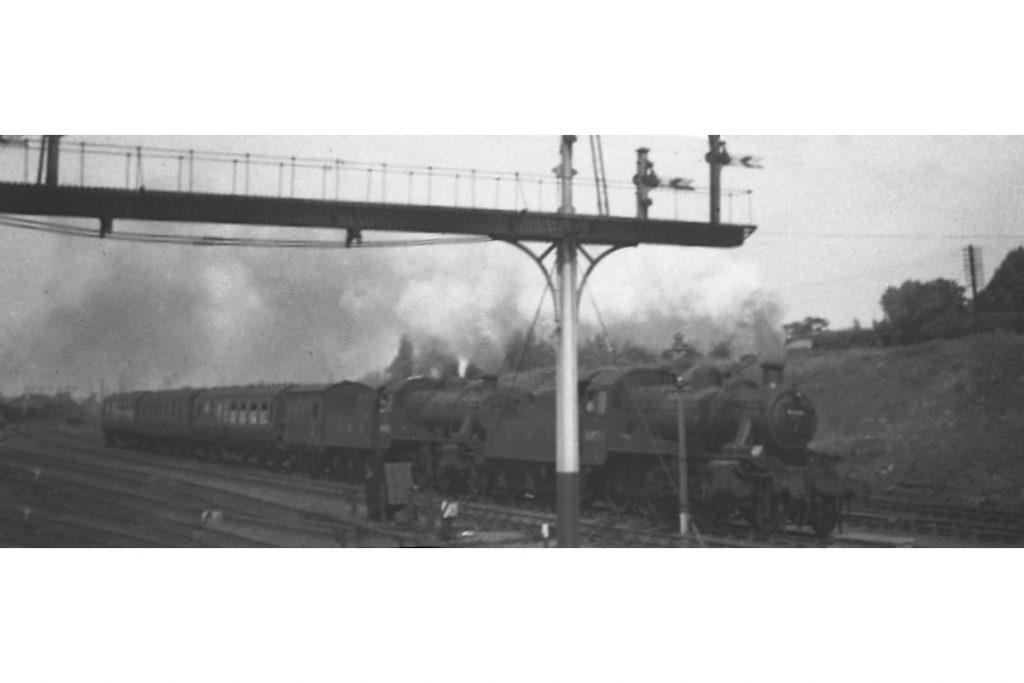
- At Kettering South, a pair of LMS Ivatt 2MTs is seen on a Cambridge train in Summer 1948. The leading locomotive would come off at Huntingdon East, turn on the turntable and run tender-first light engine to Histon where it would collect the fruit train to Ancoats which departed in the late afternoon. Photo: Robin Cullup Collection.
-
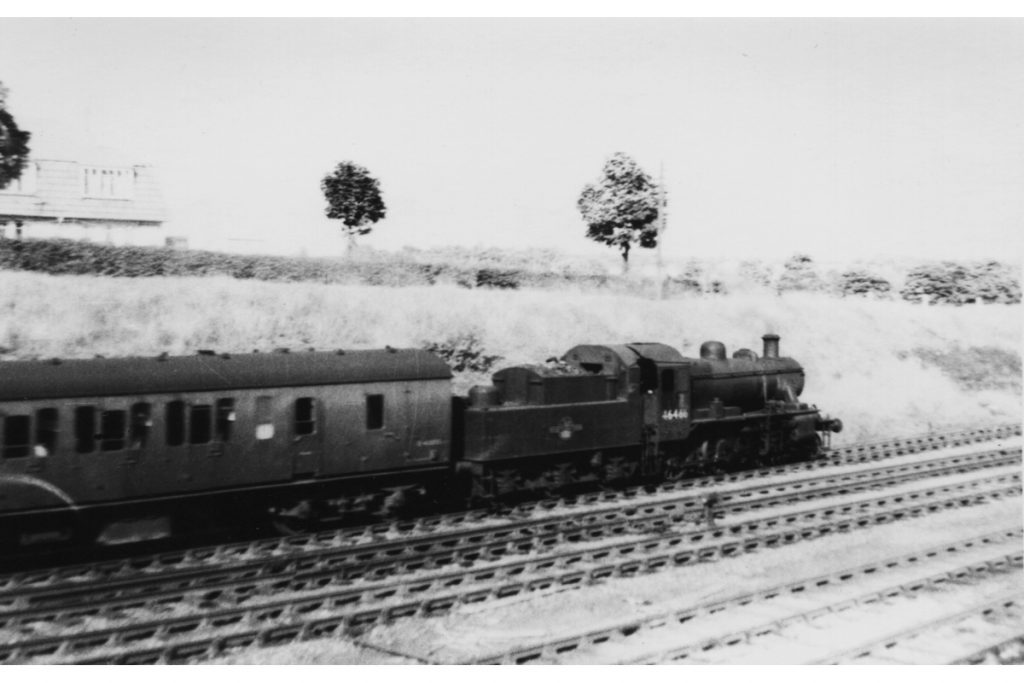
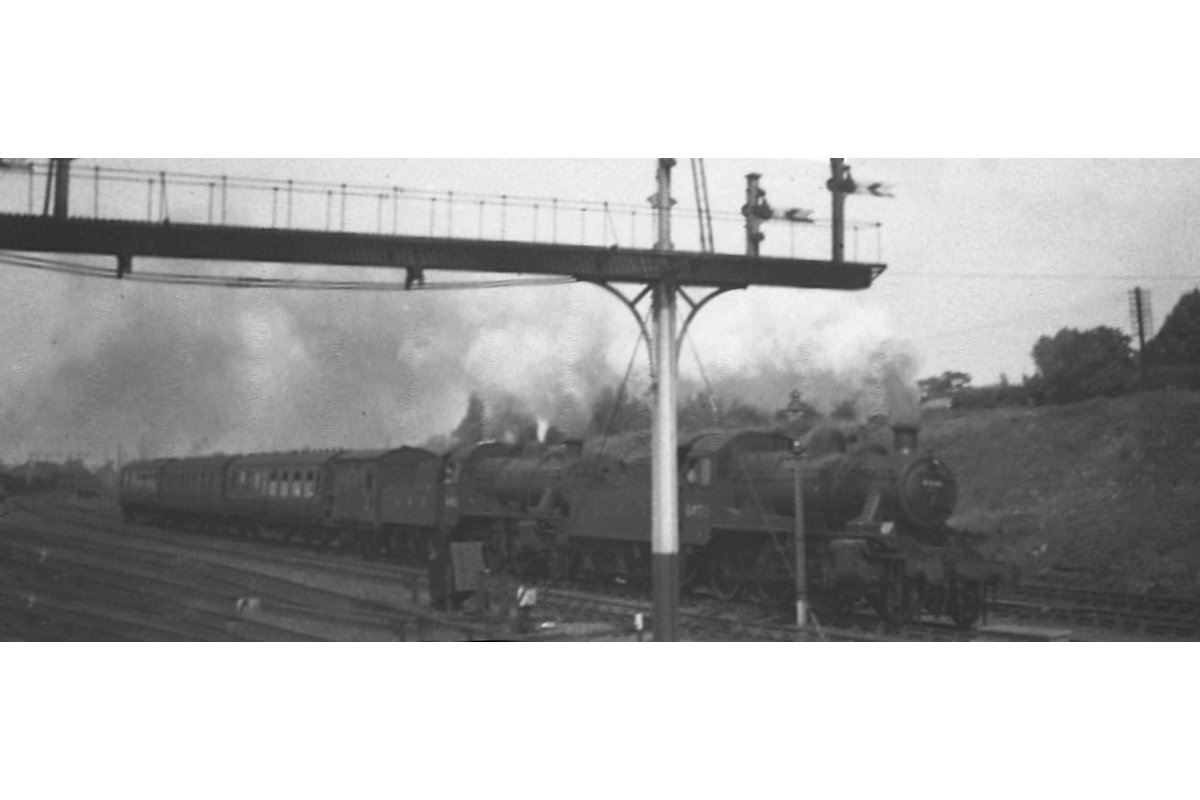
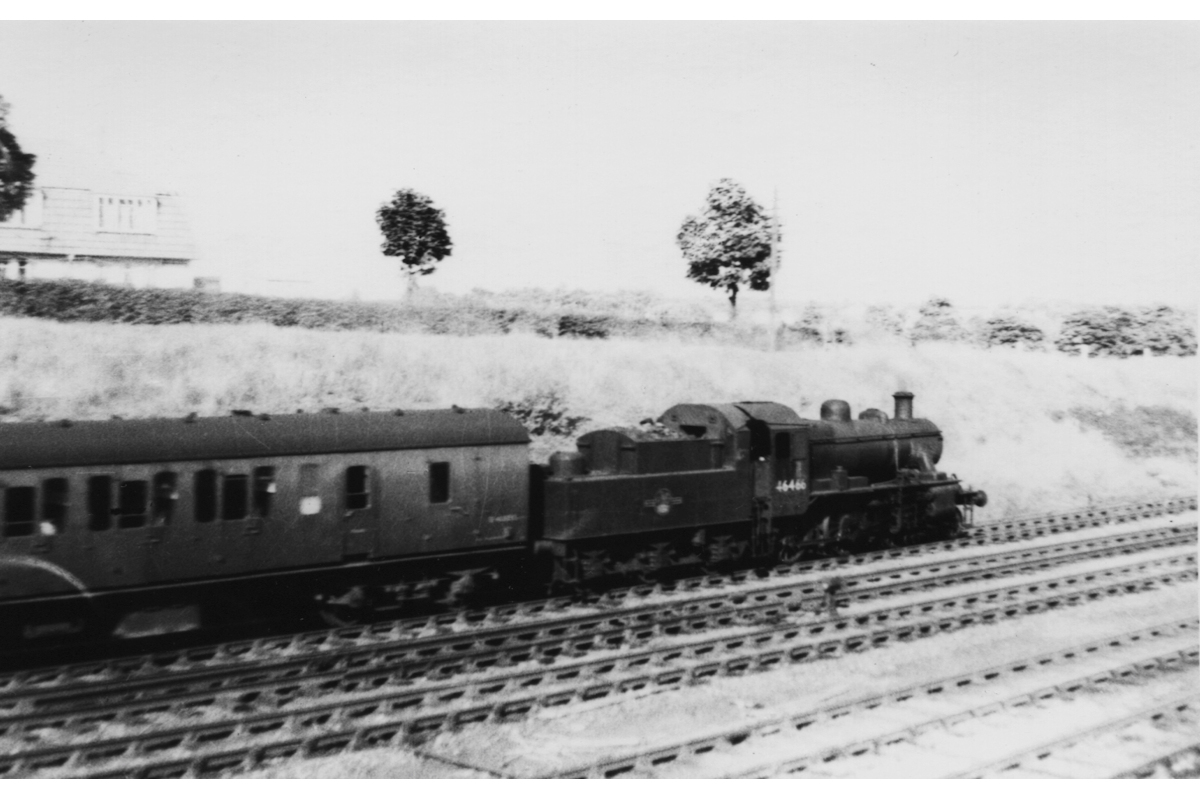
- Heading South on the Goods Lines in June 1959, Ivatt Class 2 No. 46466 has just passed Kettering Junction box and taken the Branch with a Cambridge train. Photo: Robin Cullup.
-
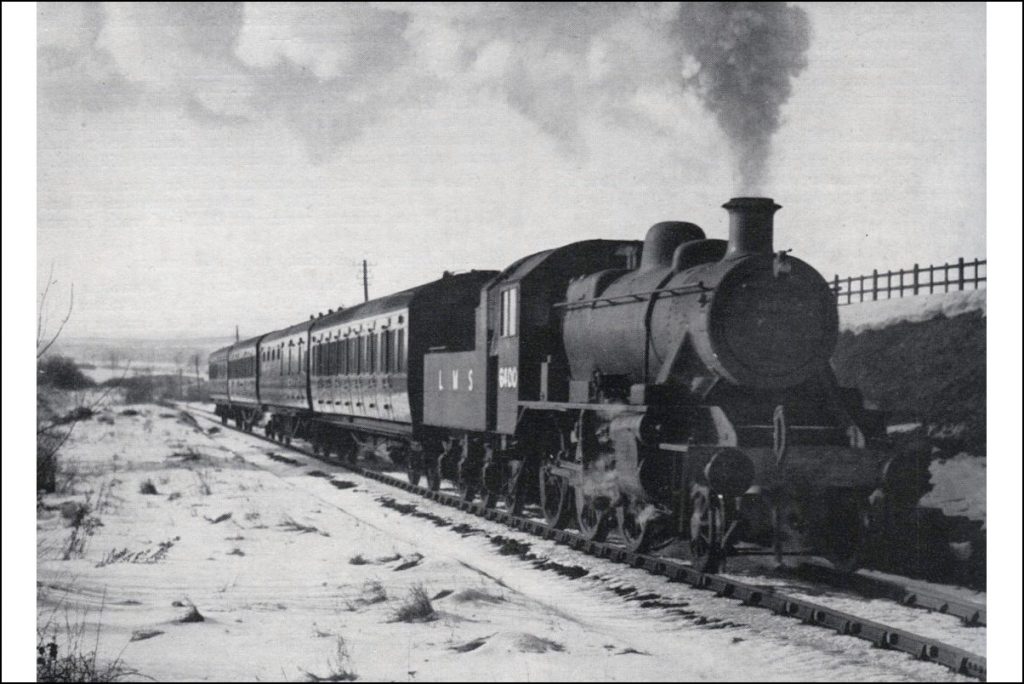
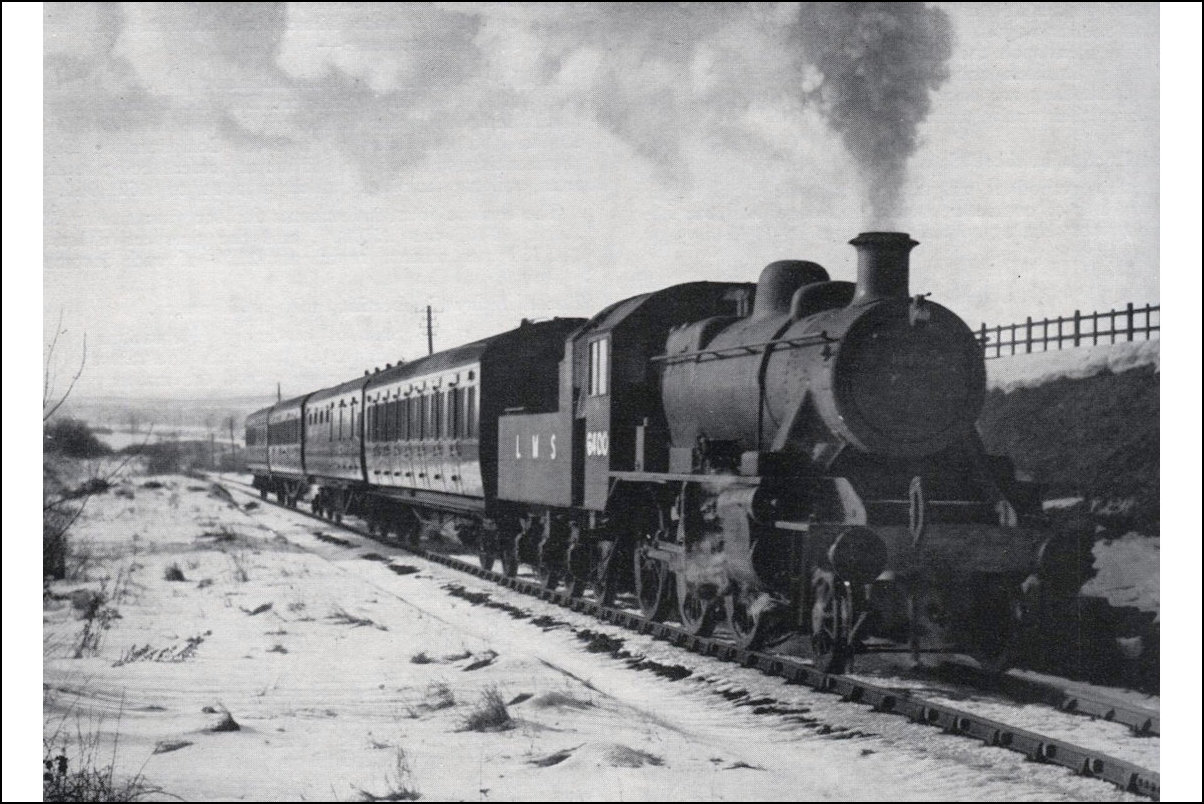
- In a light smattering of snow, first-of-class Ivatt 2-6-0 2MT No. 6400 climbs the 1:70 incline from Pytchley Junction to Butlins Sidings with the 2.10 Kettering-Cambridge. Photo: Robin Cullup Collection.
-
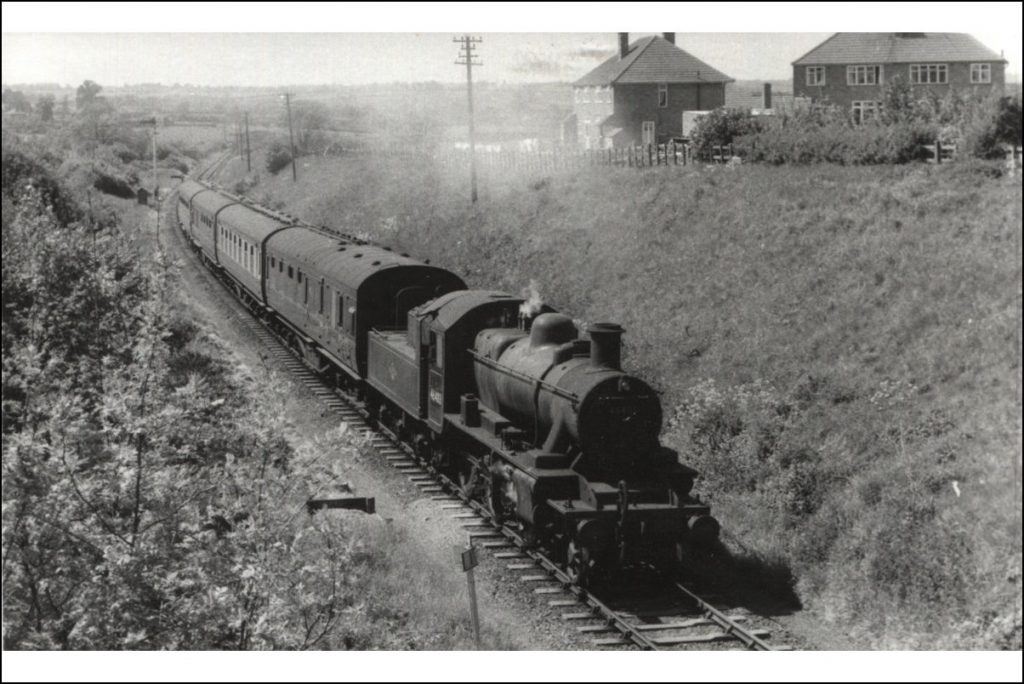
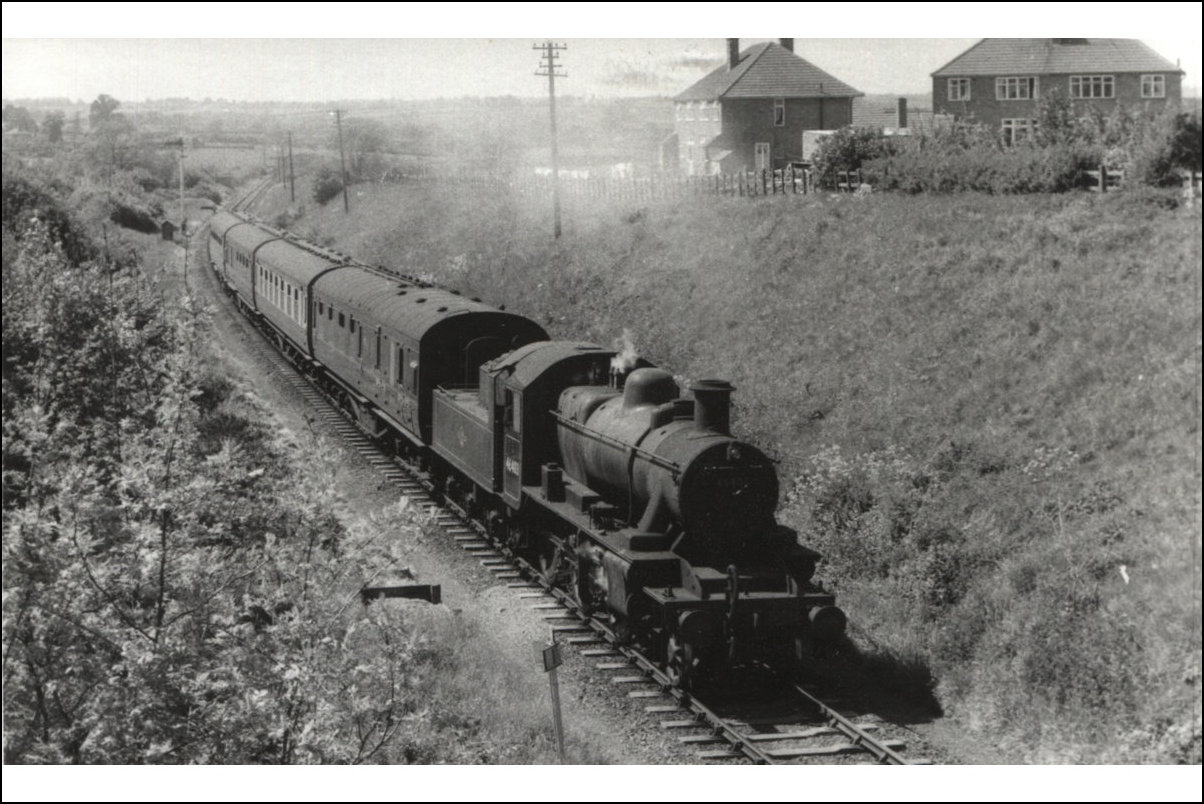
- Pounding up the bank from Pytchley Junction to Butlins Sidings, Ivatt Class 2 No. 46403 heads the 2.10 pm from Kettering to Cambridge in the last month of the Branch’s operation. The Pytchley Junction distant can be seen beyond the rear carriage. Photo: Ken Fairey – Robin Cullup Collection.
-
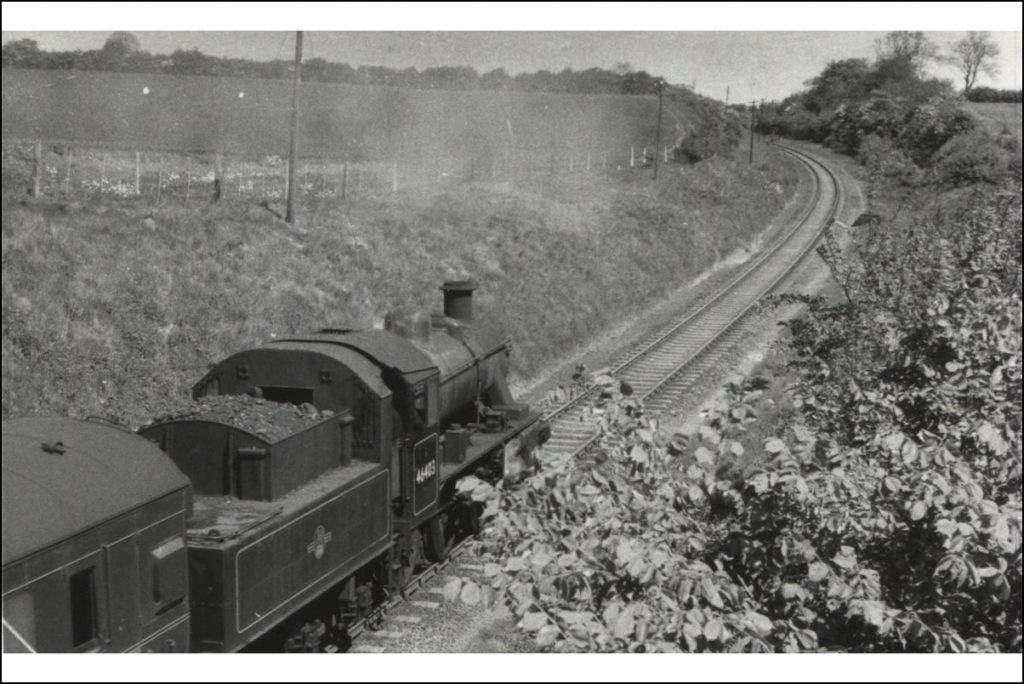
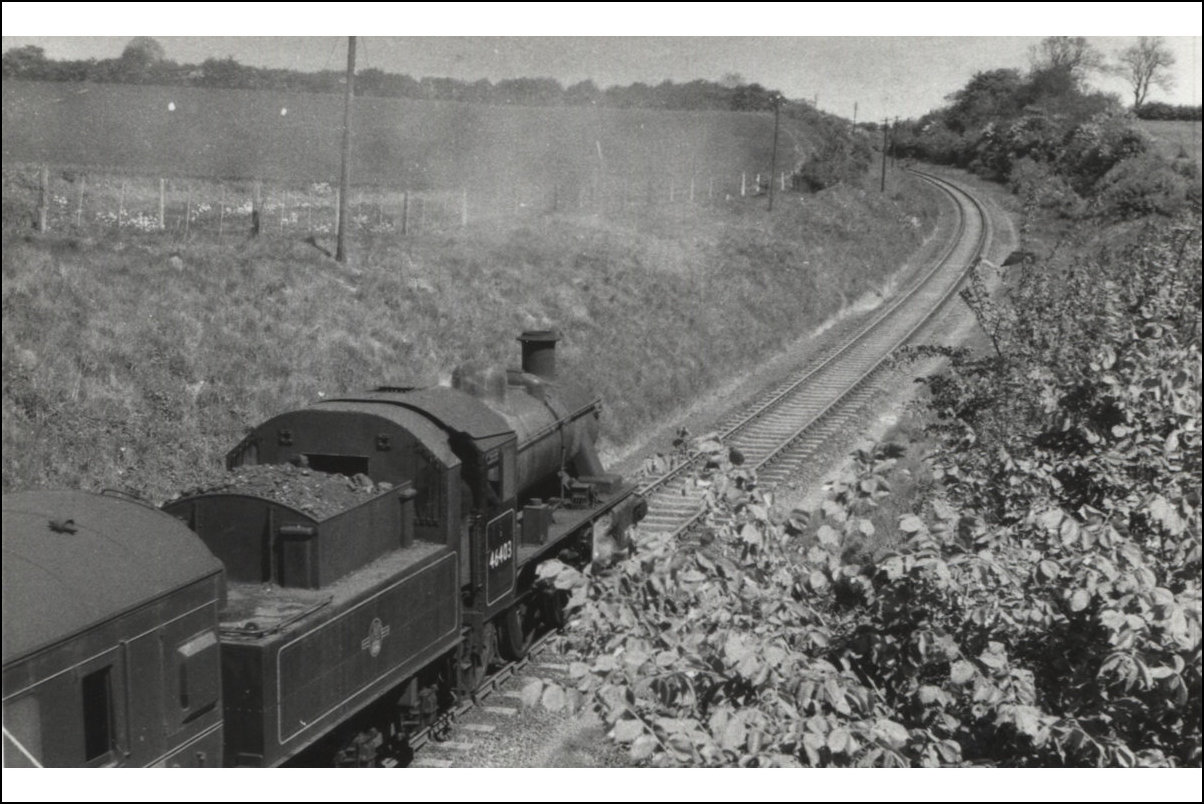
- The same working as in the previous photograph has just passed under Polwell lane on its journey East. Notice how well maintained the line is, with immaculate trackwork and shoulders on the ballast. Photo: Ken Fairey – Robin Cullup Collection.
-
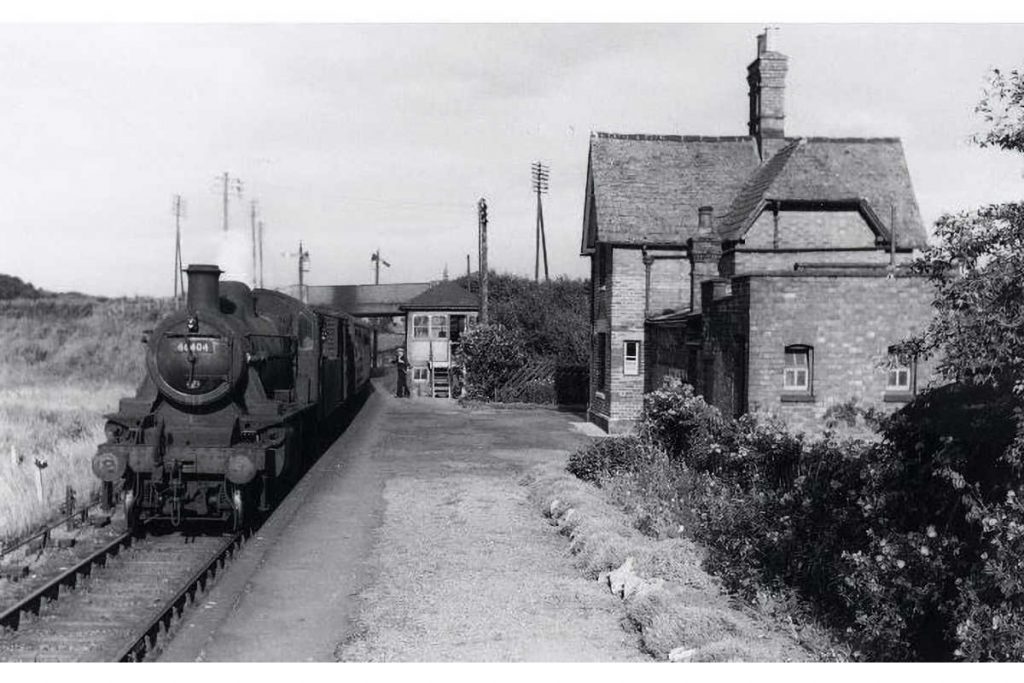
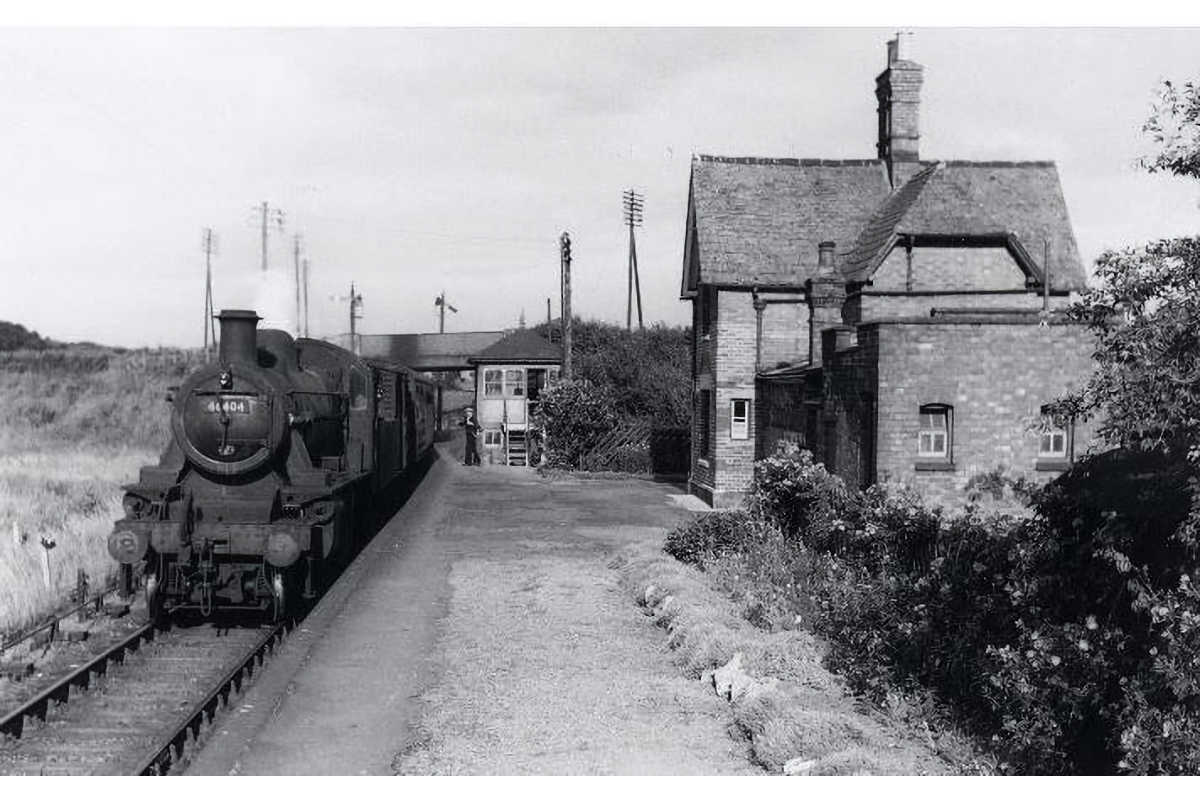
- On July 8th 1953, LMS Ivatt Class2 2-6-0 No. 46404 arrives at Twywell with the 4.55 pm Cambridge to Kettering. Photo: W.A. Camwell – SLS Collection – Robin Cullup Collection.
-
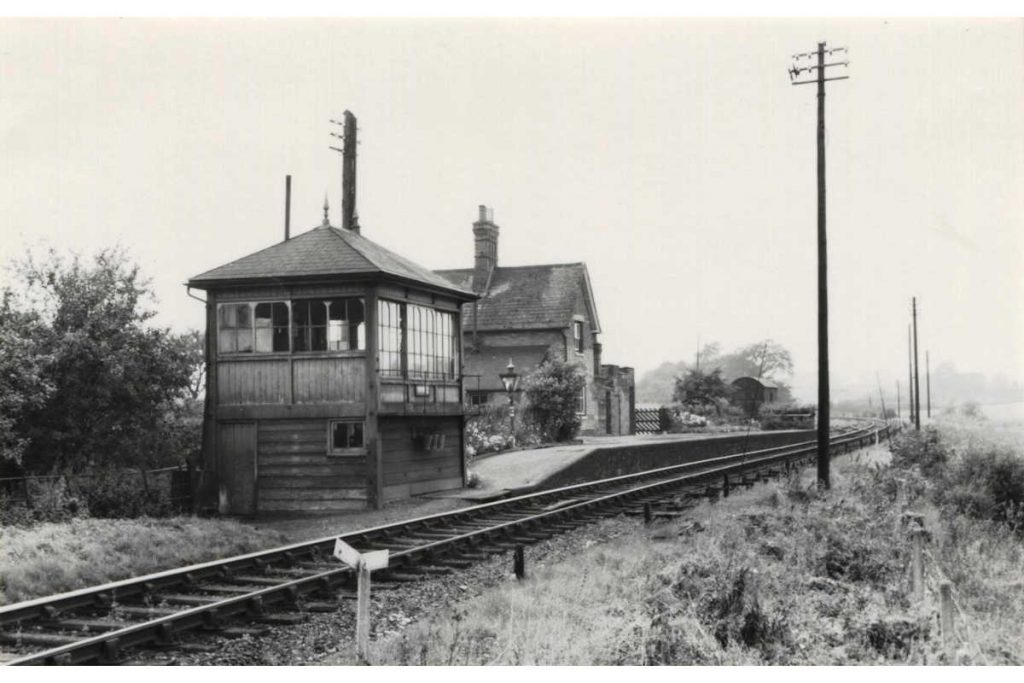
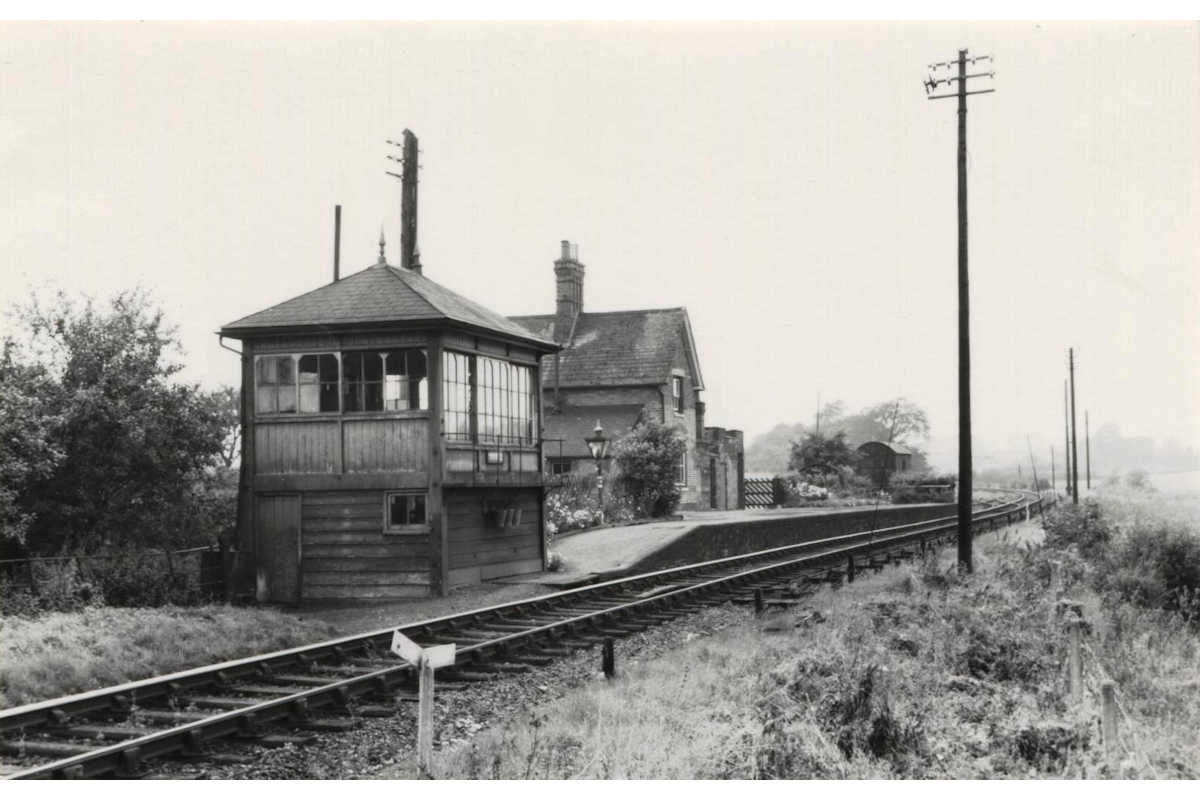
- Twywell signal box and station, circa 1952. Photographer Unknown – Robin Cullup Collection.
-
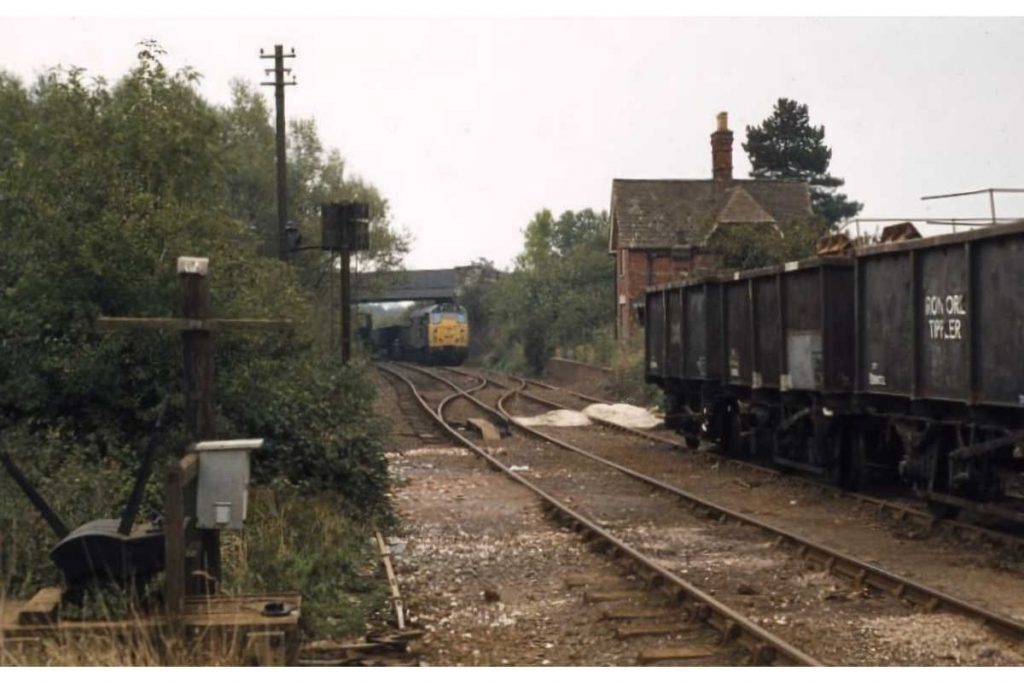
- A Brush Class 31 shunts ironstone wagons at Twywell in 1976. Photo Geoff Robinson – Robin Cullup Collection.

-
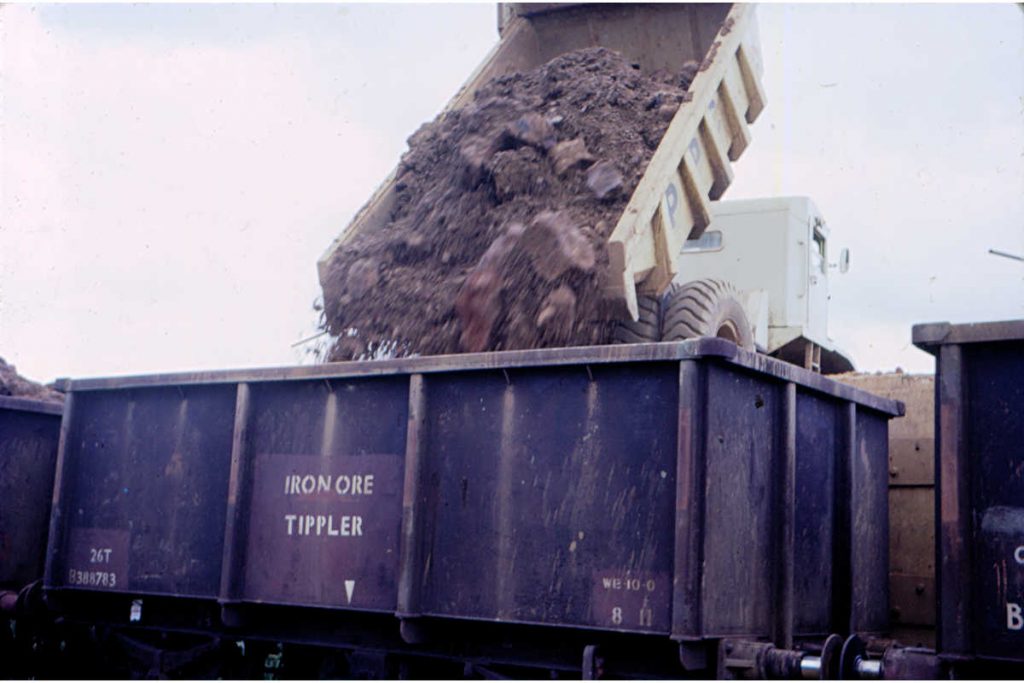
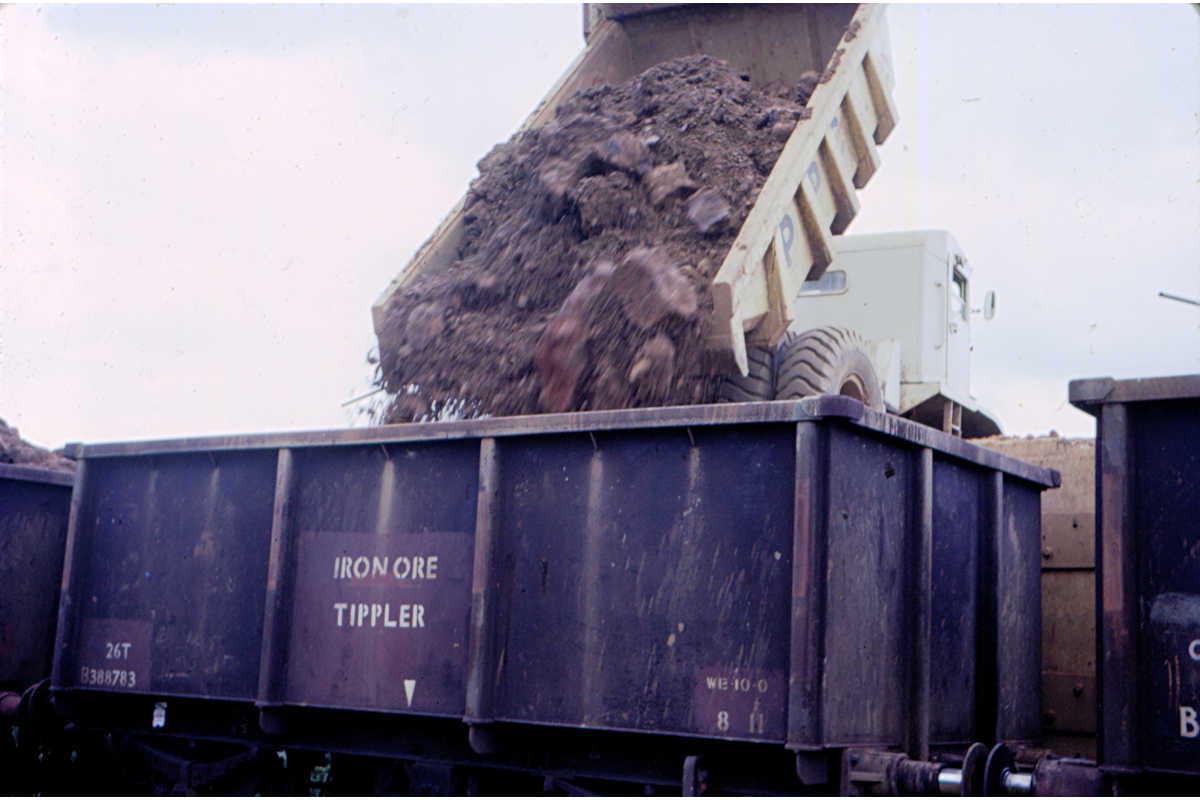
- Loading ironstone at Twywell in 1968. Photographer Unknown – Robin Cullup Collection.
-
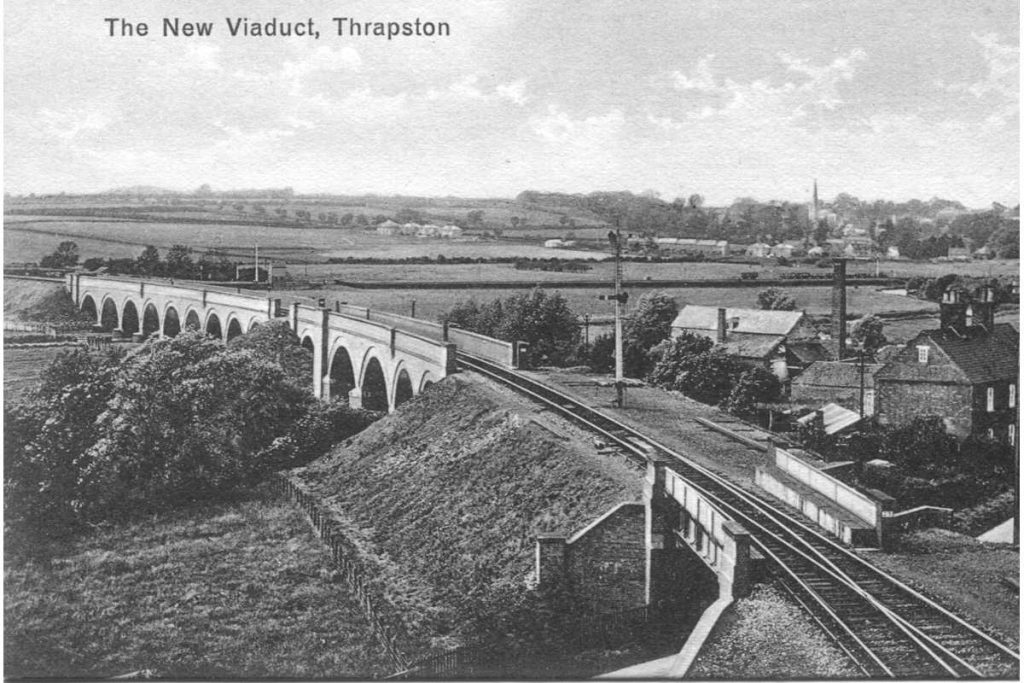
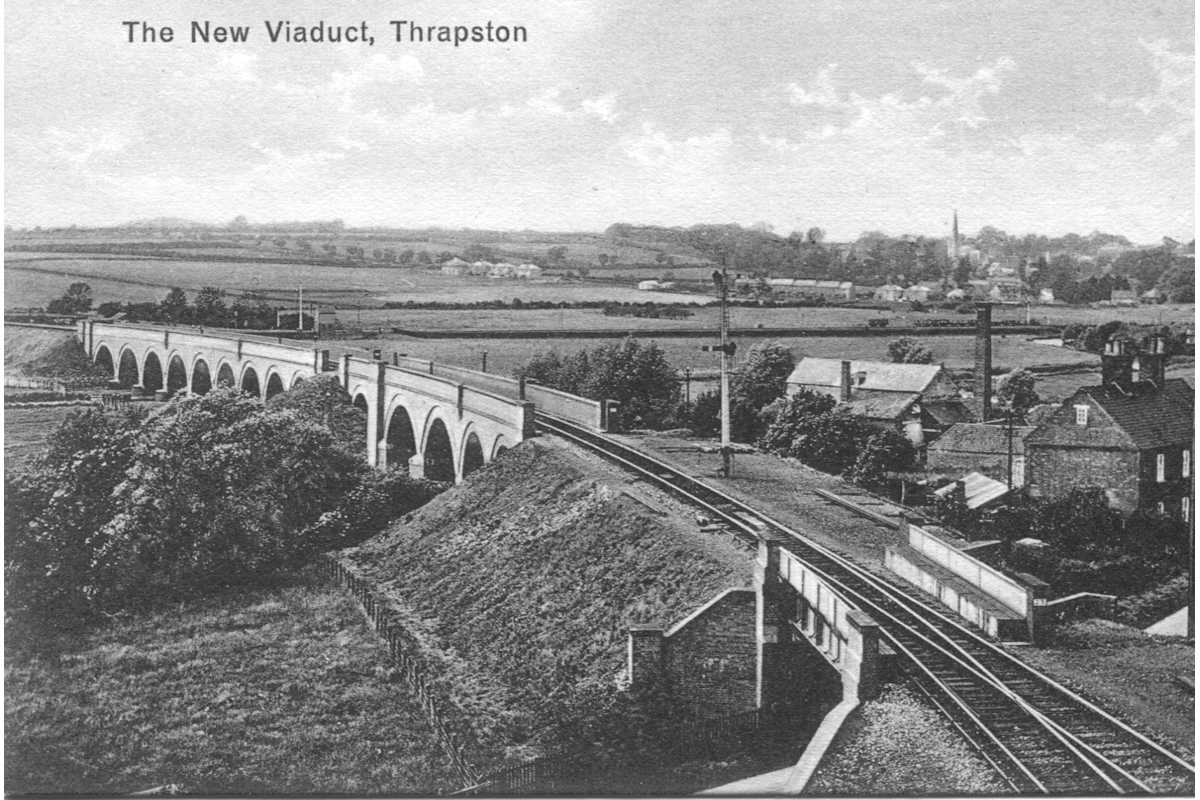
- A postcard showing the new brick-built viaduct at Thrapston, built circa 1921/22 and with a curvature of 29 chains. Photographer Unknown – Robin Cullup Collection.
-
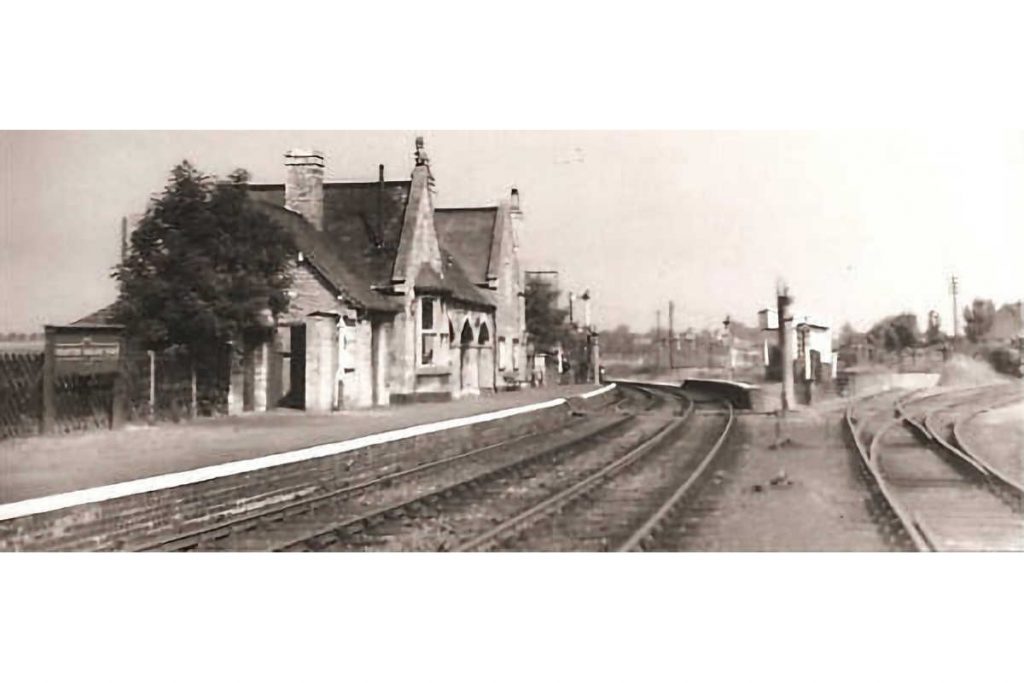
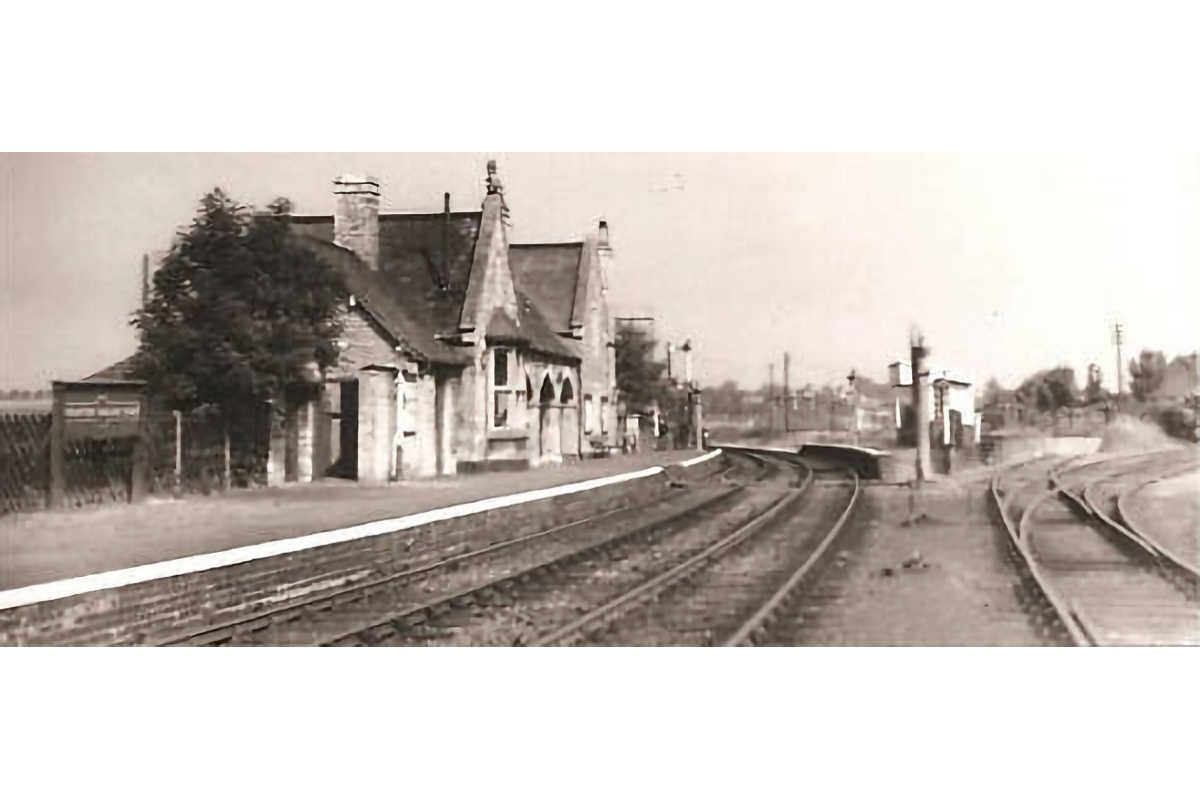
- Thrapston Midland Road station looking West. Photographer Unknown – Robin Cullup Collection.
-
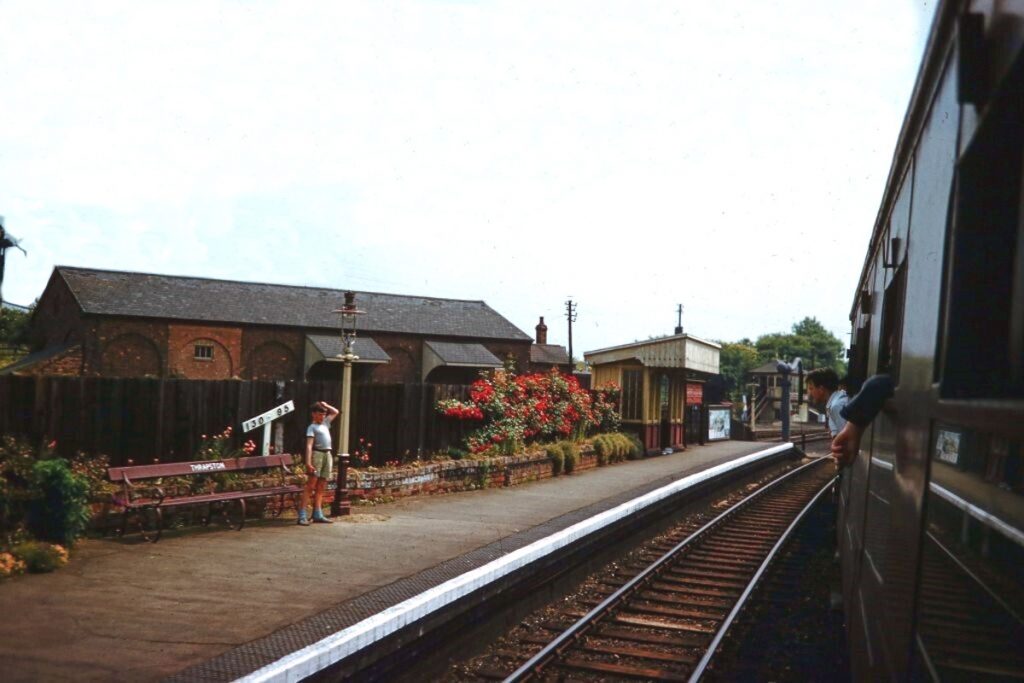
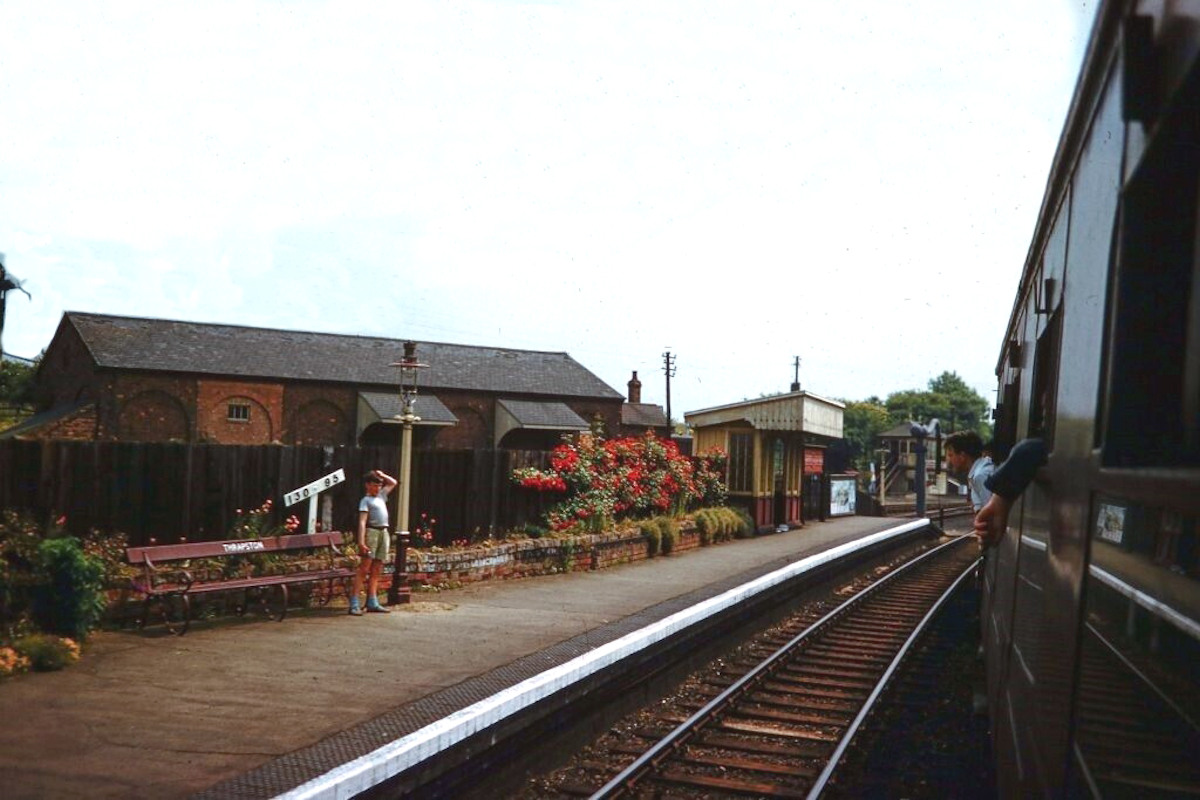
- A young enthusiast – who will by now be circa 70 years old – stands on Thrapston Midland Road’s Eastbound platform in June 1959 as one of the last Cambridge to Kettering workings waits for the single line to Twywell and Kettering. Notice the prolific floral display on the fence, behind which is the substantial goods shed. Photo: Robin Cullup Collection.
-
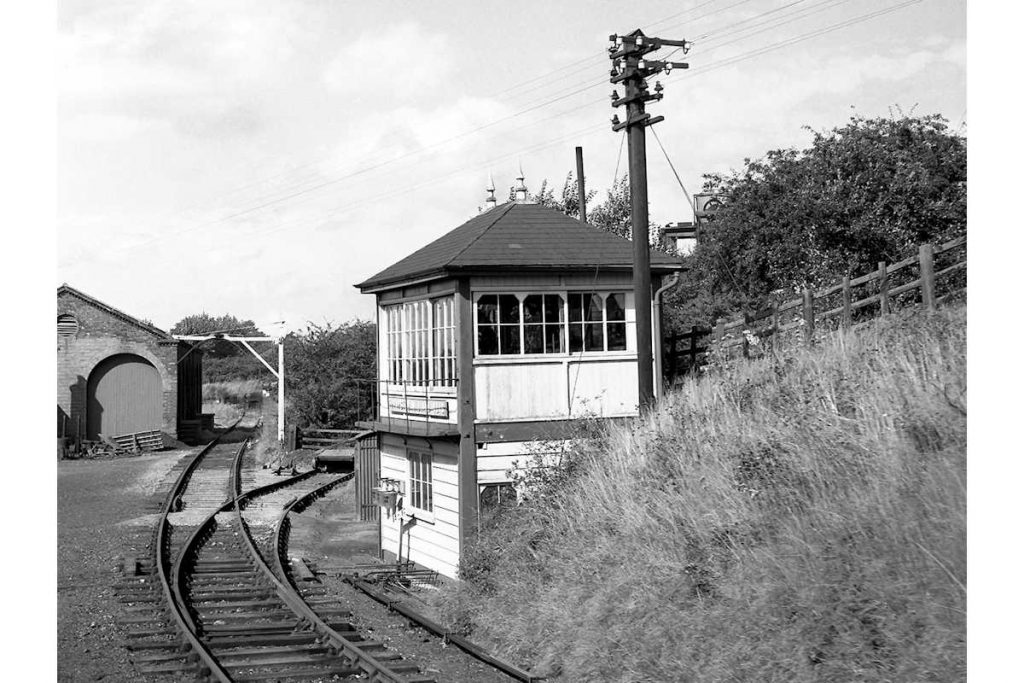
- A 1959 view of Thrapston Midland Road signal box. Photo: James S. Doubleday – Robin Cullup Collection.
-
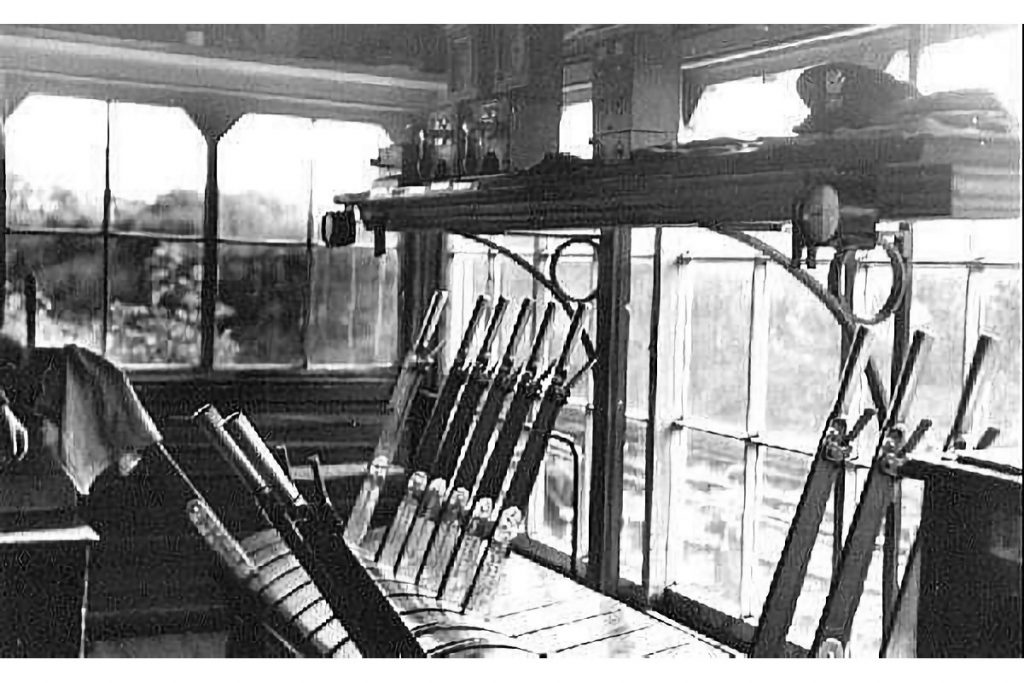
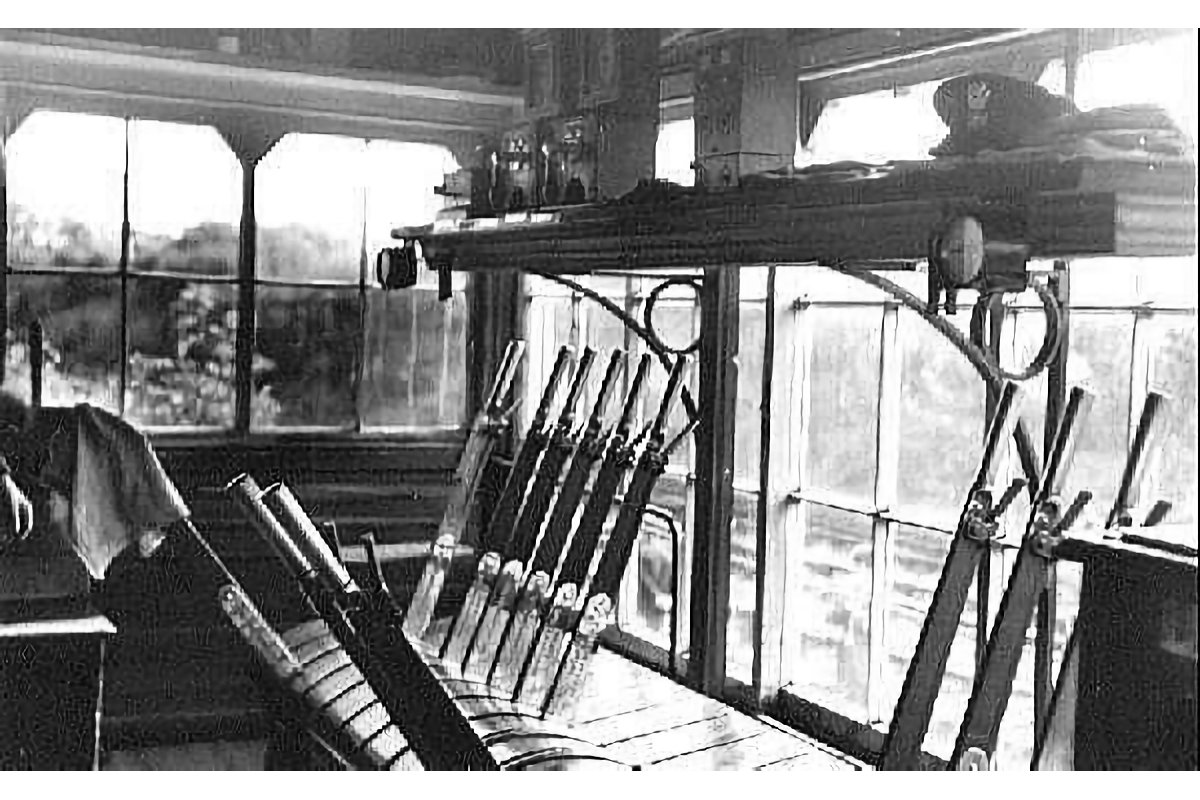
- Thrapston Midland Road signal box level frame. Photo: Jim Pope – Robin Cullup collection.
-
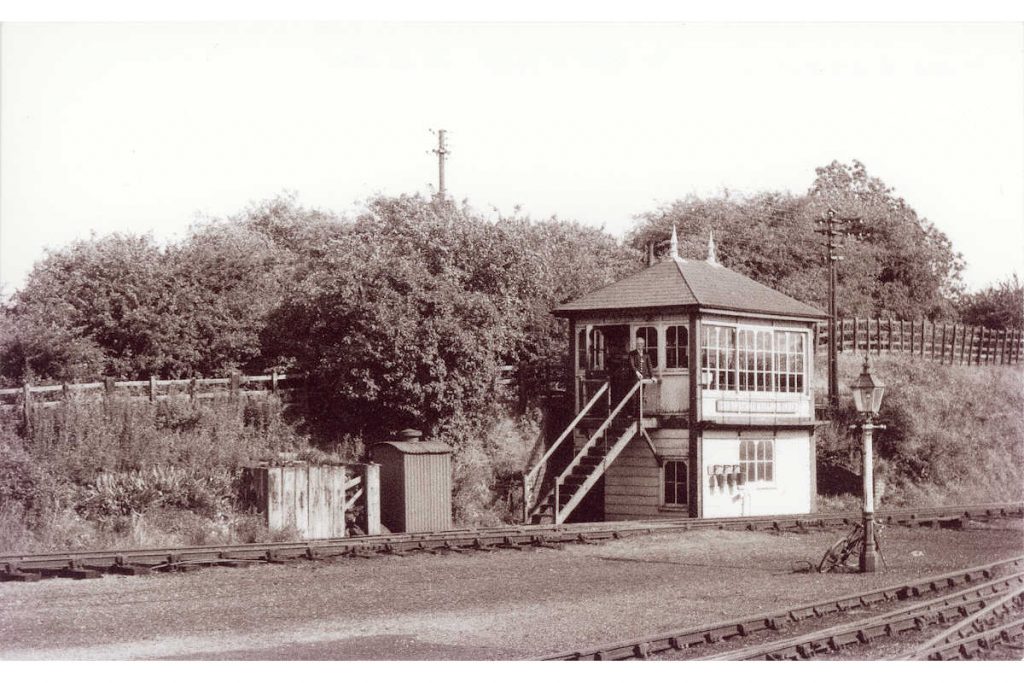
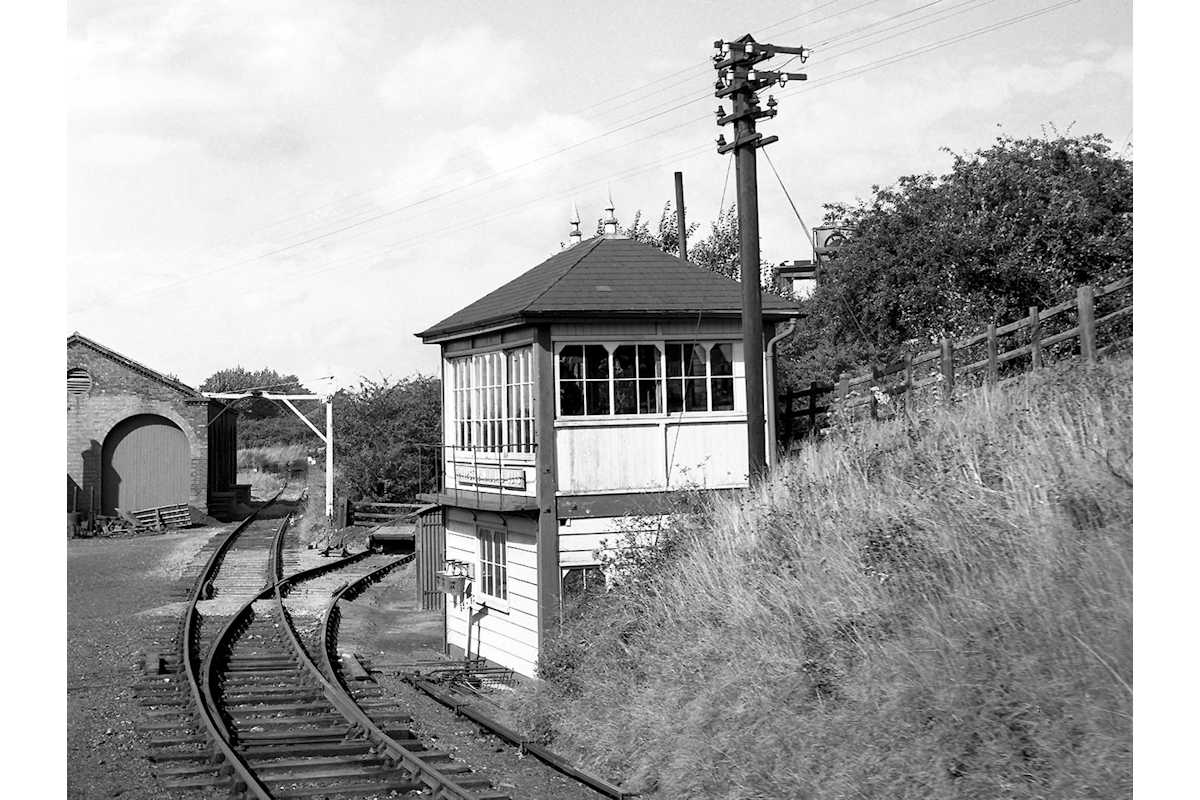
- Thrapston Midland Road Signal Box. Photographer Unknown.

-
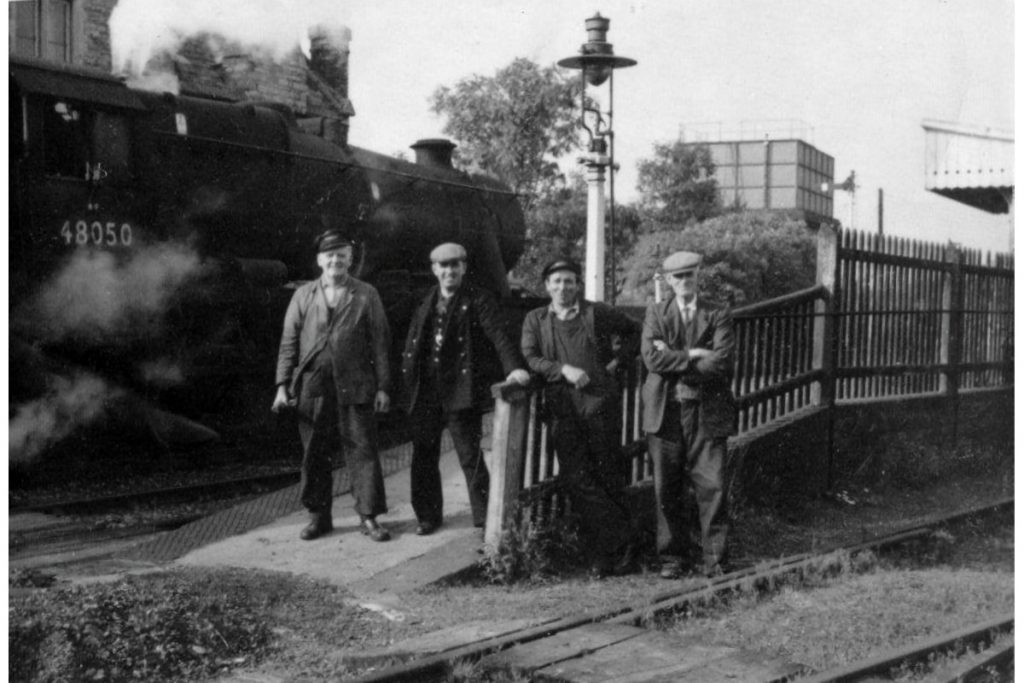
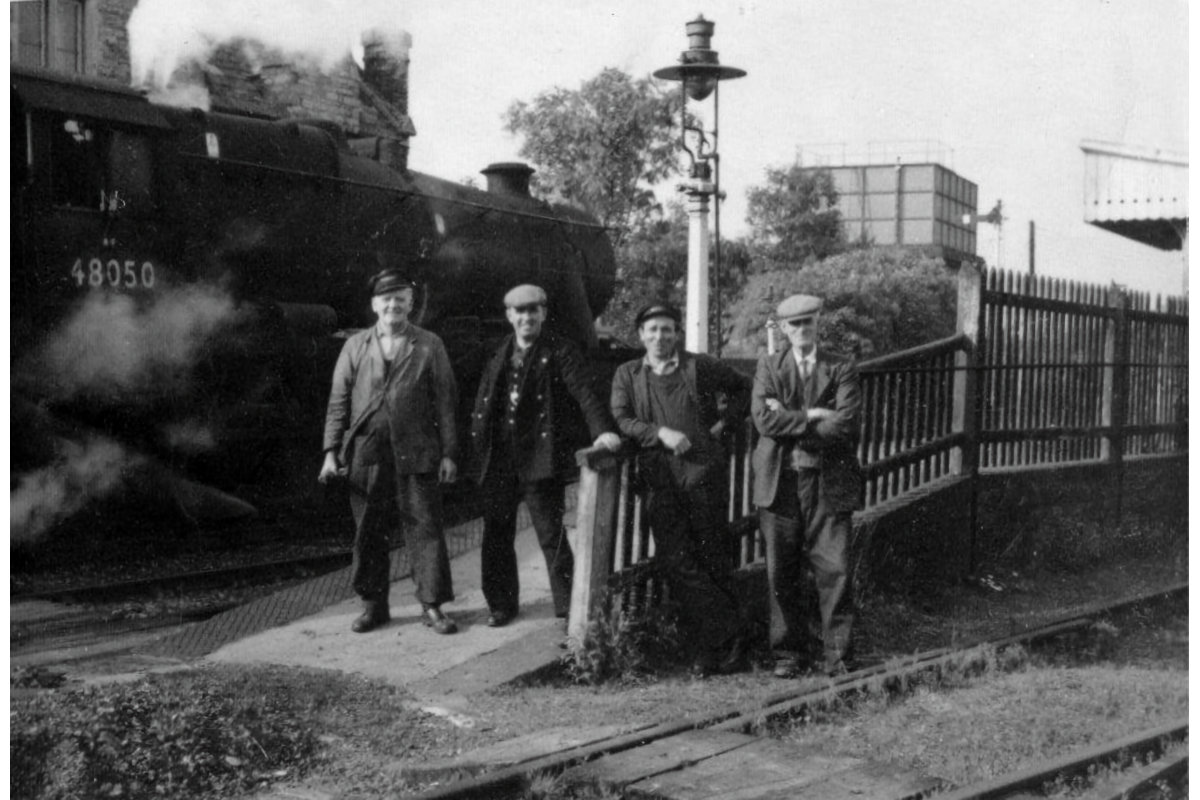
- After withdrawal of the passenger service on 13th June 1959, the line from Kimbolton to St Ives was closed completely. In 1962, the section from Twywell to Kimbolton was closed and the last freight working from Kimbolton to Kettering is seen at Thrapston behind LMS 8F 48050. From Left to Right are Driver Horace Bosworth, Guard Jack Adams, Fireman Olly Nixon and Shunter Sid Harris. Photo: Olly Nixon – Robin Cullup Collection.
-
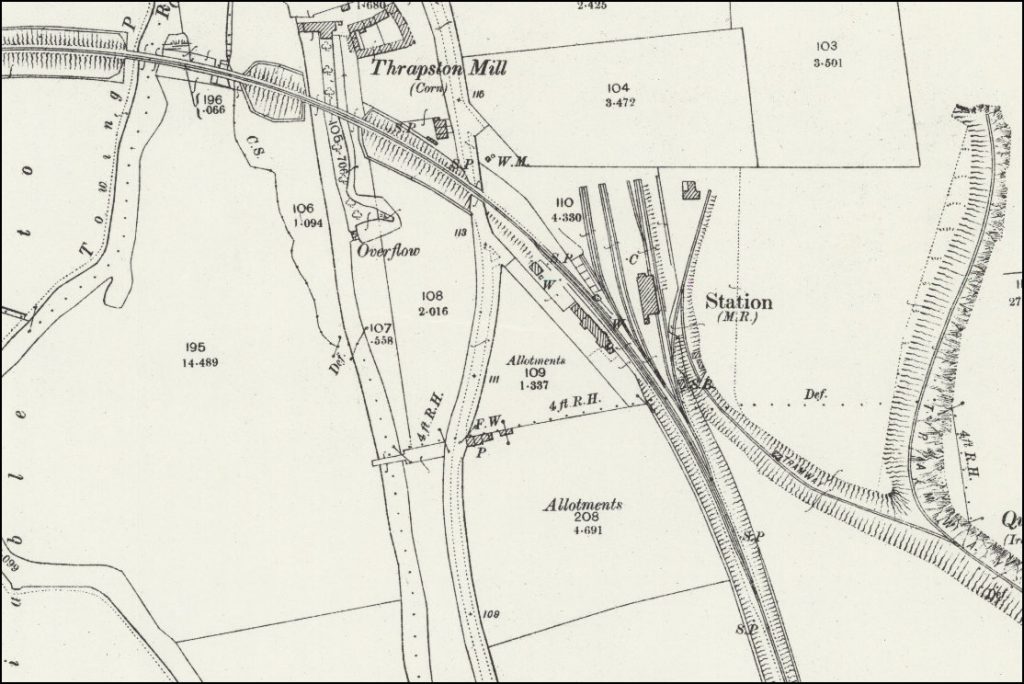
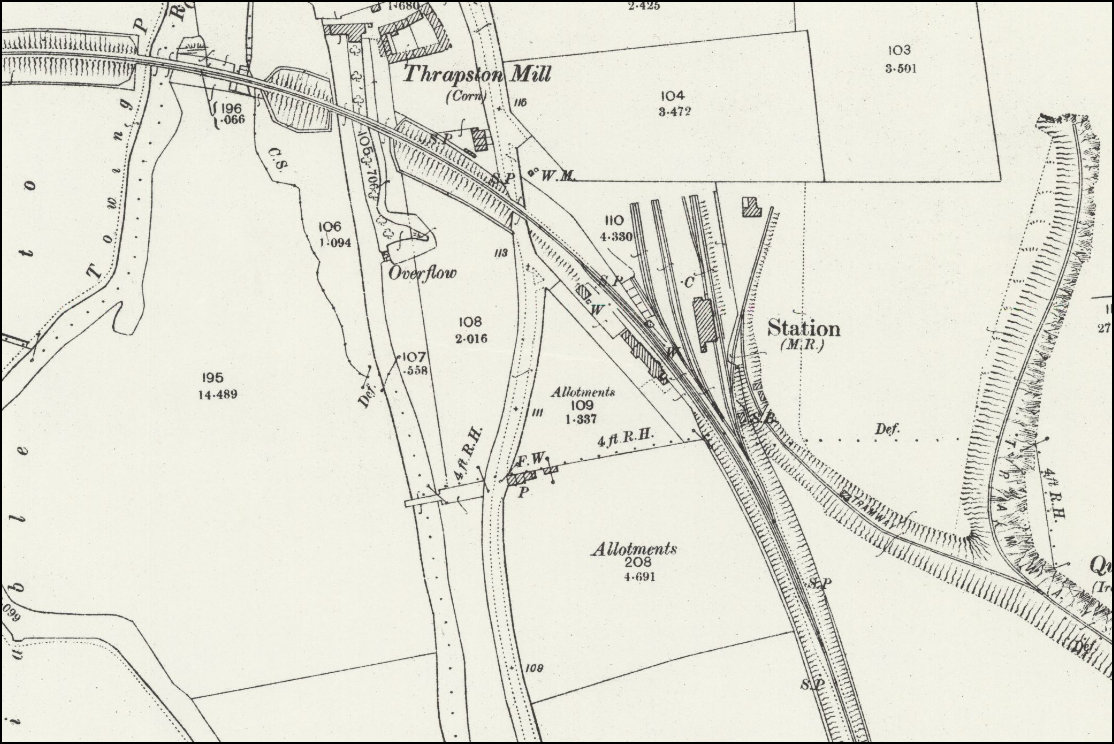
- 1883 Ordnanace Survey map of Thrapston. Reproduced with the permission of the National Library of Scotland https://maps.nls.uk/index.html
-
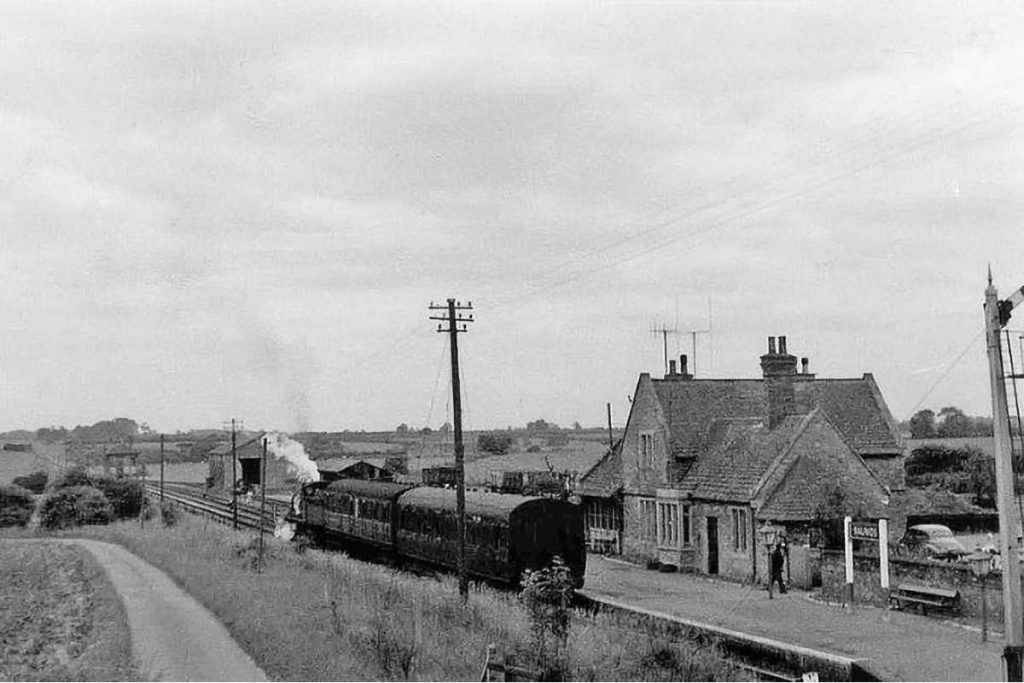
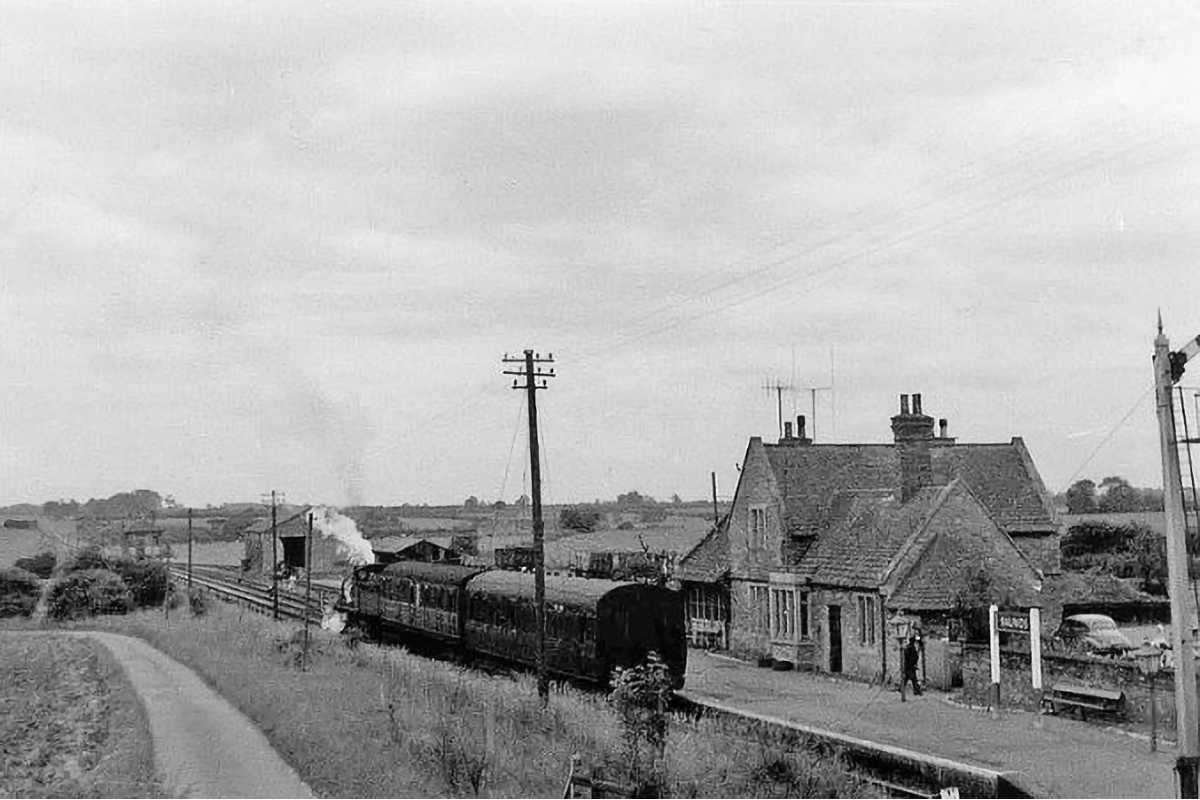
- In the finest Midland Railway style, Raunds station was some way from the village of the same name. On June 11th 1959, just before the end of passenger services, J15 0-6-0 No. 65450 departs with the 5,25pm Kettering to Cambridge. Photographer Unknown – Robin Cullup Collection.
-
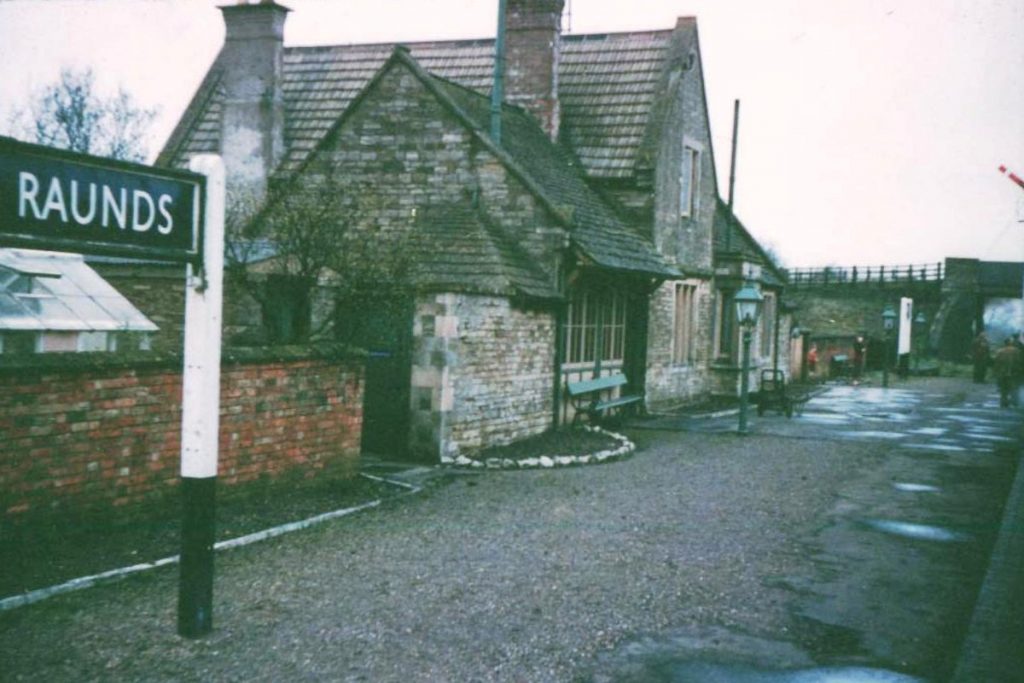
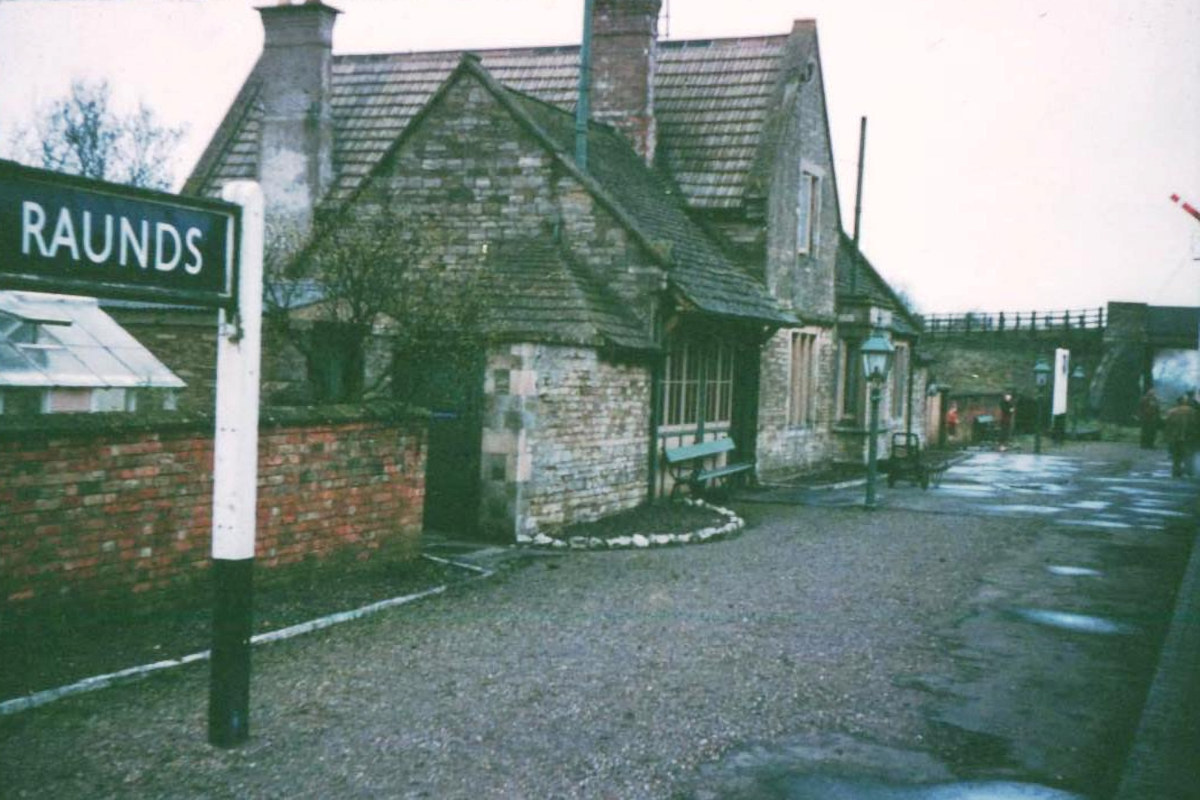
- A 1959 view of Raunds station from a Kettering-bound service. Photo: Jeff Pell, courtesy Robin Cullup Collection.
-
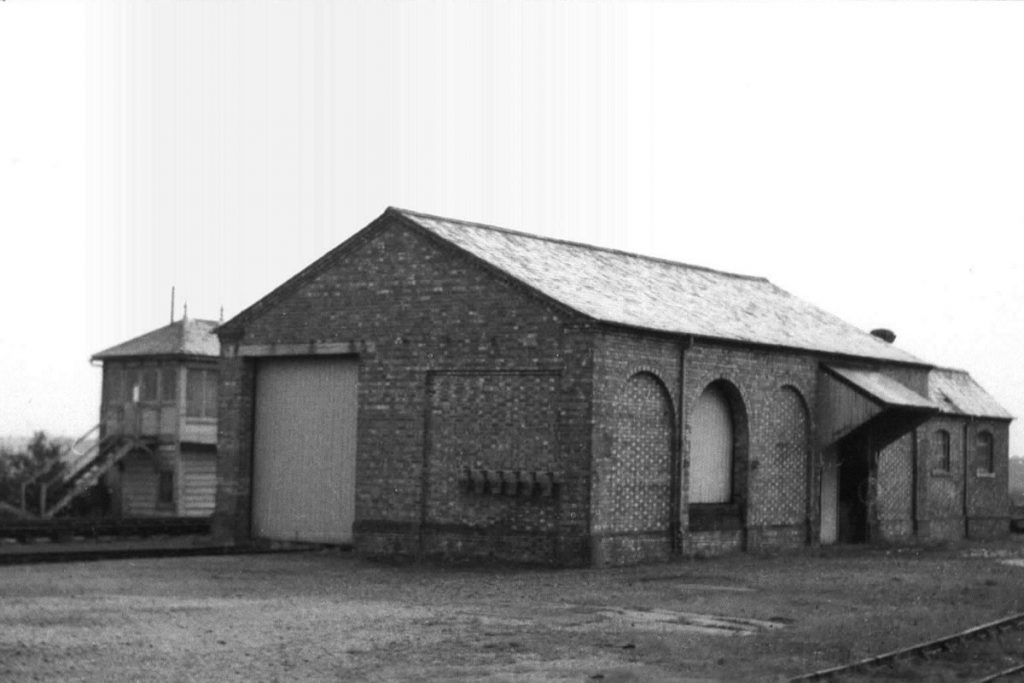
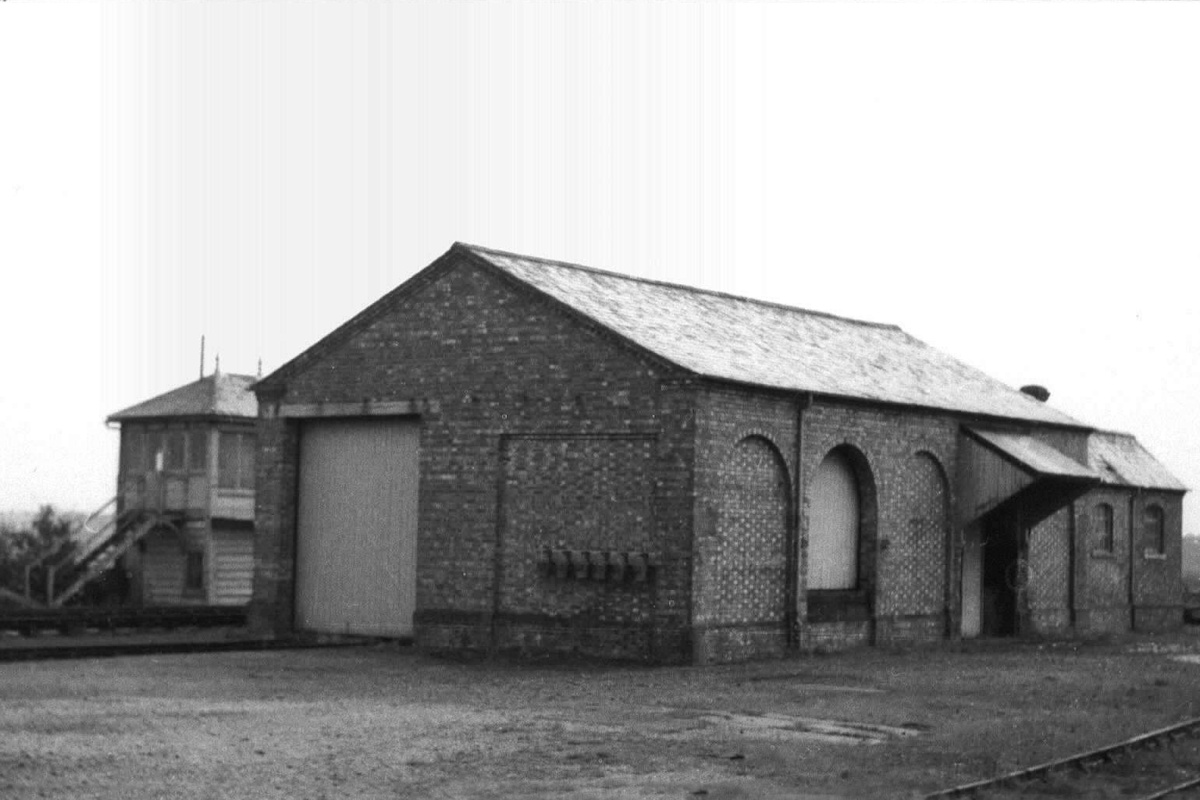
- Raunds Goods Shed, 1959. Photo: Jeff Pell, courtesy Robin Cullup Collection.
-
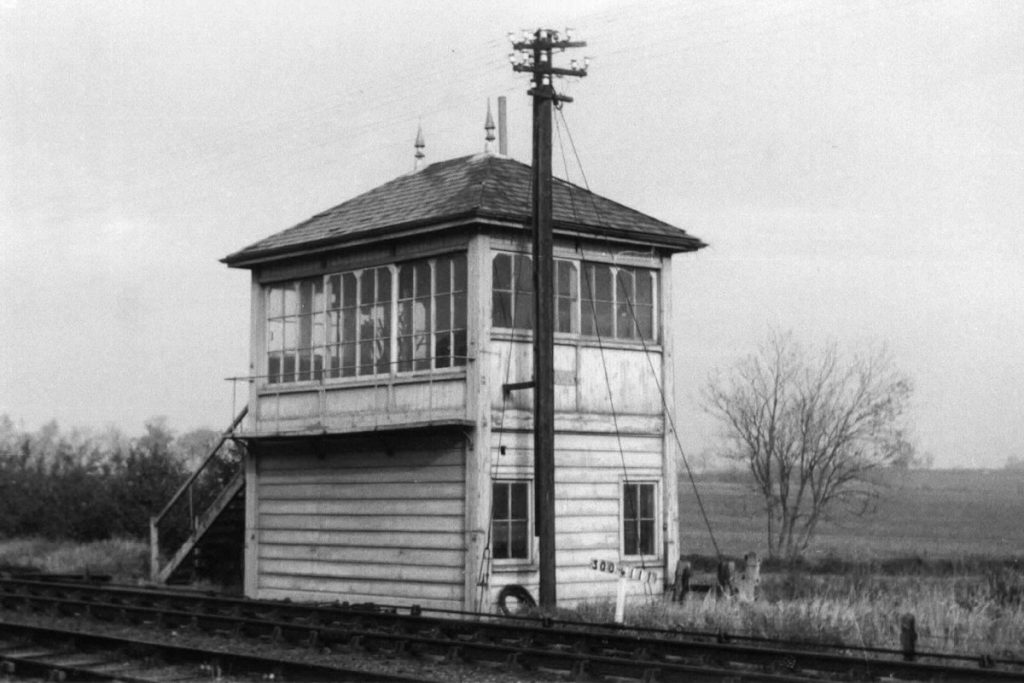
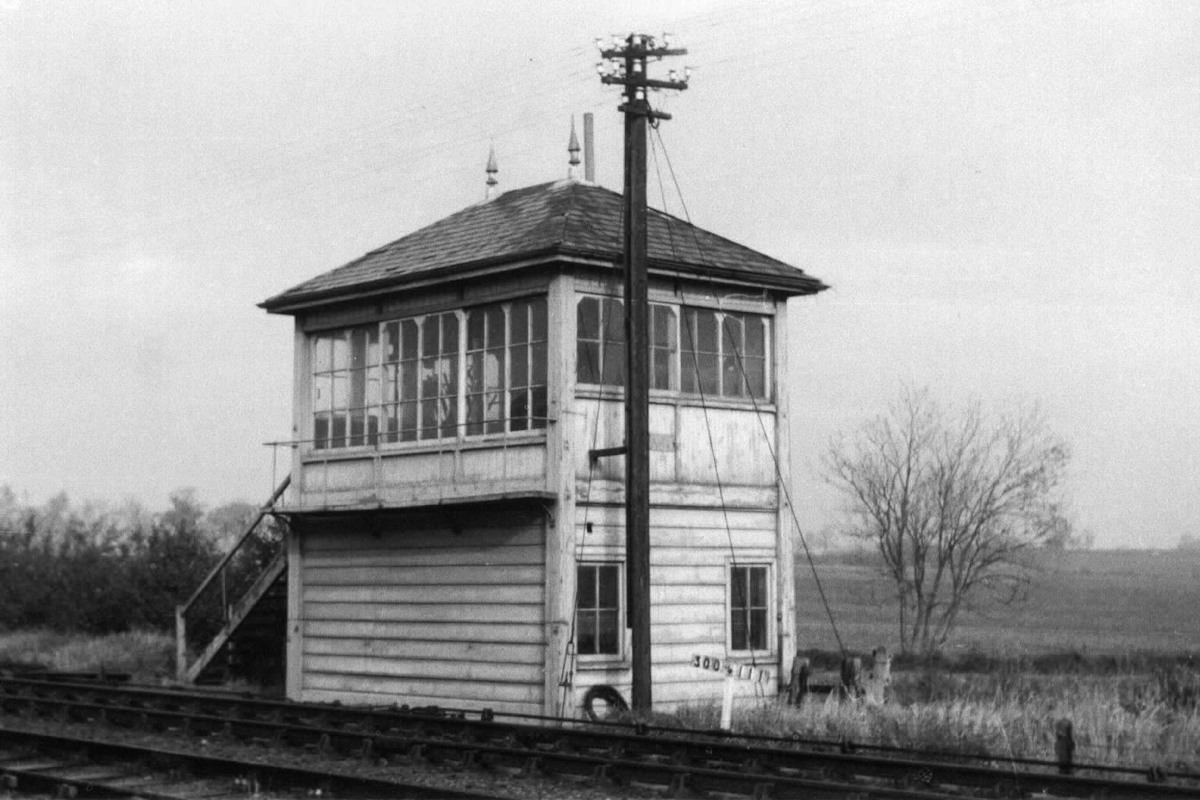
- Raunds Signal Box. Photo: Jeff Pell, courtesy Robin Cullup Collection.
-
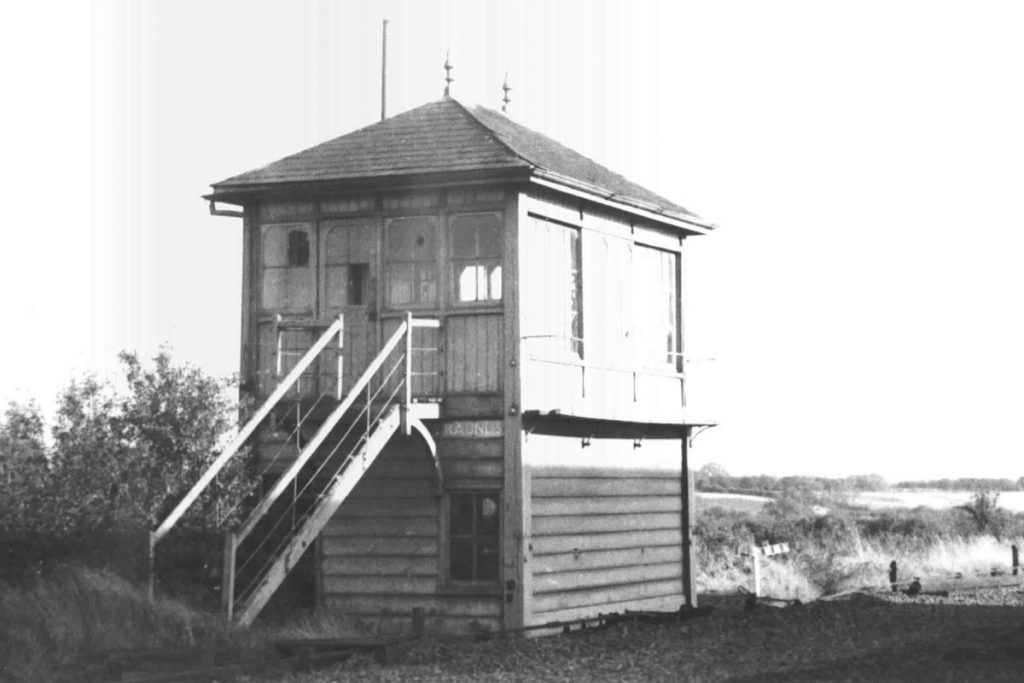
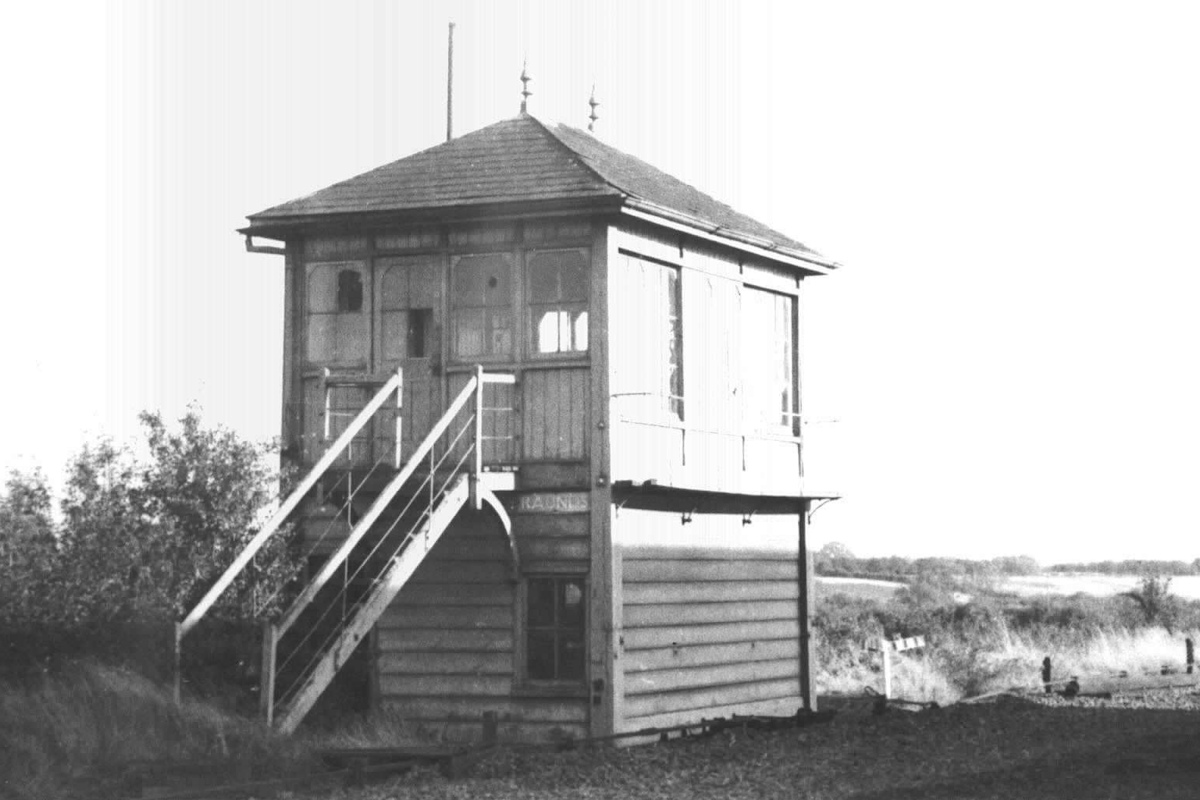
- Raunds Signal Box, trackless and forlorn. Photo: Jeff Pell, courtesy Robin Cullup Collection.
-
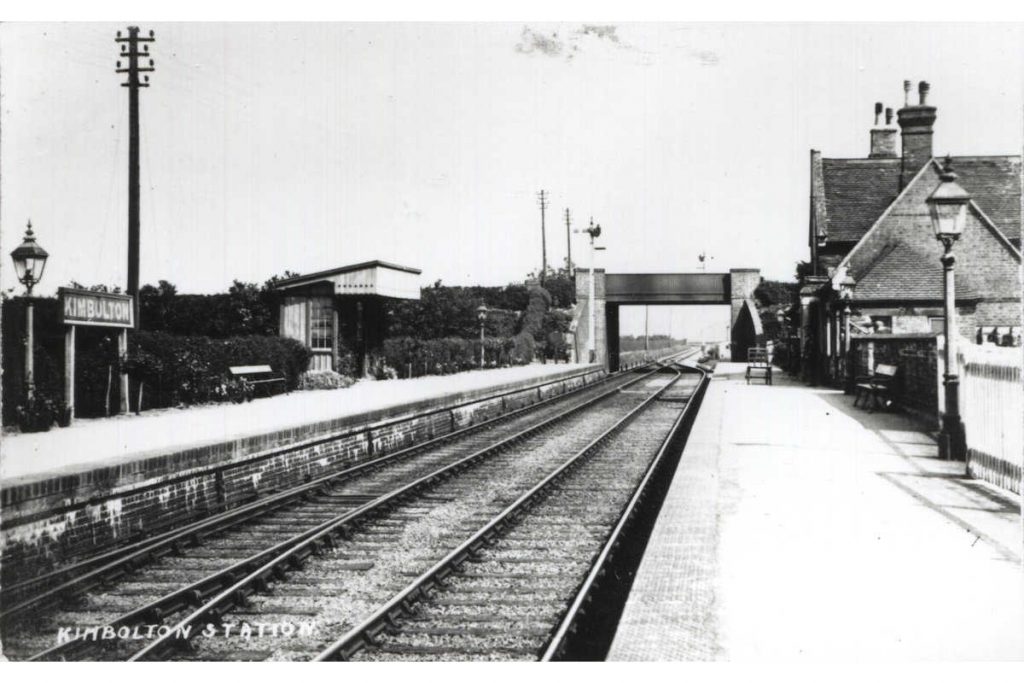
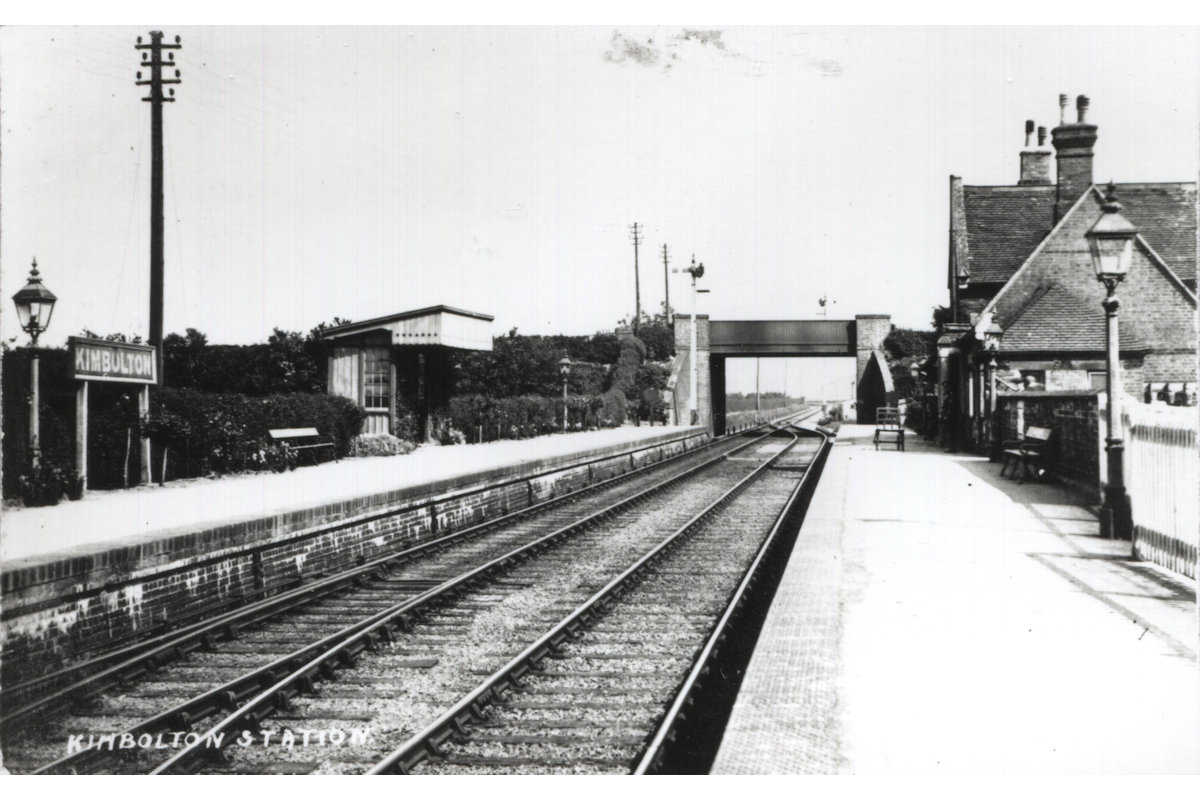
- A charming afternoon view of the tranquil scene at Kimbolton station, looking East and taken circa 1912. One wonders how many pupils’ suitcases have been carried by the barrow, to taxis and carriages for the nearby school. Photo: Robin Cullup Collection.
-
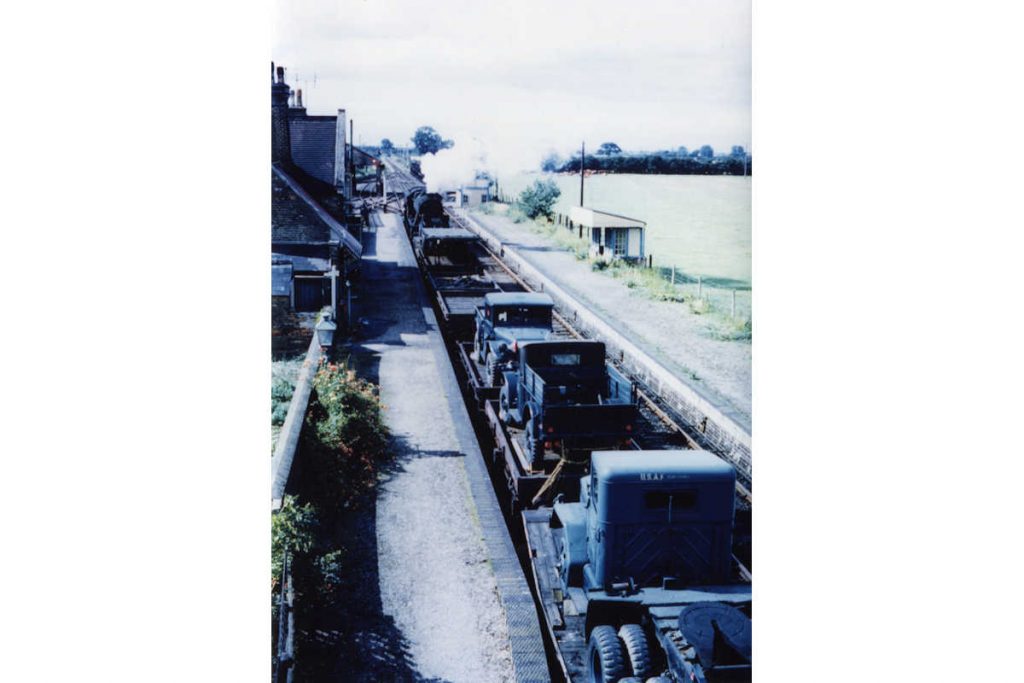
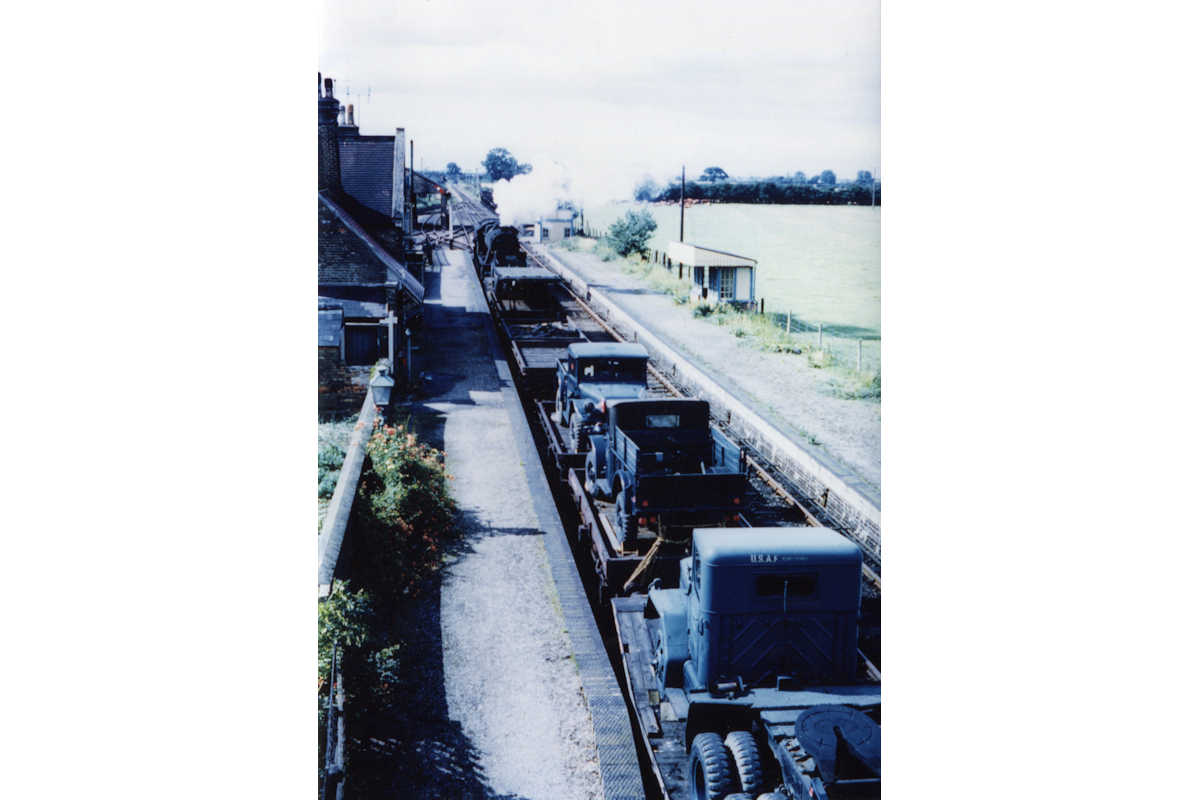
- The nearby RAF Kimbolton (opened in 1941 by Bomber Command but transferred to the US Army Air Forces in 1942) generated considerable rail traffic in the war years and immediately afterwards, mainly in support of the 379th Bombardment Group which operated four B-17 Flying Fortress Squadrons. In contrast to the tranquility of the rural setting, 8F No 48285 heads a Westbound train of US military vehicles through Kimbolton station. Photographer Unknown – Robin Cullup Collection.
-
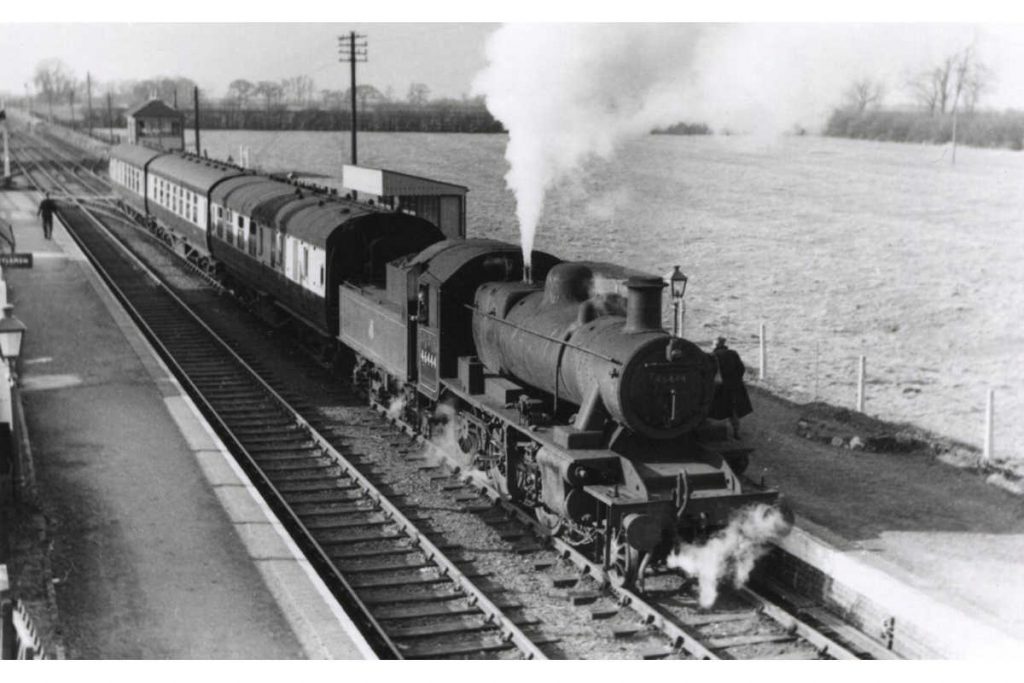
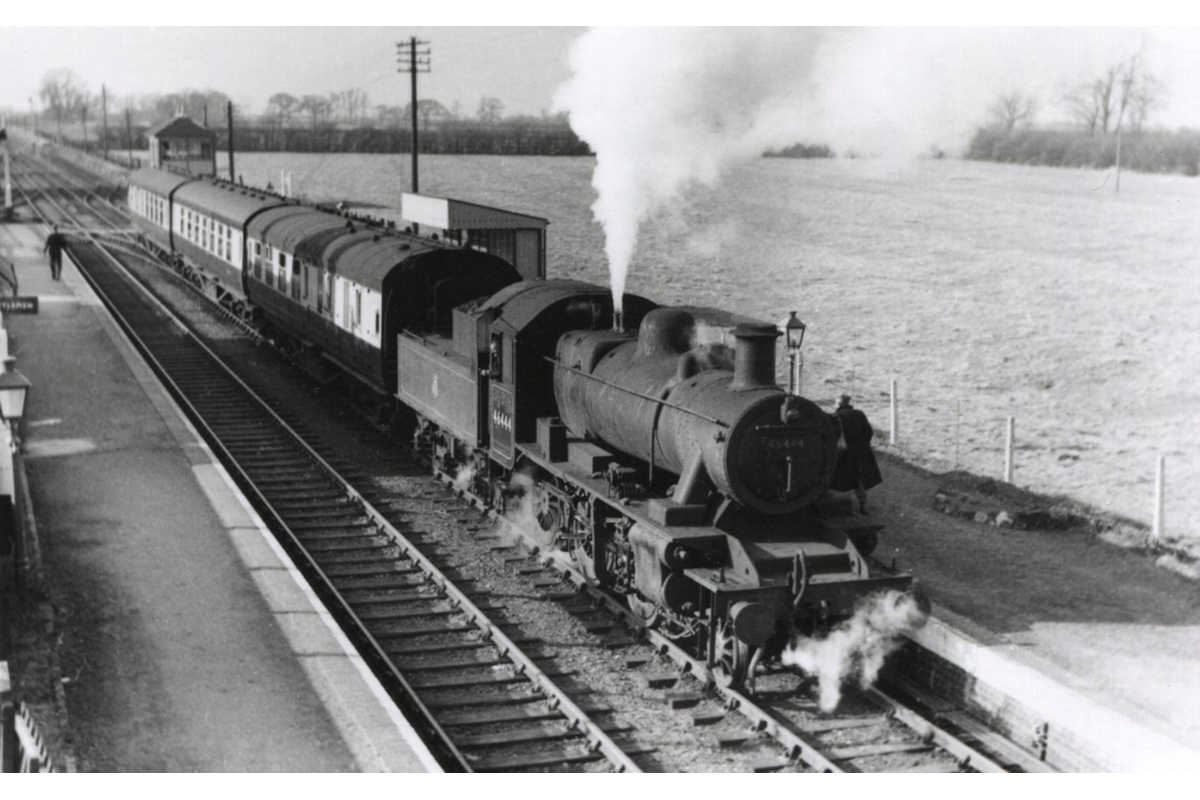
- On a bright and sunny 5th March 1956, LMS Ivatt Class 2 No. 46444 stands at Kimbolton station with the 2.10 pm Kettering to Cambridge. Photographer Unknown – Robin Cullup Collection.
-
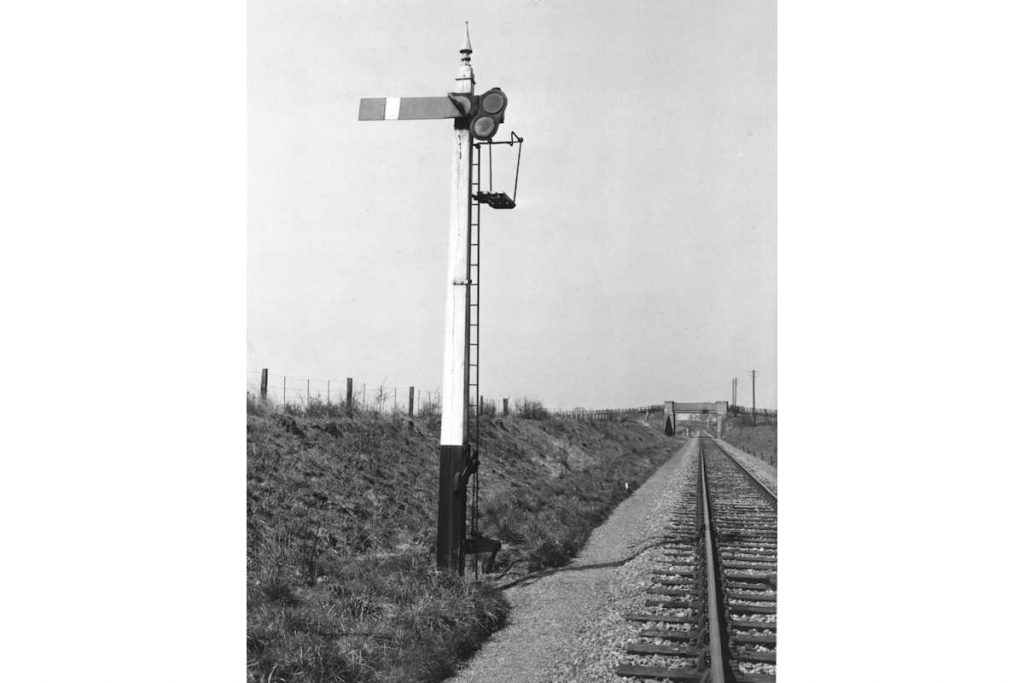
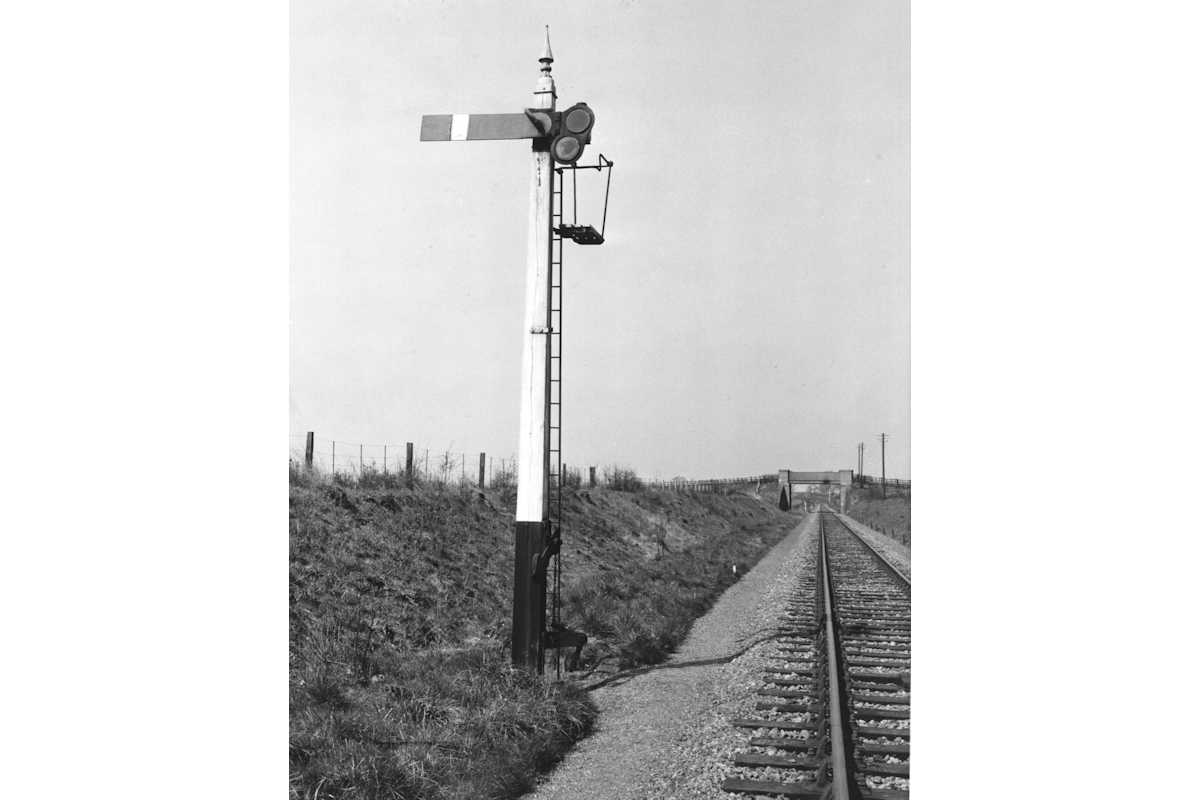
- The Westbound starting signal at Kimbolton. Photographer Unknown – Robin Cullup Collection.
-
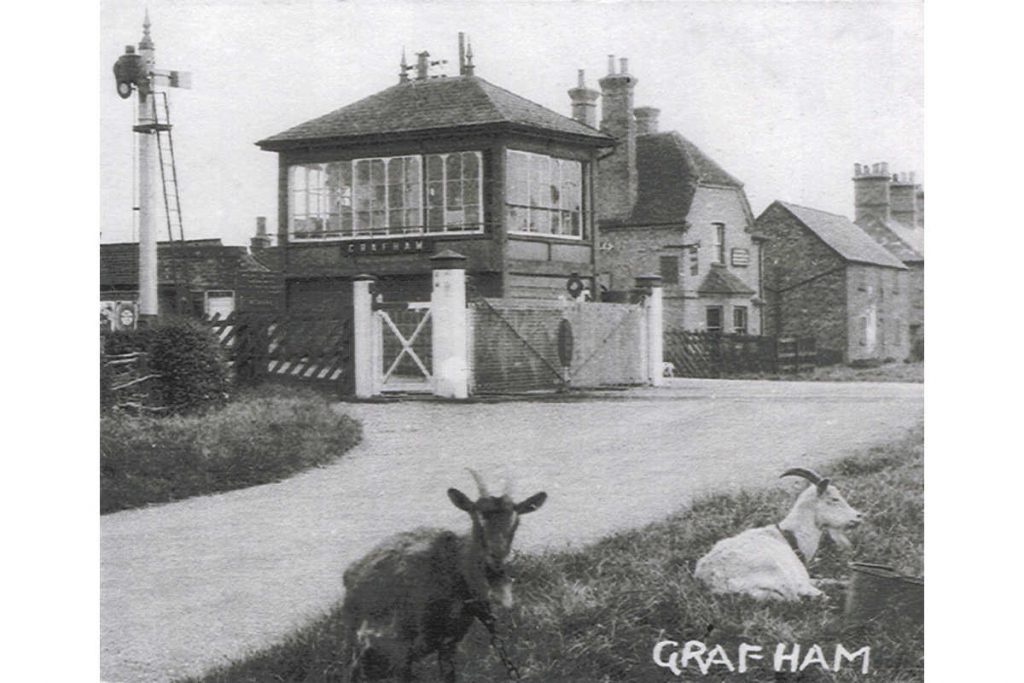
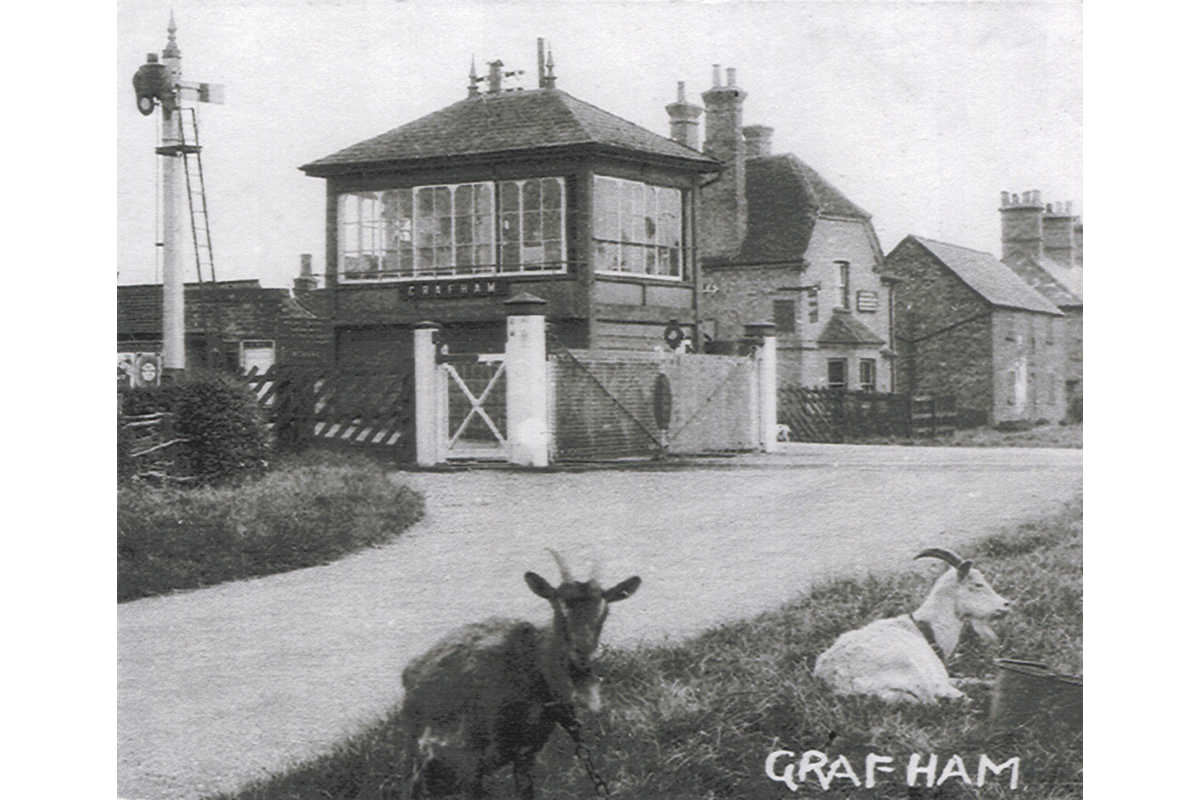
- Goats graze undisturbed by the line at Grafham and its magnificent Midland Railway fittings. Photographer Unknown.
-
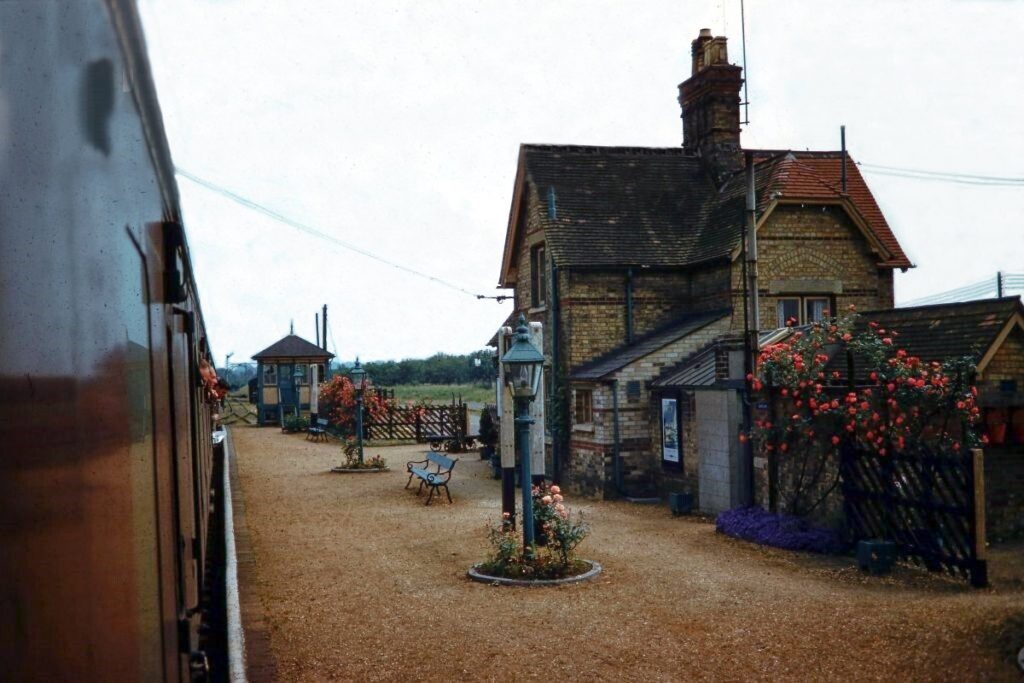
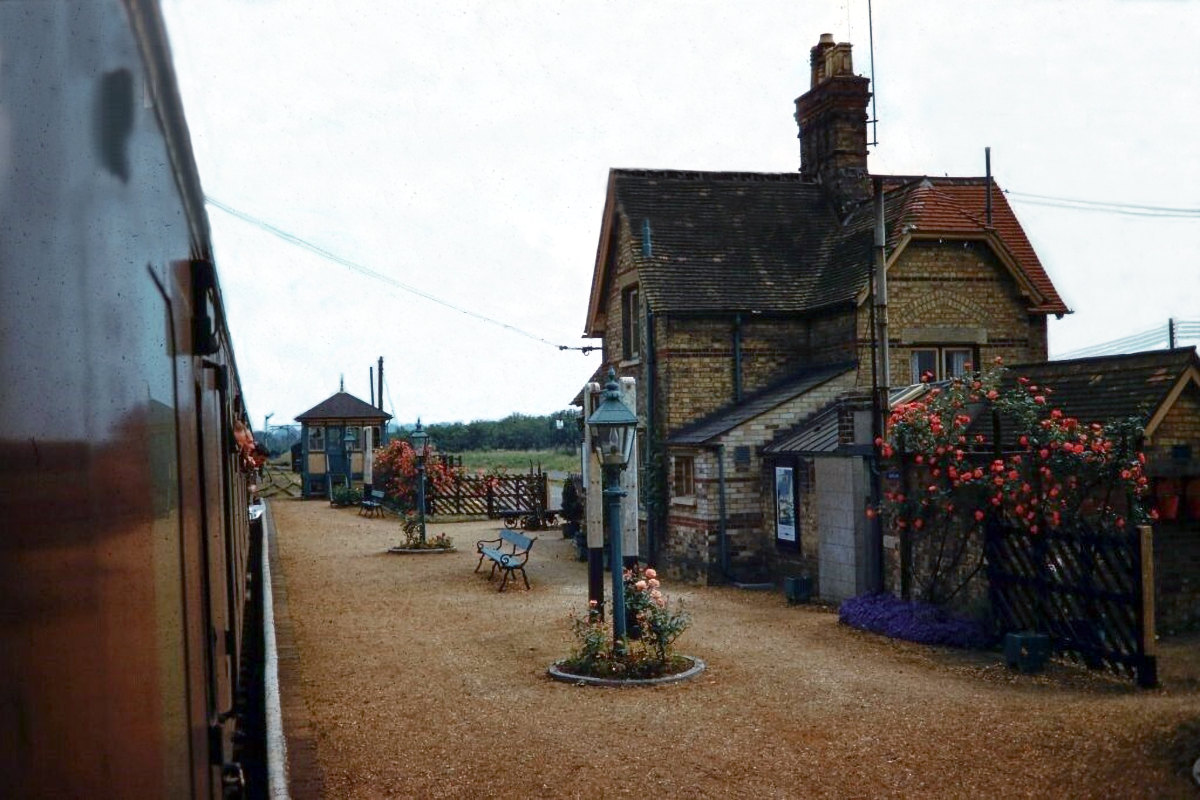
- Buckden station is deserted as a Cambridge to Kettering train stands at the platform in June 1959, shortly before closure of the line. The beautiful climbing rose on the fence is testimony to the care and attention often paid to rural stations by their staff. Photo: Robin Cullup Collection.
-
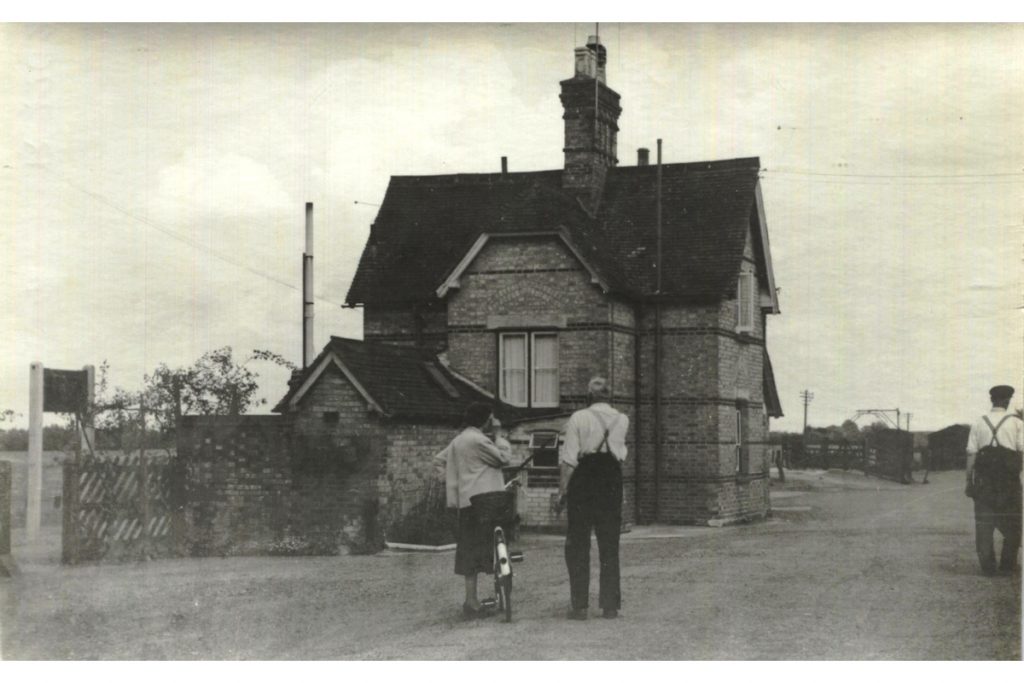
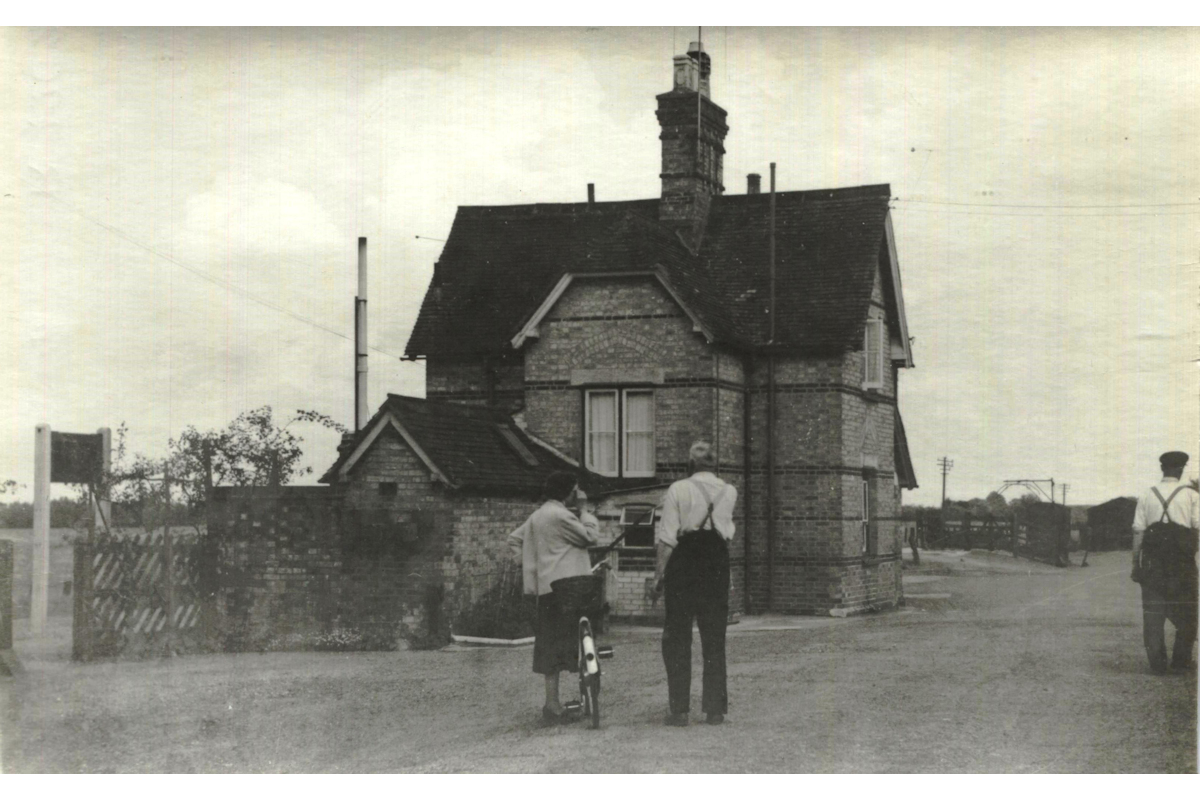
- A delightful view of the approach to Buckden station on 14th August 1954. Photo: A.E. West, courtesy Mike King – Robin Cullup Collection.
-
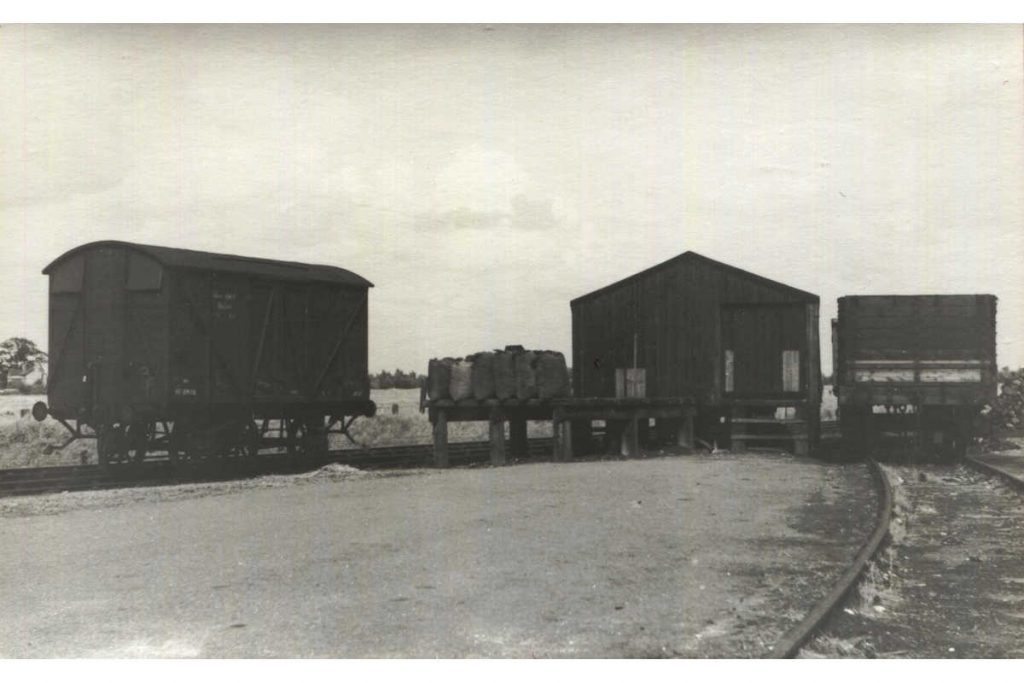
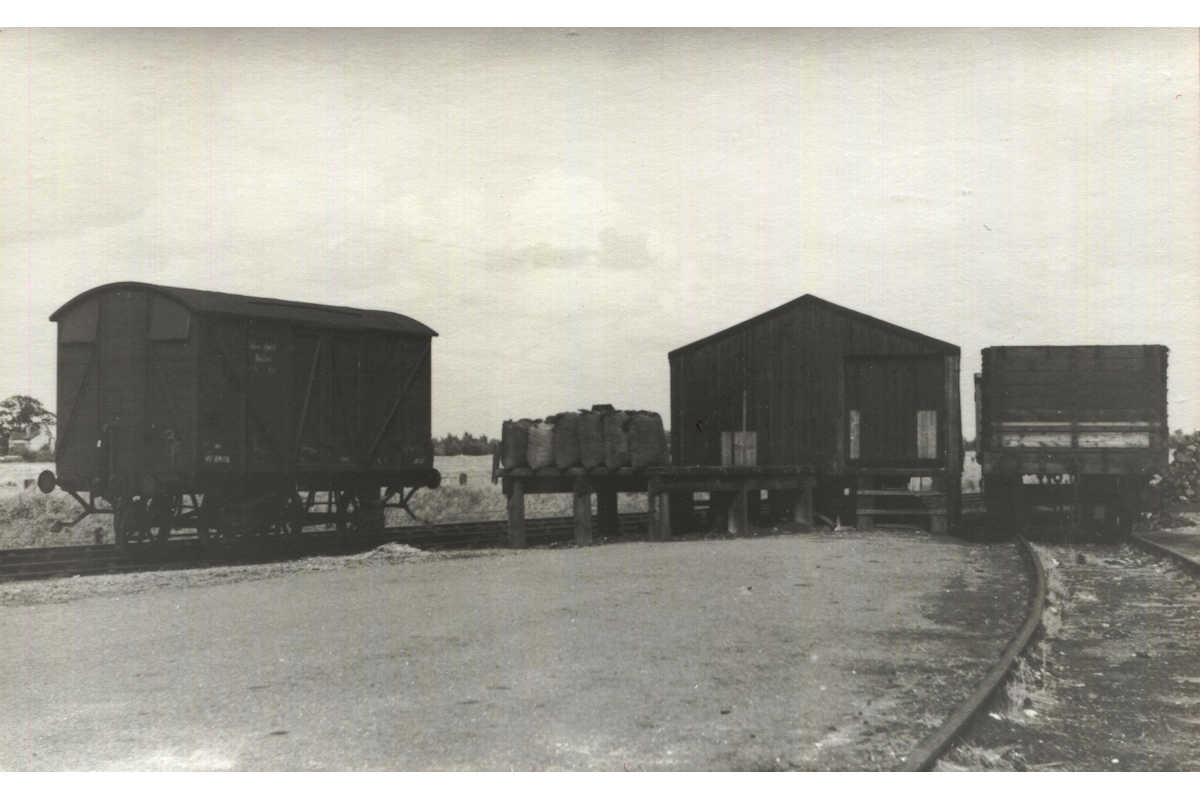
- Buckden Good Yard is seen on 14th August 1954. The flooring of the Provender store was at the same height as wagon flooring, allowing easy transfer of merchandise between the two, whilst it stilts keep pests out of reach. Photo: A E West courtesy Mike King – Robin Cullup Collection.
-
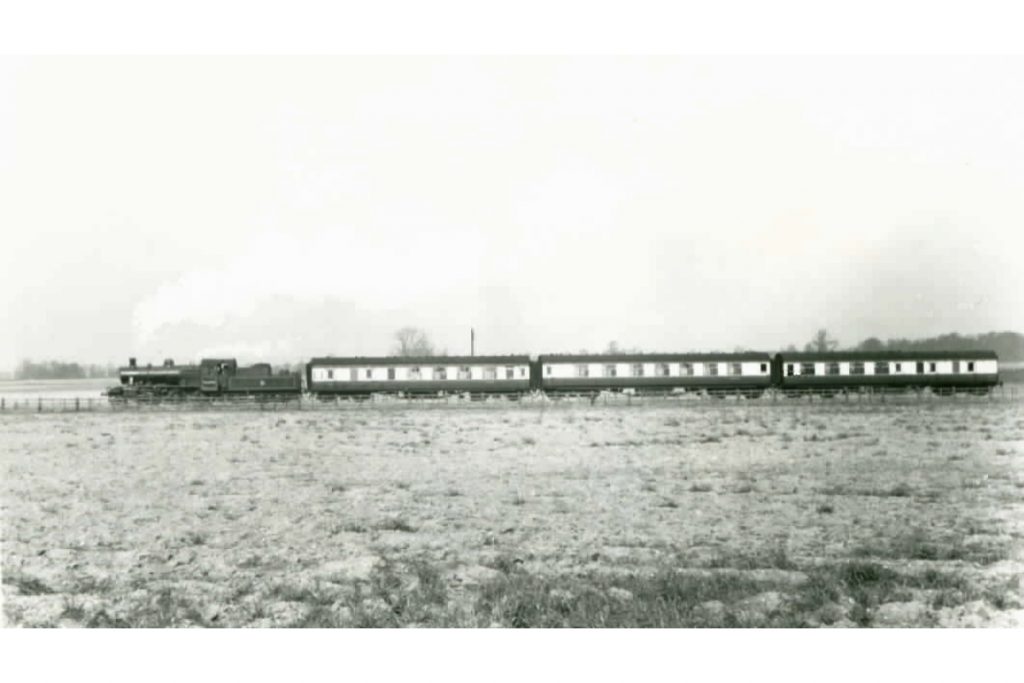
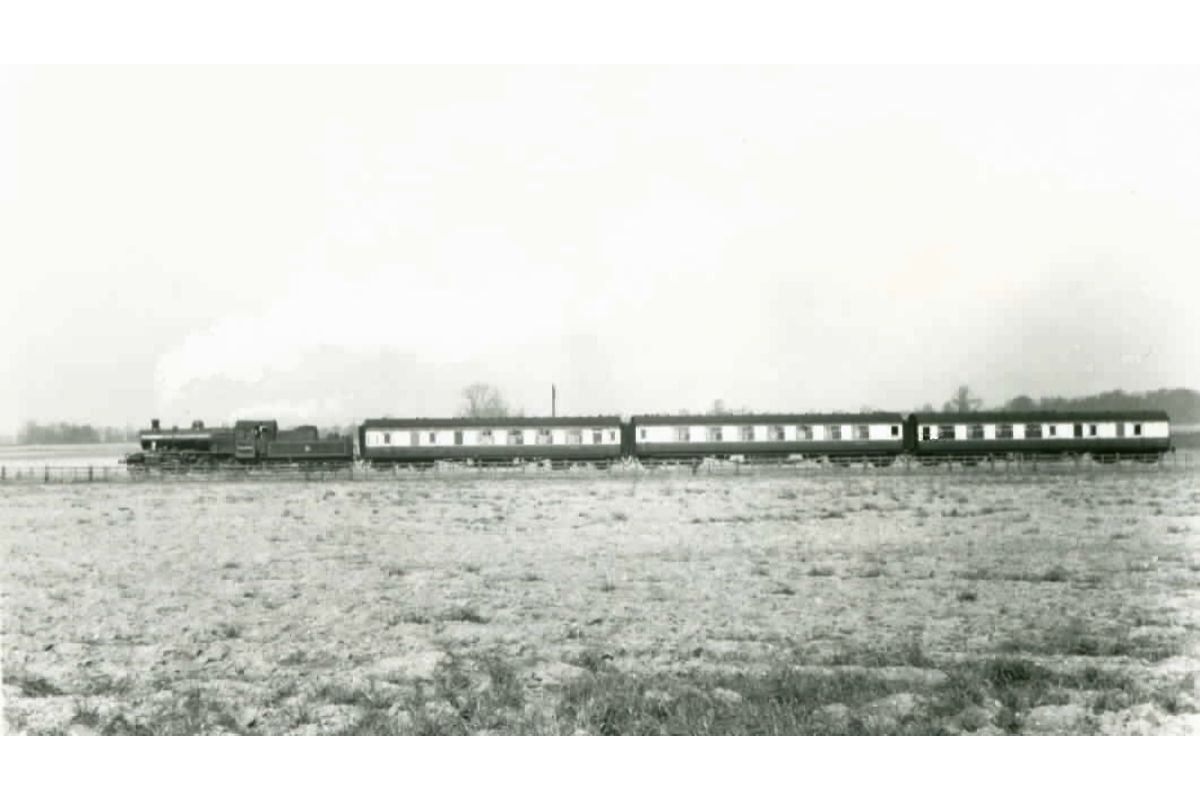
- Looking across the fields near Buckden on 23rd March 1957 as a typical 2MT with three carriages ambles along its way. Photo: Eric Sawford – Robin Cullup Collection.
-
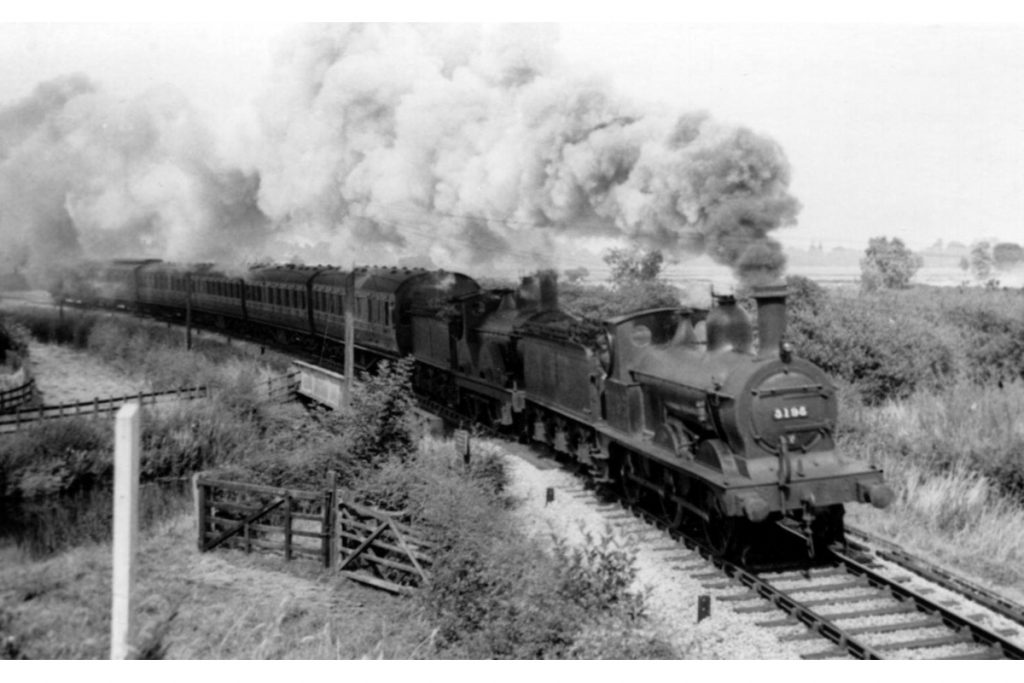
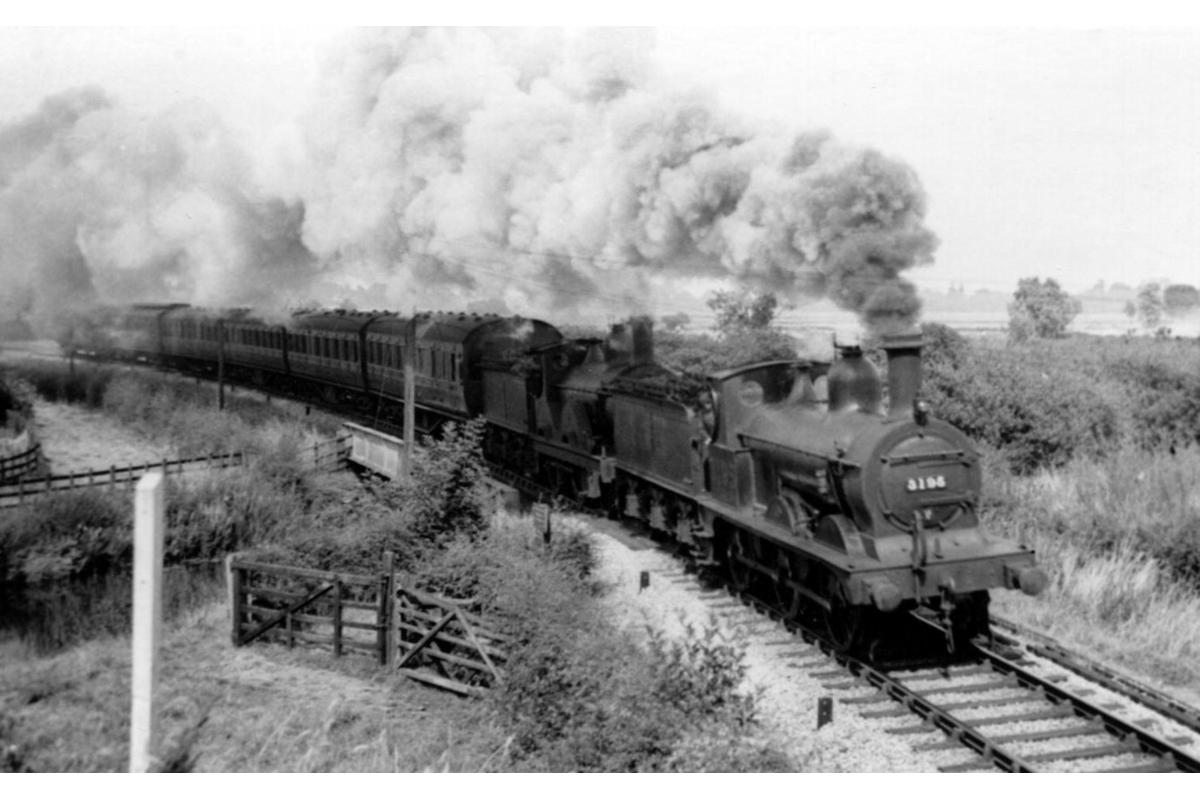
- On Saturday 3rd July 1937, Johnson 3F No. 3195 and 20092 head a strengthened formation away from Huntingdon East and are about to pass under the Great Northern main line of their way West. Photo: E S Murrell – SLS Collection – Robin Cullup Collection.
-
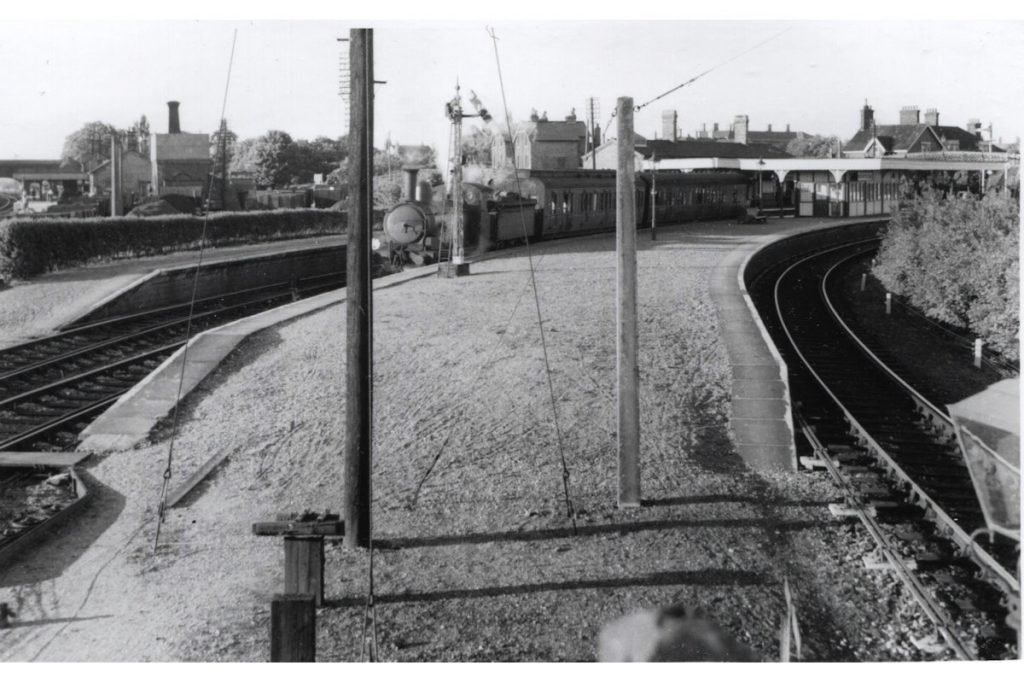
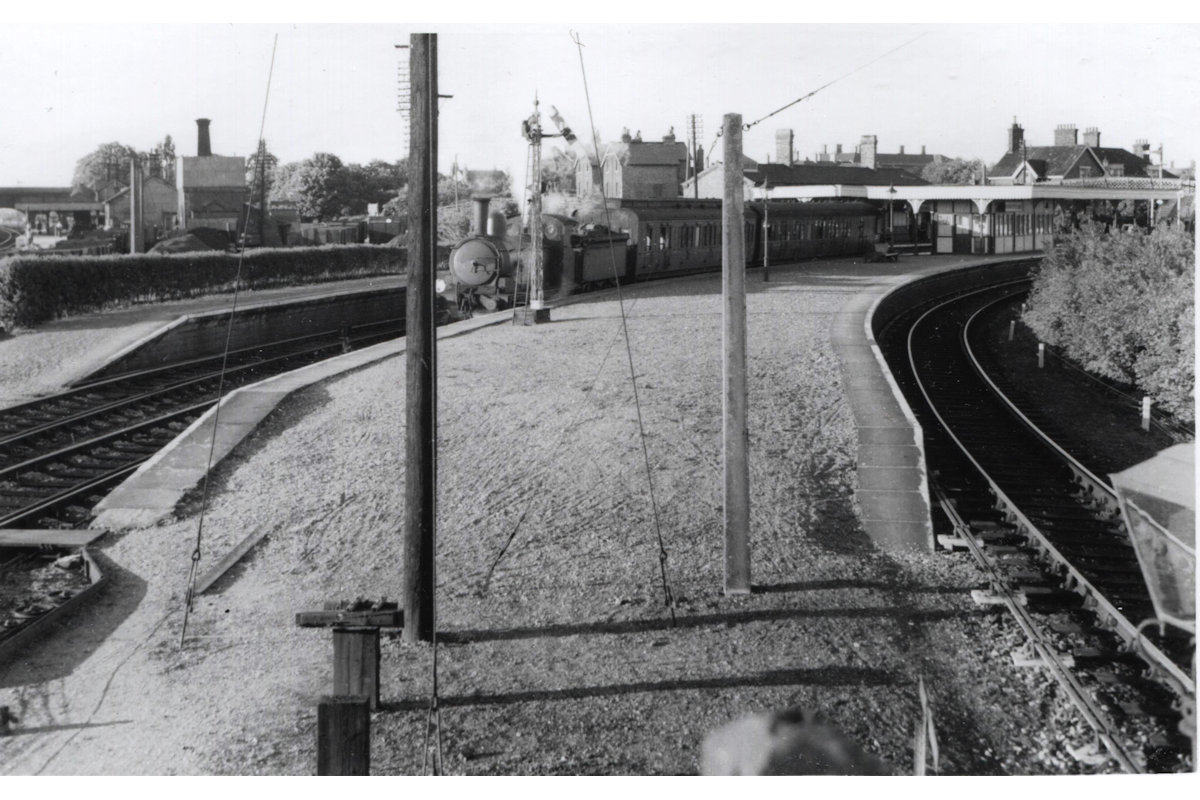
- A late afternoon view of the Joint Line platforms on May 18th 1946 shows J15 No. 5461 after arrival from St Ives. At this time, two return trips were made from Huntingdon to St Ives in the evening, leaving at 6.15 pm and 8.00 pm, arriving back from St Ives at 6.55 pm and 8.35 pm (SX) / 8.40 pm (SO). Photo: Robin Cullup Collection.
-
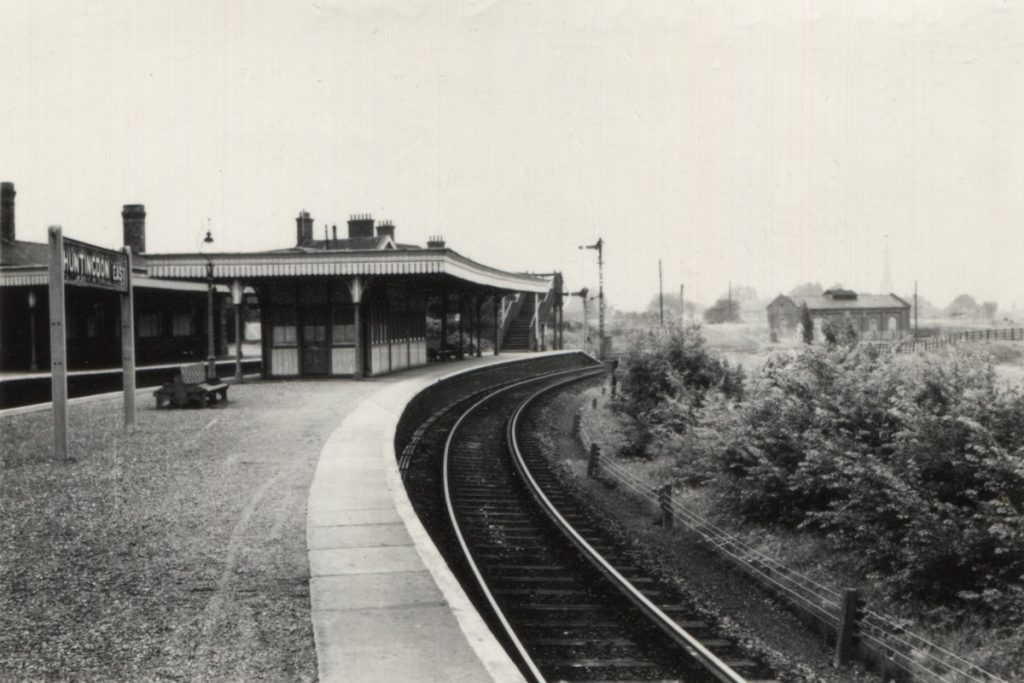
- A late 1950s view by Brian Marlow, along Platform 3 at Huntingdon East (the Kettering platform) captures something of the quietness of the location with not a soul in sight. The two Joint Line platforms can be seen to the left, and the single-road engine shed in the distance to the right. This location today is part of Huntingdon station car park. Photo: Robin Cullup Collection.

-
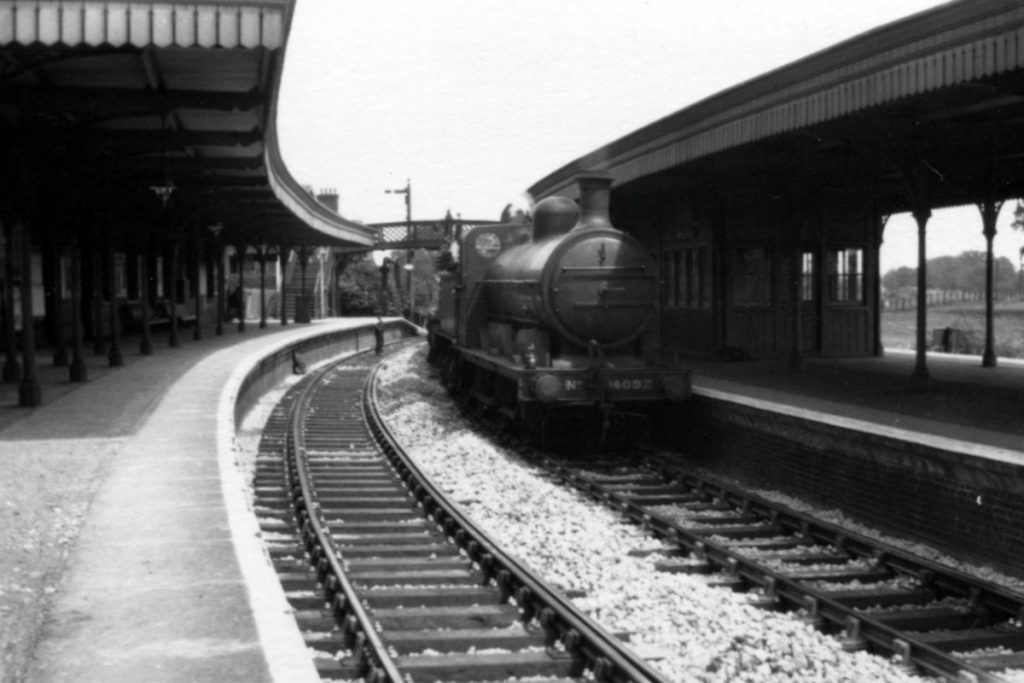
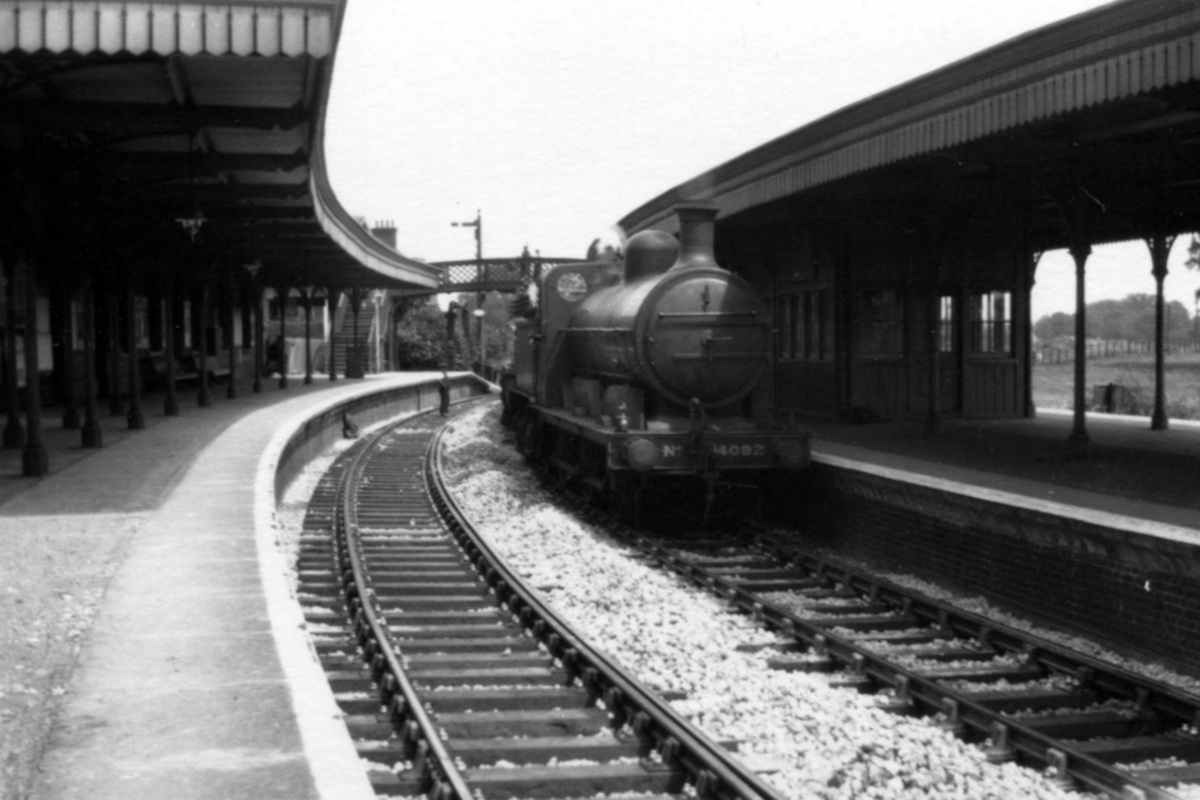
- A lovely 1930s morning view of LNER J3 No. 4092 (which later became 4113 and was withdrawn on 31st August 1947 from 40E, Boston shed) in the freshly re-laid Joint Line platforms at Huntingdon East. Photo: Robin Cullup Collection.
-
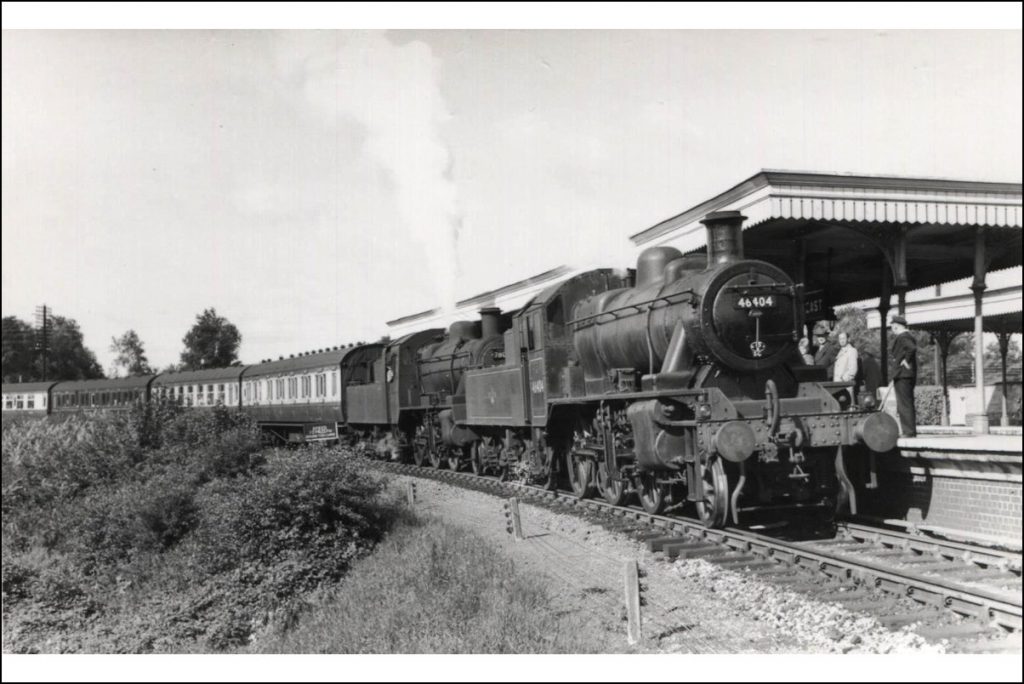
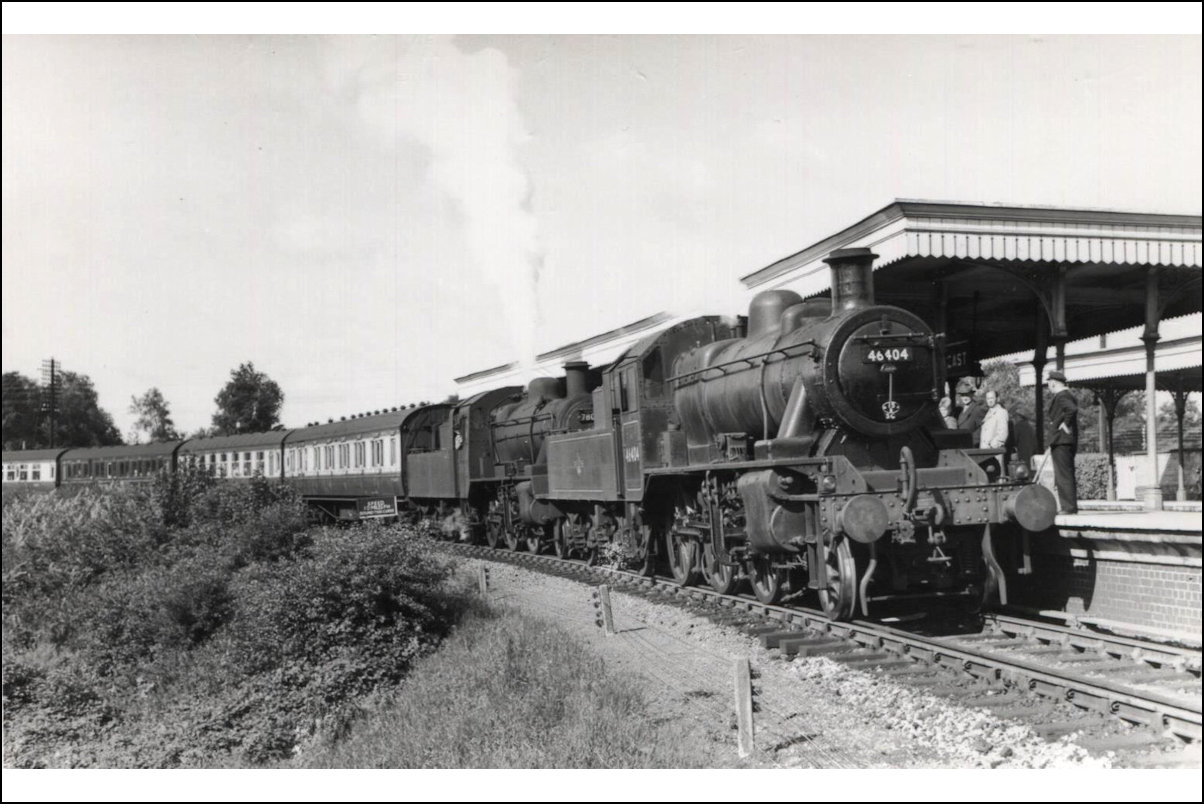
- For a few Saturdays in Summer, the Kettering to Cambridge line enjoyed the passage of its closest ‘main line’ passenger working – the Leicester to Clacton holiday train. The working is seen here drawing into Huntingdon East station’s platform 3, round the very tight 10 mph-restricted curve, behind Ivatt Class 2 No. 46404 and BR Standard Class 2 No. 78028. On the right of the picture are the two seldom-used Joint Line platforms 1 and 2. Latterly the only regular working from these platforms was a Friday Only train to Kings Cross at approximately 5.45 pm, laid on primarily for Servicemen from nearby airbases taking weekend leave. Photo: T.G. Hepburn courtesy Brian Stephenson – Robin Cullup Collection.
-
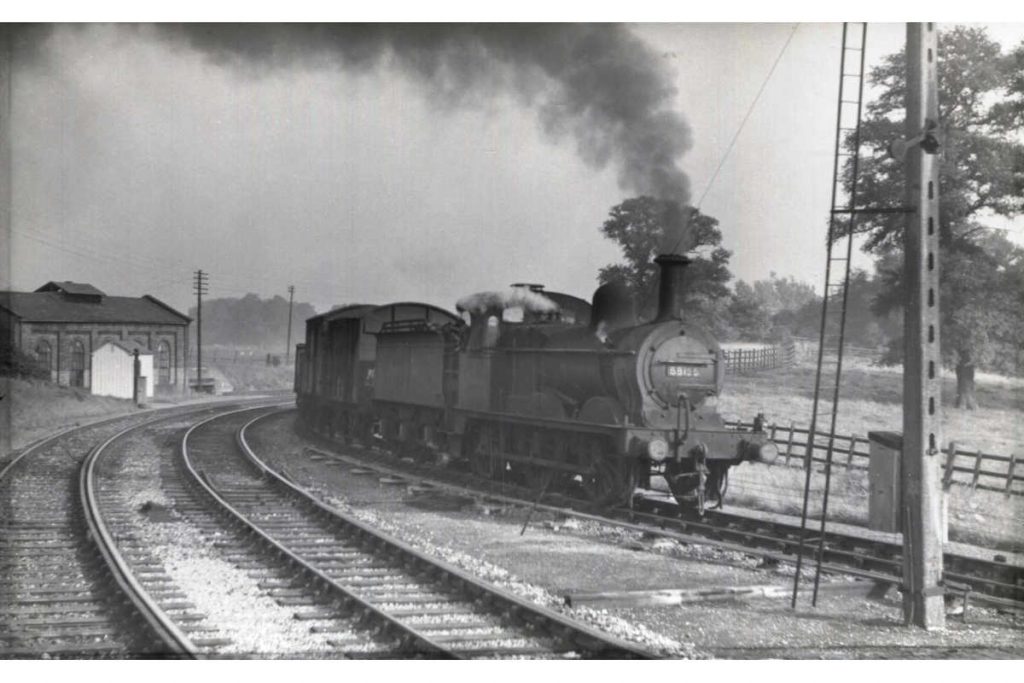
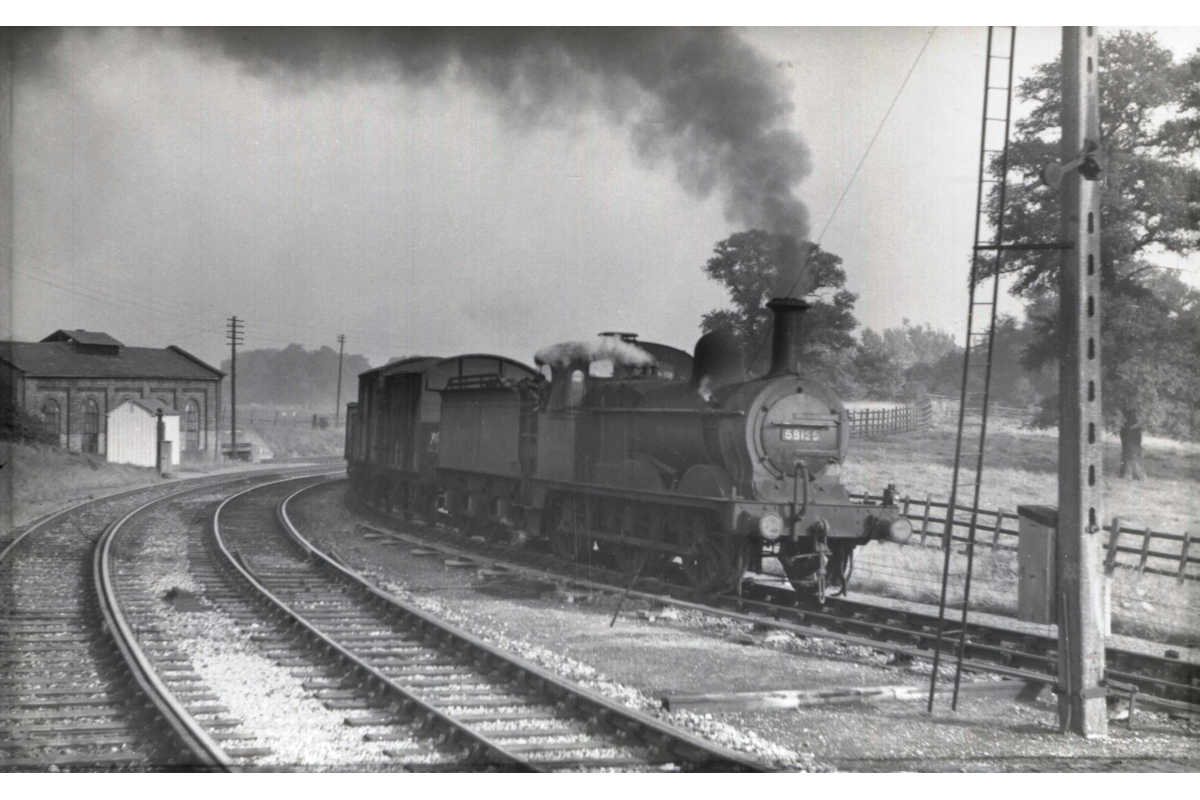
- On September 29th 1951 at Huntingdon East, Johnson 2F 0-6-0 No. 58195 swings off the Joint Line and onto the single line to Kettering with a local goods. Photo: A. E. West courtesy Mike King.
-
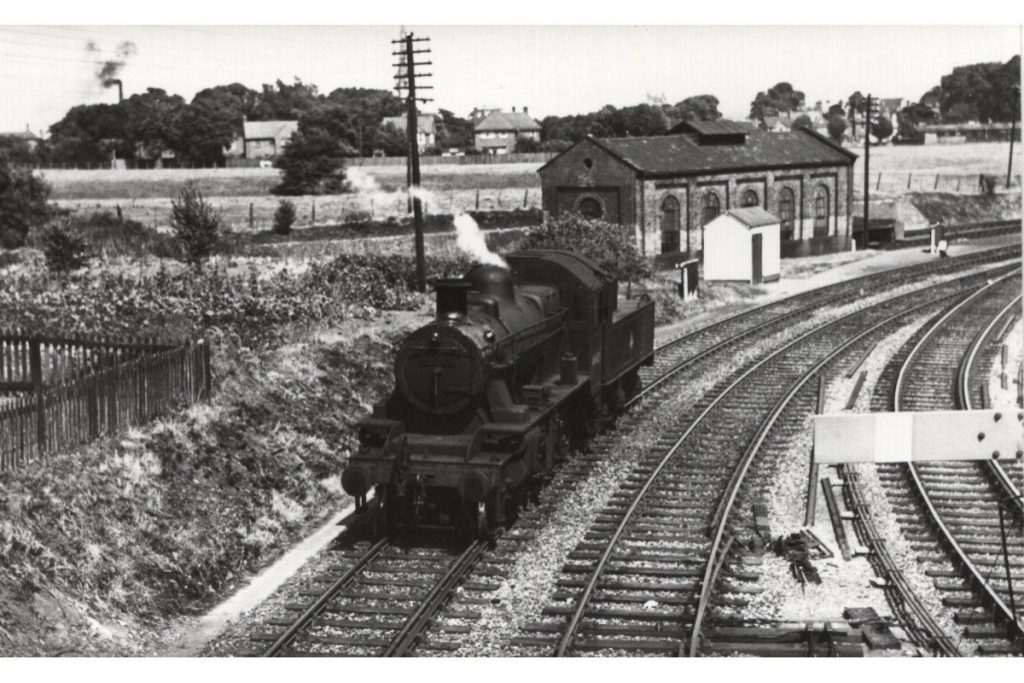
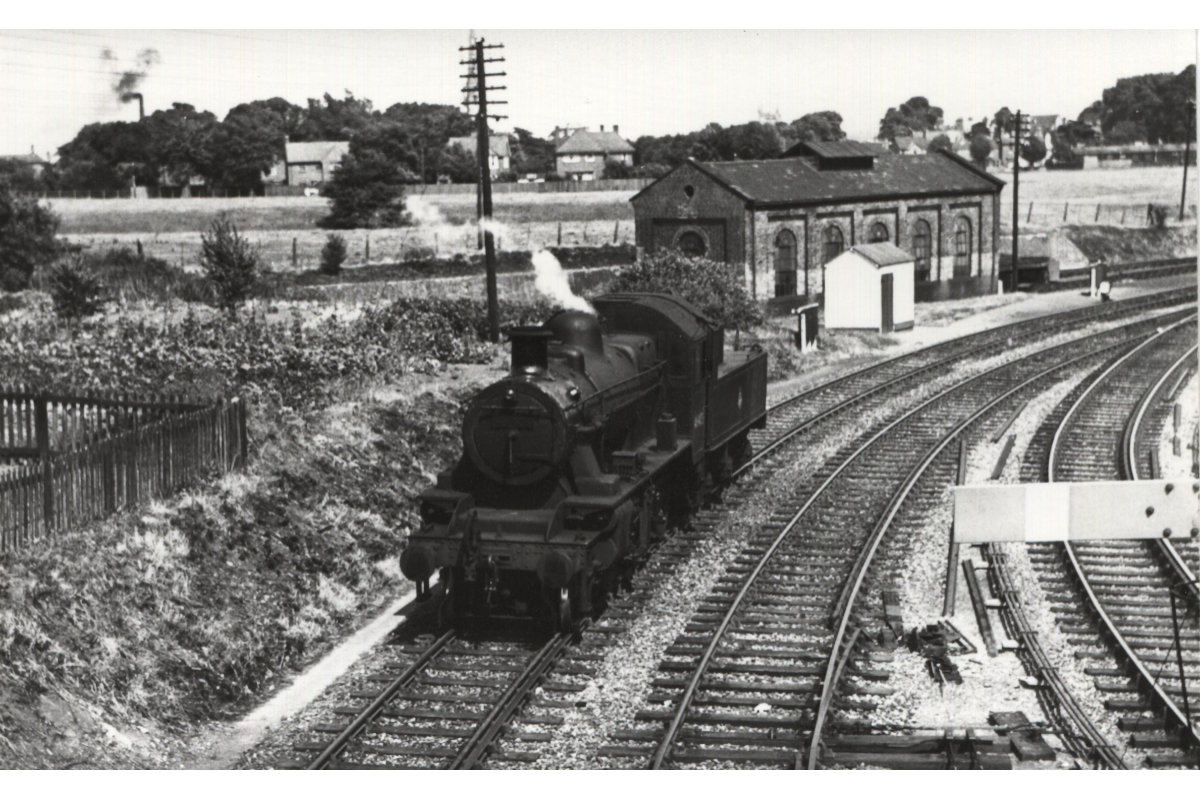
- An undated view from the footbridge at Huntingdon East shows LMS Ivatt Class 2 No. 46495 (built January 1952 at Darlington and withdrawn in October 1966) drifting slowly Eastwards through the station, in a scene which captures something of the pace of life on the Kettering Branch. Photo: Robin Cullup Collection.
-
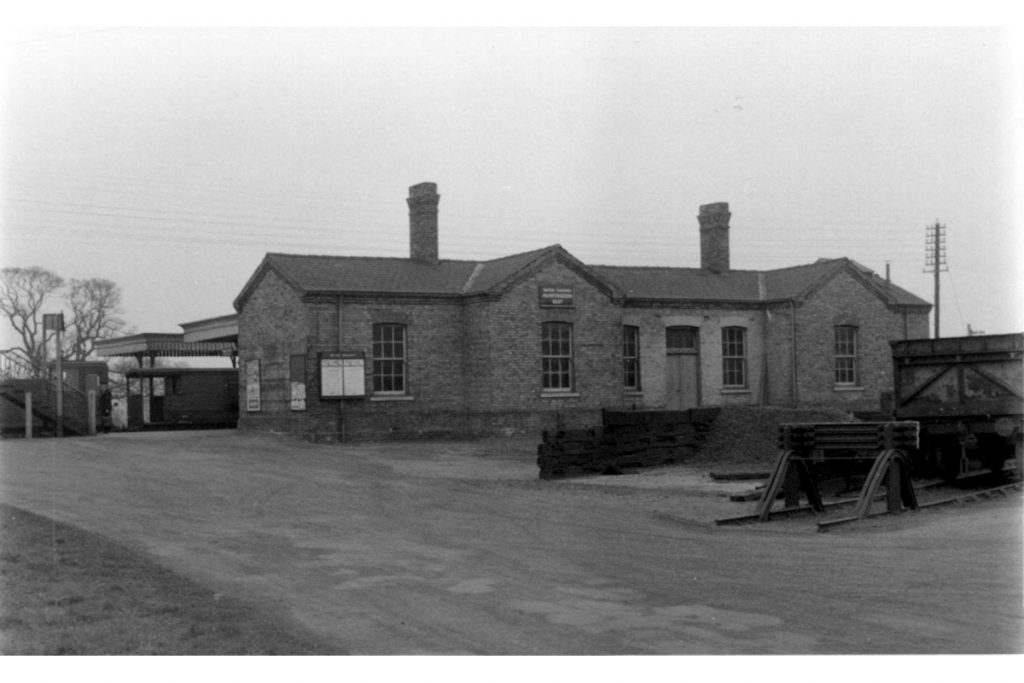
- The station buildings at Huntingdon East were modest. They are seen here, complete with what looks like a Class 03 engine and brake, on March 21st 1959, three months before closure to passengers. This site is now part of Huntingdon station car park. Photo: AE West, Robin Cullup Collection.

-
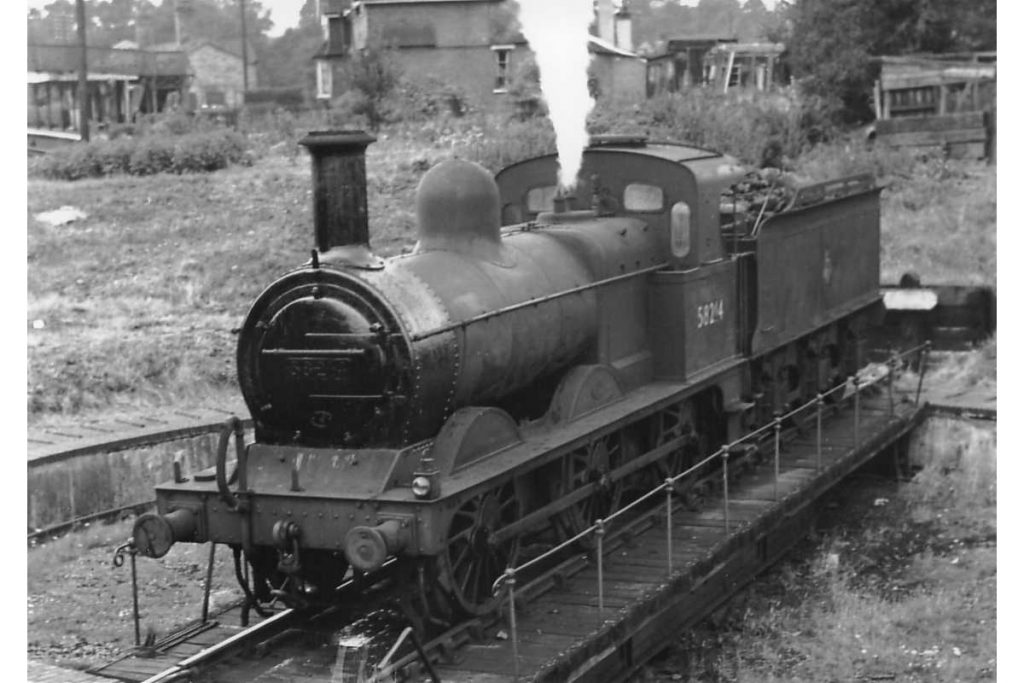
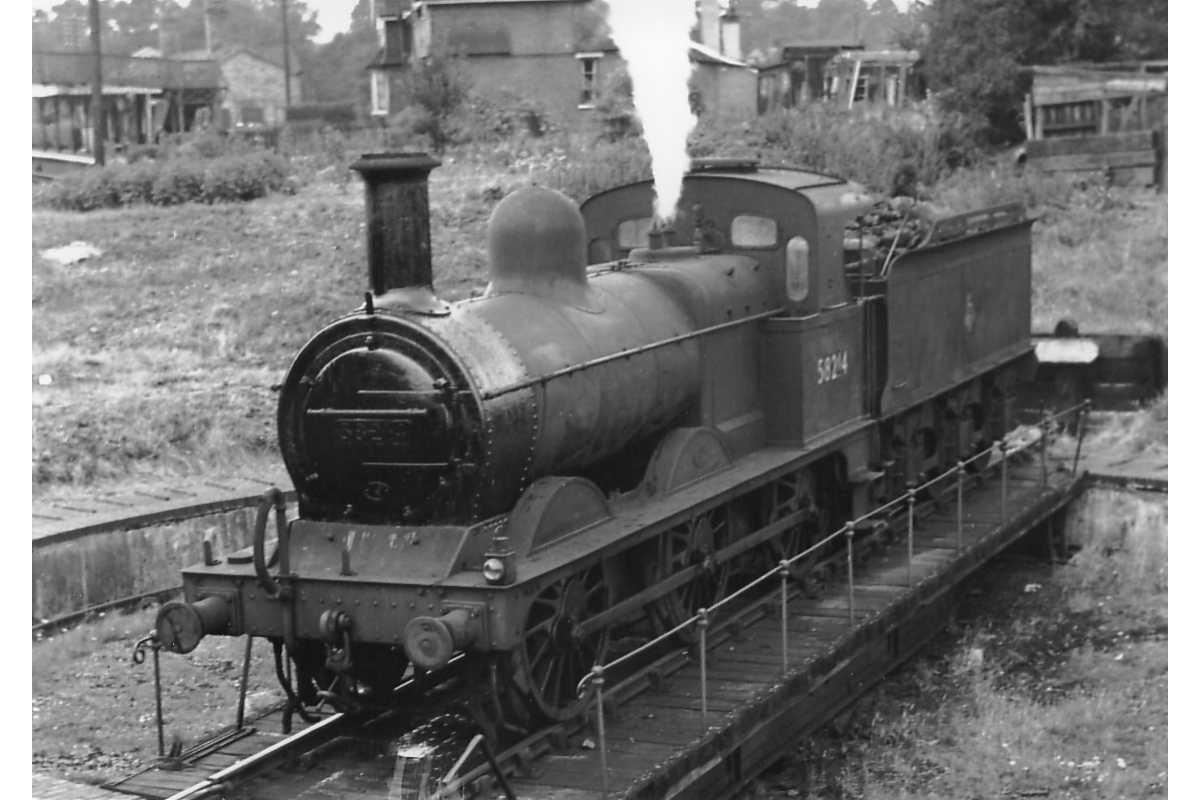
- Midland Railway Johnson 2F 0-6-0 No. 58214 stands on the turntable at Huntingdon East. Photographer Unknown.
-
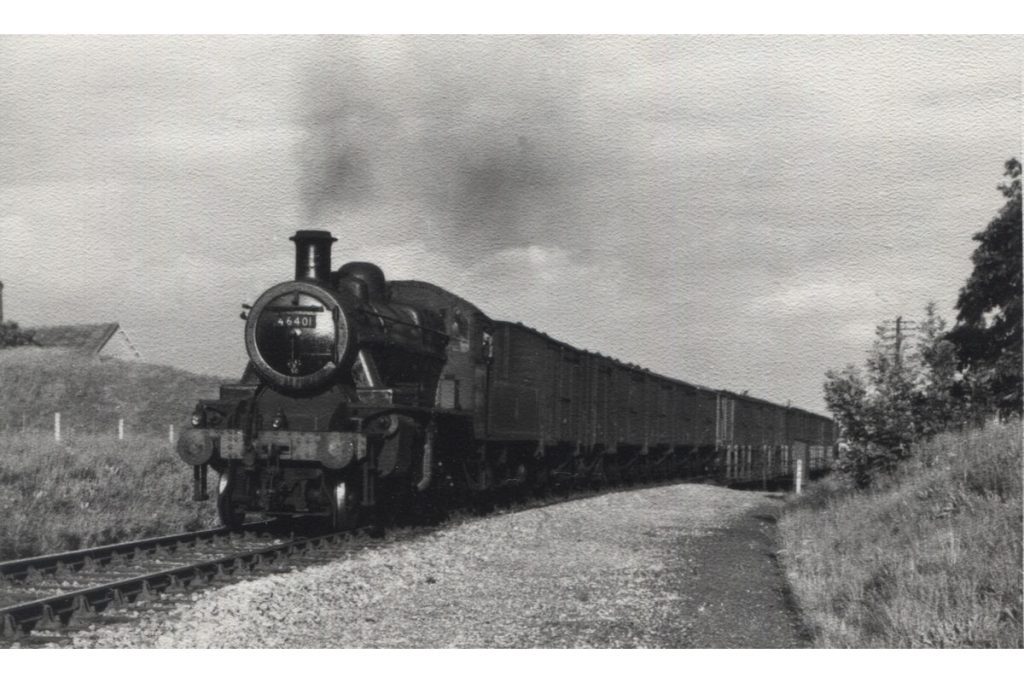
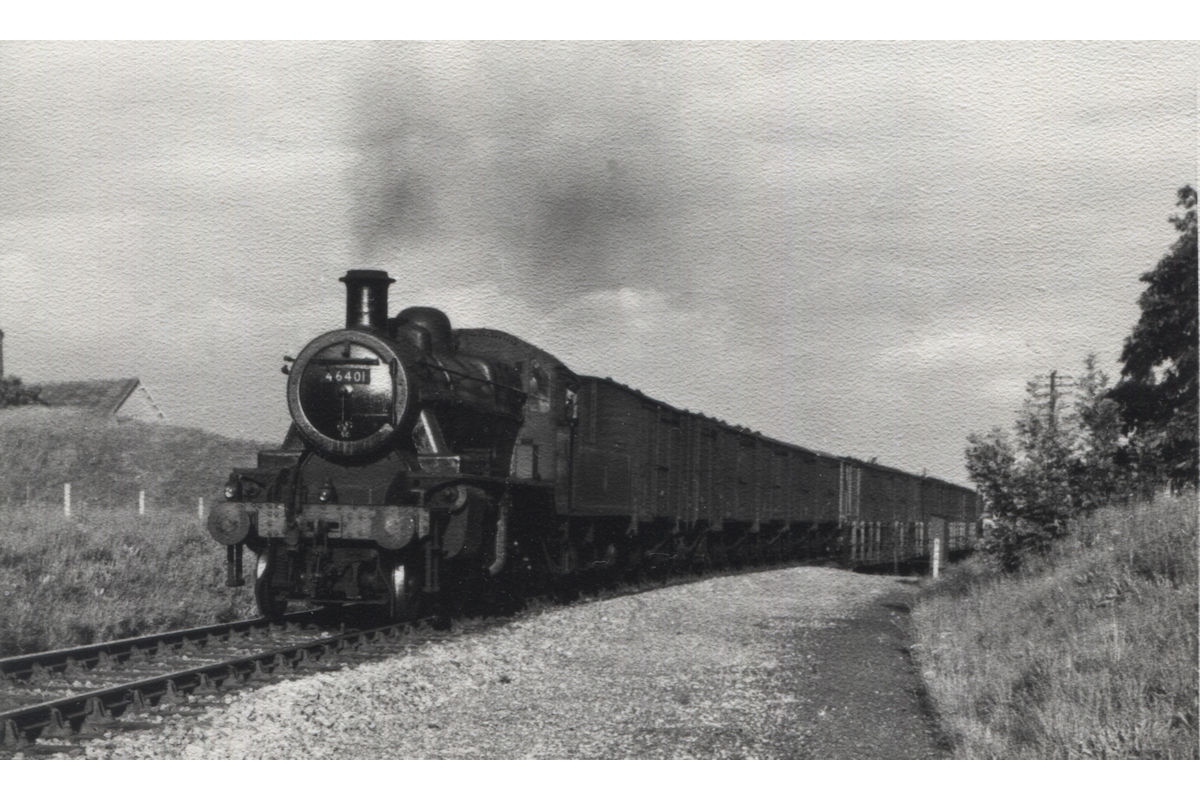
- The Histon to Manchester Class C Fruit Train is seen behind Ivatt 2-6-0 Class 2 No. 46401 on the approach to Huntingdon East on August 10th 1954. The perishable nature of fruit traffic meant that the punctual running of this train was of the highest priority. Photo: E.H. Sawford – Robin Cullup Collection.
-
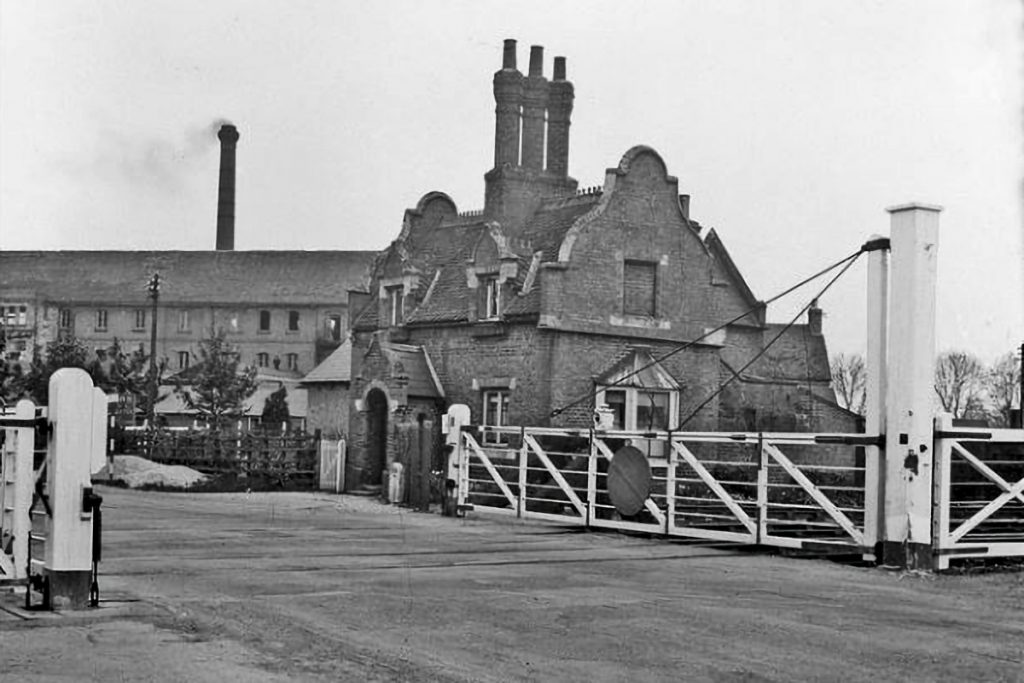
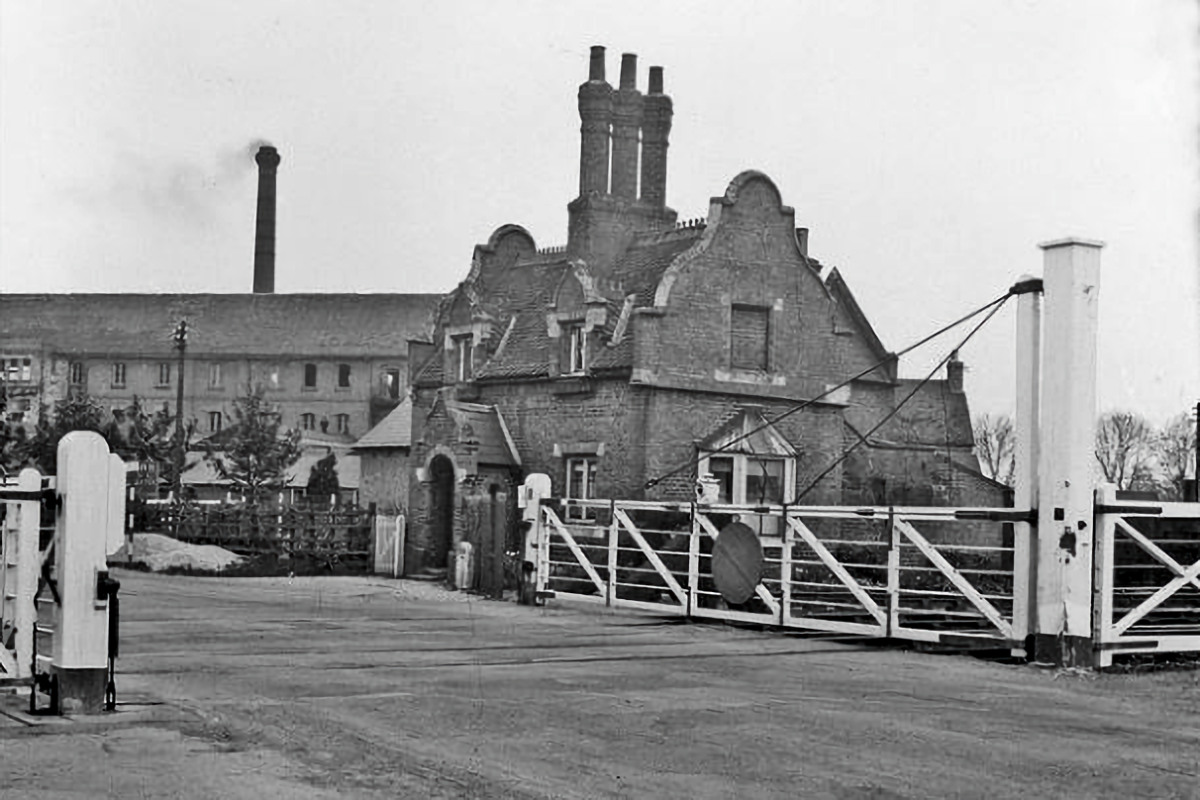
- A lovely (undated) view of Godmanchester Level Crossing, to the West of the station, which carried Ermine Street over the railway. Photo: A. E. West, courtesy Robin Cullup Collection.
-
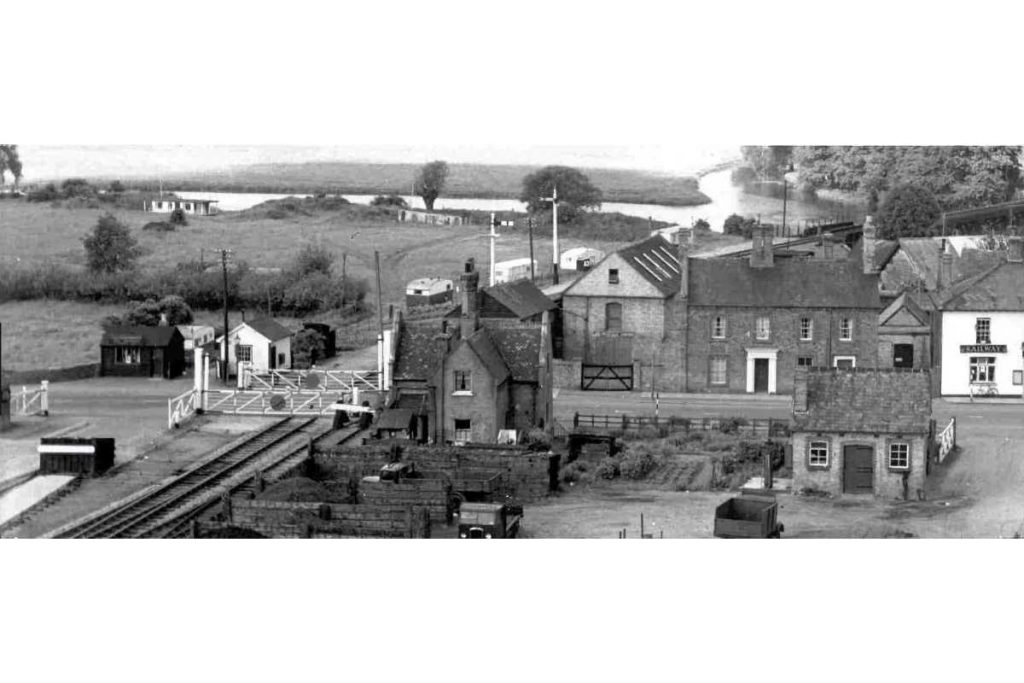
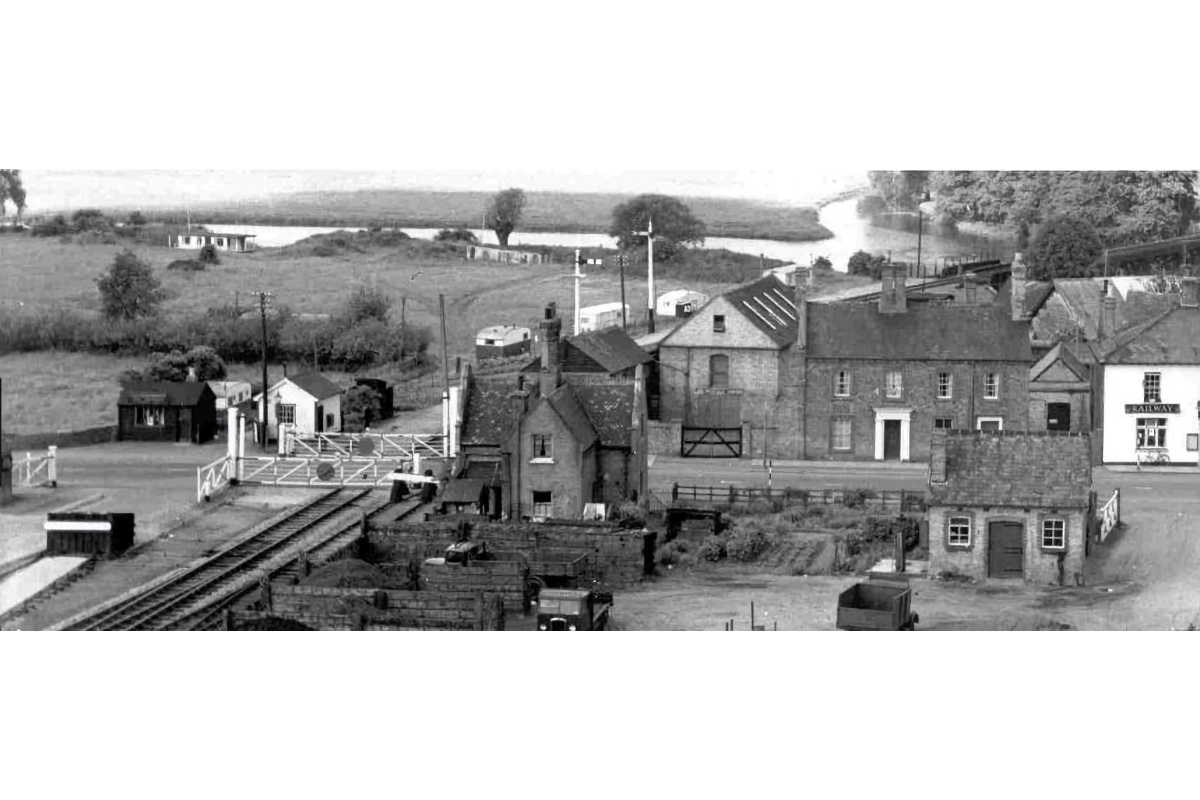
- Seen from high up in the corn mill next to Godmanchester station and looking towards Huntingdon, Ermine Street crosses the line before it passed over the River Great Ouse. Today this site is covered by the A1307 road, which was formerly the A14 until the Huntingdon bypass was opened on May 5th 2020. Photographer Unknown.
-
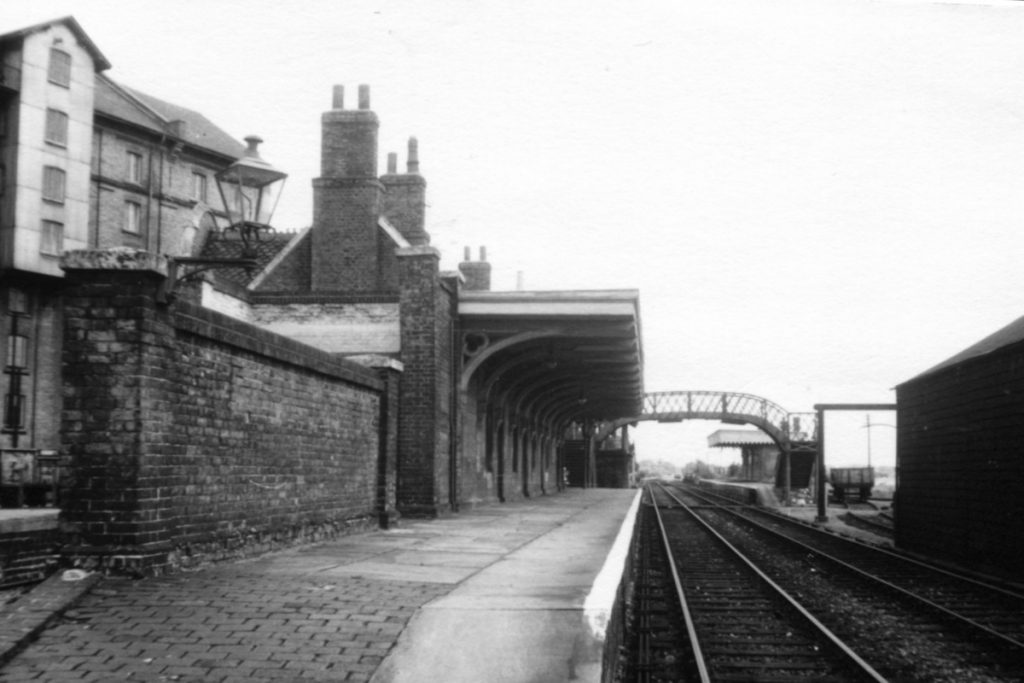
- A deserted Godmanchester station, looking East towards St Ives. Unknown Photographer, courtesy Robin Cullup Collection.

-
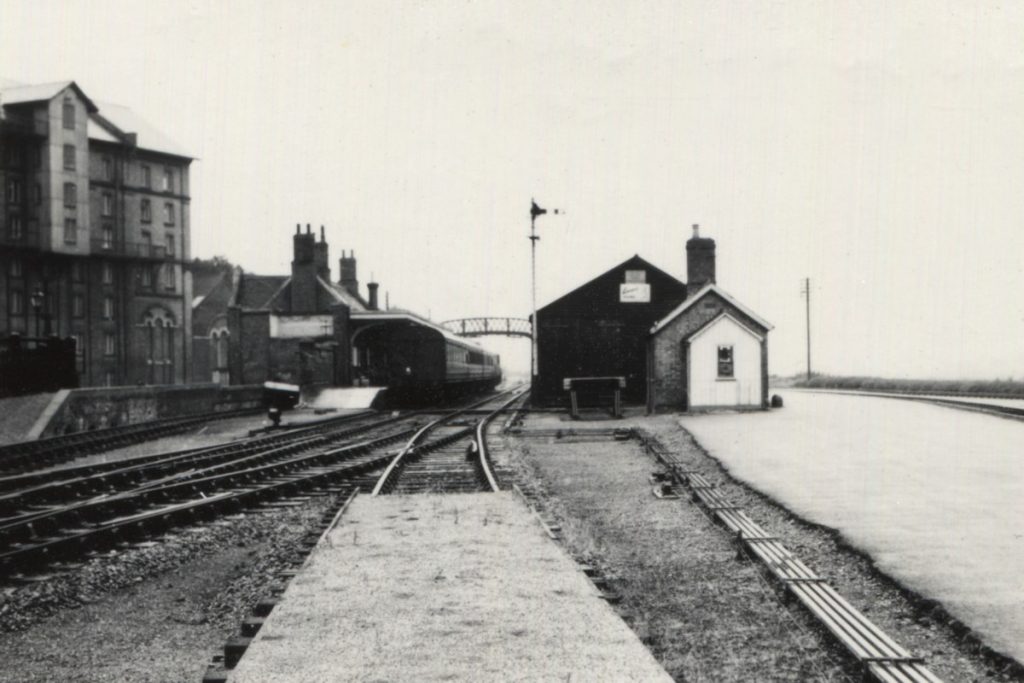
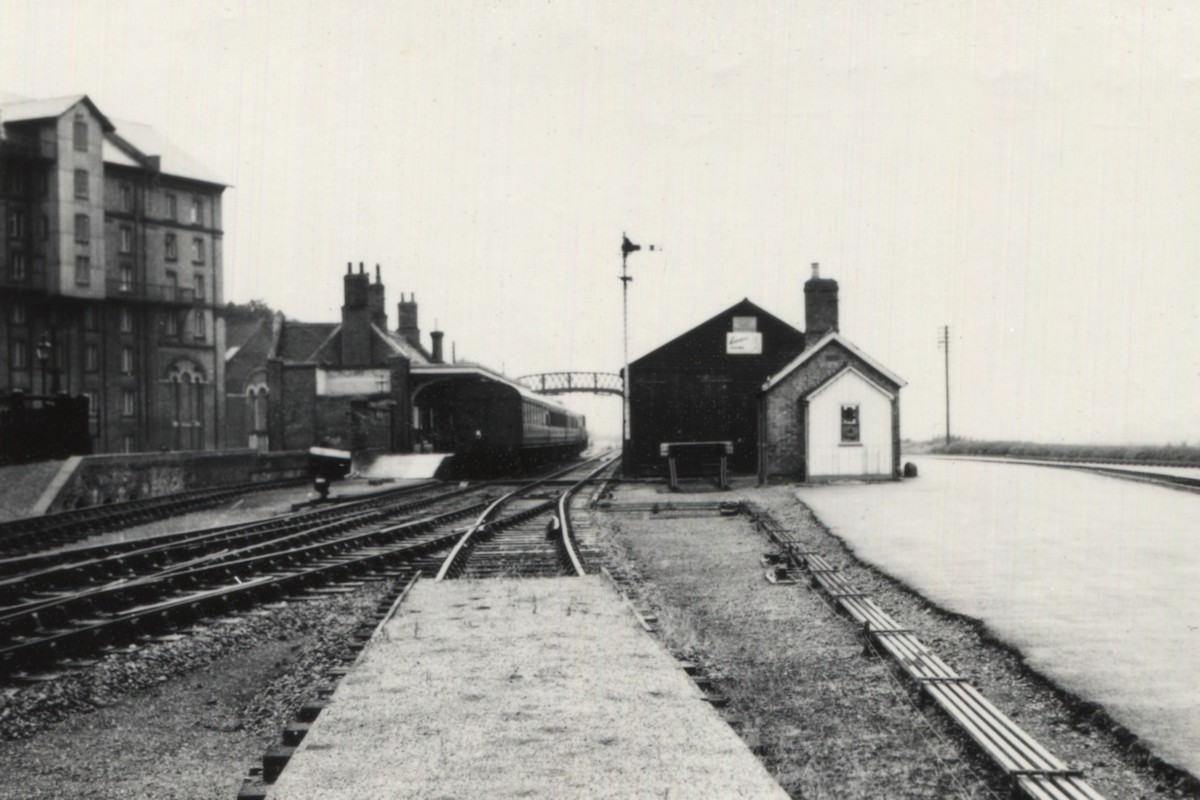
- Godmanchester station looks a bleak and desolate place on this wet, late 1950’s day as a Cambridge trains waits to depart. The line from here to St Ives crossed the River Great Ouse no fewer than six times and was weight and speed restricted over the wooden trestle bridges. The trackbed is still discernible over much of this section since nothing has been built on the floodplain of the river. Photo: Brian Marlow/Robin Cullup Collection.
-
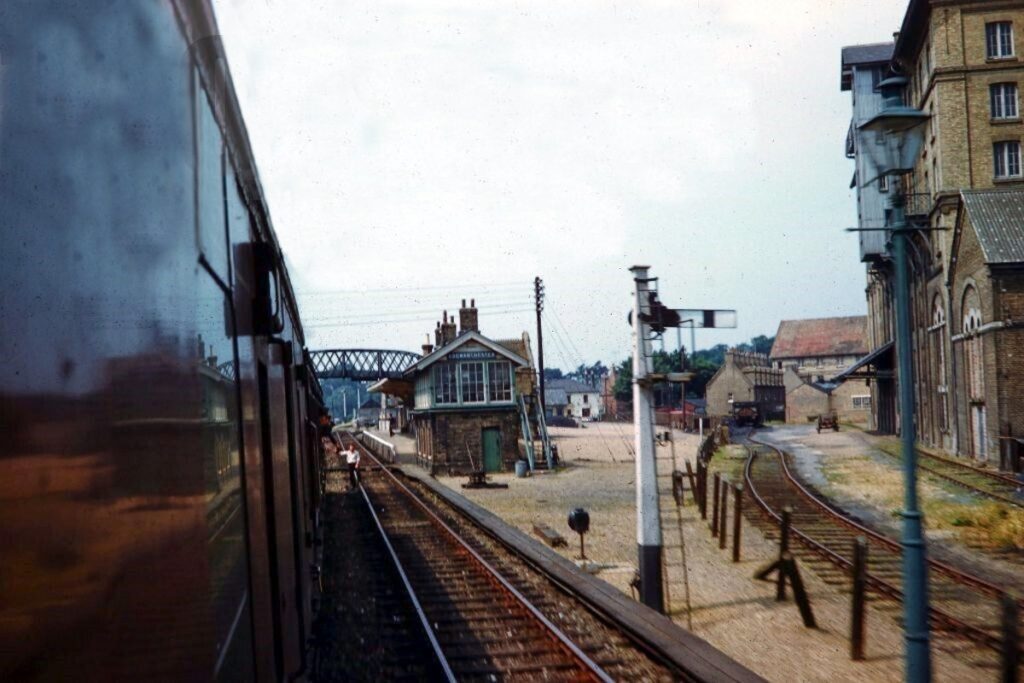
- Entering Godmanchester station from St Ives, the signalman prepares to receive the single line token from the driver of the 11.25 Cambridge to Kettering in the last days of operation of the line, in June 1959. Photo: Robin Cullup Collection.

-
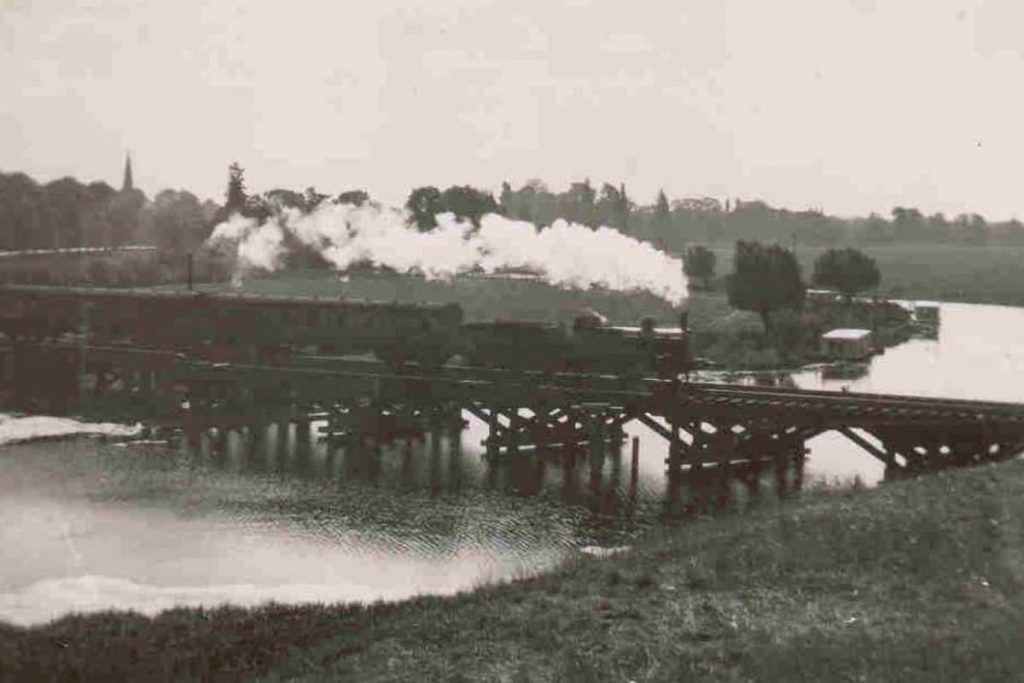
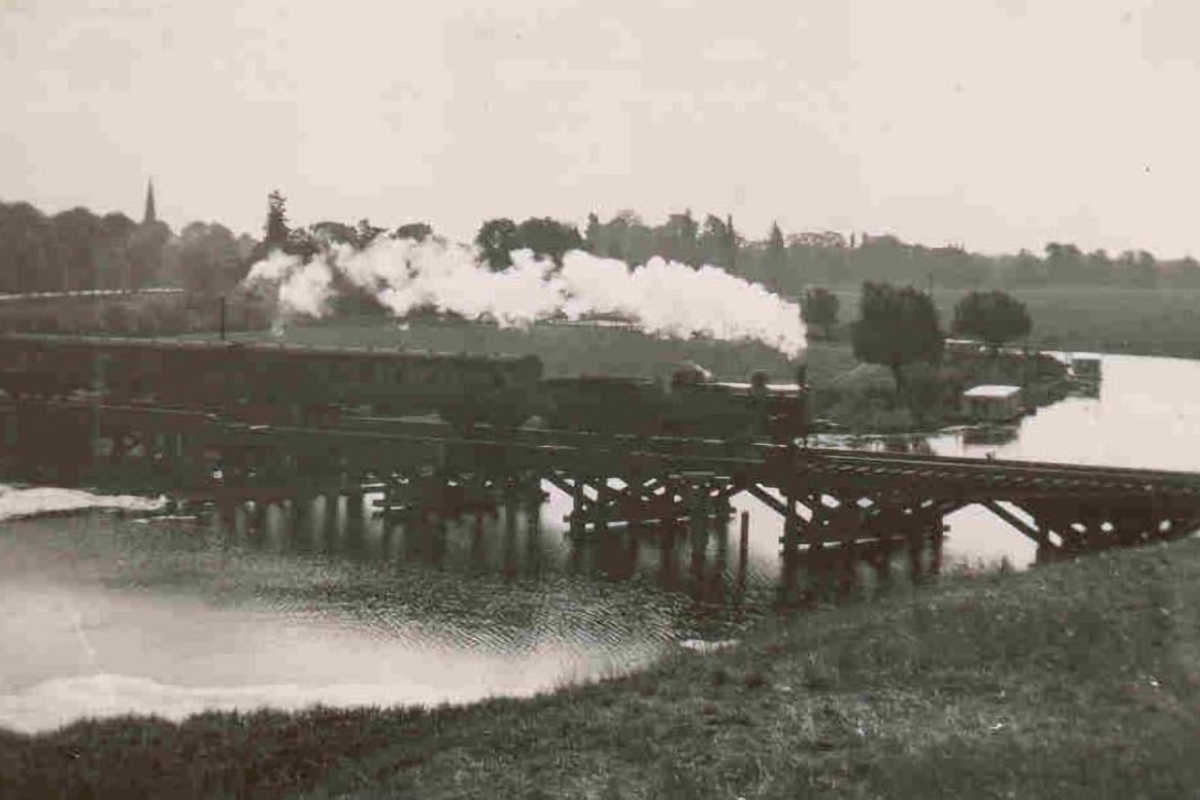
- Seen from the site of where Huntingdon’s 1068 castle once stood, a Midland Railway 2-4-0 heads along the short twin-track section from Godmanchester to Huntingdon East with a Cambridge to Kettering train. The steeple of Godmanchester’s St Mary the Virgin church can be seen in the background. Photographer Unknown.
-
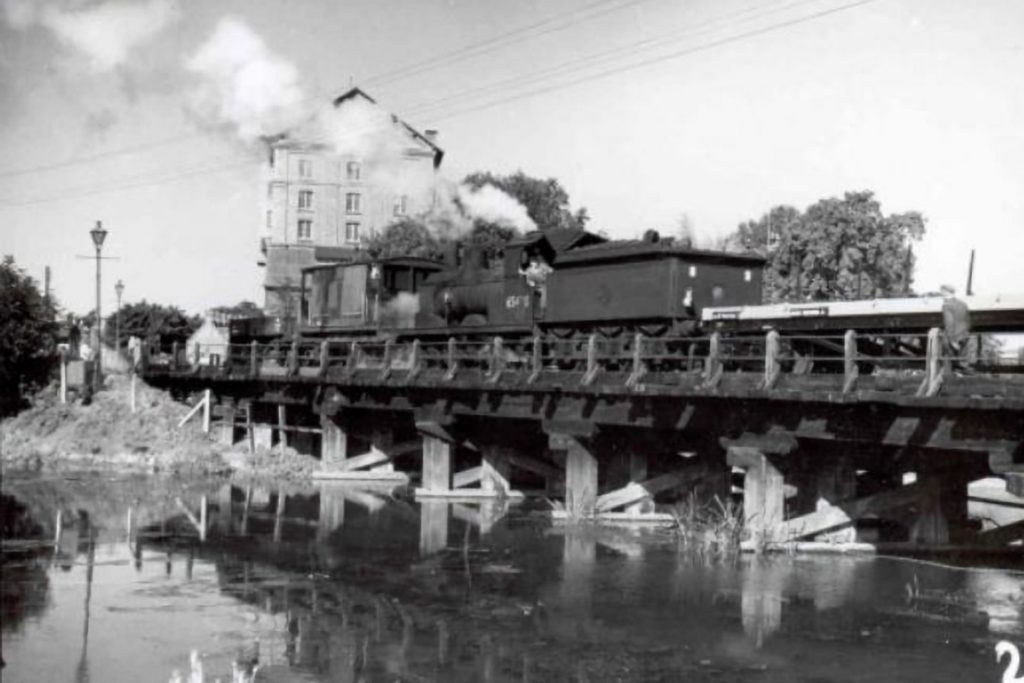
- A 1961 view of a J15 on a track lifting train at Godmanchester, paused on one of the timber trestle bridges that charactersied this section of the line as it crossed the flood plain of the River Great Ouse between here ant St Ives. Photo: Eric Sawford, courtesy Robin Cullup Collection.

-
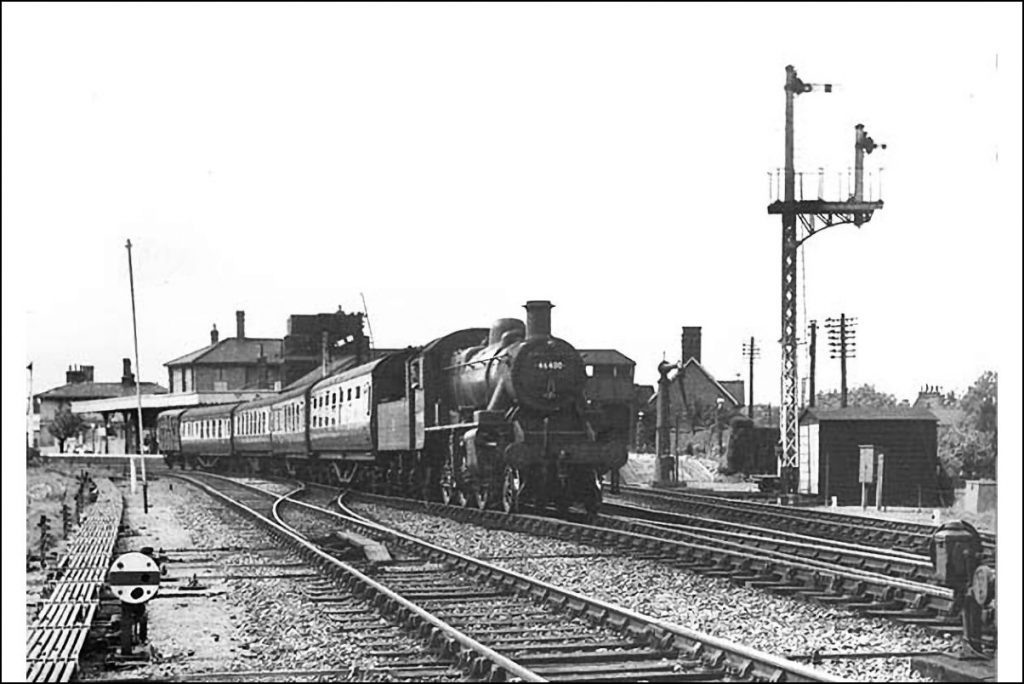
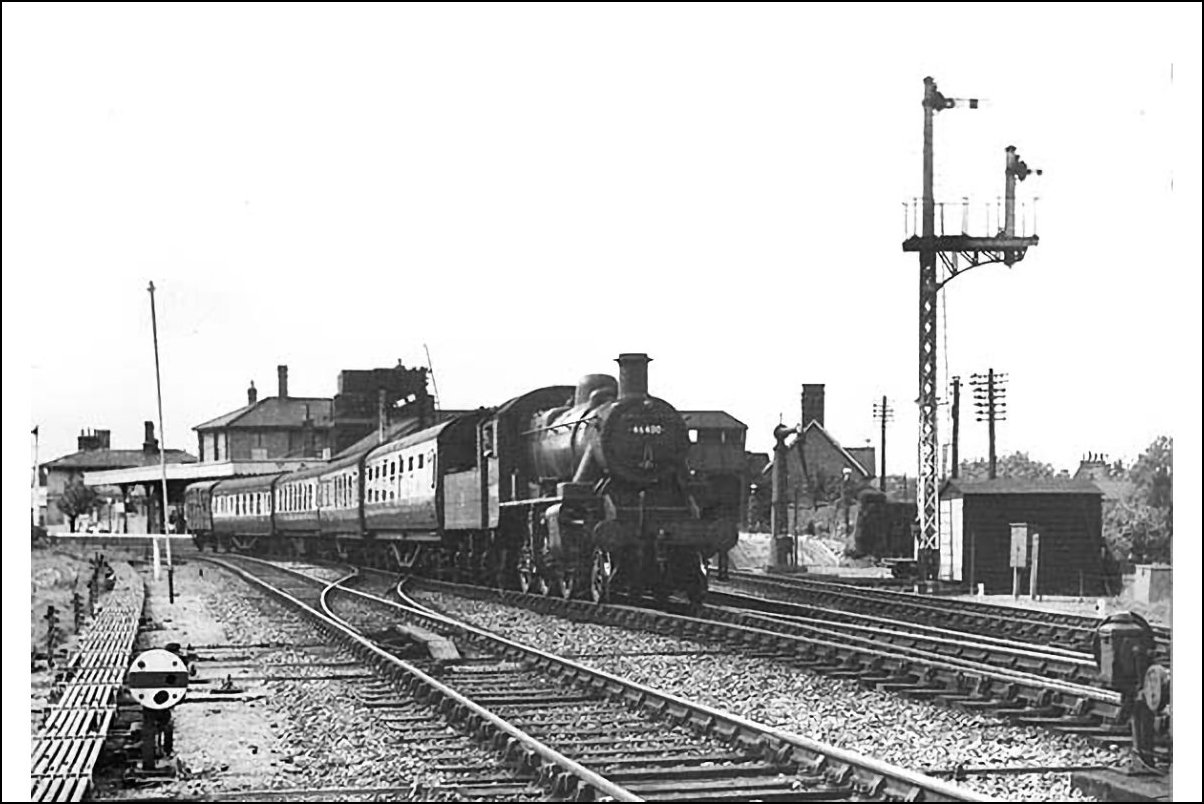
- An Ivatt Class 2 2-6-0 draws out of the Huntingdon platform at St Ives station in the 1950s. Photo: Nick Catford – Disused Stations.
-
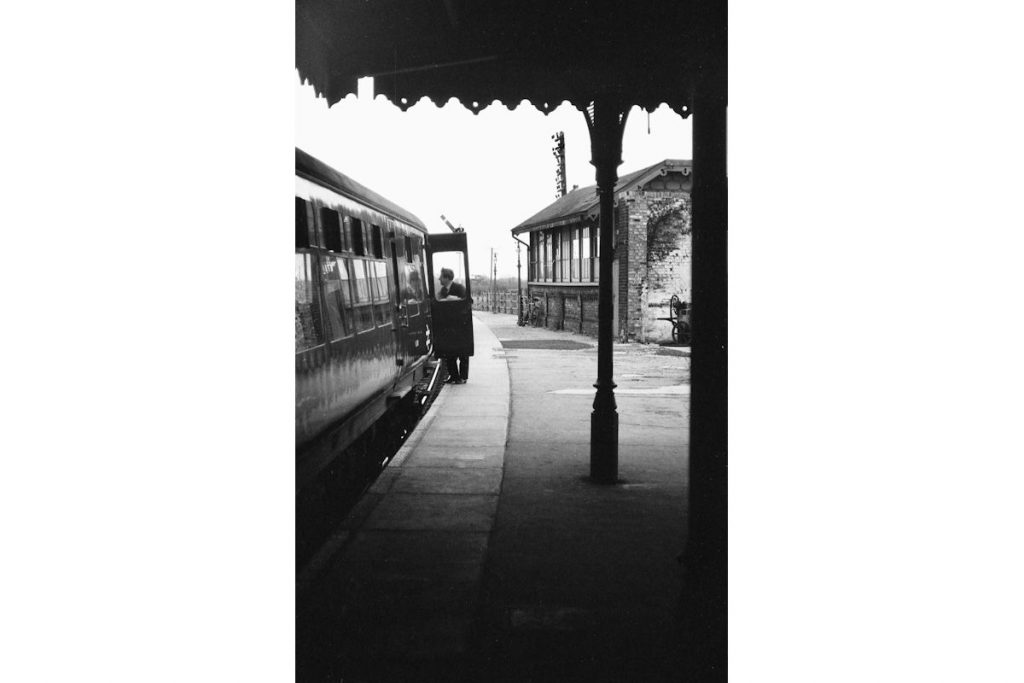
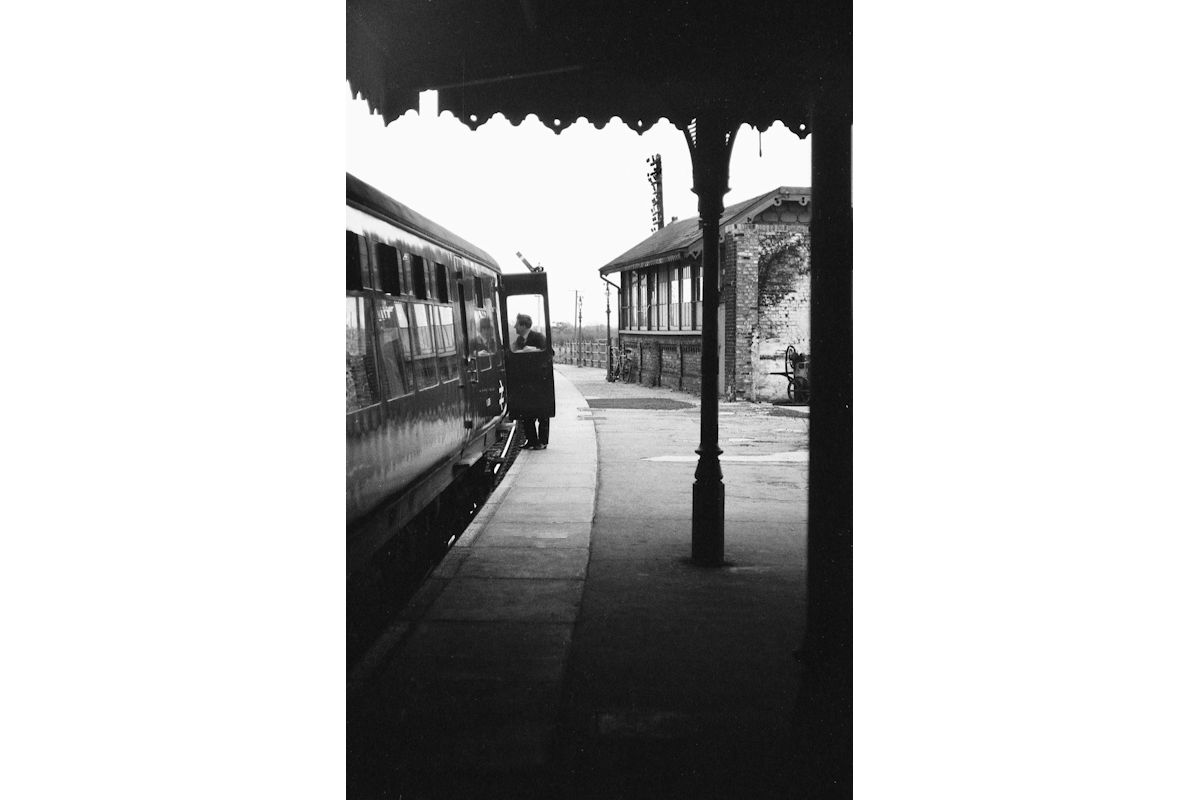
- St Ives station retained its canopy to the end, although latterly it and the rest of the station were in a poor state of repair. With the attractive platform-mounted signal box to the right, driver and guard exchange a few words before departing to Cambridge on 23rd April 1970. Photo: Michael Smyth.
-
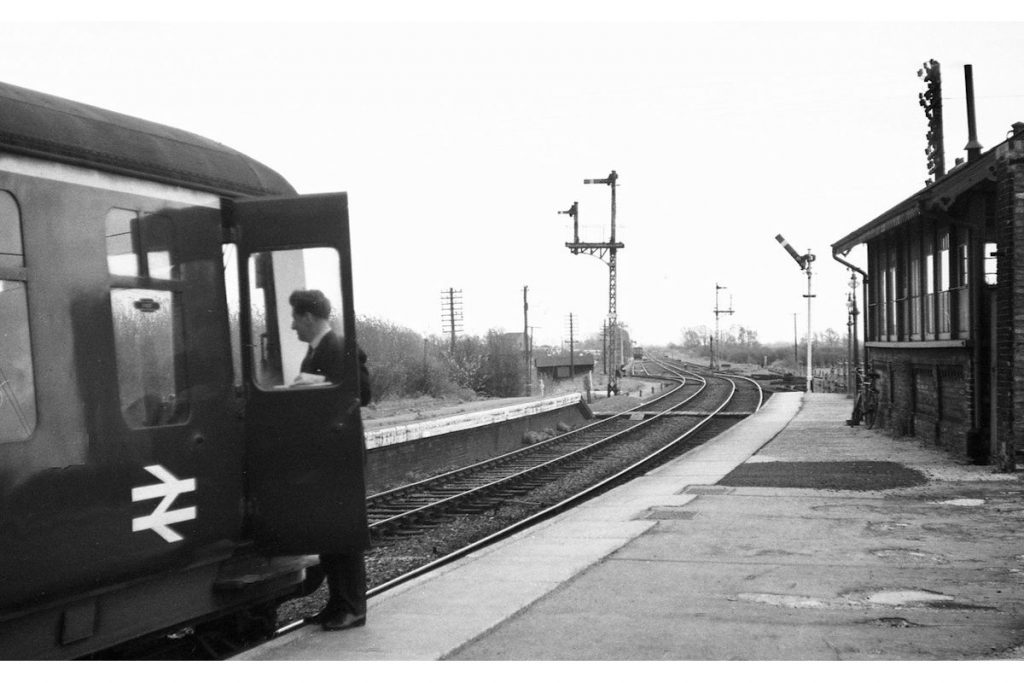
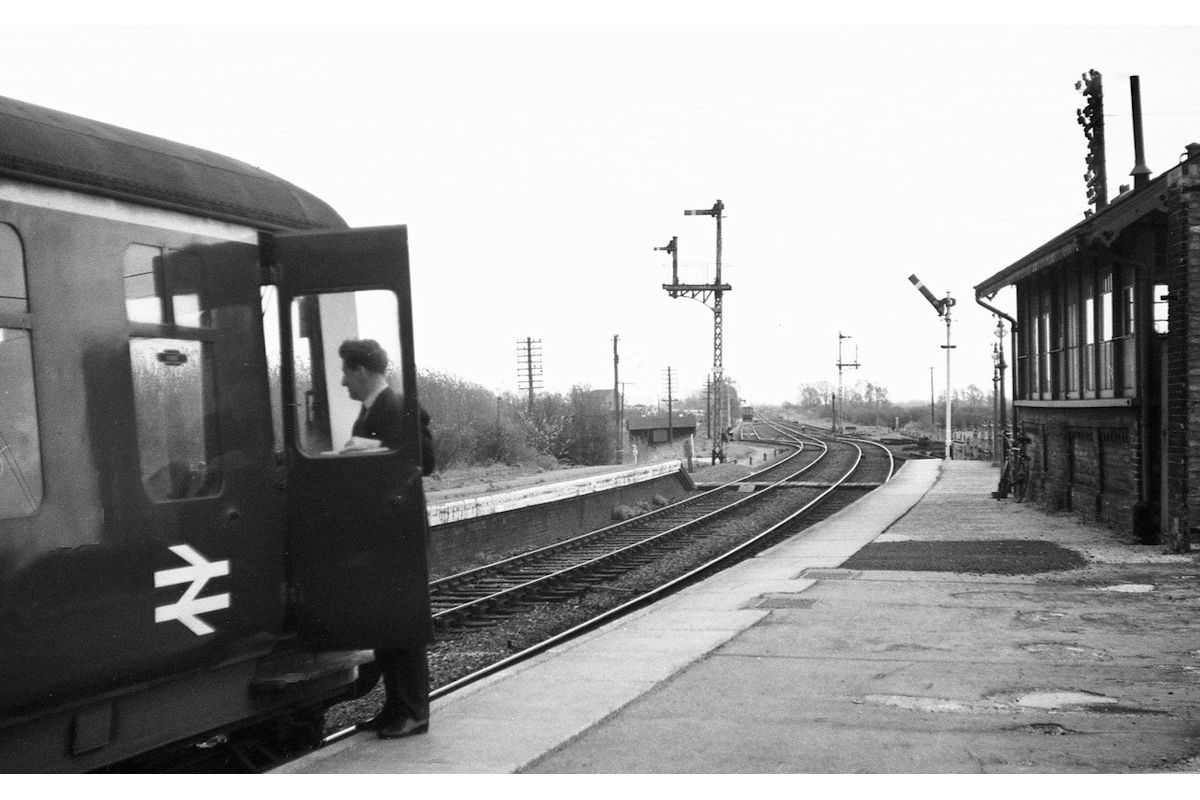
- October 5th 1970 was a sad day for the railways in Eastern England, with the closure of the majority of the Peterborough-Grimsby main line, the Bellwater Junction-Lincoln line and the Cambridge-St Ives branch. A Gloucester-Cravens pair is seen in the Joint Line platforms, having terminated on a service from Cambridge and preparing to return. The abandoned Huntingdon line can be seen coming in from the right at the severed set of points. 23rd April 1970. Photo: Michael Smyth.
-
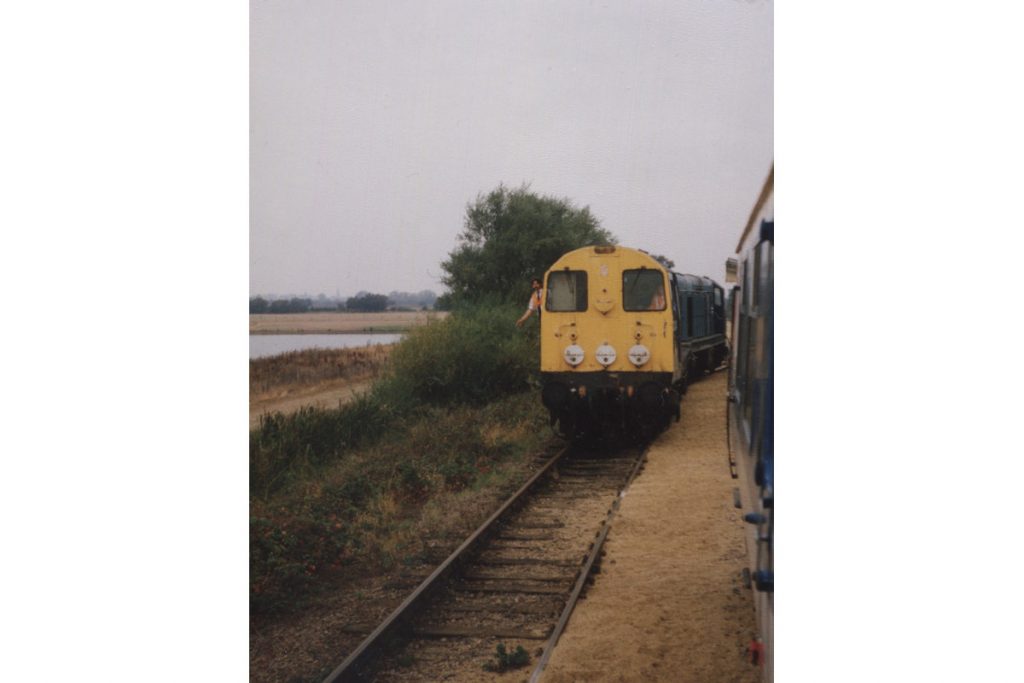
- As part of Network South East’s ‘Cambridge Gala Day’ on 29th September 1990, an excursion ran to Fen Drayton comprising Class 310 EMU No. 310052 and Class 20s Nos. 20004 and 20047, leaving Cambridge at 15.10 and Fen Drayton at 16.30. The class 20s are seen running round at Fen Drayton gravel terminal, which by then was the terminus of the line. Photo: Robin Cullup.

-
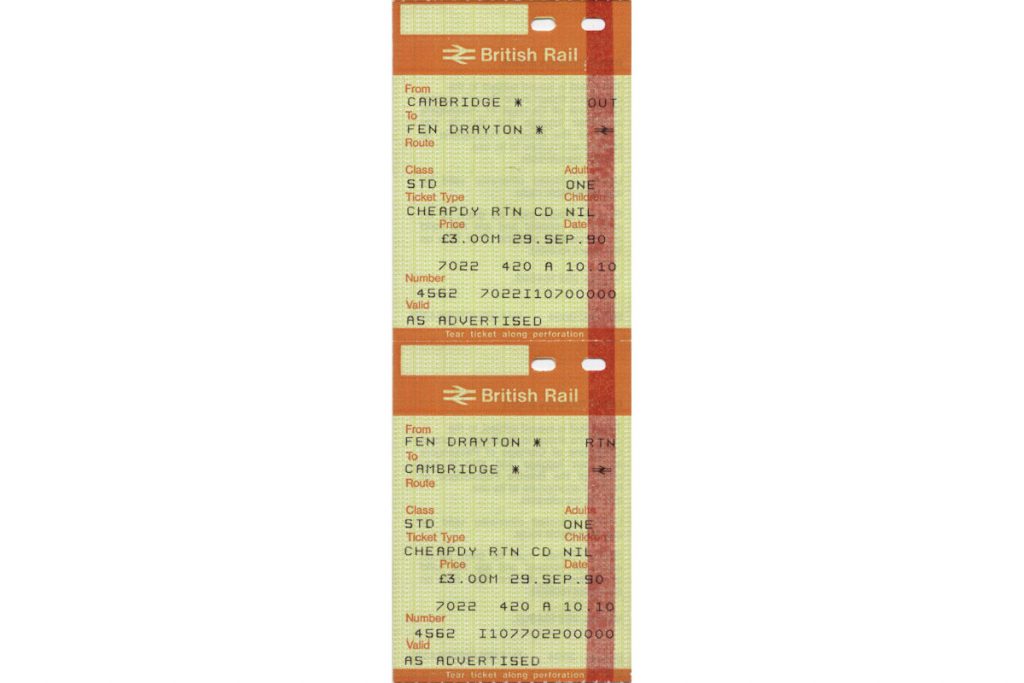
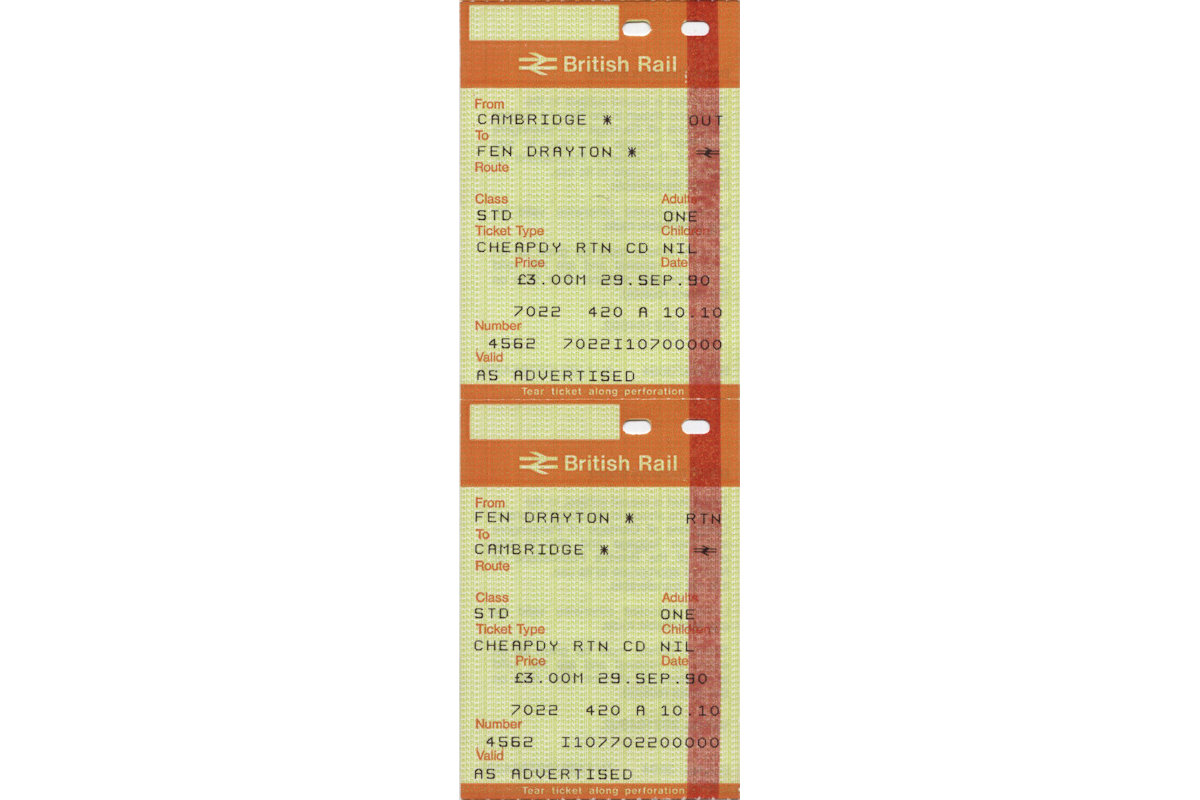
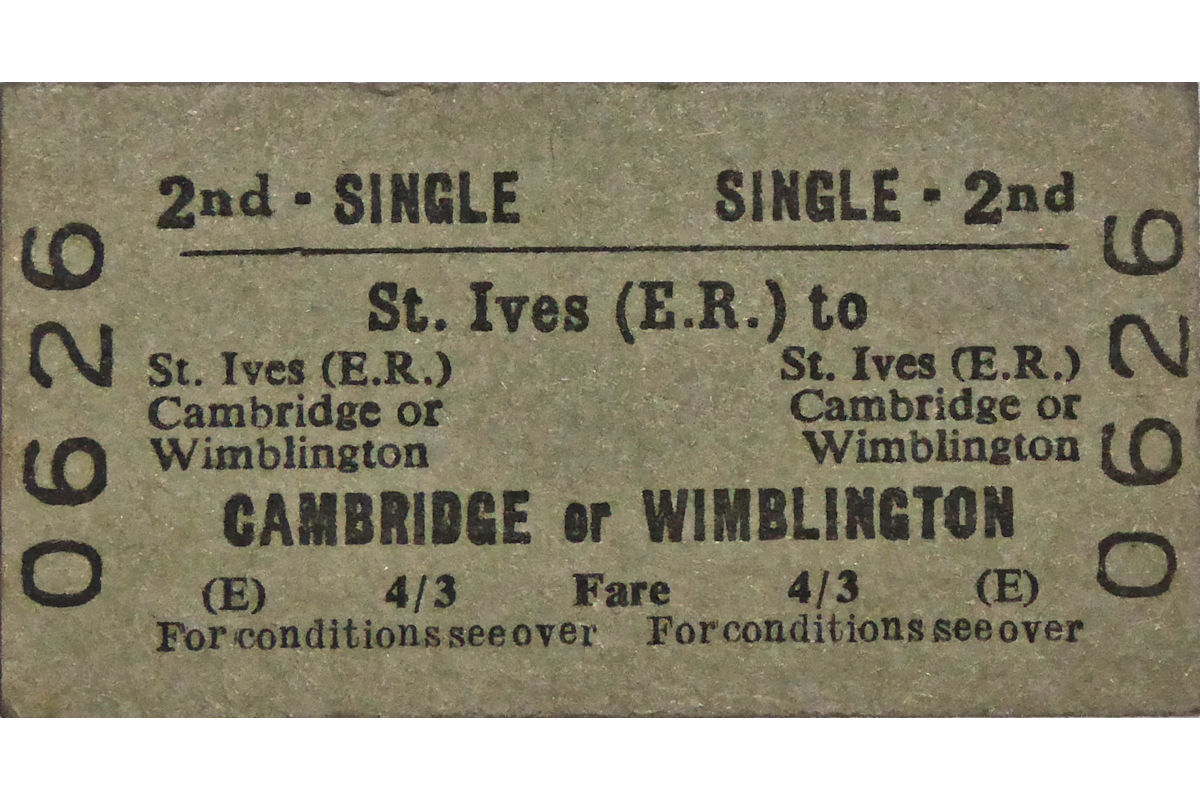
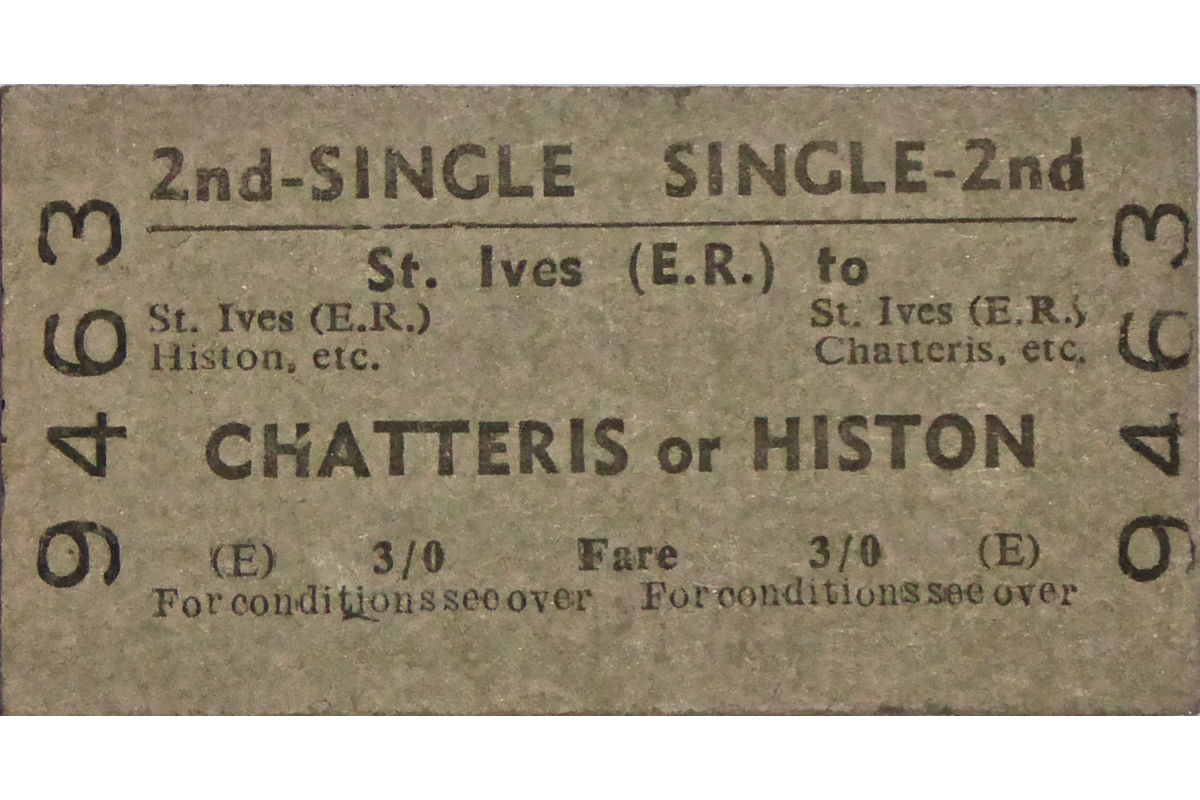
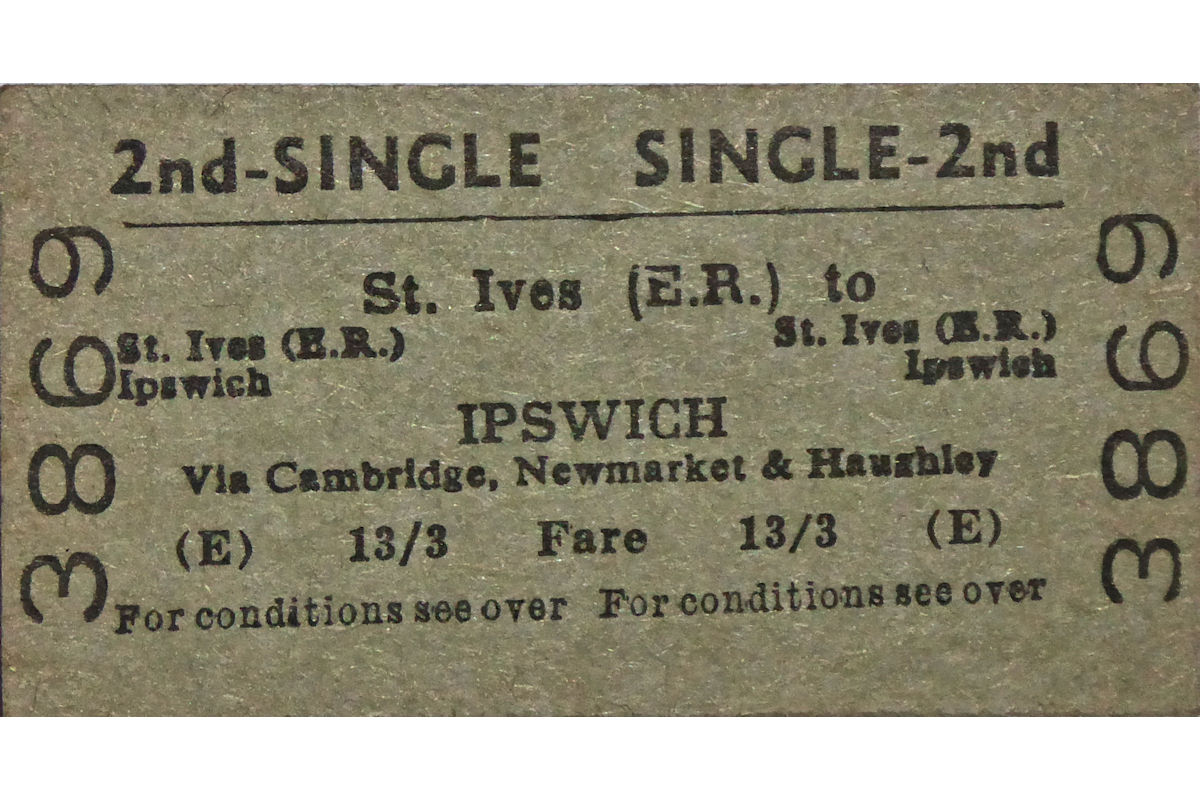
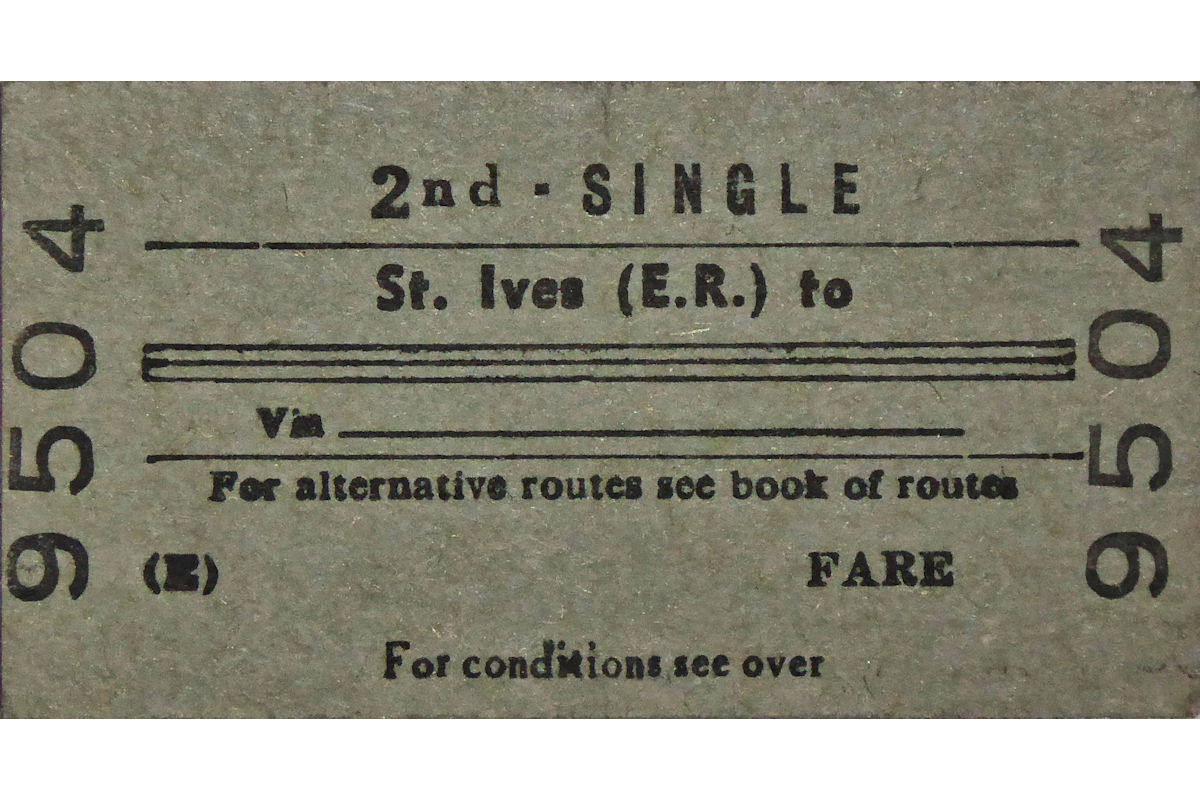
- Fen Drayton never had a passenger station, so tickets of any form are very rare! For the bargain price of £3.00, passengers could enjoy a ride over the branch as part of Network South East’s ‘Cambridge Gala Day’ on 29th September 1990. Photo: Robin Cullup.
-
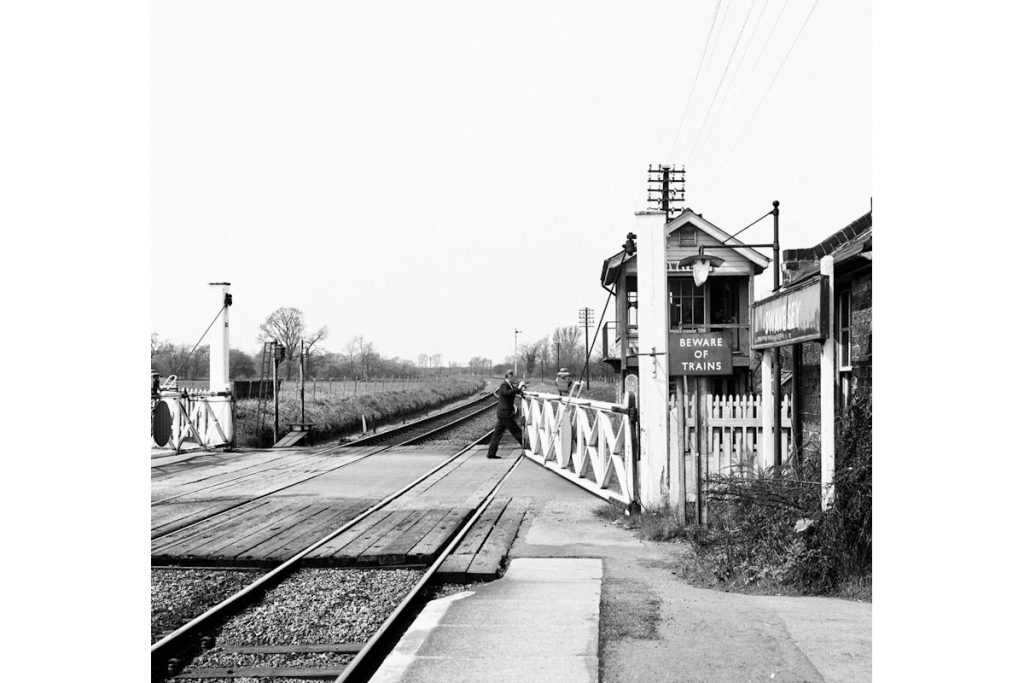
- Cost-saving measures on the St Ives branch resulted in the line between St Ives and Swavesey being singled. The signalman opens the gates over the line in readiness for the branch unit to pass. 2nd May 1970. Photo: Michael Smyth.

-
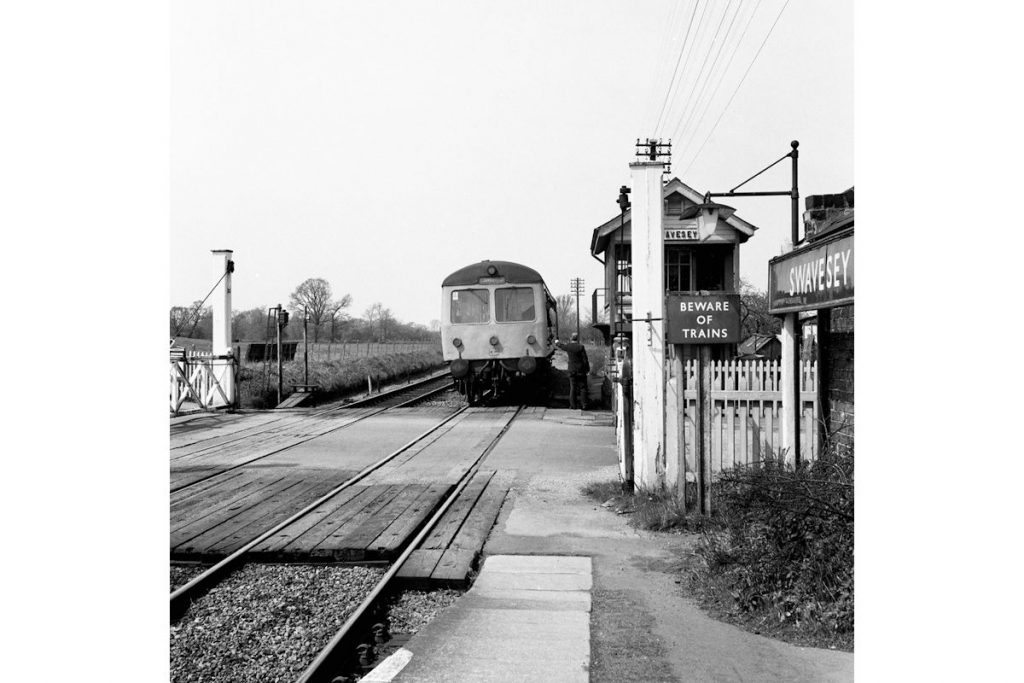
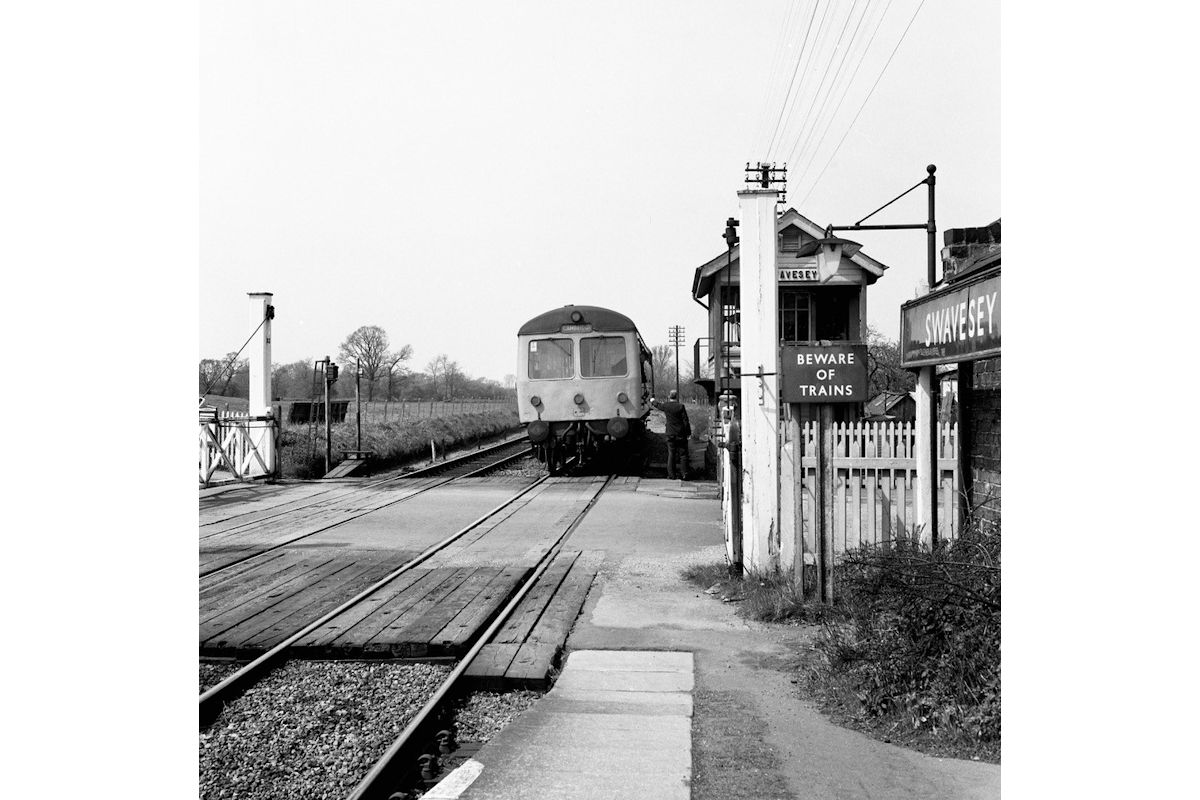
- Moments later, the Gloucester-Cravens set passes by on its way to Cambridge and the signalman collects the token from the driver. After withdrawal of the passenger service on 5th October 1970, sand traffic continued as far as Fen Drayton until 1992. Photo: Michael Smyth.
-
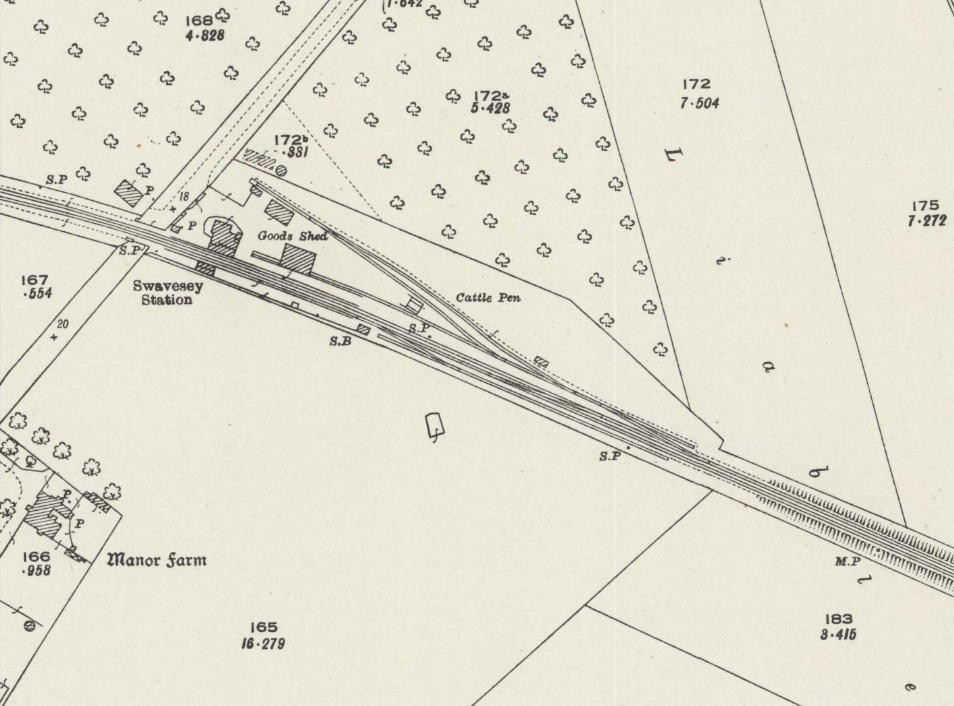
- 1926 Ordnance Survey Map of Swavesey. Reproduced with the permission of the National Library of Scotland https://maps.nls.uk/index.html
-
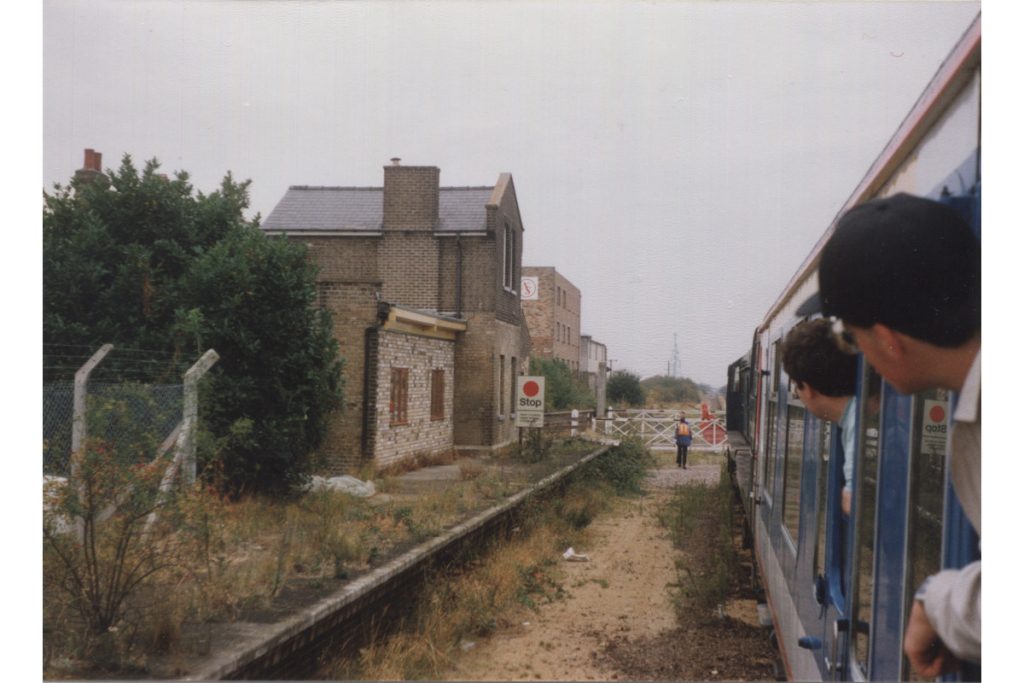
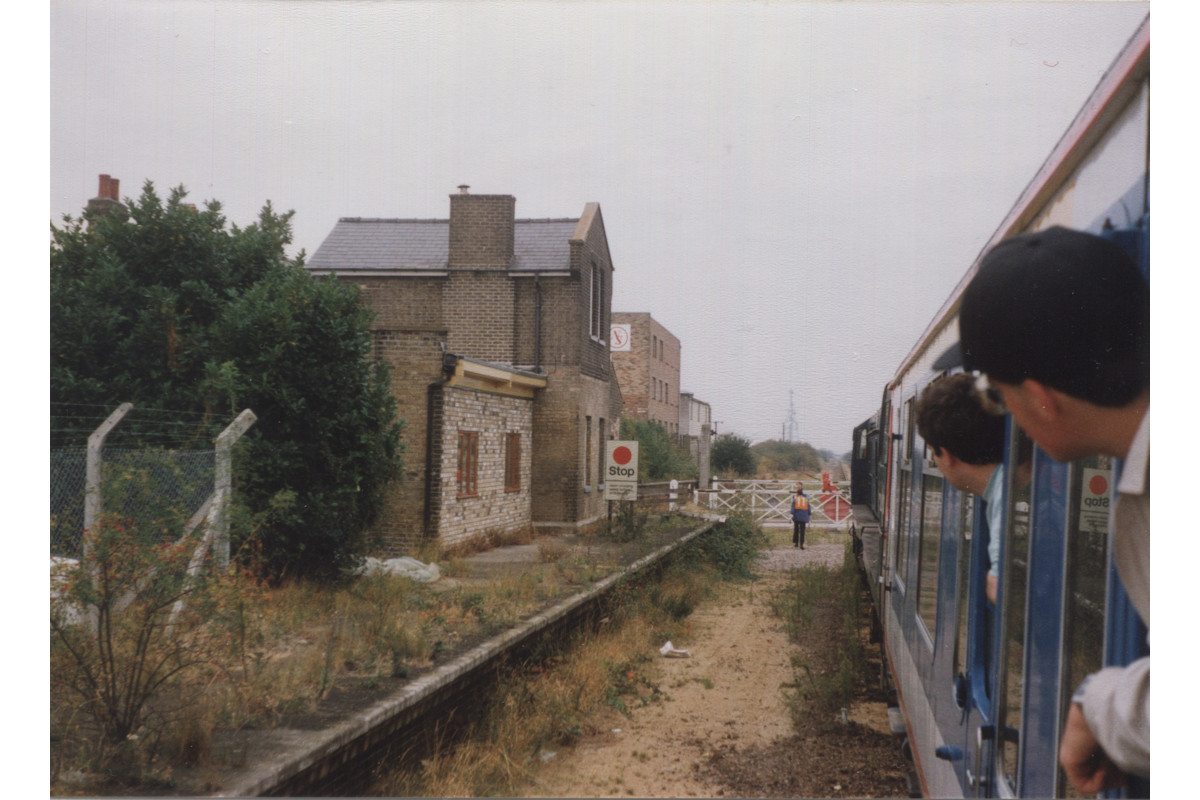
- The 15.10 Cambridge to Fen Drayton excursion pauses whilst the crossing gates are opened at Long Stanton on the Cambridge Gala Day on 29th September 1990. This station was named in the famous Flanders and Swan song ‘Slow Train’ with the line “At Long Stanton I’ll stand well clear of the doors no more”. Photo: Robin Cullup.
-
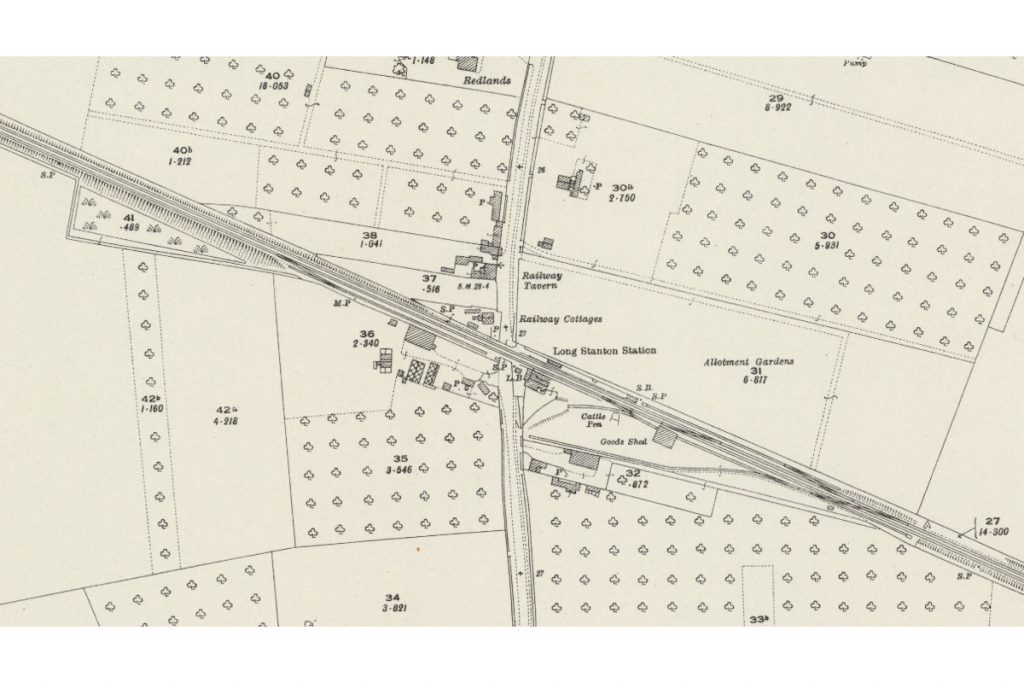
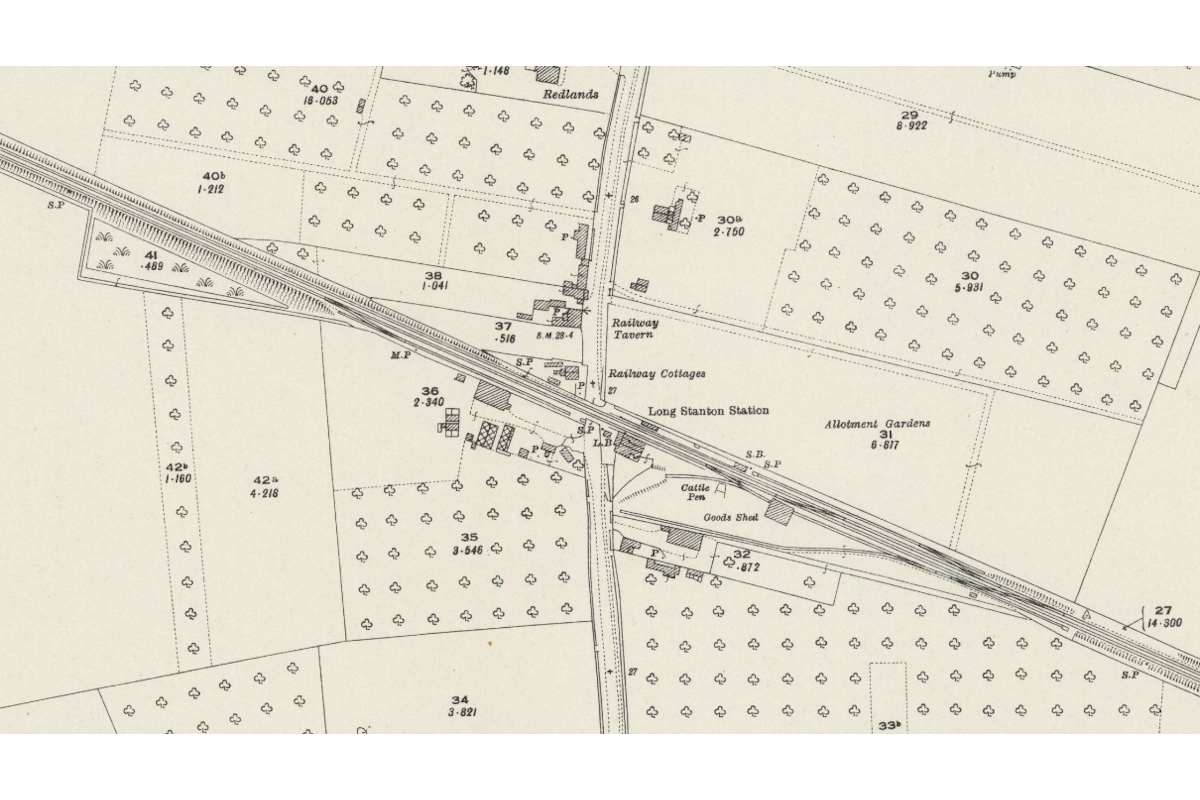
- 1926 Ordnance Survey Map of Long Stanton. Reproduced with the permission of the National Library of Scotland https://maps.nls.uk/index.html
-
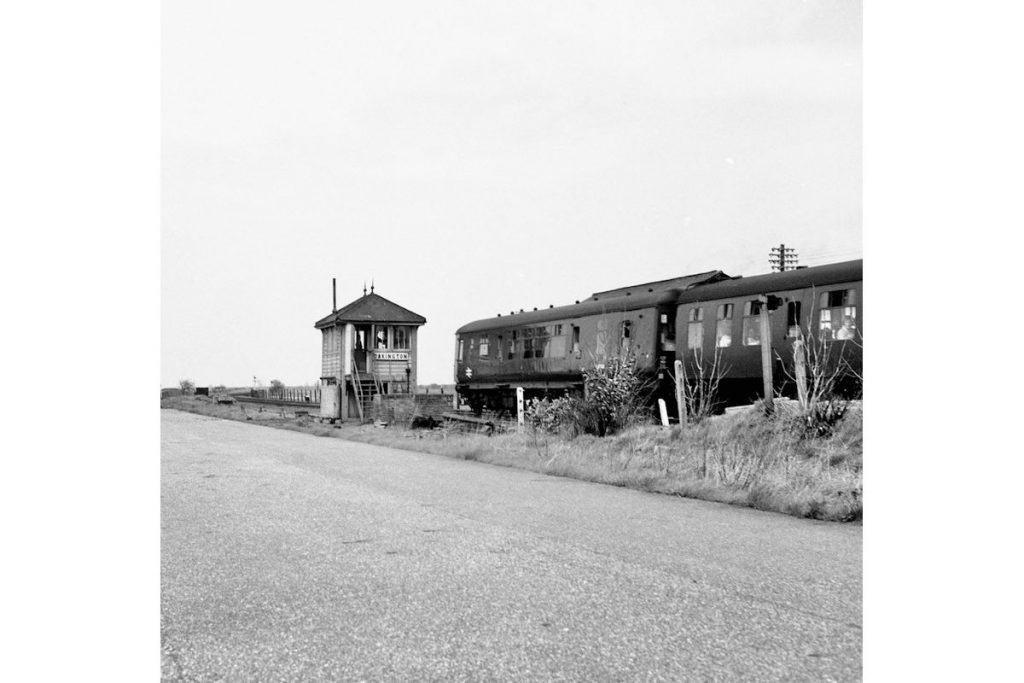
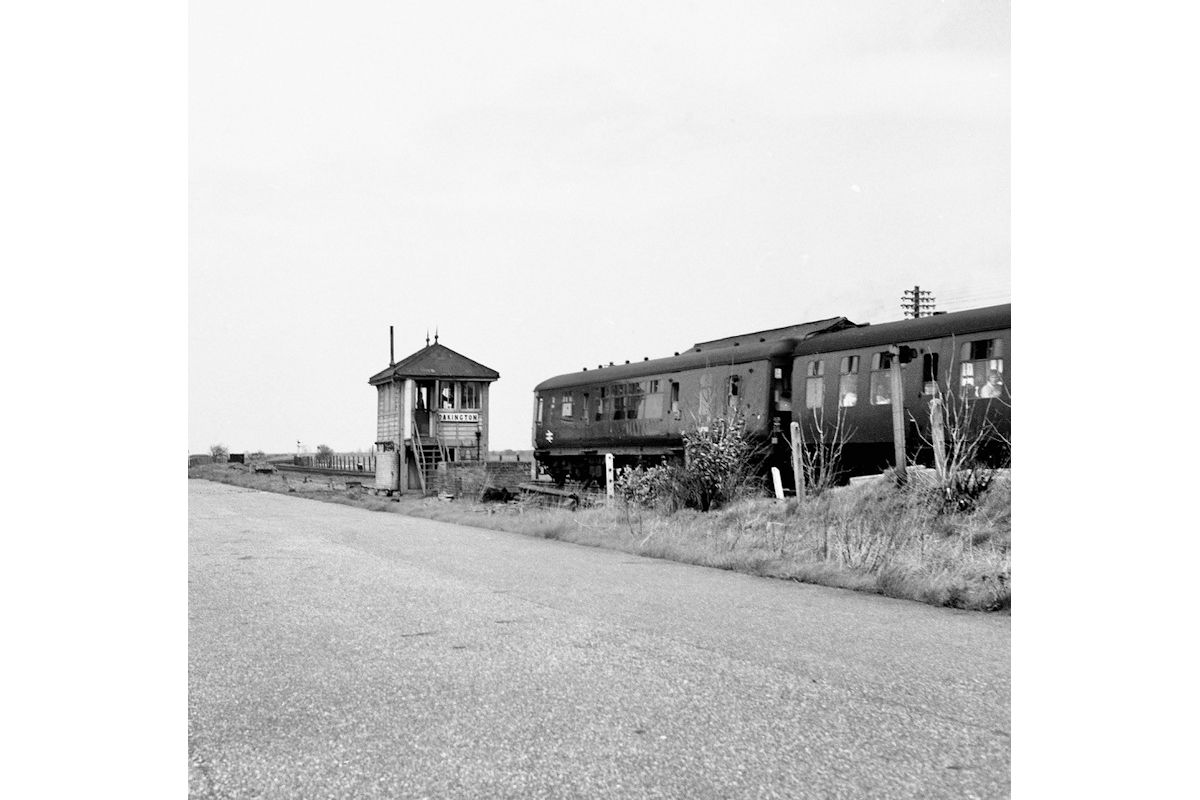
- Many stations in East Anglia has extensive goods yards to cater for seasonal fruit and vegetable traffic. Oakington was no exception and in the 1950s regularly sent out soft and hard fruits to the Manchester area via Kettering and the Midland Main Line. Latterly, as this traffic was lost, sidings were lifted and often concreted over, as seen at Oakington on May 2nd 1970. Photo: Michael Smyth.
-
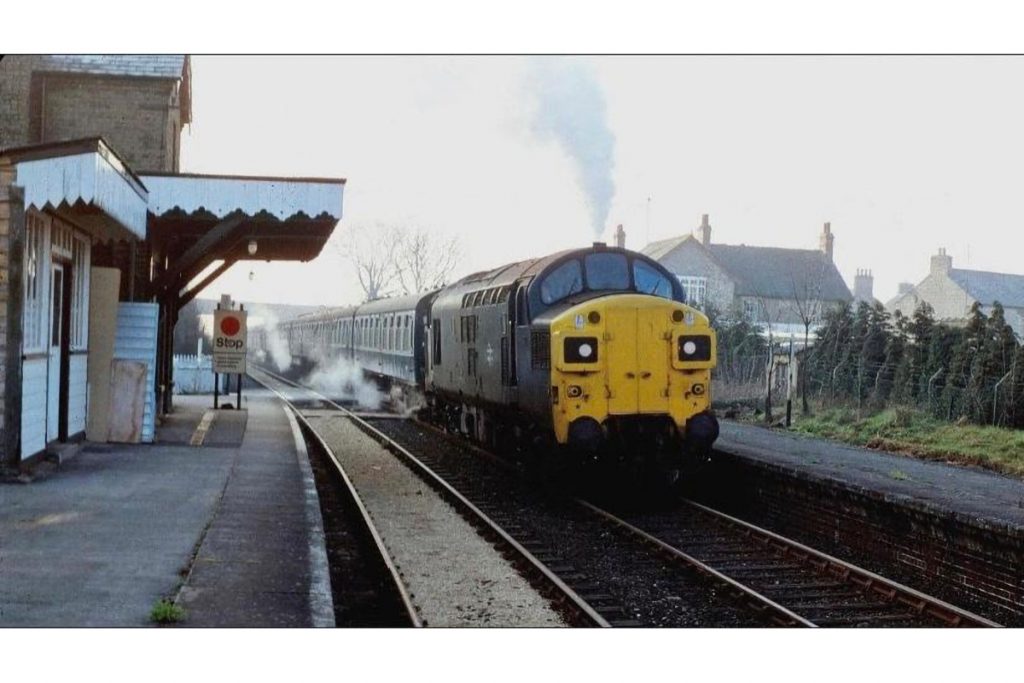
- On April 12th 1980, the Railway Development Society ran a very well patronised special from Swavesey to Liverpool Street and return. Here the empty stock heads North through Histon early in the morning, to Swavesey, behind English Electric Class 37 No. 37097. The steam heating boiler is clearly in good working order, as it blows off with excess pressure. Photo: Alan Moore.

-
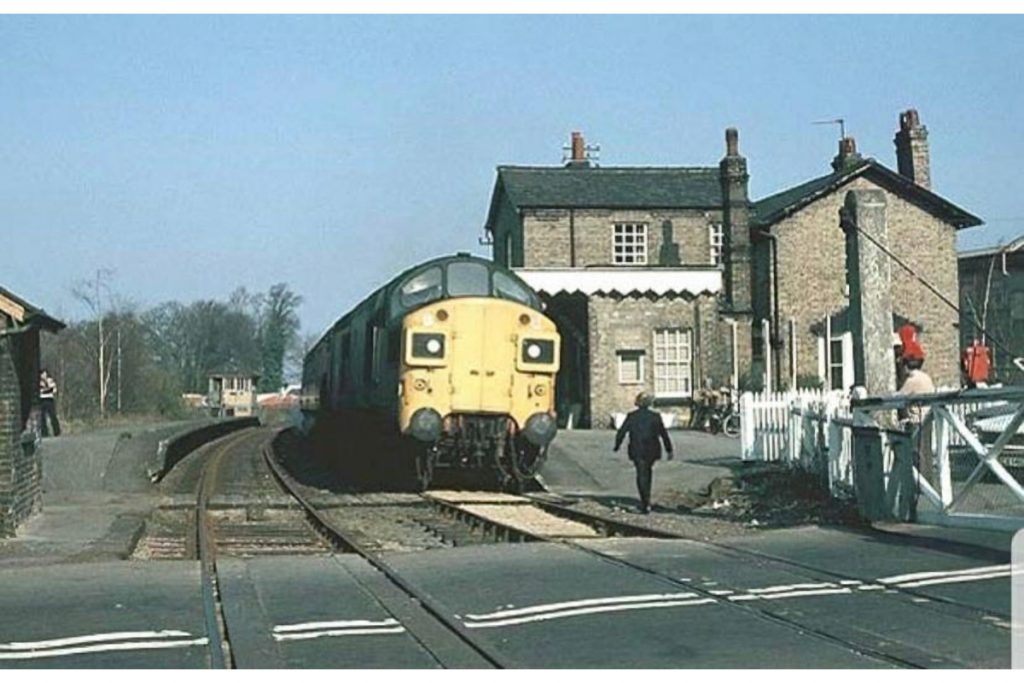
- Having picked up a good number of passengers along the branch, Class 37 No. 37097 stands at Histon station with the Railway Development Society special from Swavesey to Liverpool Street on April 12th 1980. By this time the station had been disused for almost 10 years, the service to St Ives having been withdrawn in October 1970. Photo: Alan Moore.

-
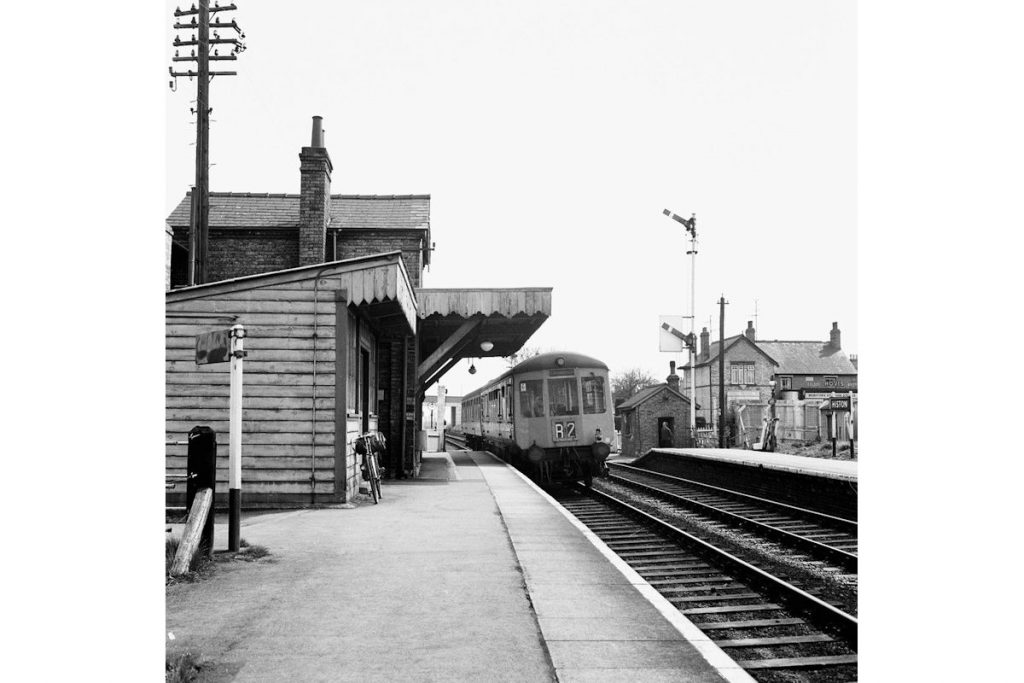
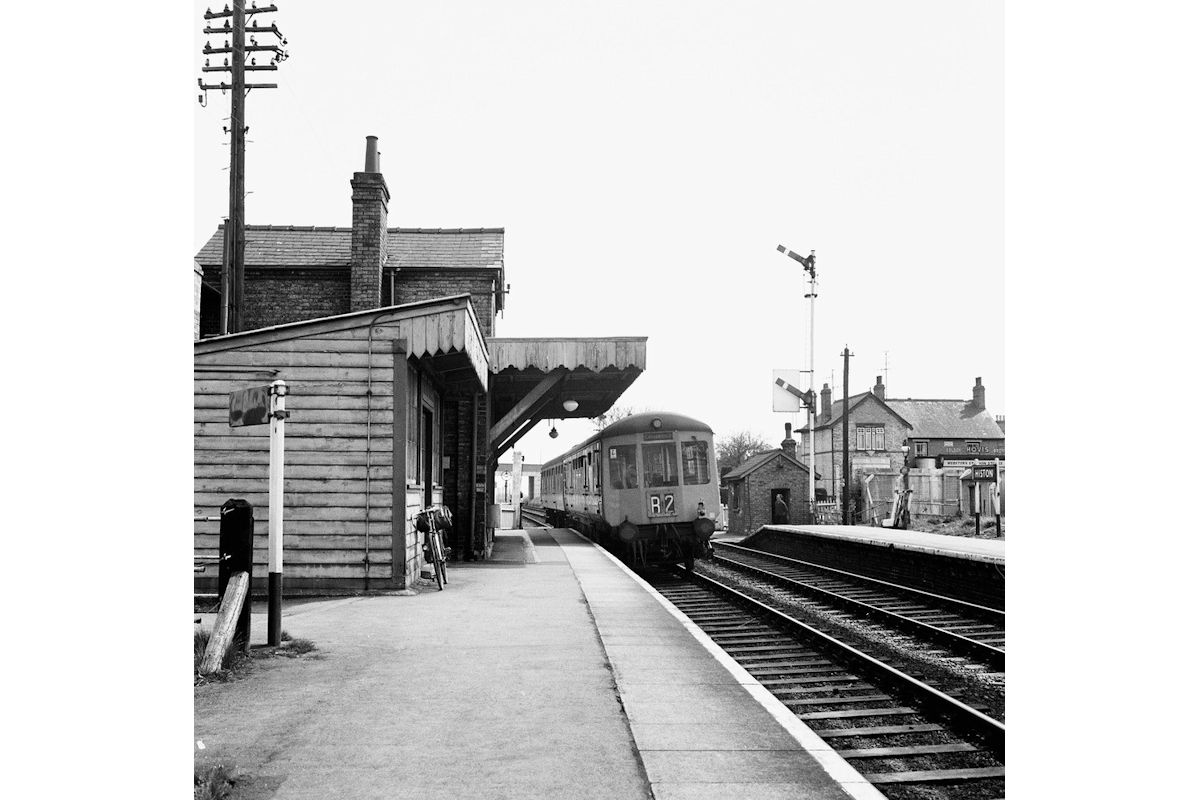
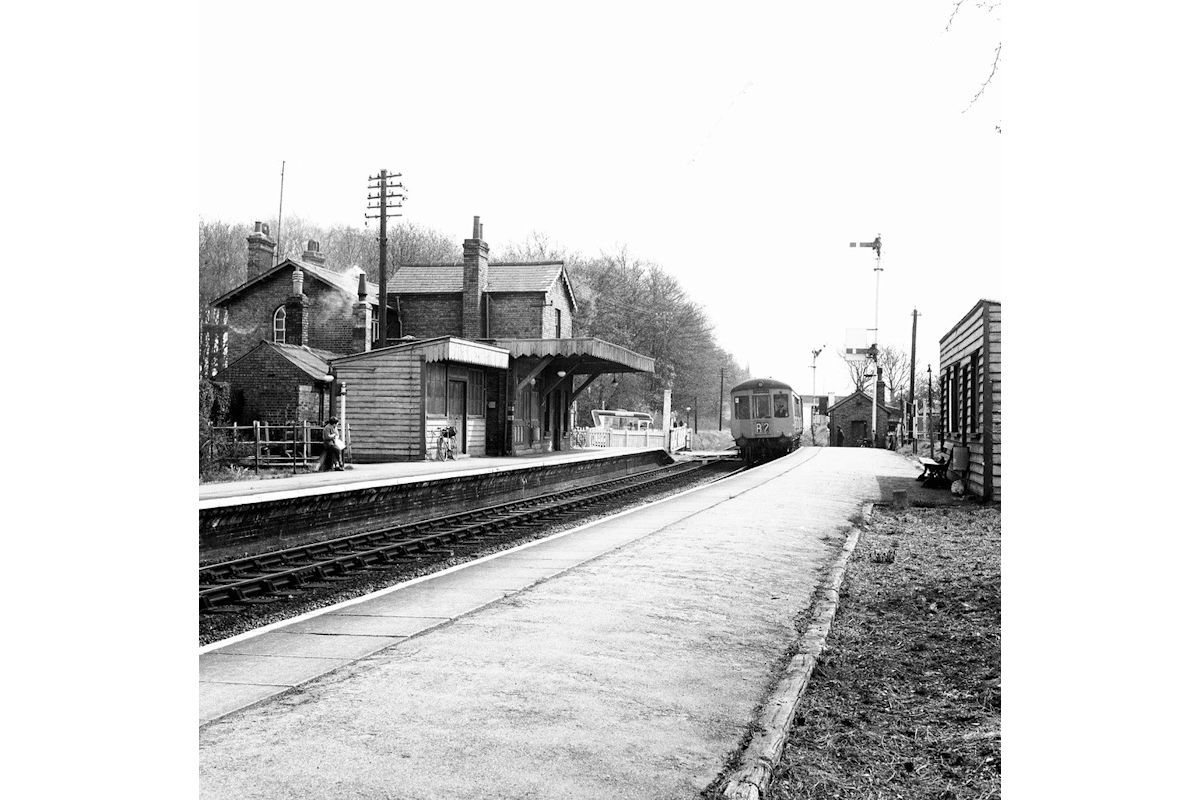
- Looking in the Cambridge direction at Histon and showing the repeater signal to excellent effect, the branch set heads back to Cambridge on 2nd May 1970. Photo: Michael Smyth.
-
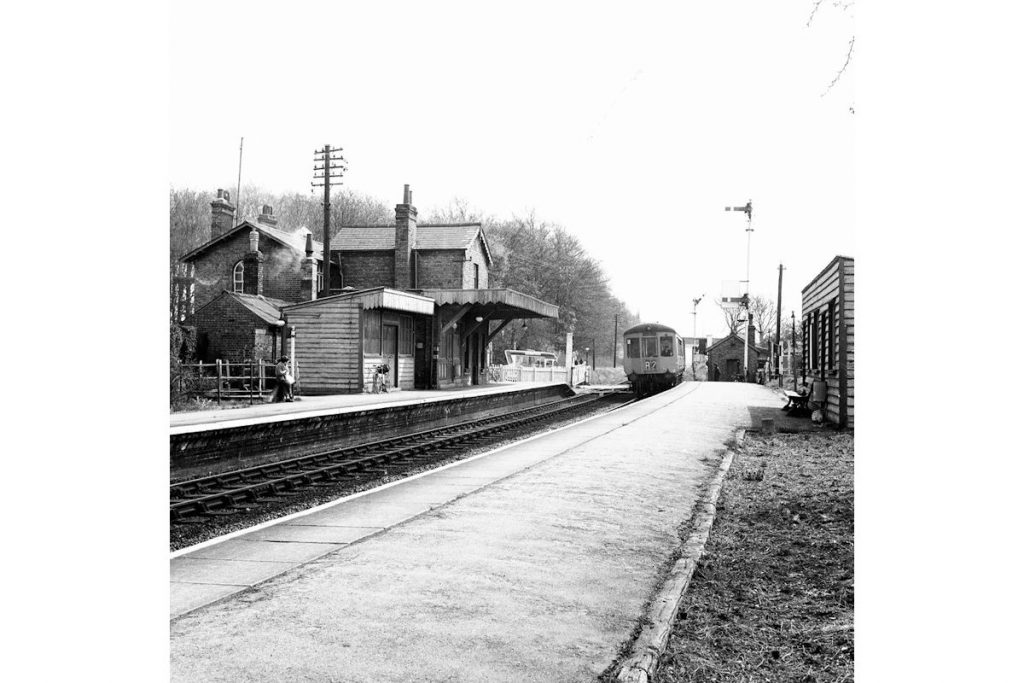
- The curvature of the line at Histon called for a repeater signal for Cambridge trains, seen next to the Gloucester RCW vehicle arriving from Cambridge. 2nd May 1970. Photo: Michael Smyth.
-
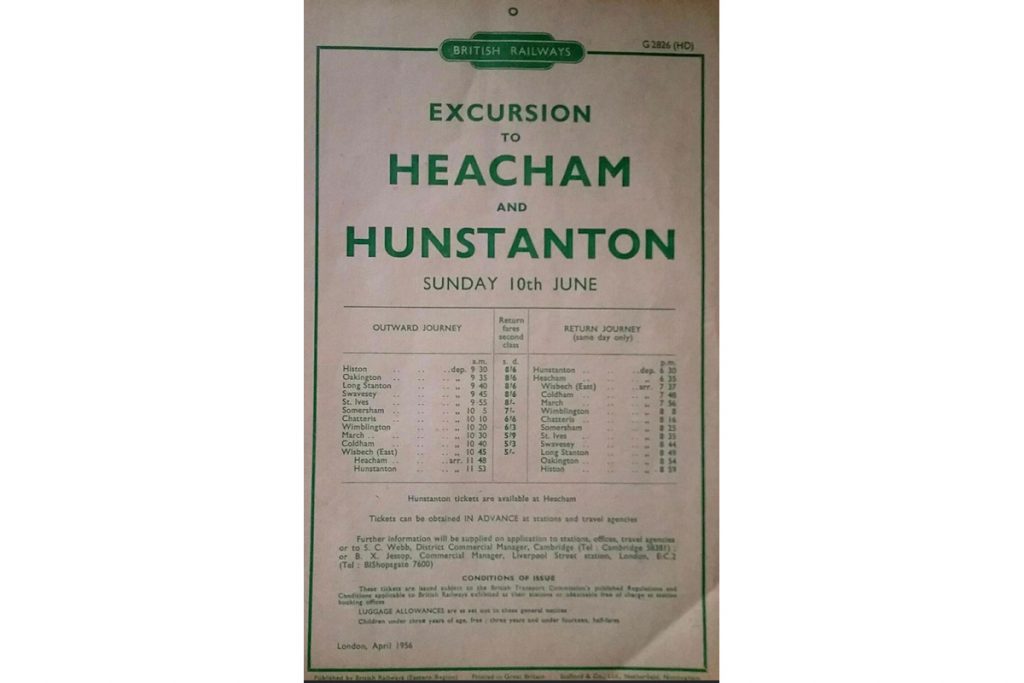
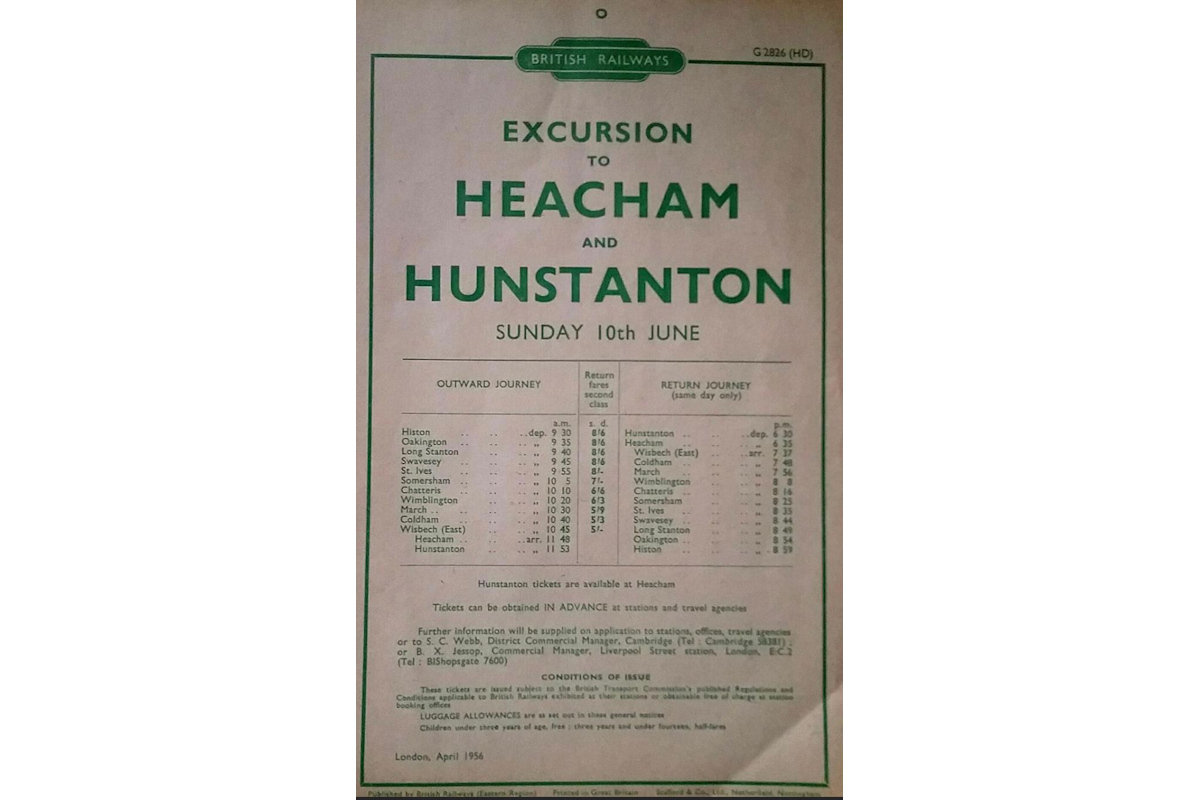
- Handbill for a Sunday excursion from Histon to Heacham and Hunstanton on 10th June 1956. A delightful day out! Photo: David Runham.
-
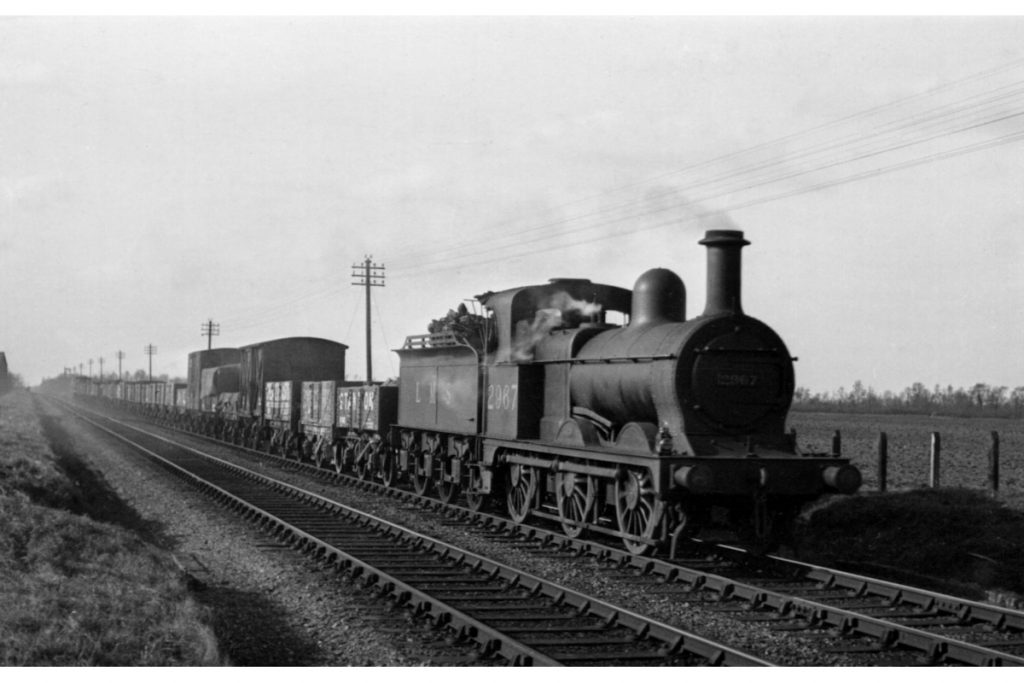
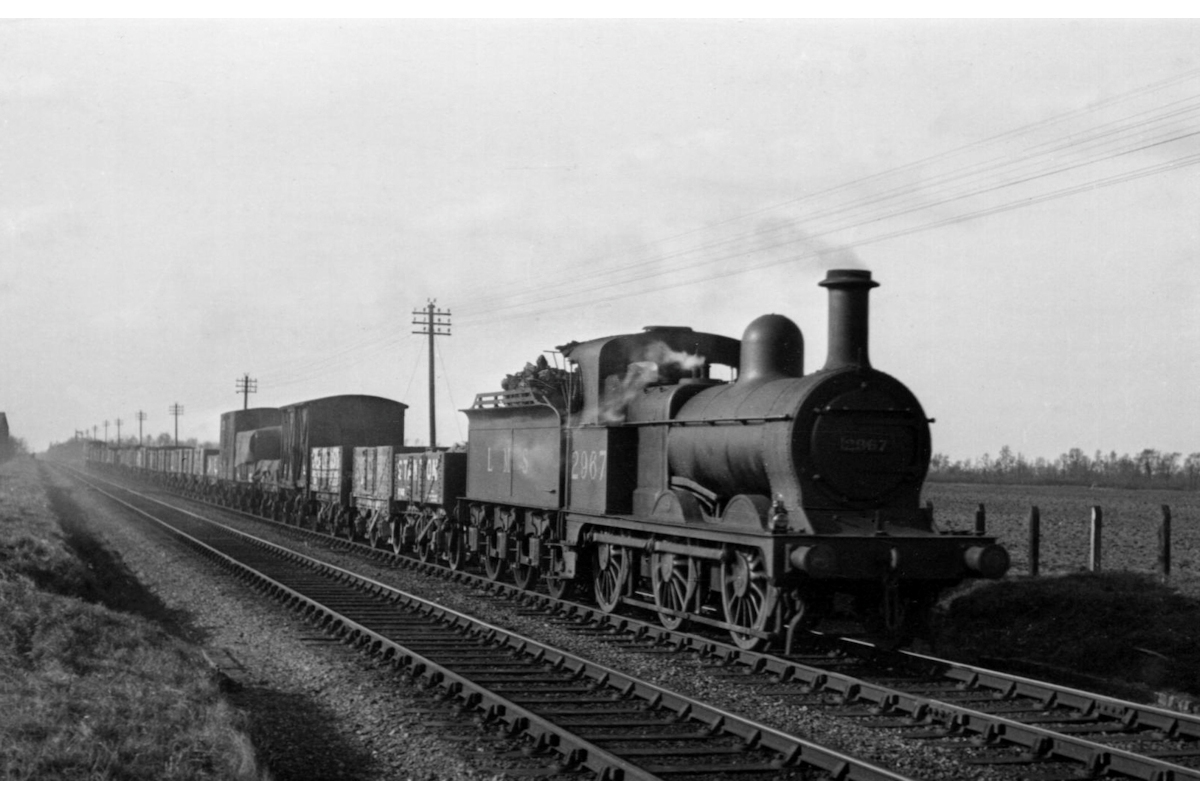
- Johnson Midland 2F No. 2967 (subsequently 22967 as of April 1934 and 58148 in BR days) is a sight for sore eyes as it ambles towards Histon and Cambridge with an unfitted goods train. Photo: Robin Cullup Collection.
-
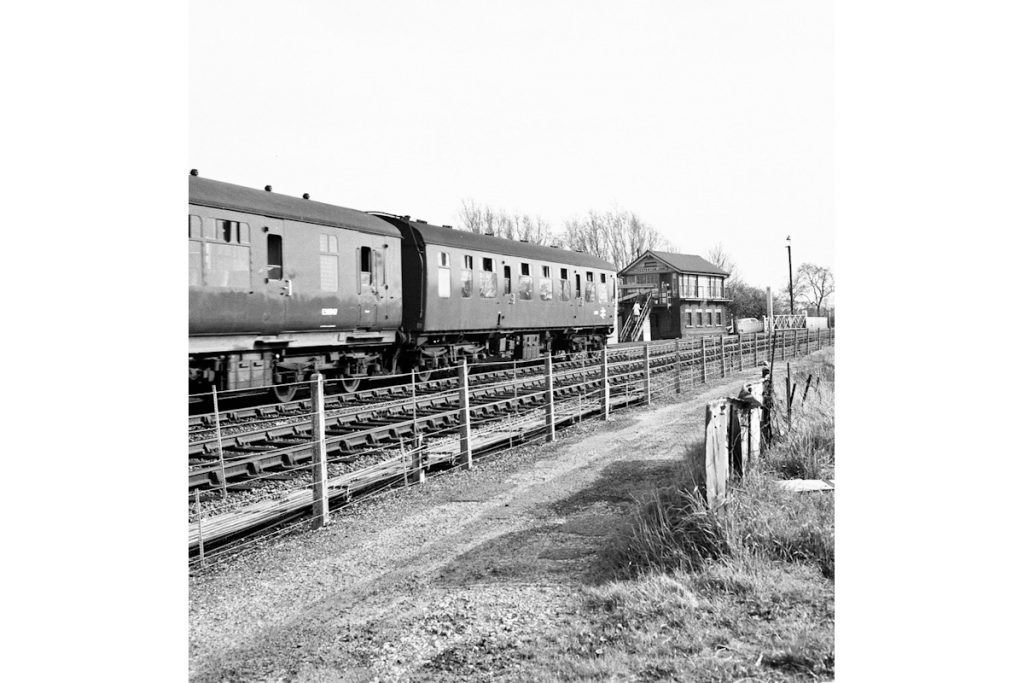
- At Chesterton Junction the St Ives line joined the Great Eastern main line from Kings Lynn to Liverpool Street, marking the Southern end of the loop from Cambridge to March via St Ives. The Gloucester-Cravens branch set approaches the signal box on the bright and sunny afternoon of 2nd May 1970. Photo: Michael Smyth.
-
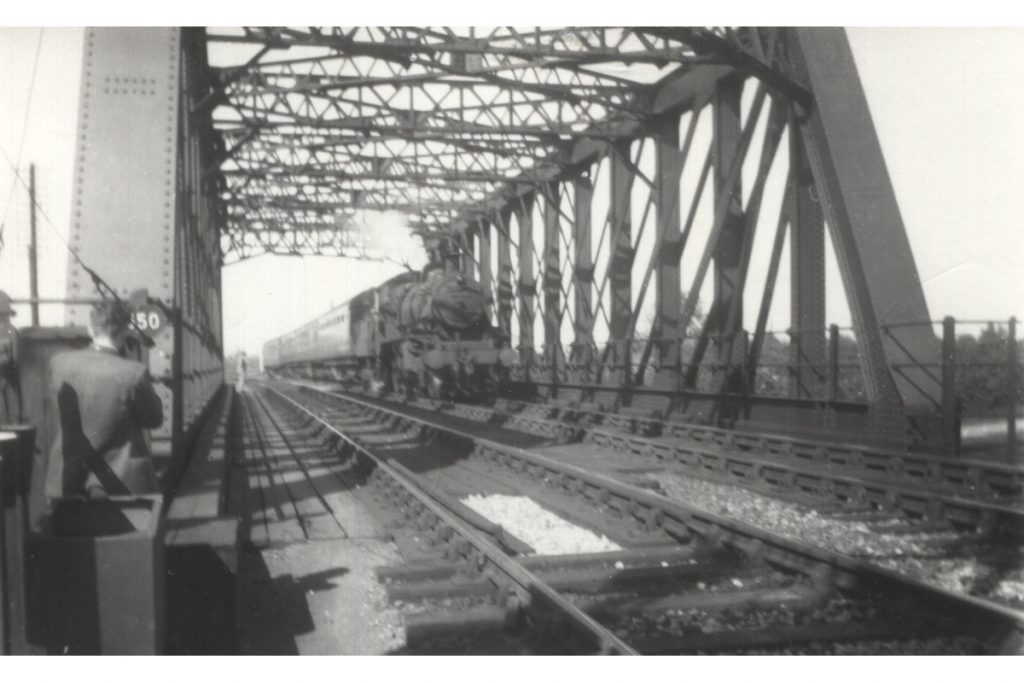
- A photograph which would give the authorities palpitations today, but which wasn’t such an issue on Wednesday 10th August 1949. Ivatt Class 2 No. 46403 joins the Great Eastern main line at Chesterton Junction and crosses over the River Cam with the 5.20 pm from Kettering. Photo: Robin Cullup Collection.
-
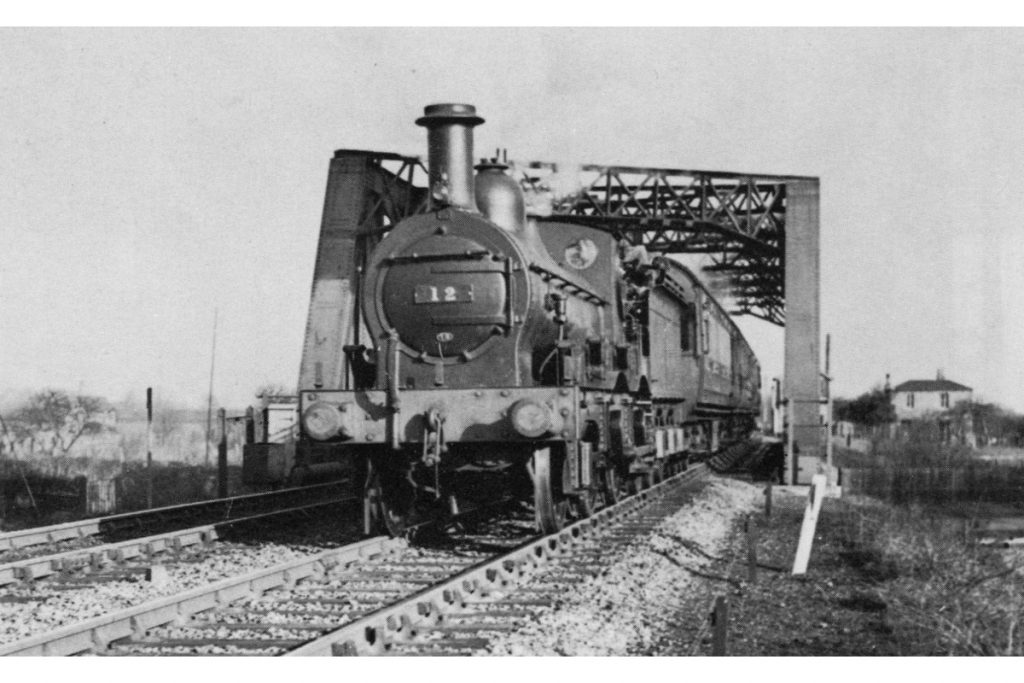
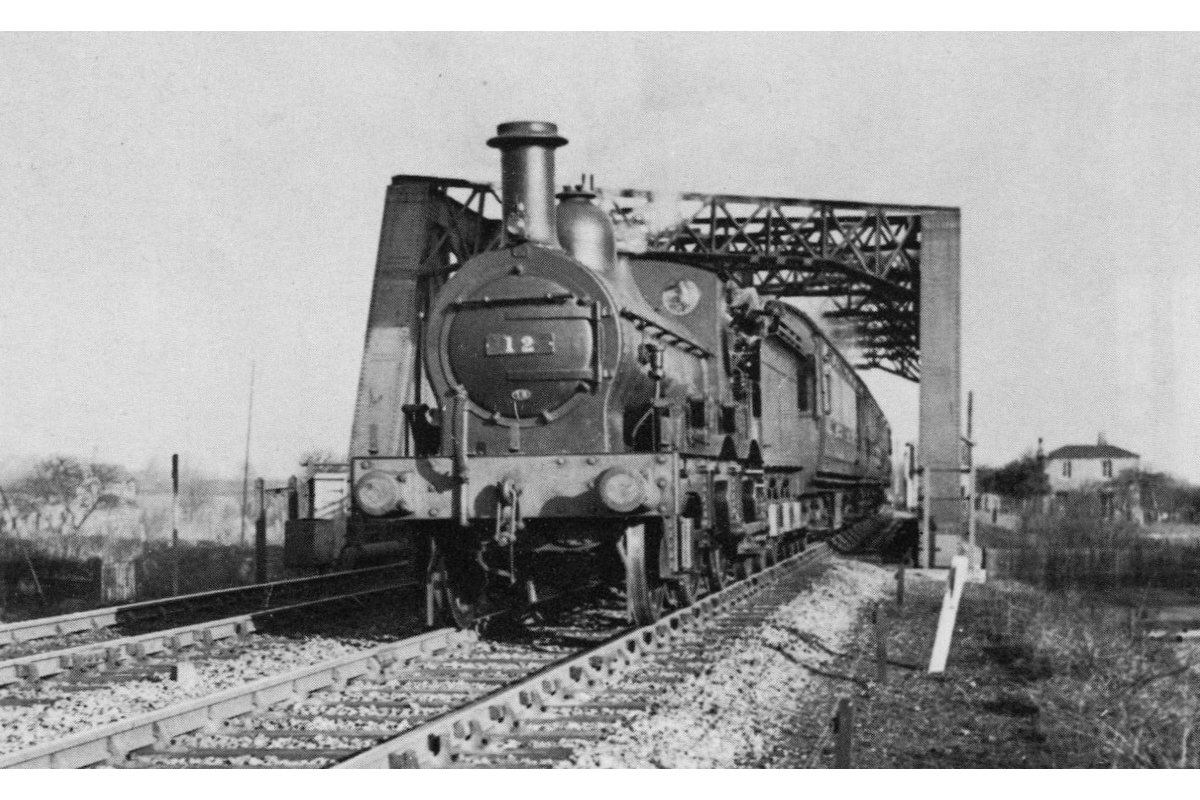
- Midland Railway 156 Class 2-4-0 No. 12 is seen crossing the River Cam and heading towards Cambridge station. Chesterton Junction signal box can just be made out behind the bridge girders on the right. Photo: Robin Cullup Collection.
-
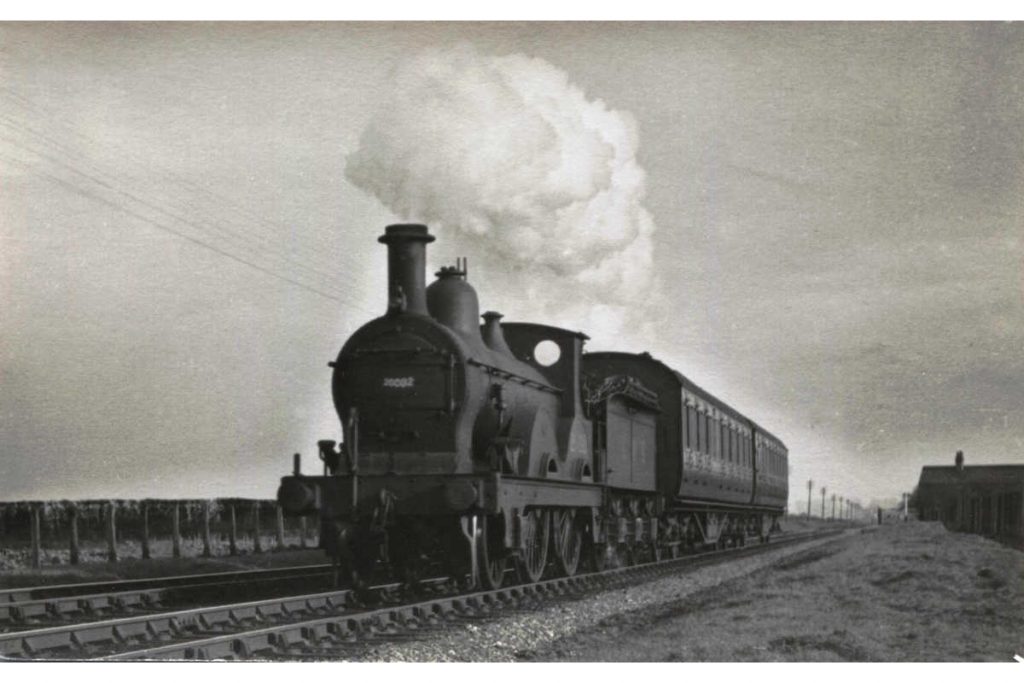
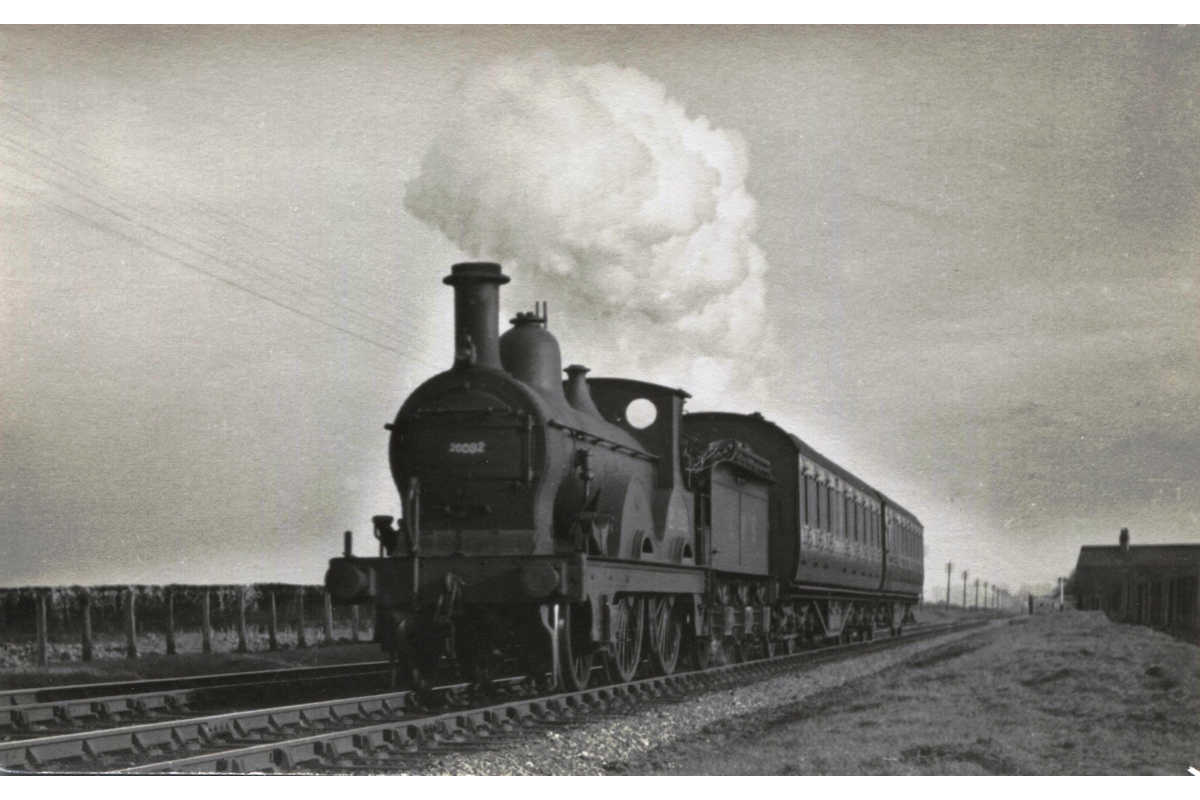
- 20092 on a Cambridge to Kettering train in 1937. Photographer Unknown.
-
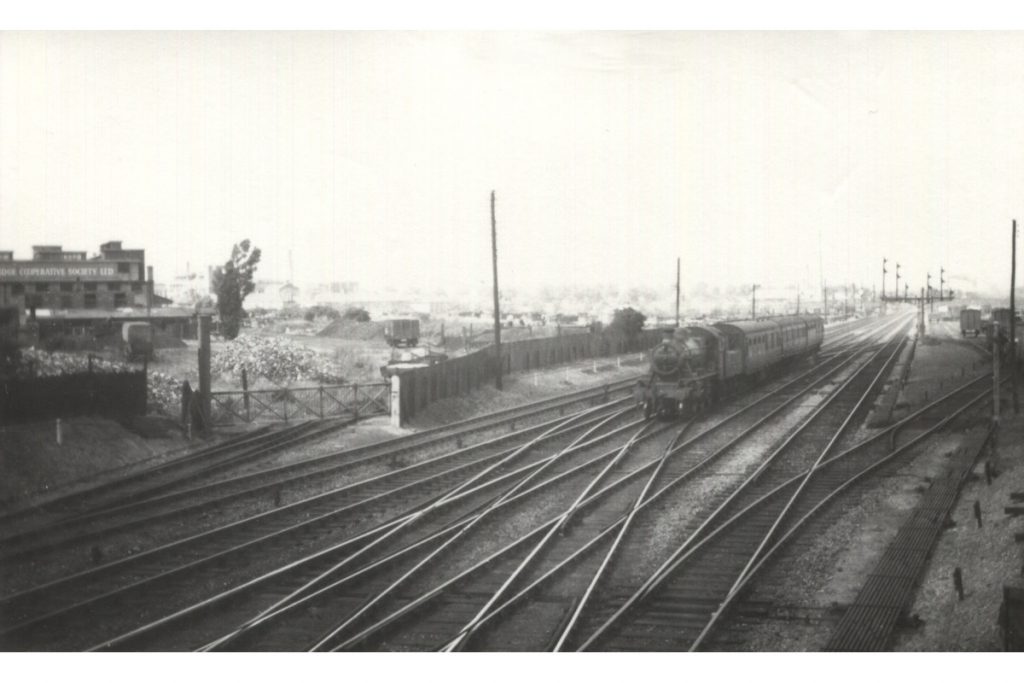
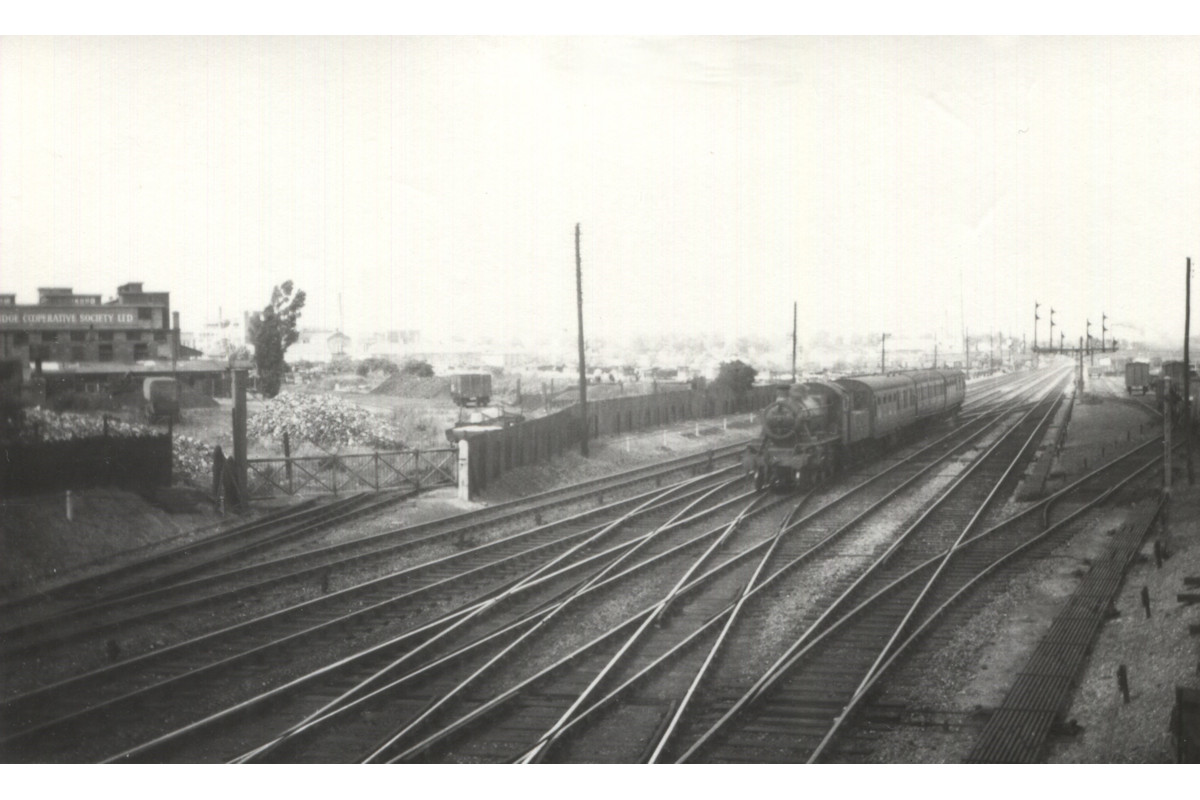
- Seen on 22nd July 1948, Ivatt Class 2 No. 46400 approaches Colham Lane with a branch train from Kettering. The two tracks to the right of the train are the lines from Newmarket. Photo: Robin Cullup Collection.
-
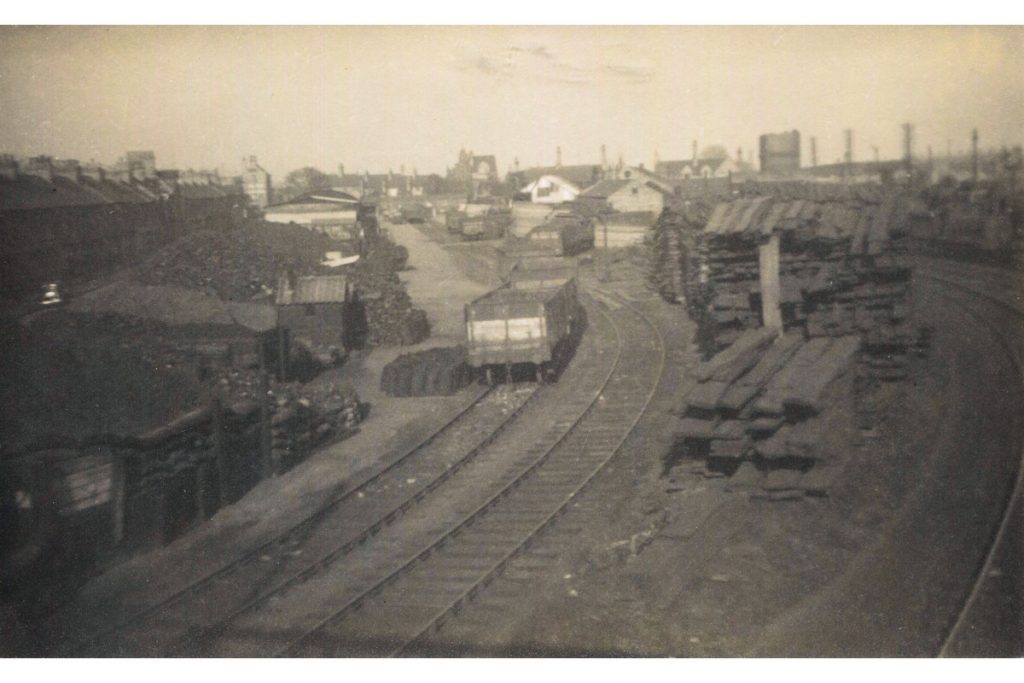
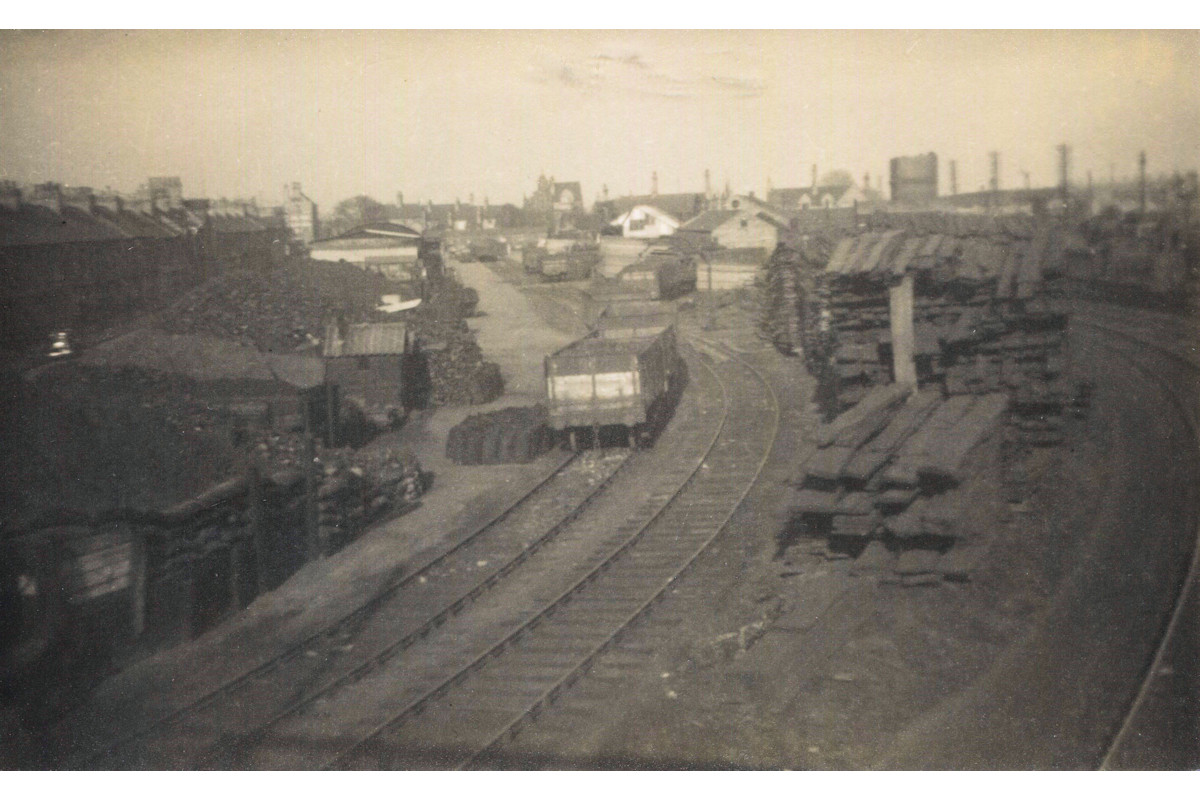
- A view of the former Midland Railway goods yard at Mill Road, Cambridge, taken on 30th October 1949, gives a wonderful insight into domestic coal operations in the age before natural gas. Photo: Robin Cullup Collection.
-
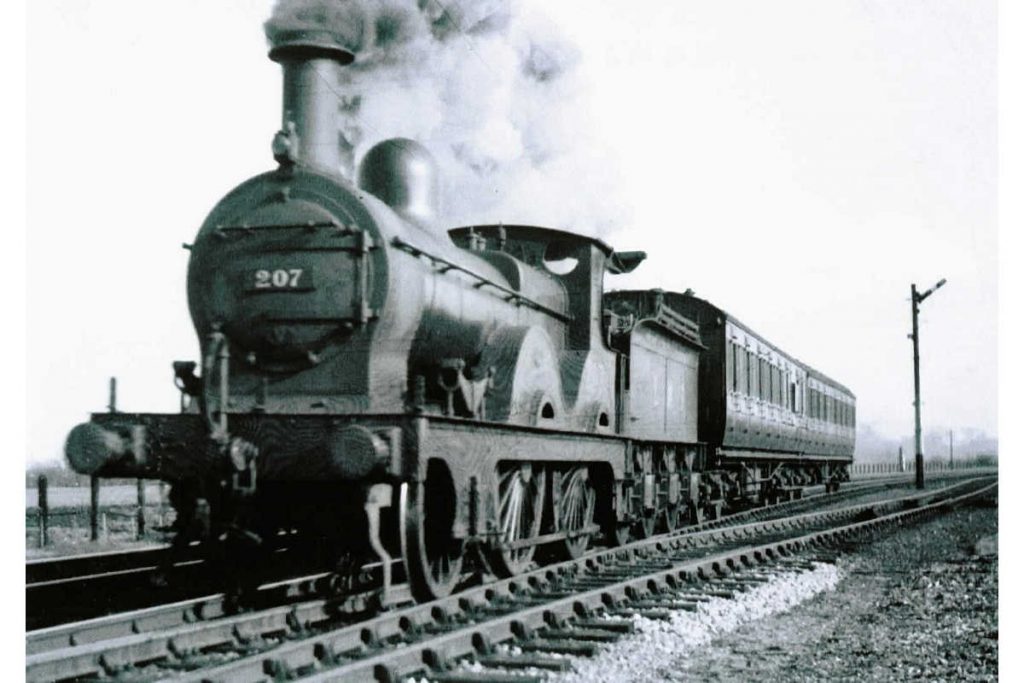
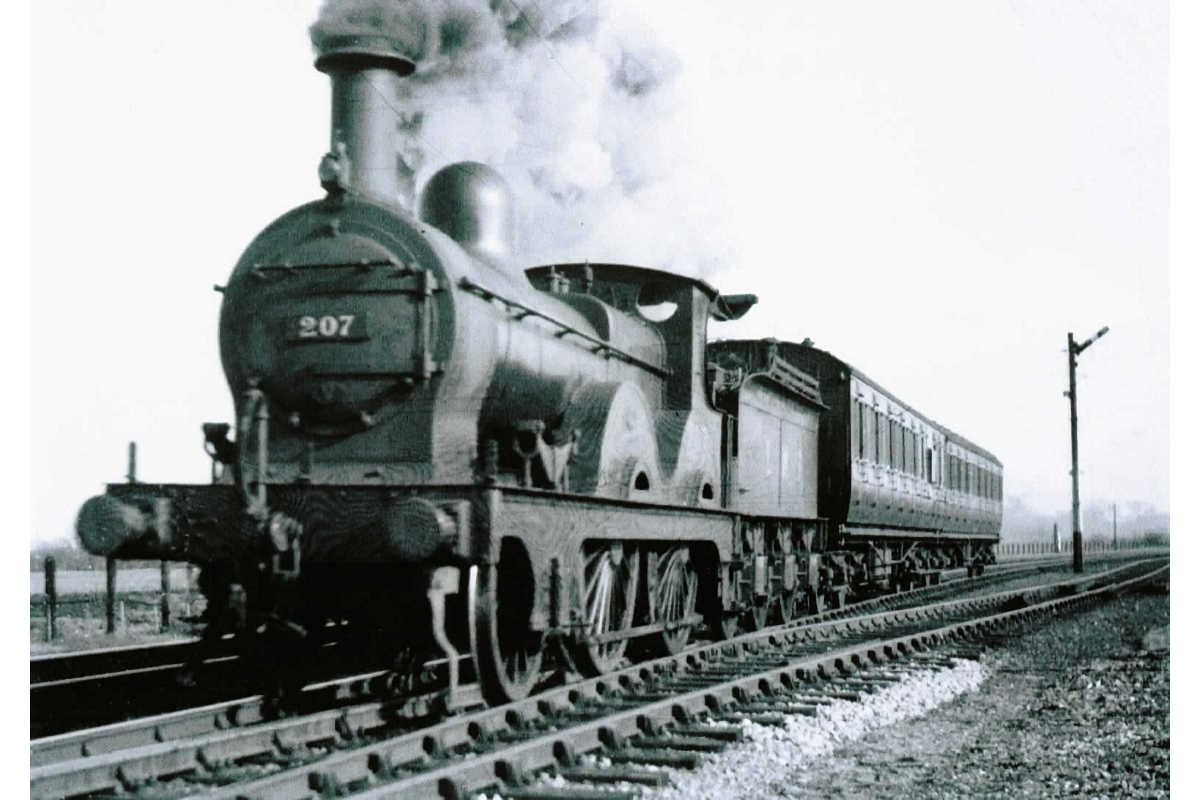
- Midland Railway 207 near Cambridge. Photographer Unknown.
-
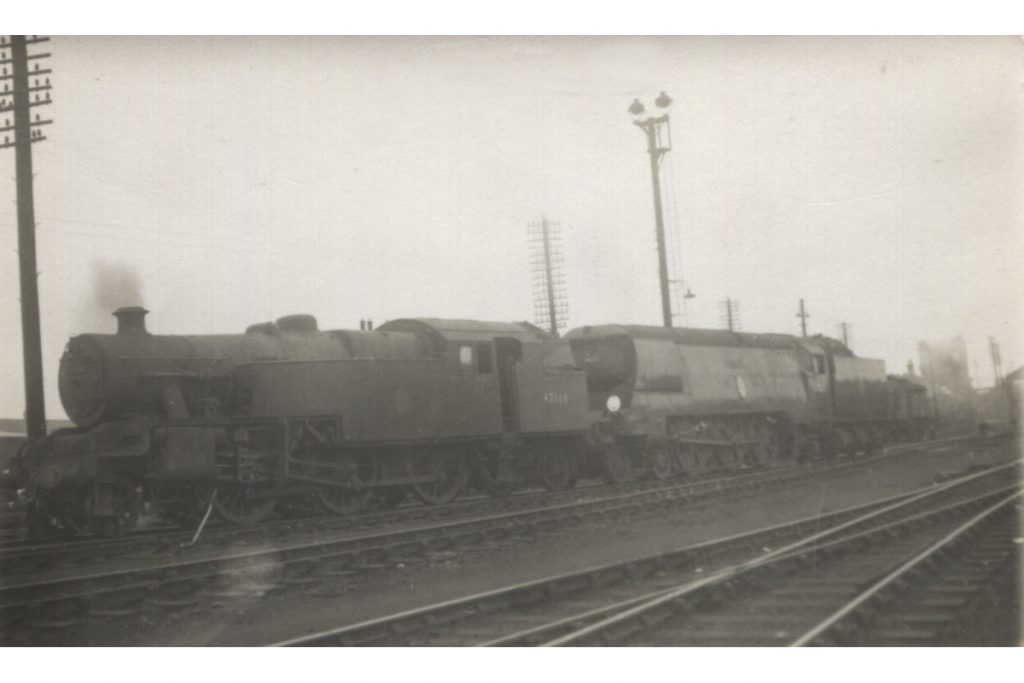
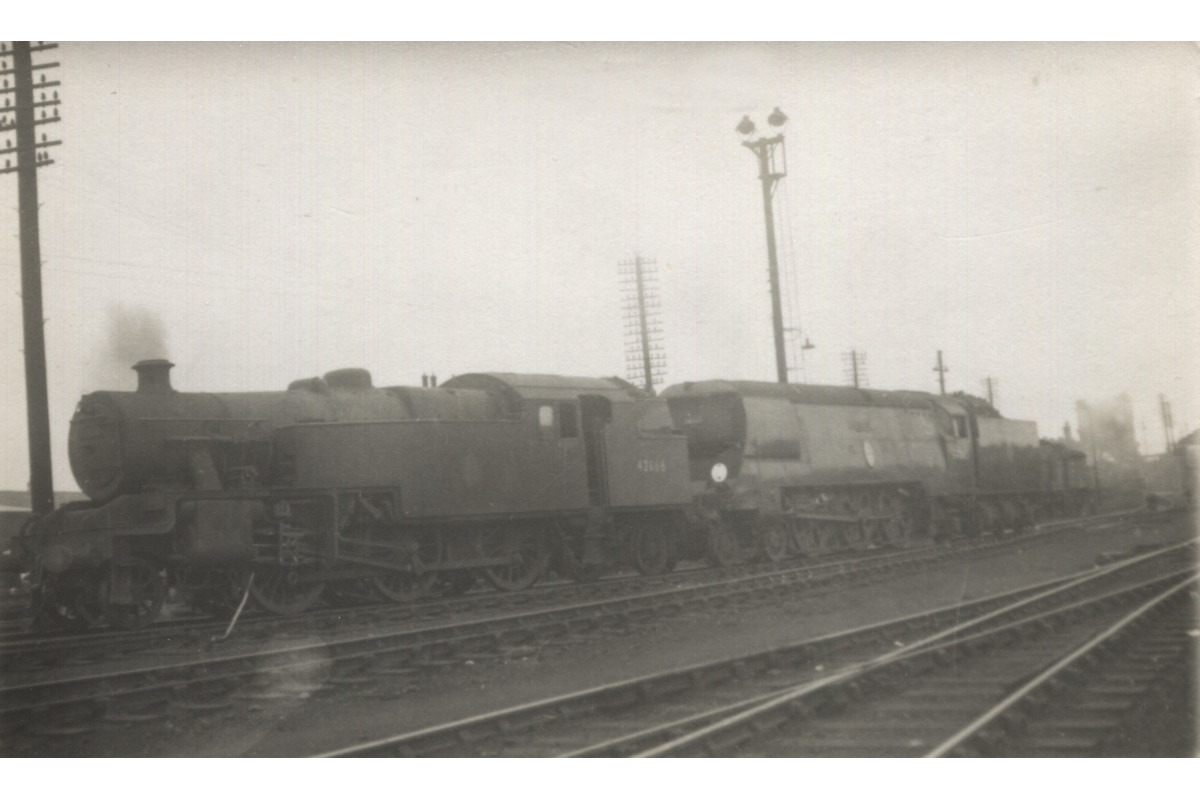
- An interesting pair of engines is caught on shed on August 6th, 1951: LMS 2-6-4T No. 42666 and Southern Railway ‘Battle of Britain’ Class 4-6-2 No. 34065 ‘Hurricane’. Photo: Robin Cullup Collection.
-
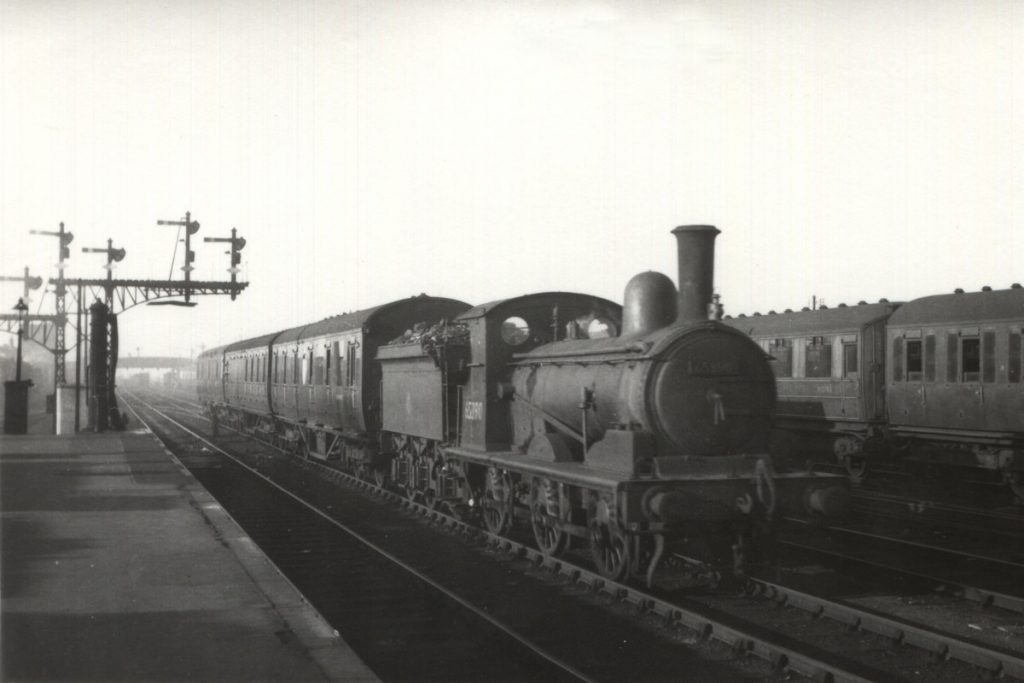
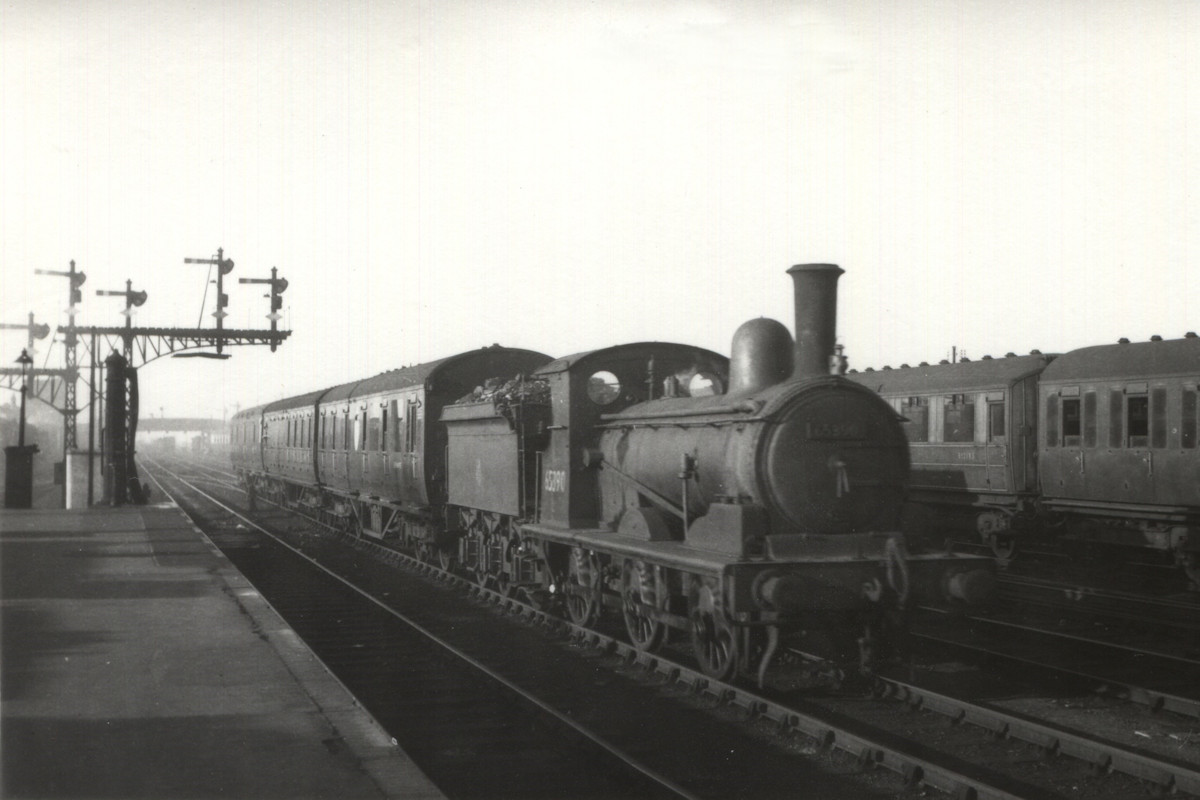
- Vintage Class J15 No. 65390 arrives at Cambridge on 7th July 1953 with the 5.25 pm from Kettering. Photo: Robin Cullup Collection.
-
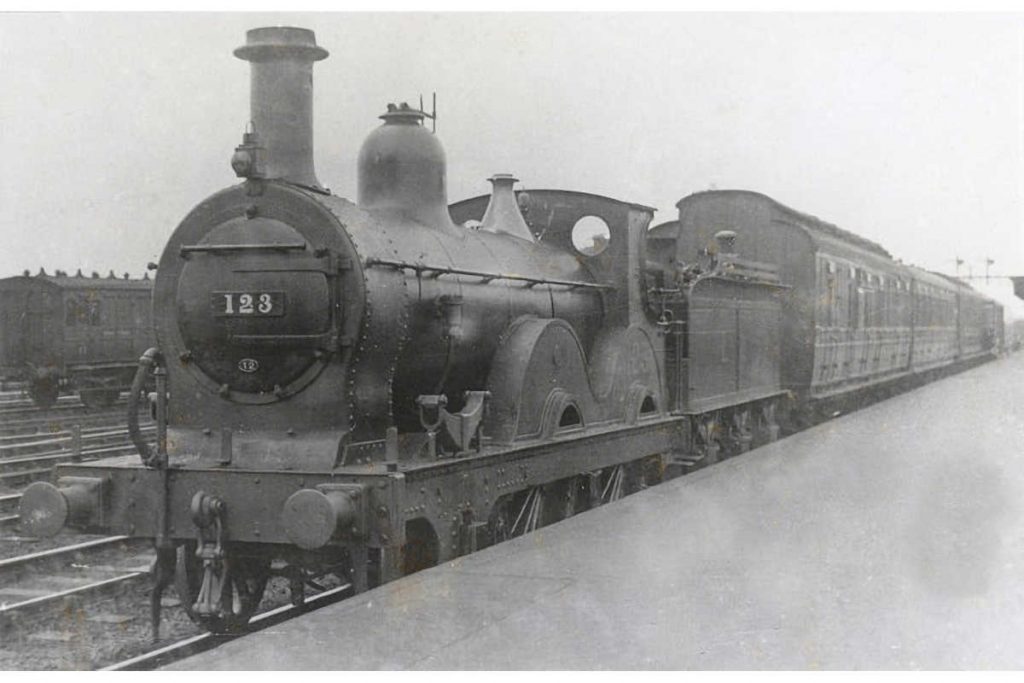
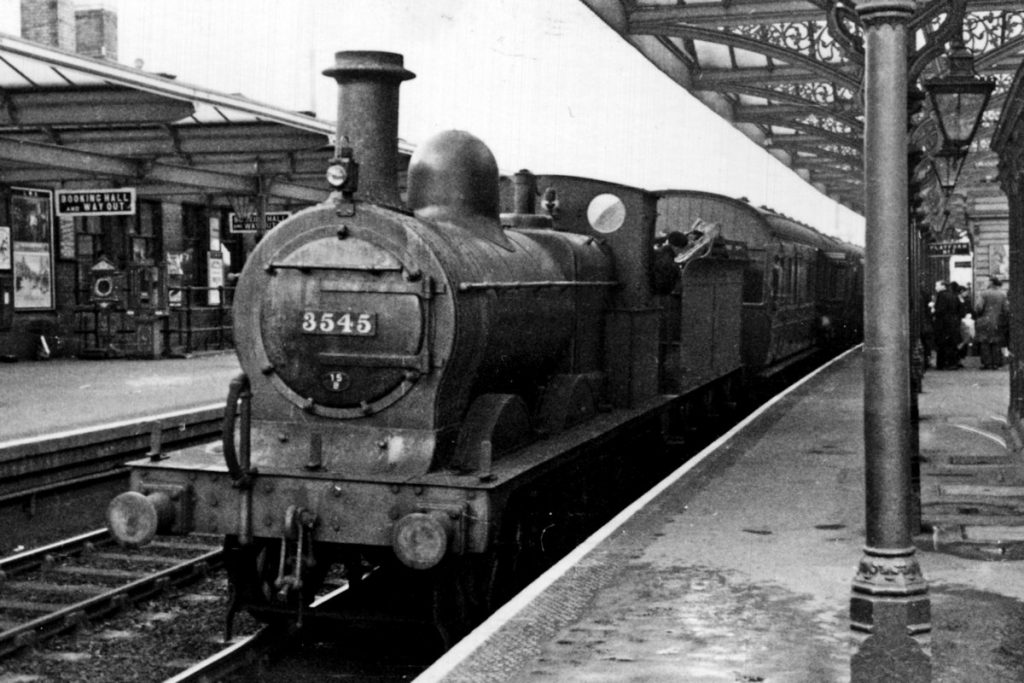
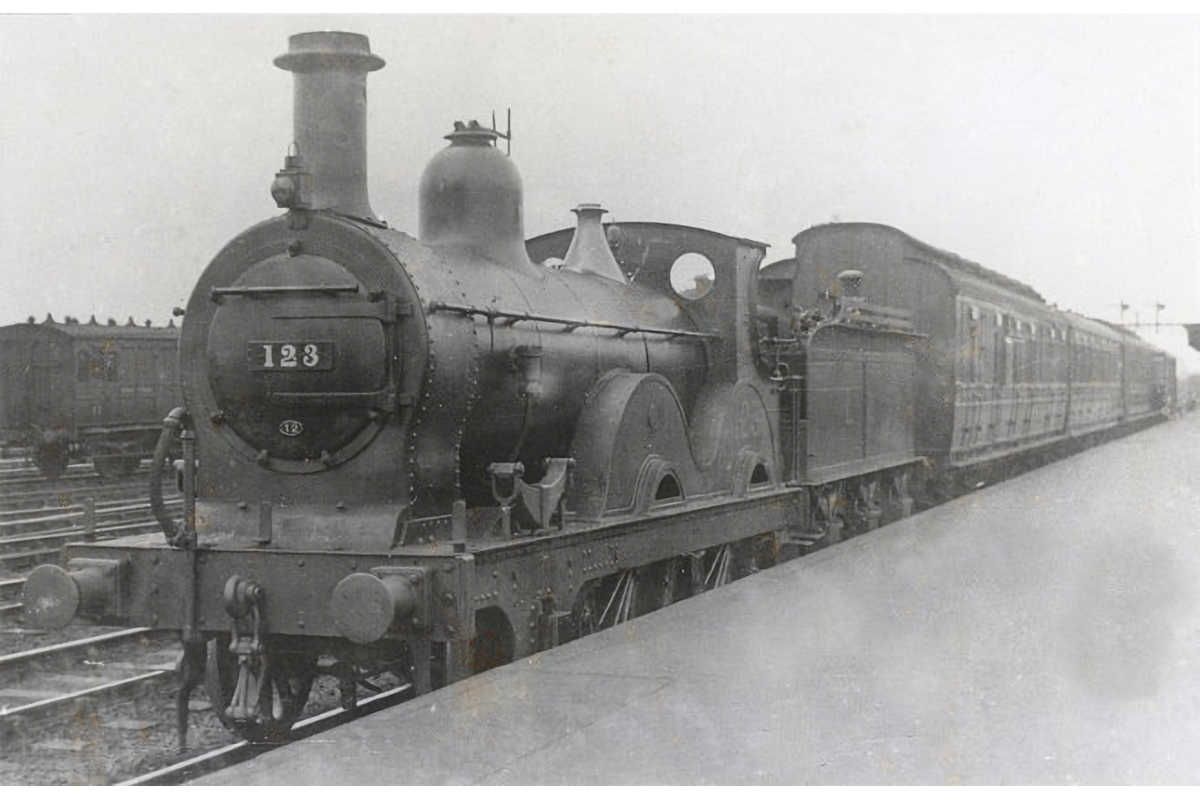
- Seen previously on Kettering Shed, Midland Railway 123 is now seen at Cambridge on the 2.42 pm to Kettering in 1932. Photographer Unknown.
-
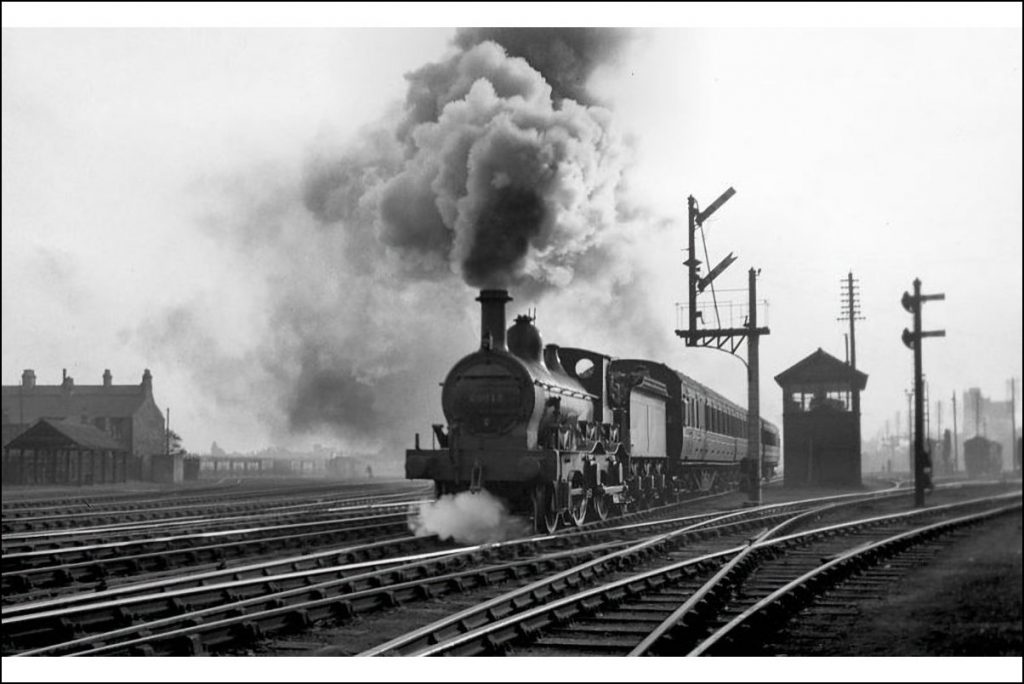
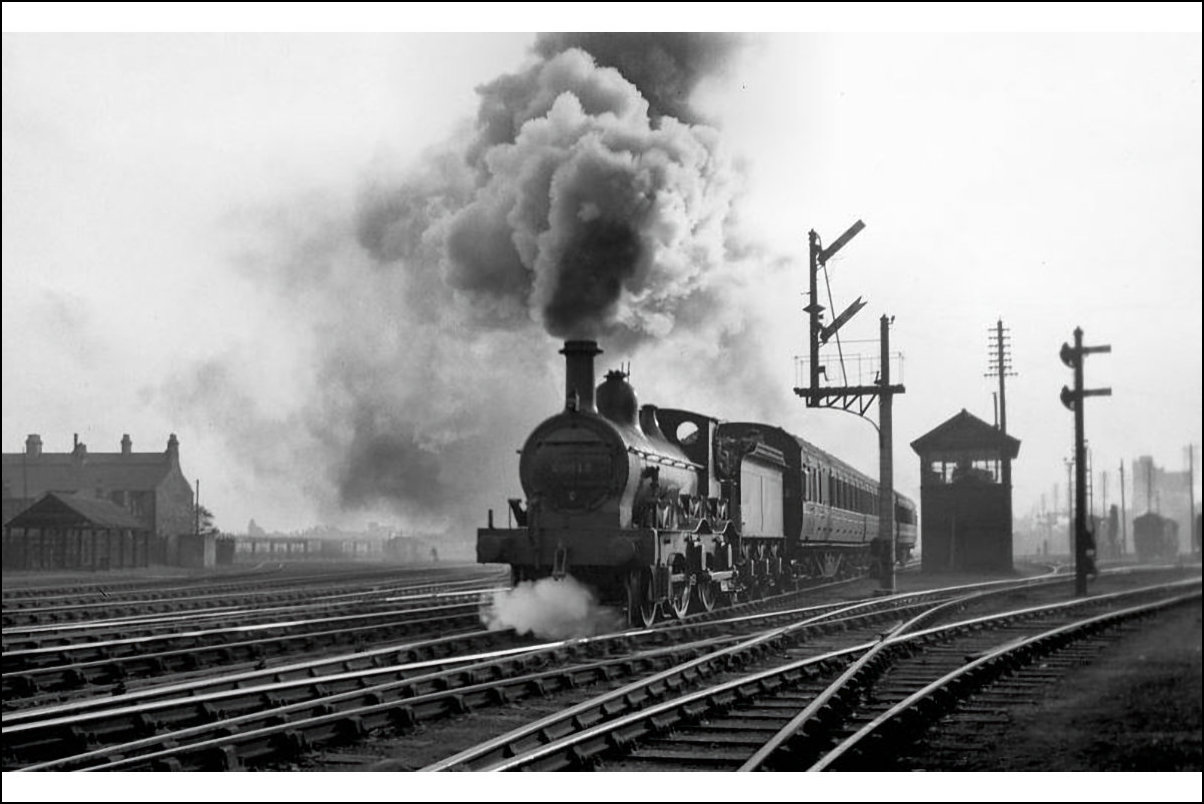
- Midland Railway Kirtley Class 156 No. 20012 departs from Cambridge and passes Cambridge North signal box with a Kettering train. Photo: Mike Morant Collection – Robin Cullup Collection.
-
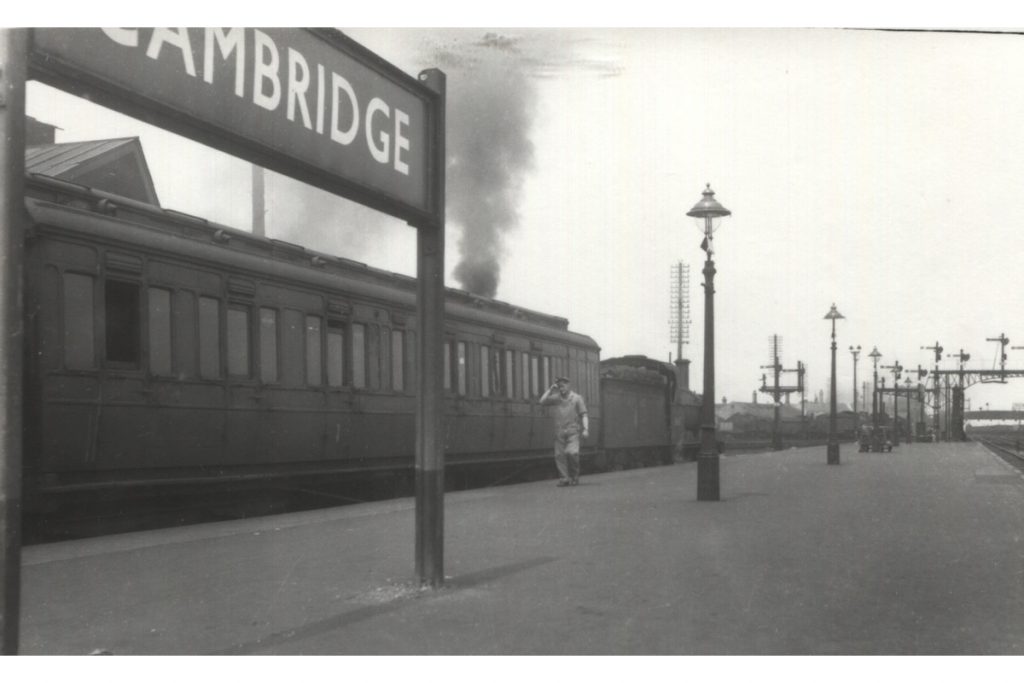
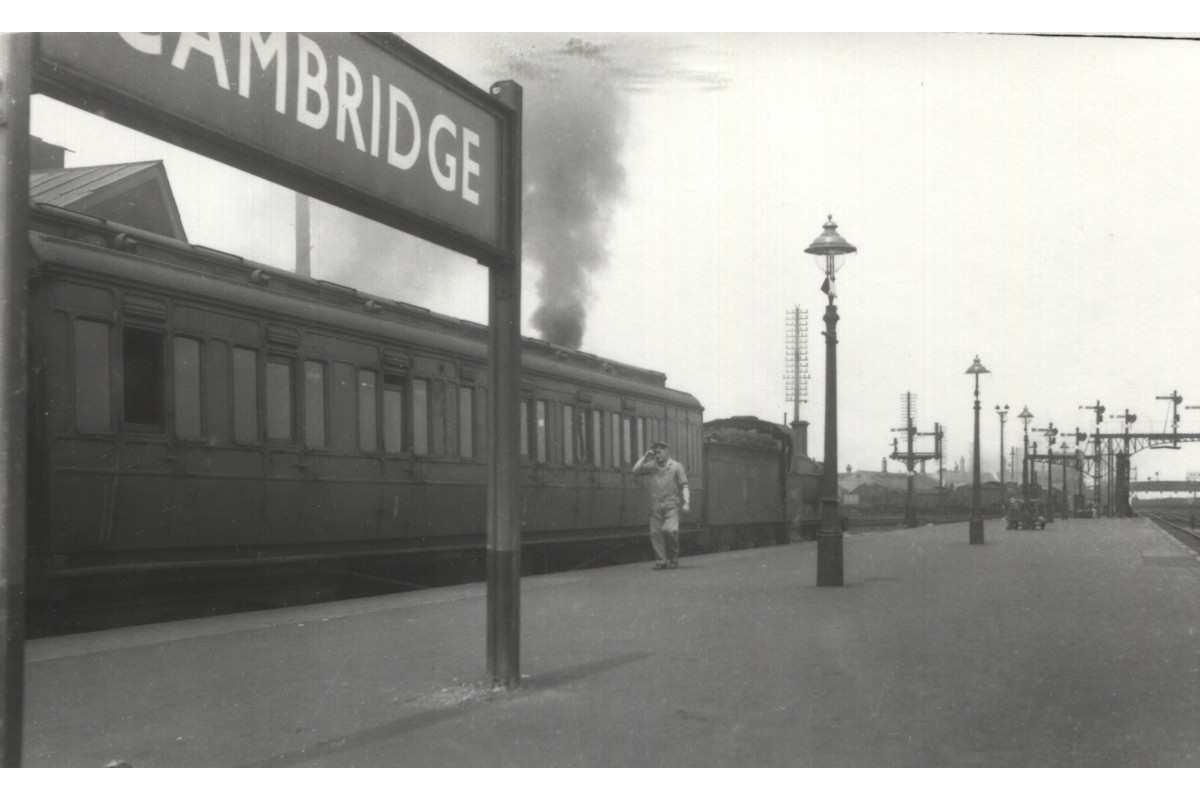
- On June 30th 1951, Midland 2F No. 58162 stands in the North bays at Cambridge with the 2.20 pm (Saturdays Only) to Kettering. The former Midland Railway clerestory carriage is seeing out is last days on the branch. Photo: Robin Cullup collection.
-
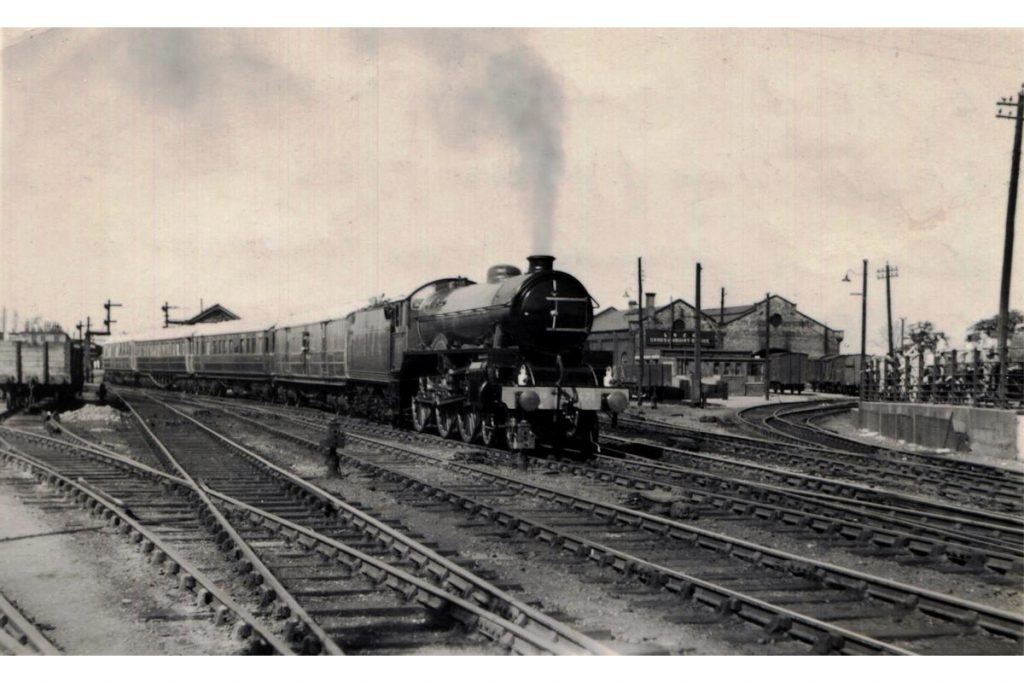
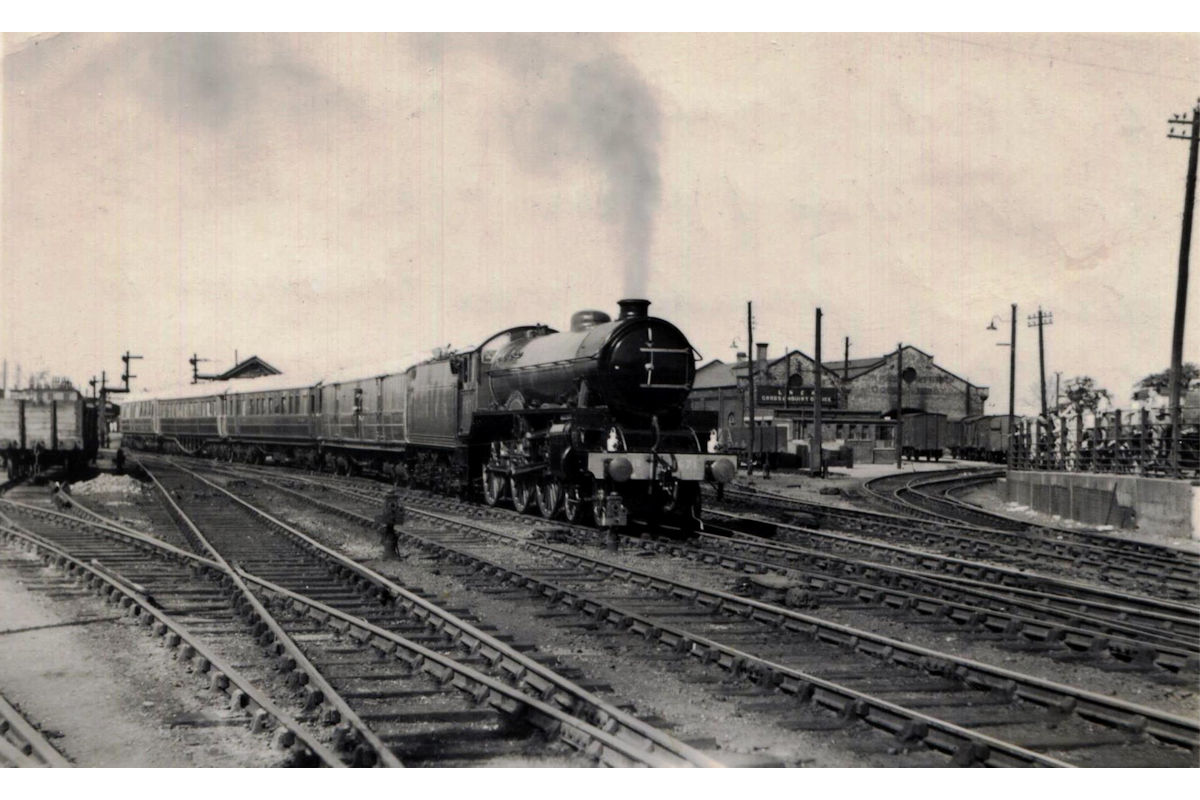
- 20060 at Cambridge in 1937. Photo: J.E. Simpson.
-
- On 3rd June 1947, LNER B2 4-6-0 No. 1671 makes a truly spectacular sight as it departs Southbound from Cambridge with the Royal Train. The cattle dock to the right has a good complement of enthusiasts to see the spectacle. Photo: Robin Cullup Collection.
-
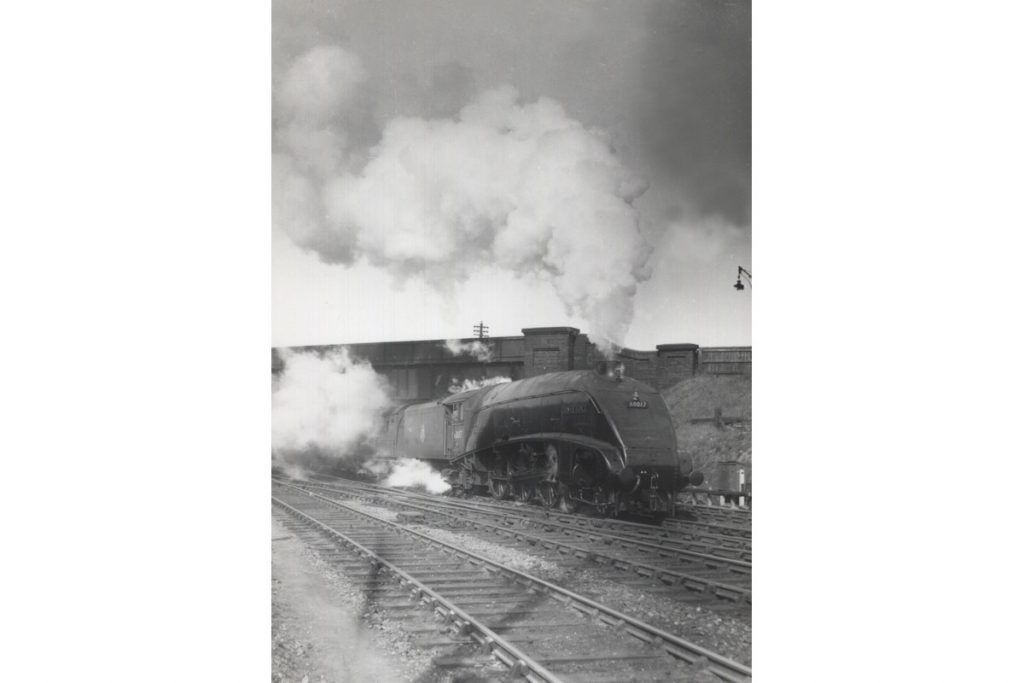
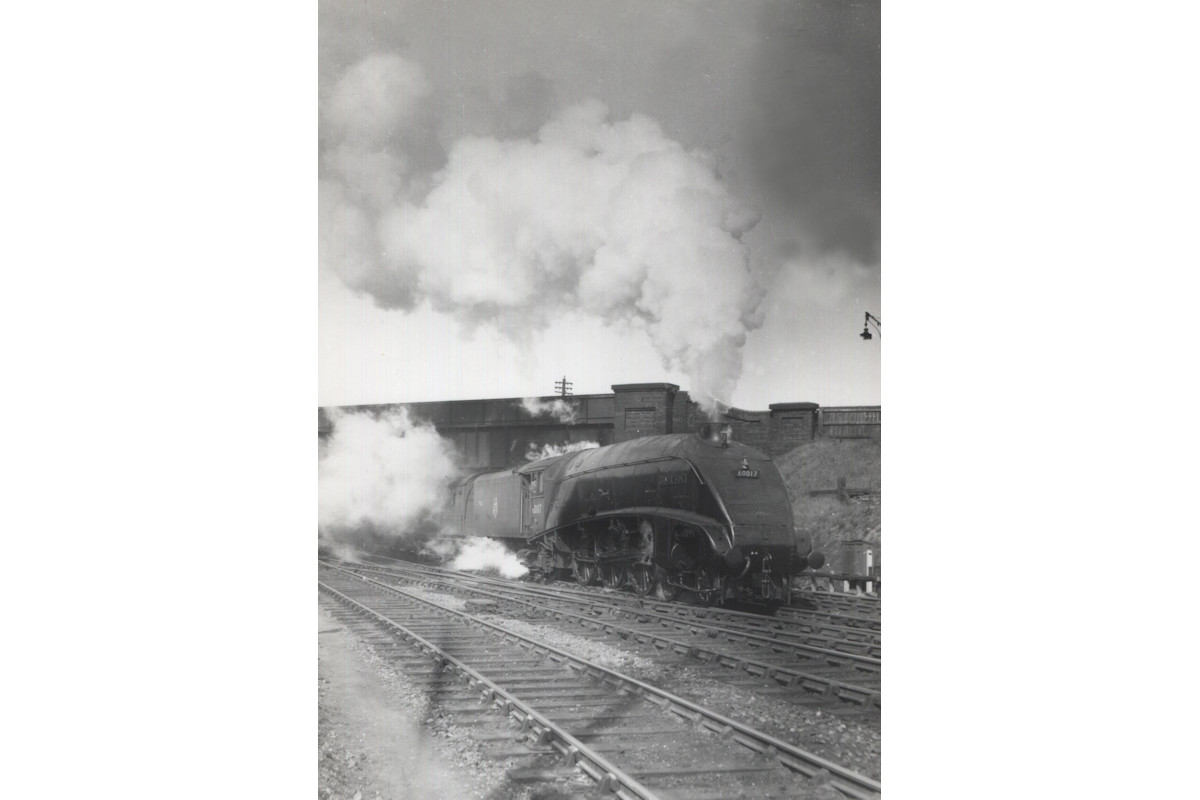
- A4s were never that common a sight at Cambridge, but on April 26th 1953 No. 60017 ‘Silver Fox’ made a very welcome appearance on the 3.50 pm to Kings Cross. Photo: Robin Cullup Collection.
-
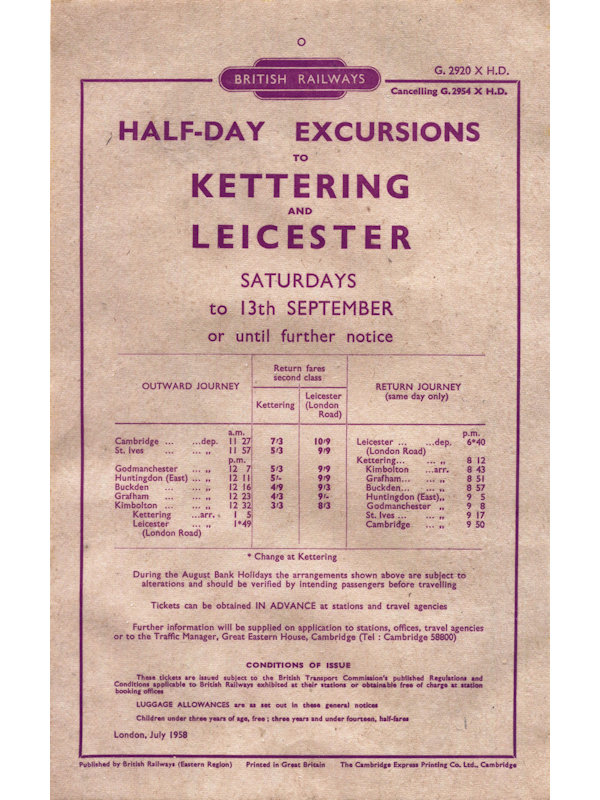
- In the 1950s many people worked on Saturday mornings, so Saturday afternoon half-day excursions were popular. This example from July 1958 offered reduced fares on regular service trains (11.27 am from Cambridge and 8.12 pm from Kettering – see the Summer 1958 timetable below), giving an opportunity to spend time in these towns at modest cost. Photo: Robin Cullup.
-
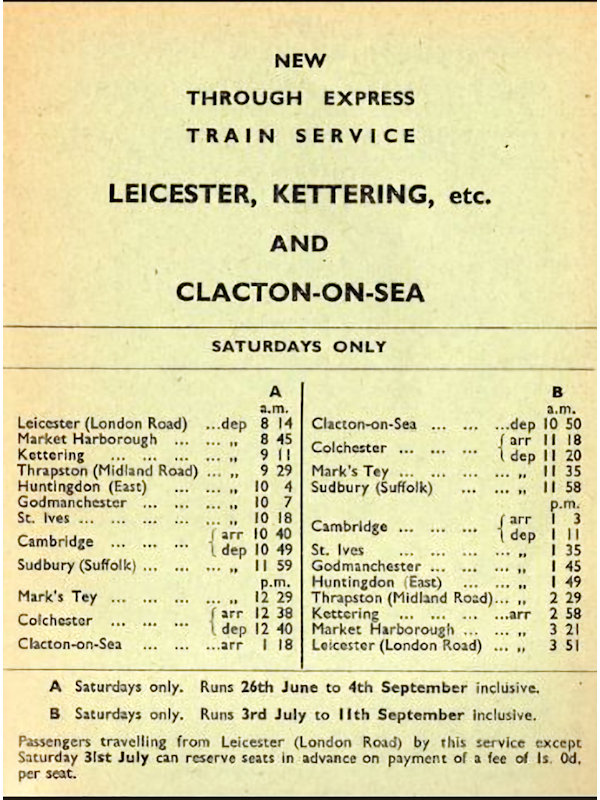
- The introduction of the new through Leicester to Clacton Summer Saturday holiday train in 1954 warranted publicity. Photo: Robin Cullup.
-
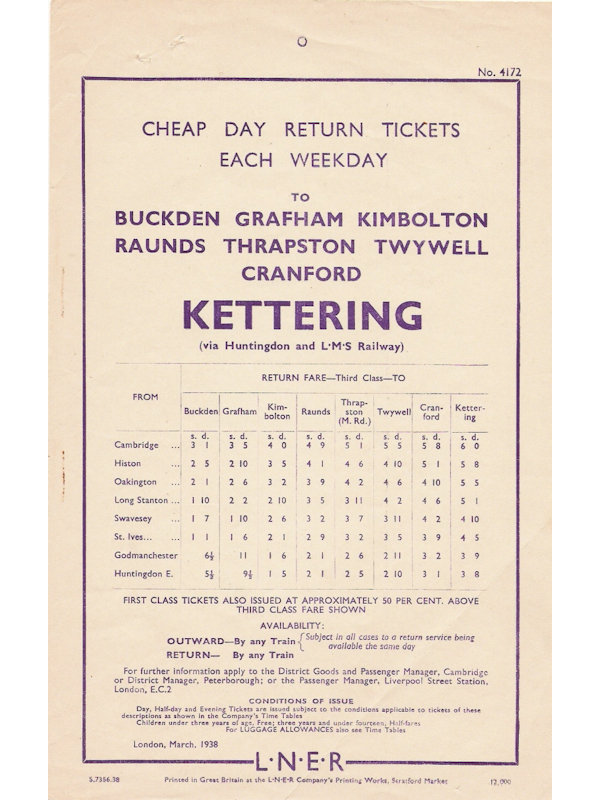
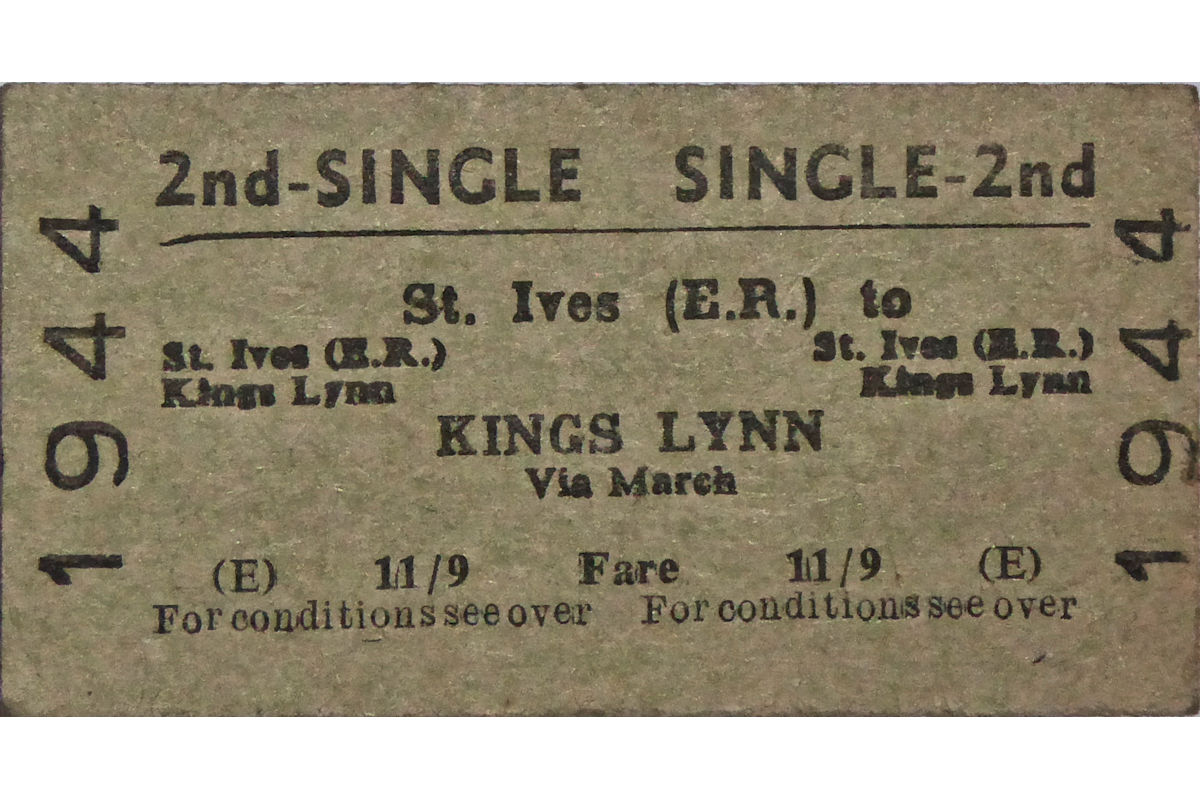
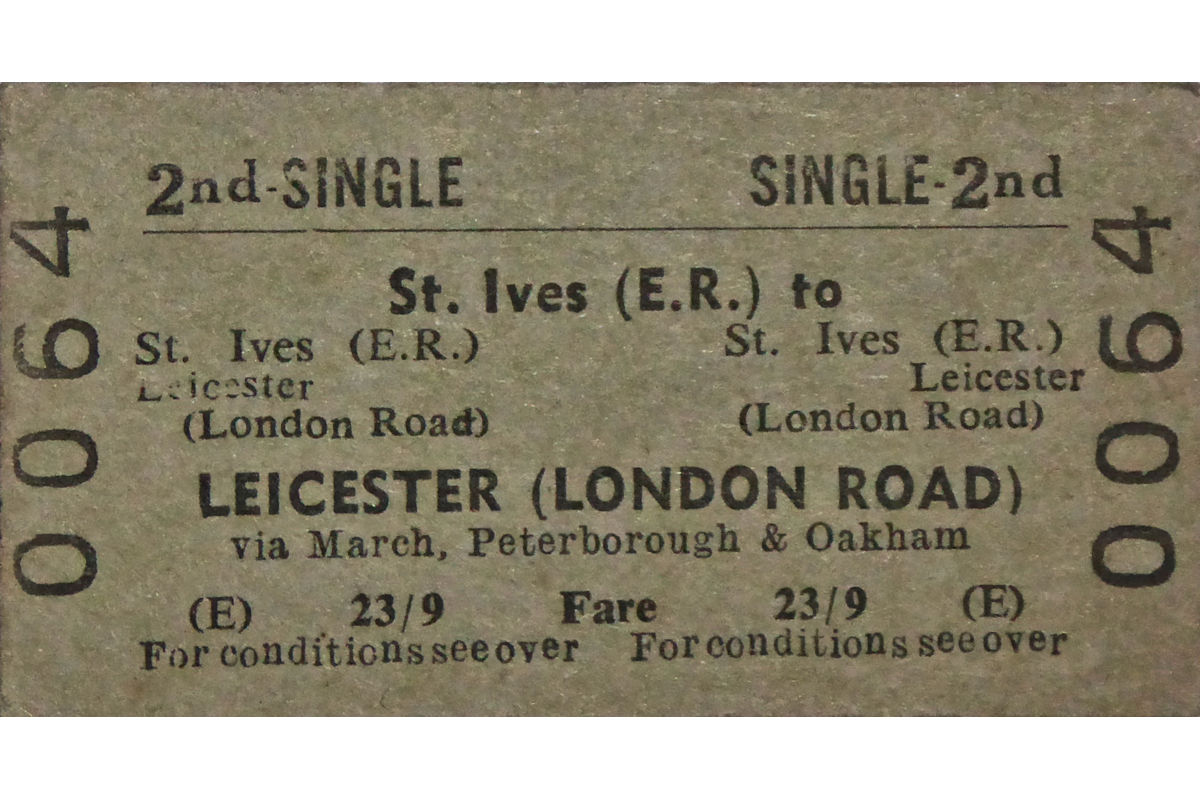
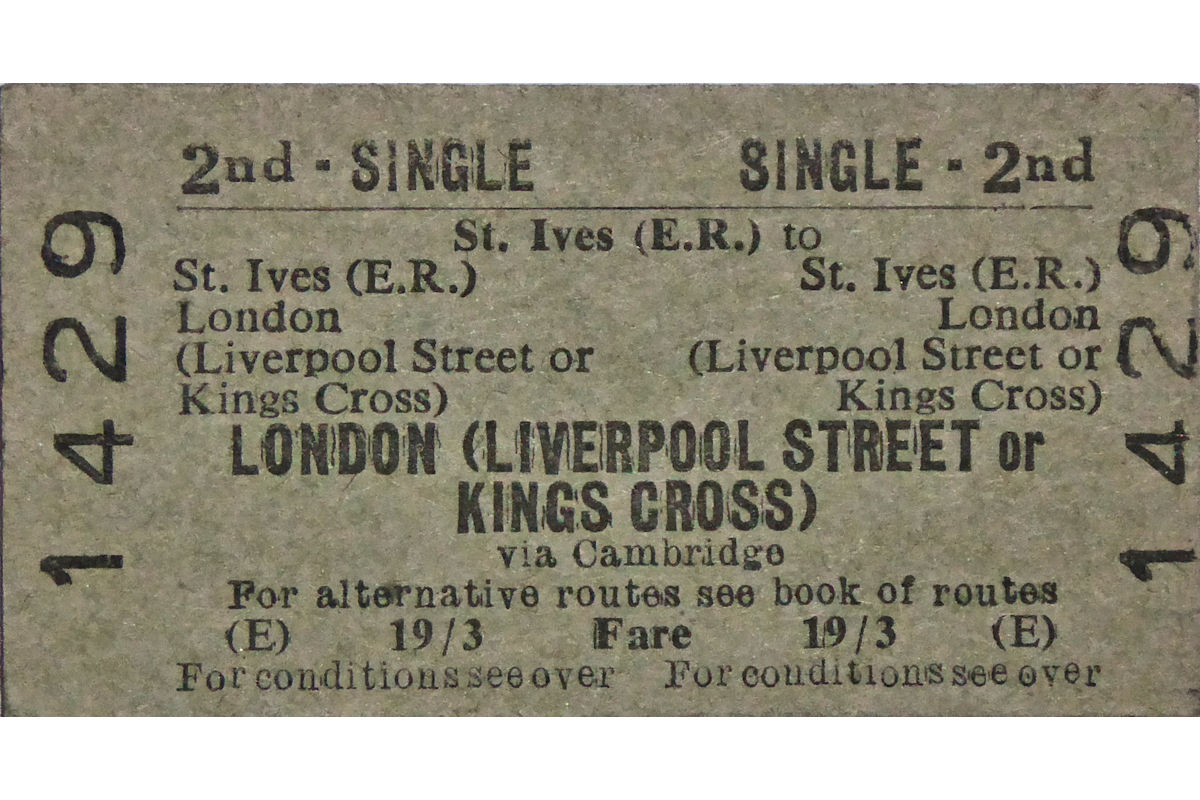
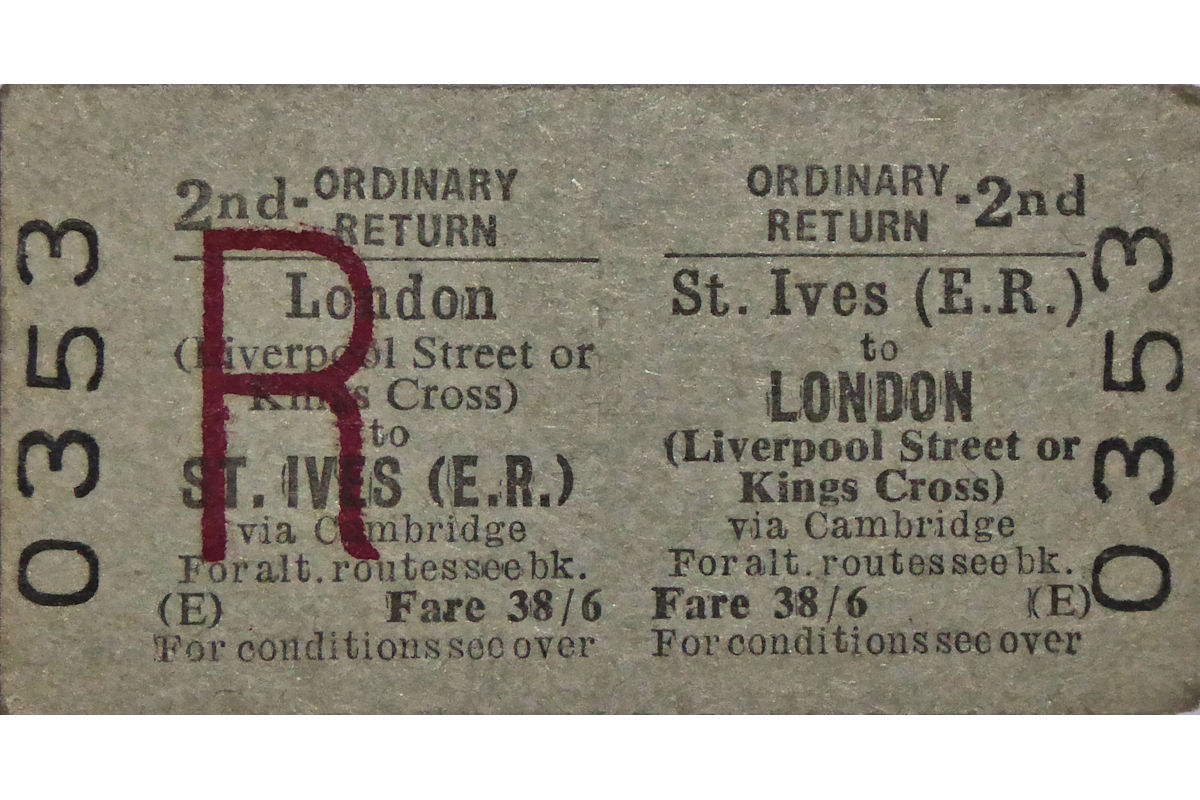
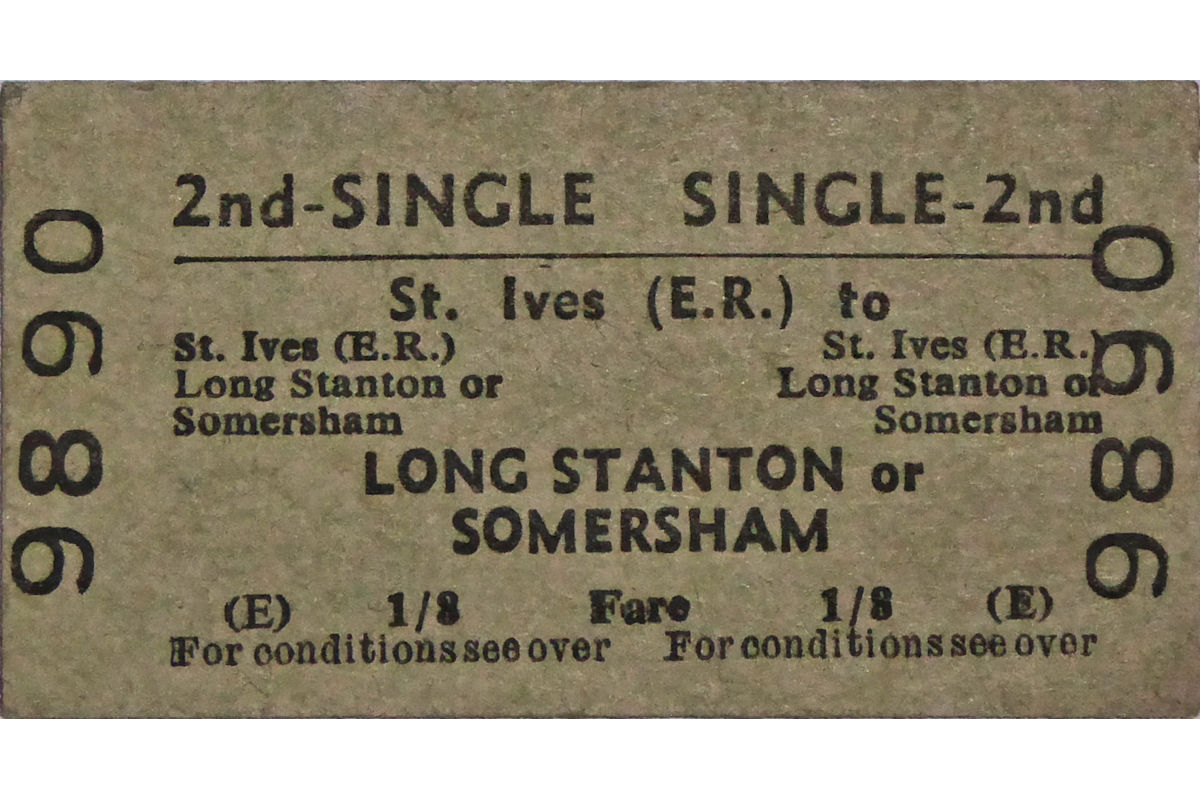
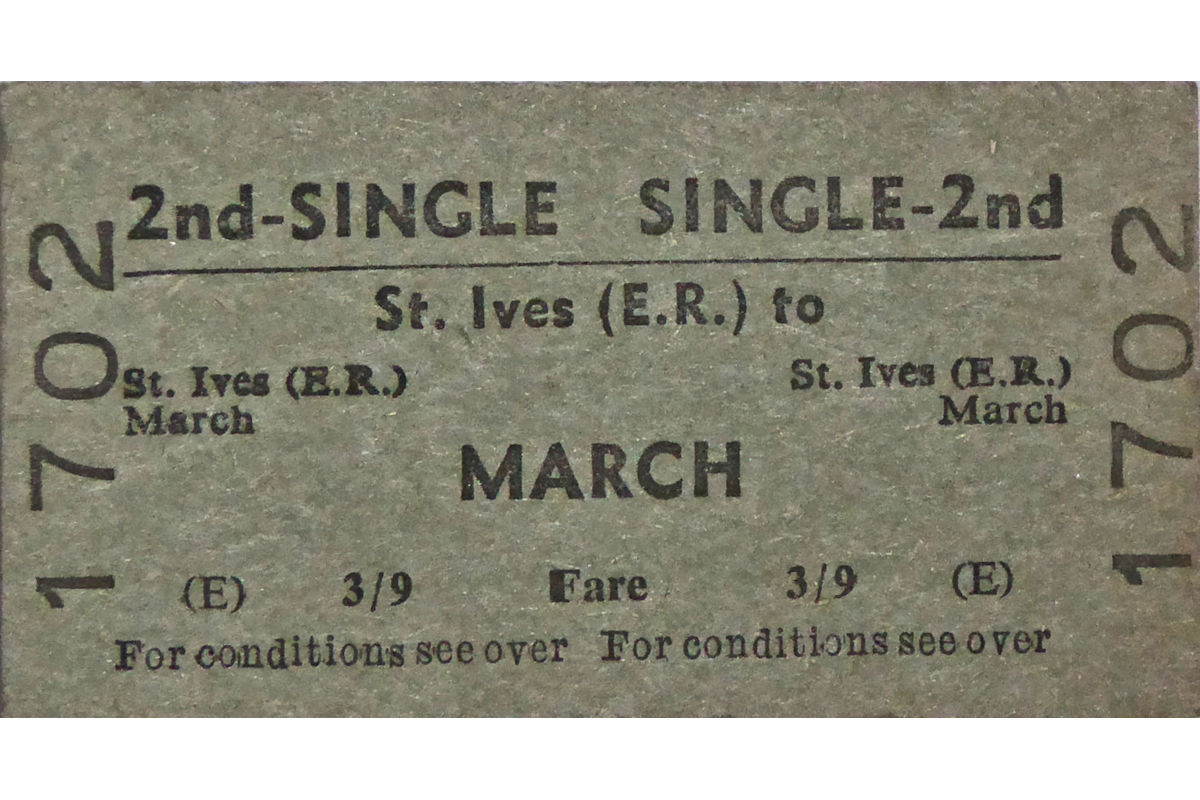
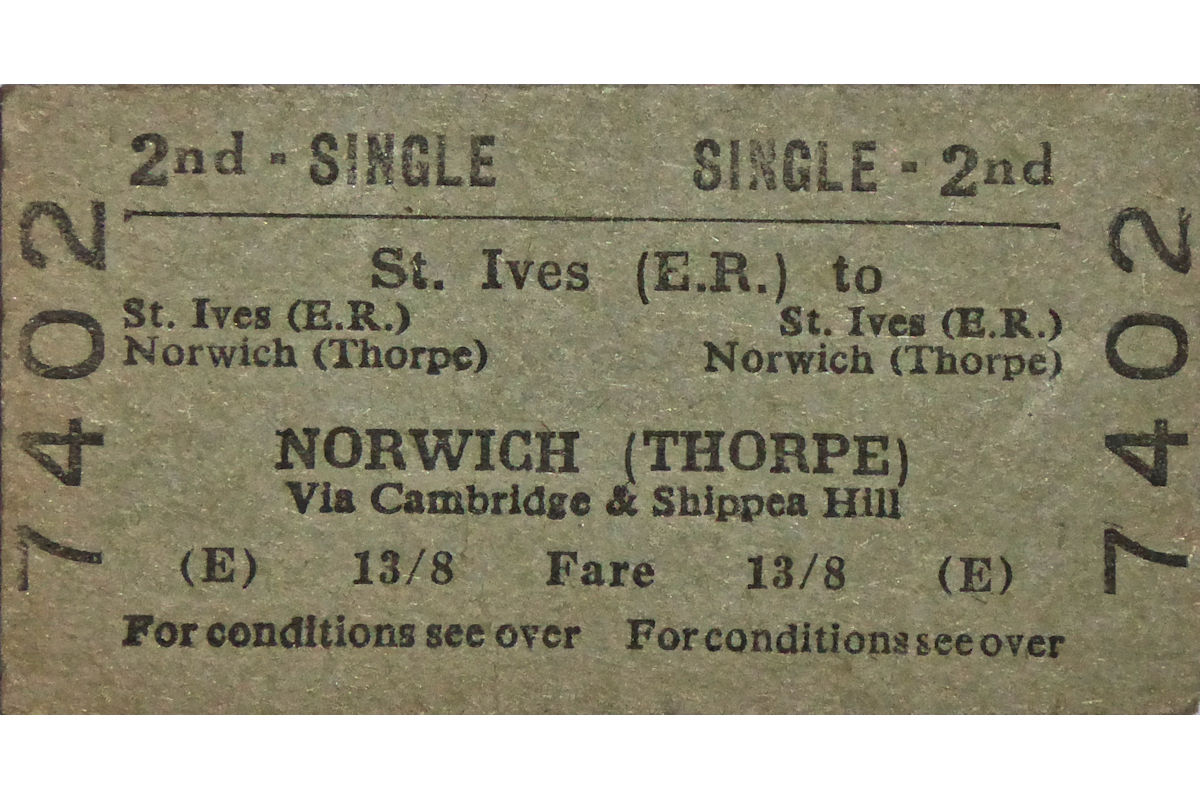
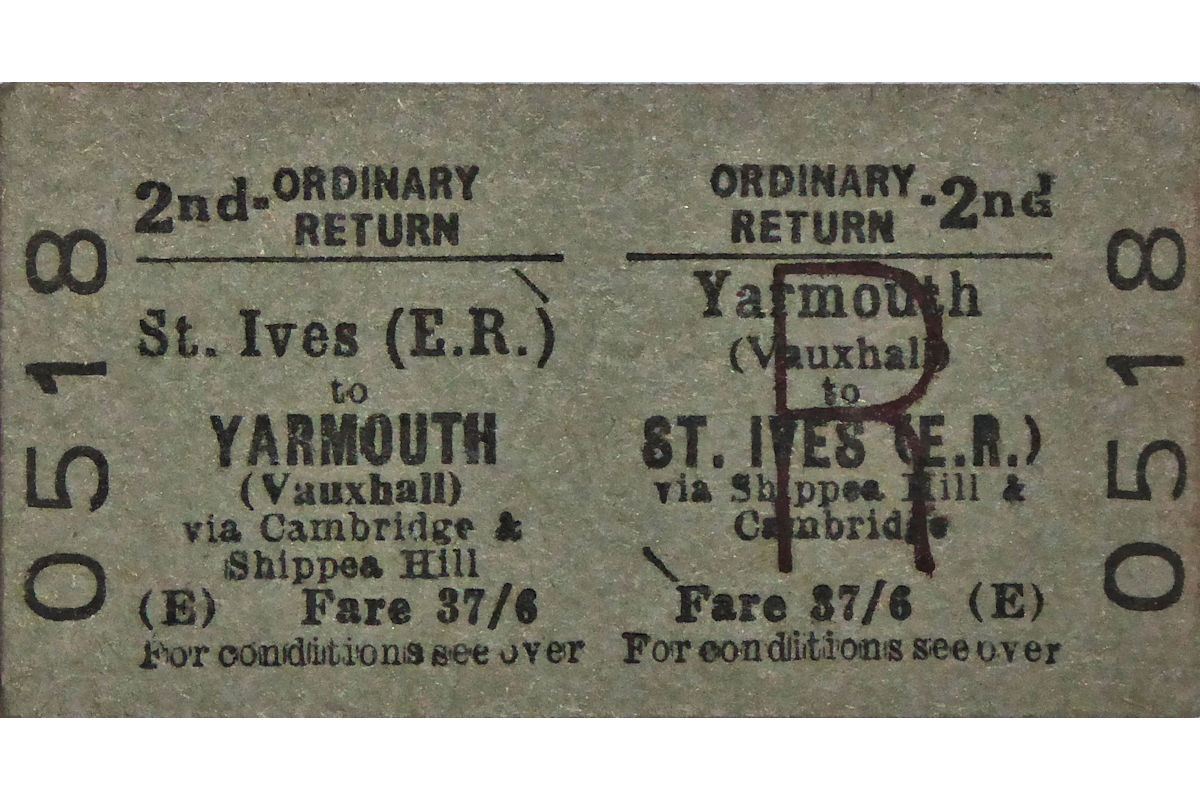
- March 1938 – Cheap Day Return fares, valid on any train, from stations between Cambridge and Huntingdon to stations between Buckden and Kettering. A return fare of six shillings (30p) and a journey time of an hour and three quarters from Cambridge to Kettering in 1938 compares with an Off Peak Return fare of £109.30 and a journey time of two hours and twenty-eight minutes in October 2022! Photo: Robin Cullup.

-
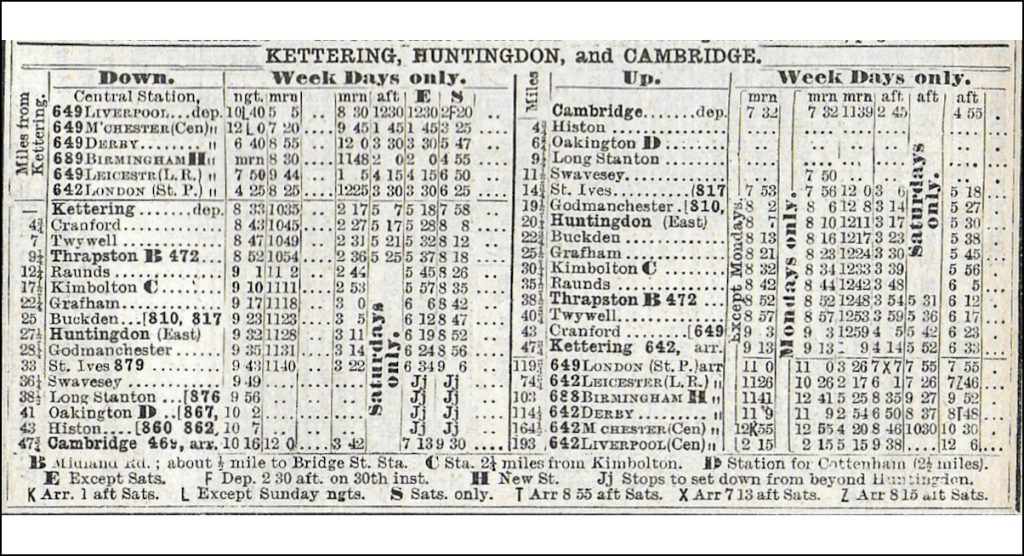
- May 1936 Bradshaw – showing four workings in each direction over the branch and a late Saturday afternoon out-and-back from Kettering to Thrapston. The departure of the last Cambridge train is almost three hours later on Saturdays – a pattern that was retained to the very end. Photo: Alan Jones

-
- August 1939 Bradshaw – an additional Summer Saturday working from Kettering to Cambridge and back has appeared, running just four times. In 1954 this would become the through working from Leicester to Clacton. Photo: Alan Jones
-
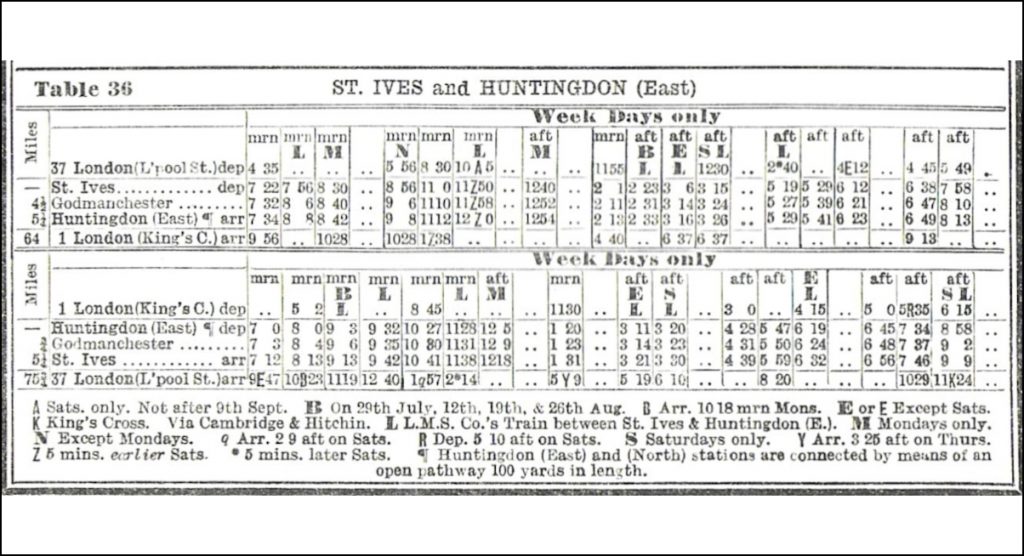
- 1939 Summer LNER Timetable – shows an interesting combination of the four LMS workings to and from Kettering, plus the four runs of the Summer Saturday additional, as well as an LNER shuttle service of eight round trips between Huntingdon East and St Ives, augmented to nine on Mondays. These LNER services would have used the Joint Line platforms (1 and 2) at Huntingdon East. Photo: Alan Jones.

-
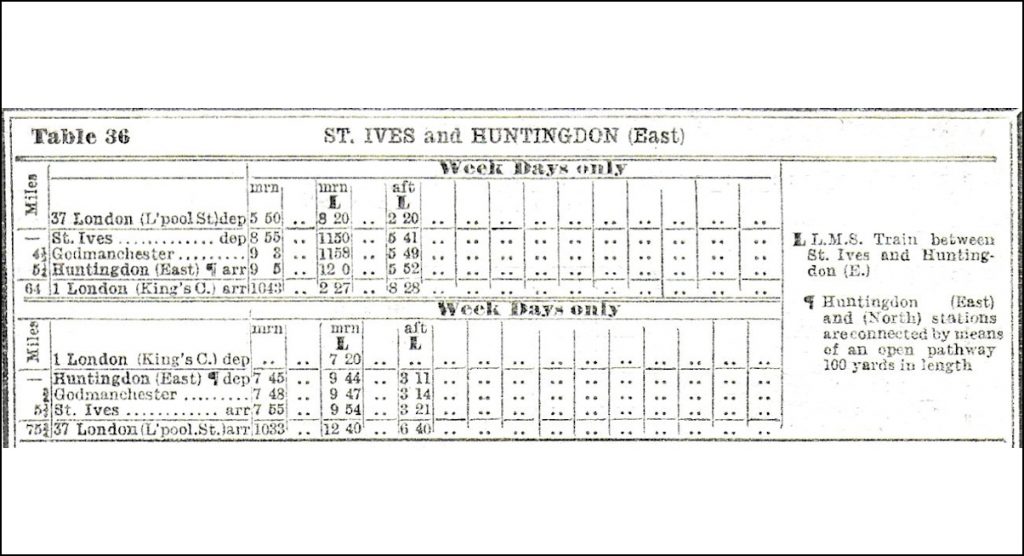
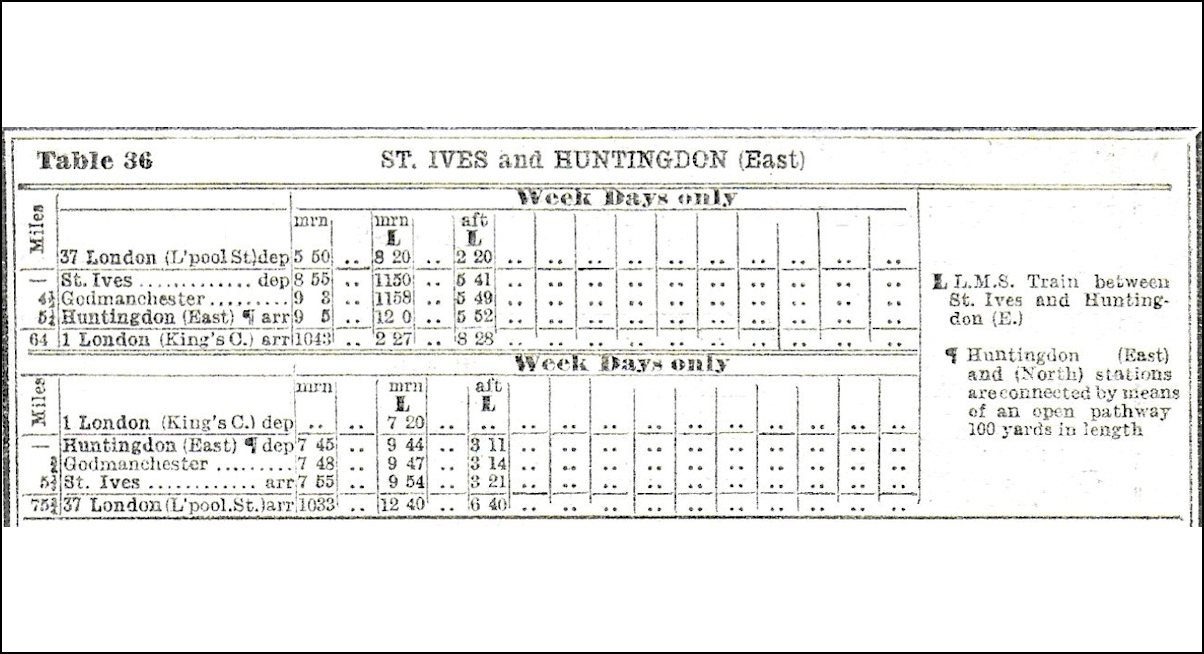
- Spring 1940 LNER Timetable – wartime services over the branch were reduced to just two return trips from Kettering to Cambridge per day, worked by the same LMS train, plus a morning return trip from Huntingdon East to St Ives provided by the LNER. Photo: Alan Jones.
-
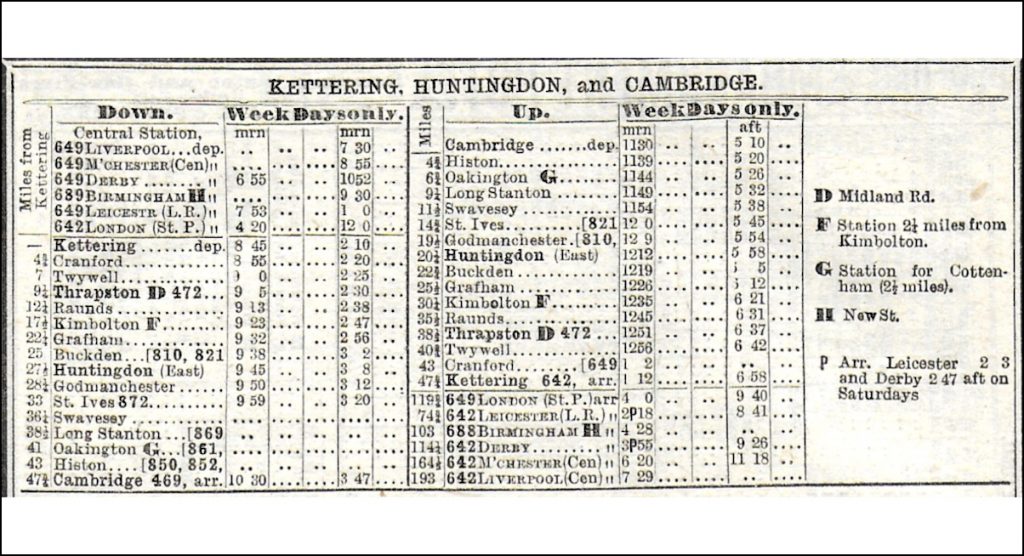
- August 1946 Bradshaw – the basic wartime service of two return trips from Kettering to Cambridge continued for a couple of years after the war. Photo: Alan Jones.

-
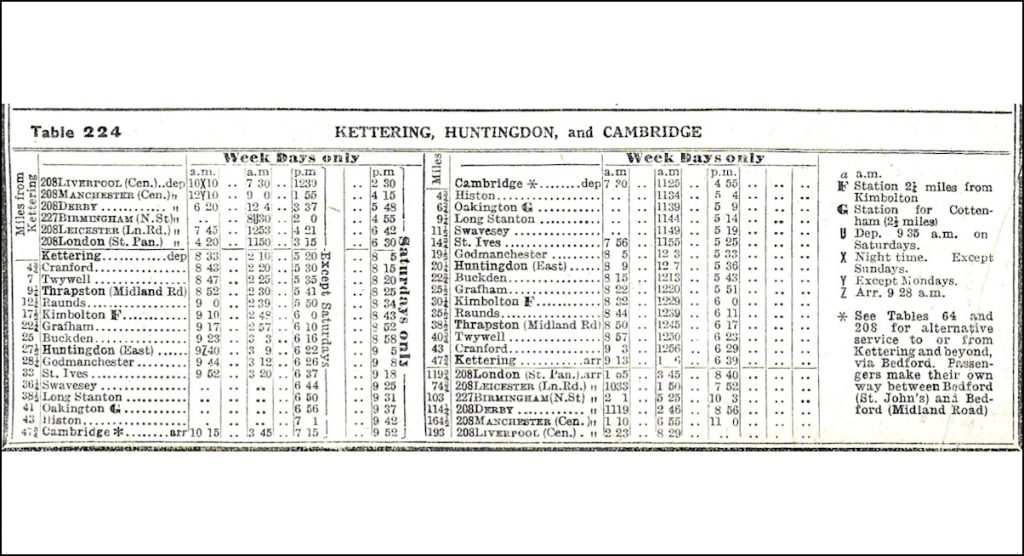
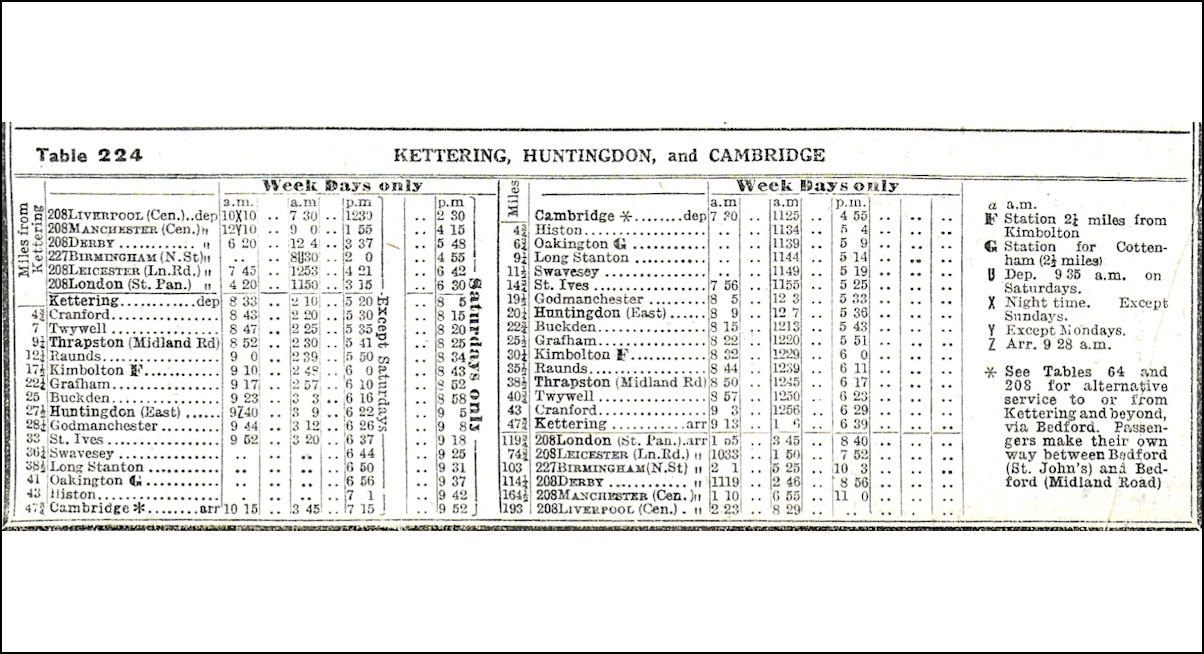
- 1947 LMS Summer Timetable – the branch service was back up to three trains per day in each direction, with the last departure from Kettering being shortly after 8 pm on Saturdays rather than 5.20 pm as during the week – a pattern that would endure. Photo: Alan Jones.
-
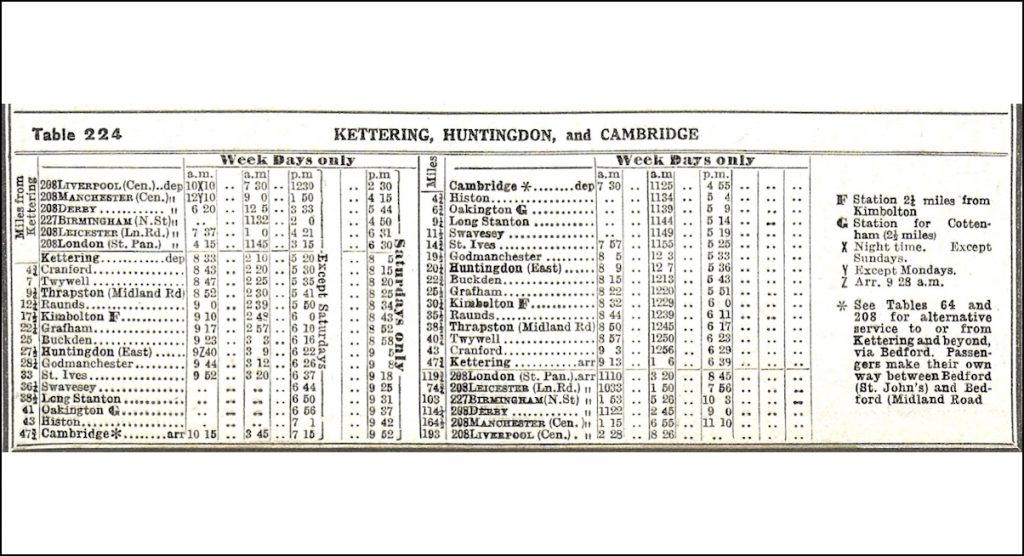
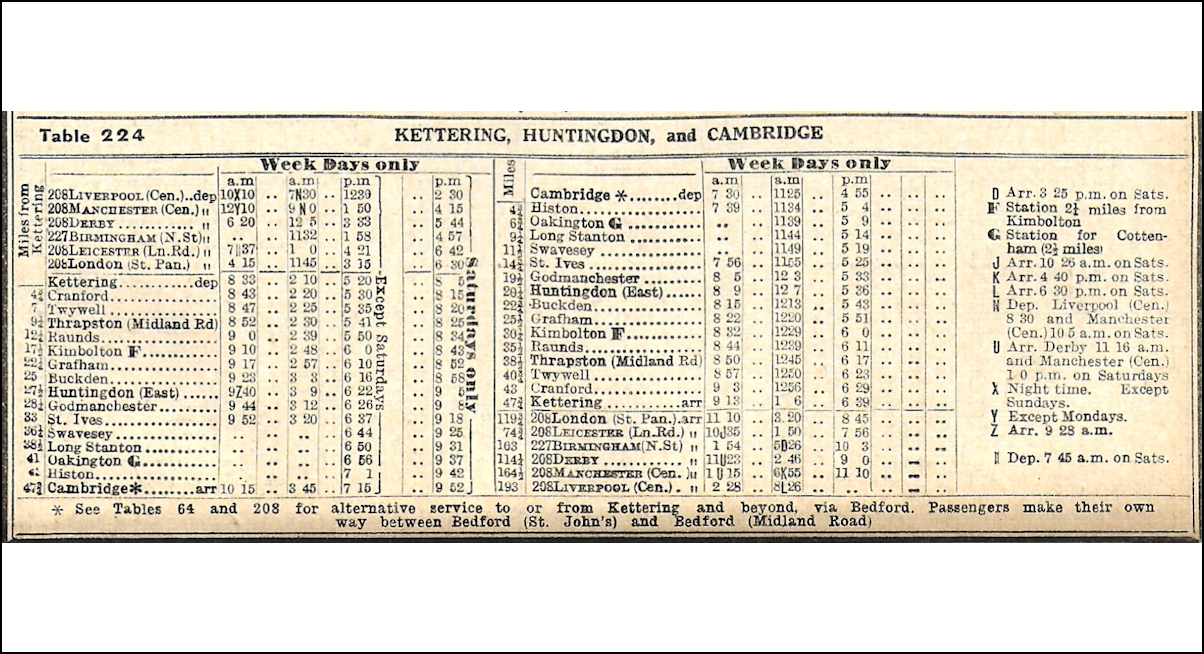
- October 1947 – the final LMS timetable. Photo: Alan Jones.
-
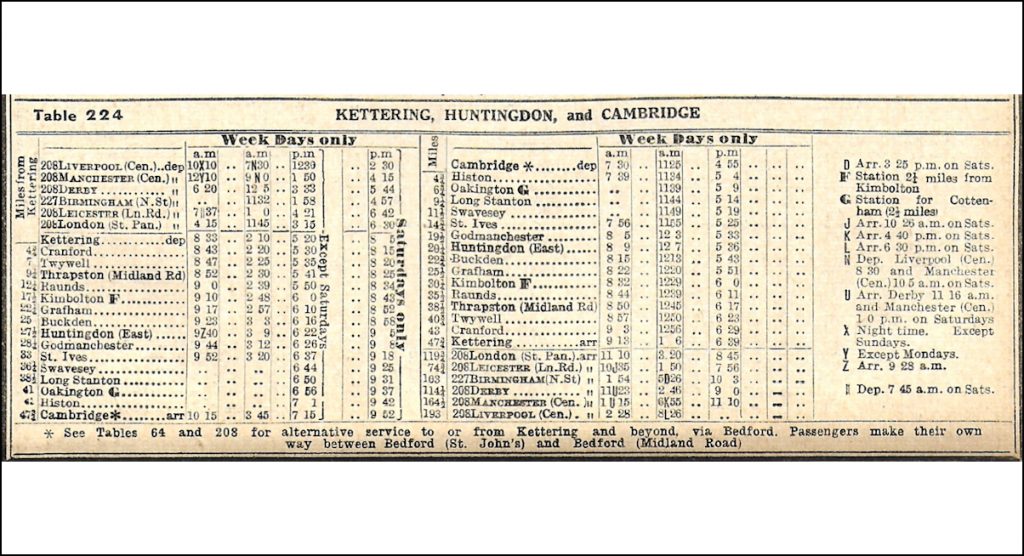
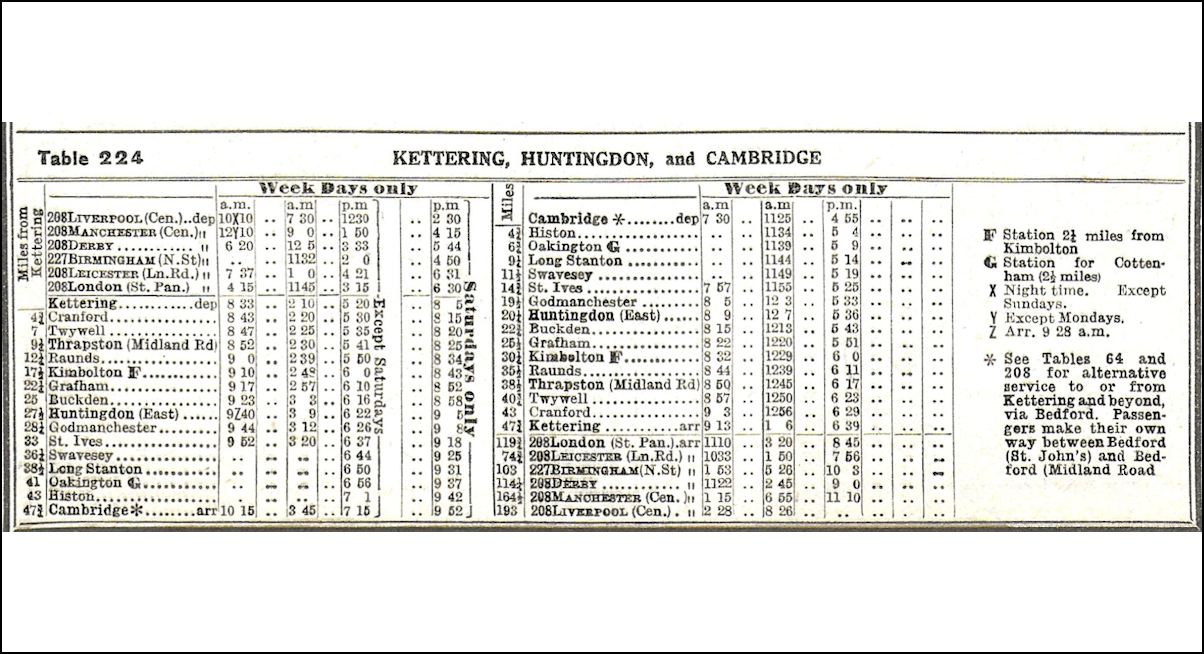
- Summer 1948 BR London Midland Region Timetable – no change! Photo: Alan Jones.
-
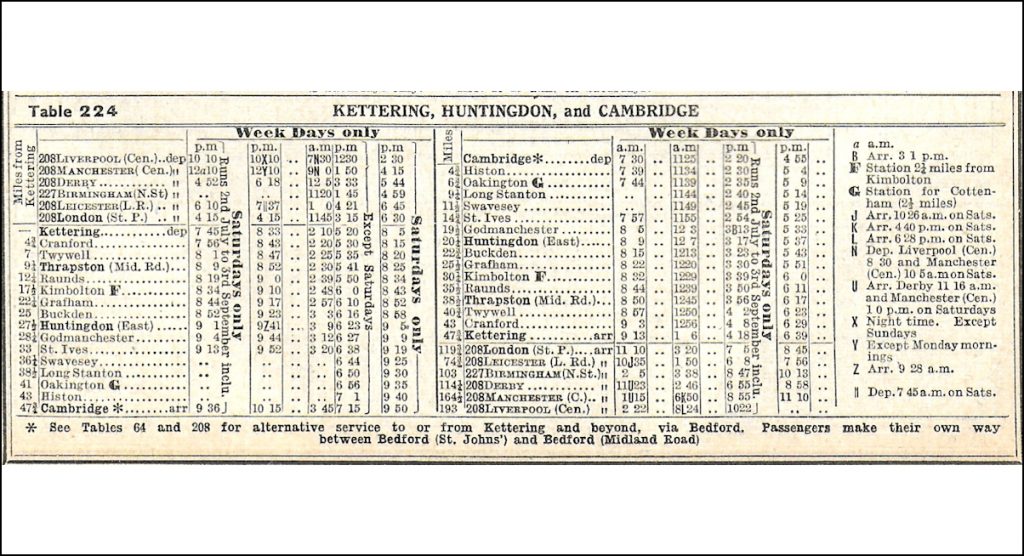
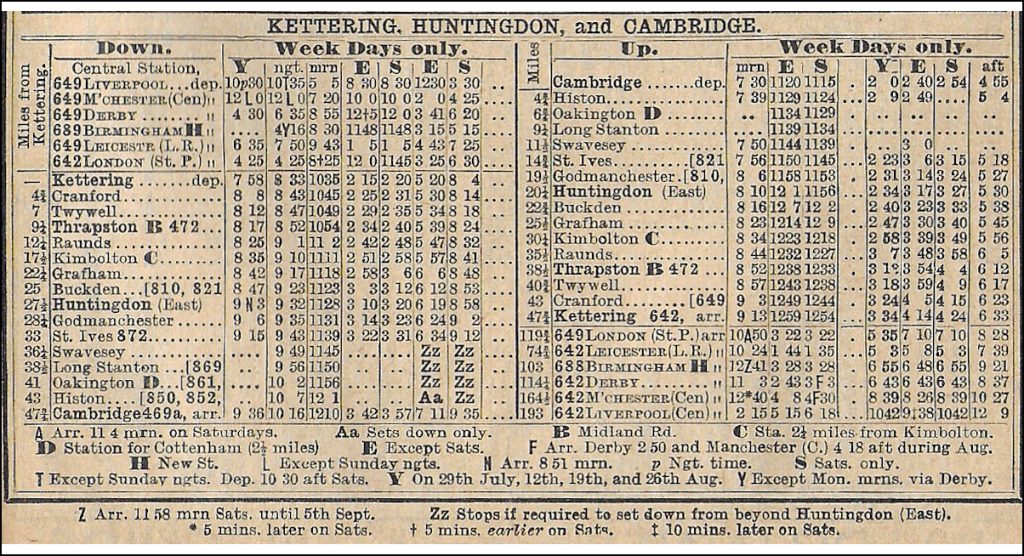
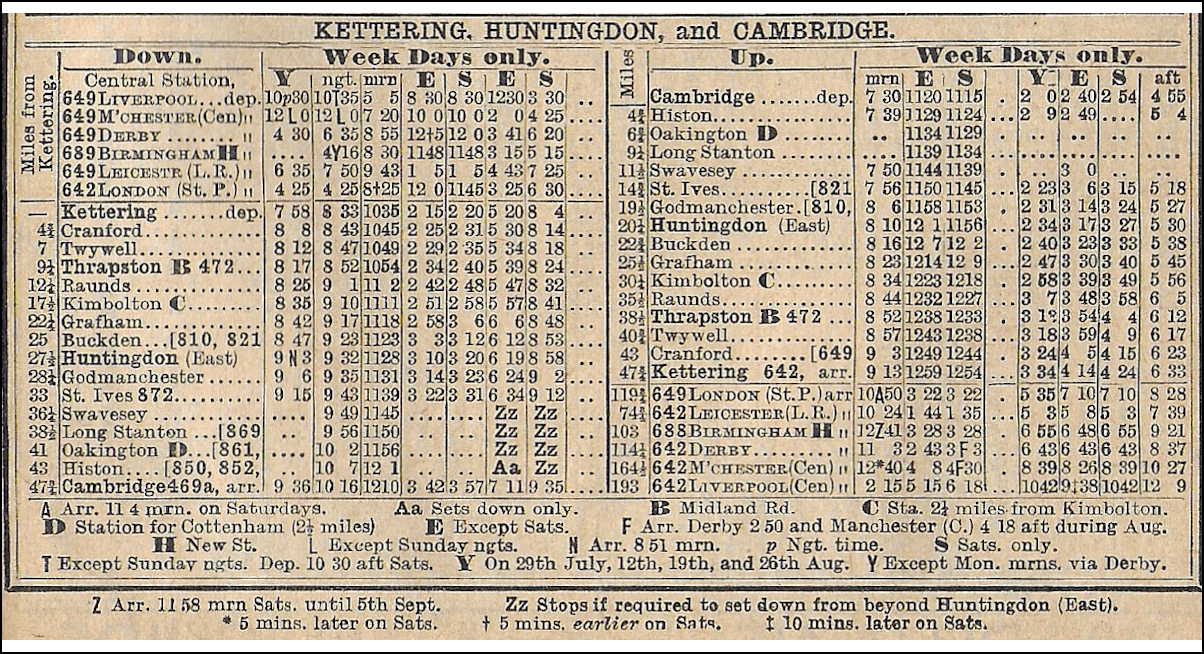
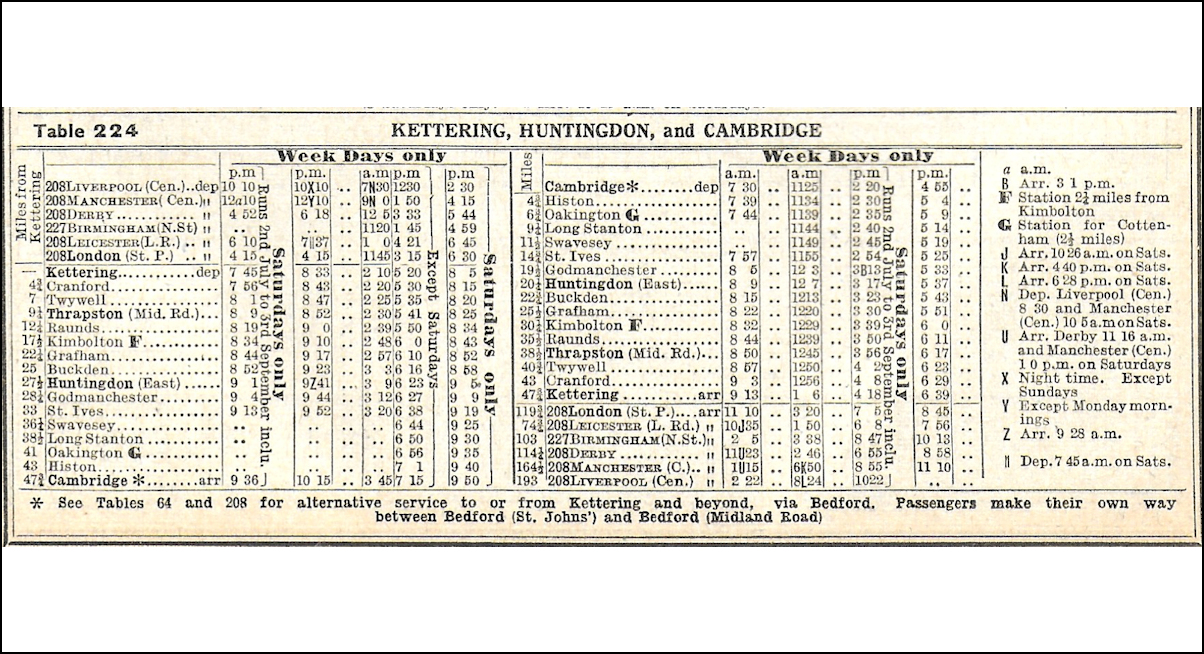
- Summer 1949 BR LMR Timetable – an additional Summer Saturday working has been introduced, running from Kettering to Cambridge and back between 2nd July and 3rd September inclusive. In 1954, this service would be merged with a similar Summer Saturday Cambridge to Clacton service and extended, to form the Leicester to Clacton. Photo: Alan Jones.
-
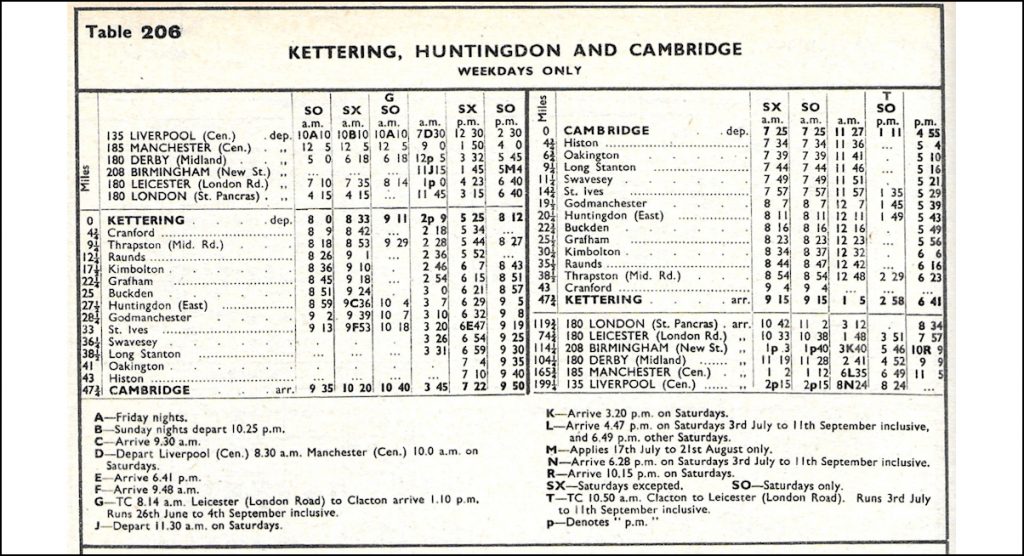
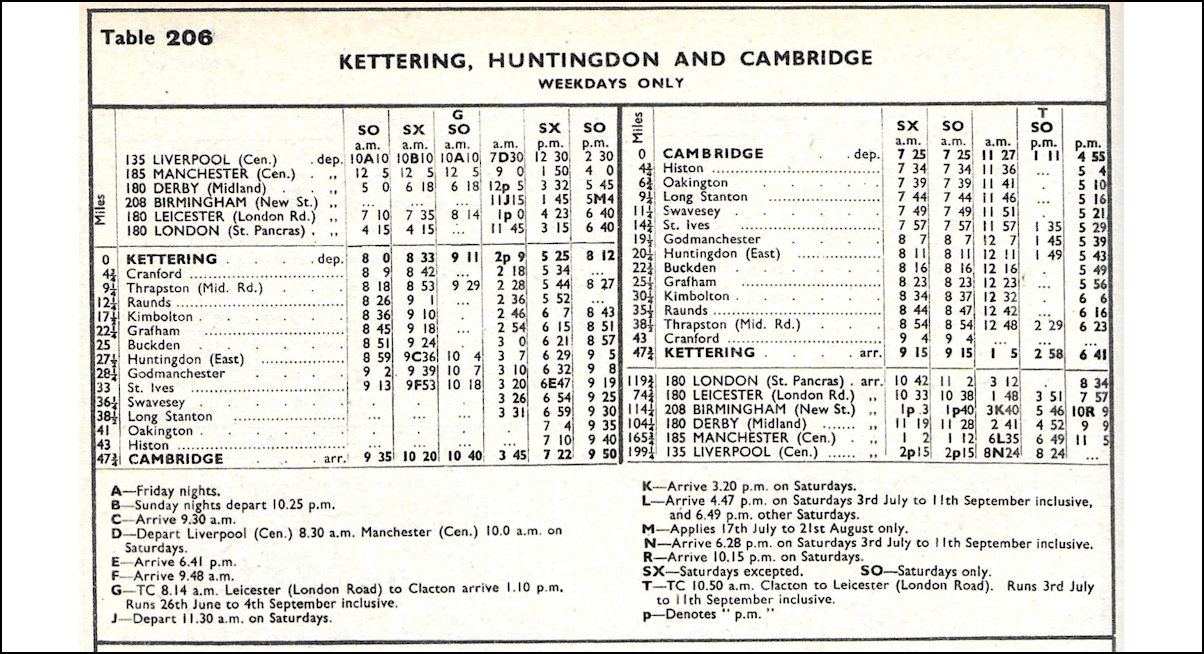
- Summer 1954 and the Summer Saturday Leicester to Clacton has appeared. Note that to accommodate it on the single line, the first train from Kettering runs half an hour earlier and crosses the first train from Cambridge at Kimbolton, rather than Thrapston. The Clacton working is unbalanced, with the stock laying over and hence the return working runs a week later than the outward working. Photo: Alan Jones.
-
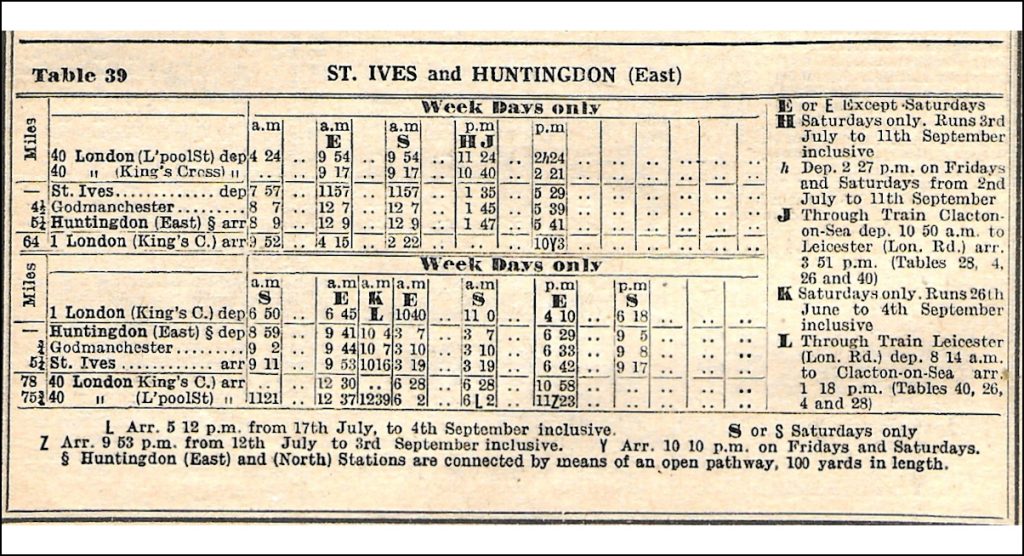
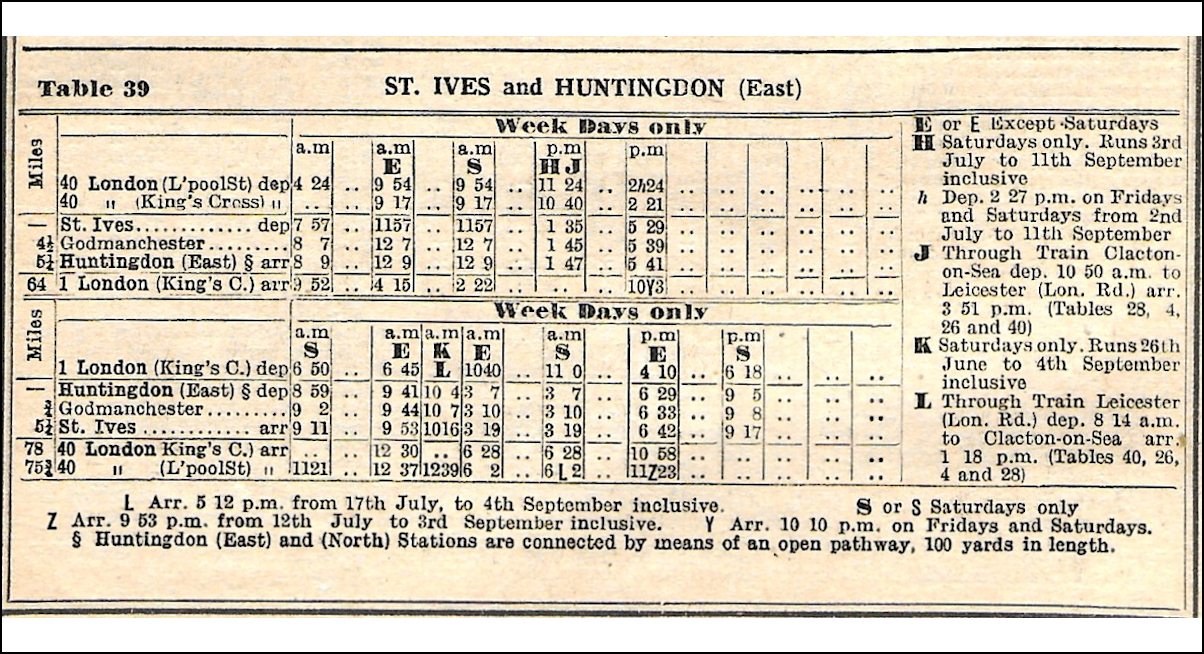
- Summer 1954 BR Eastern Region Timetable – the Huntingdon to St Ives shuttle was stopped in wartime and never re-introduced. The only trains are now the Kettering trains and the service that was 11-12 trains per day is now down to 3. Photo: Alan Jones.
-
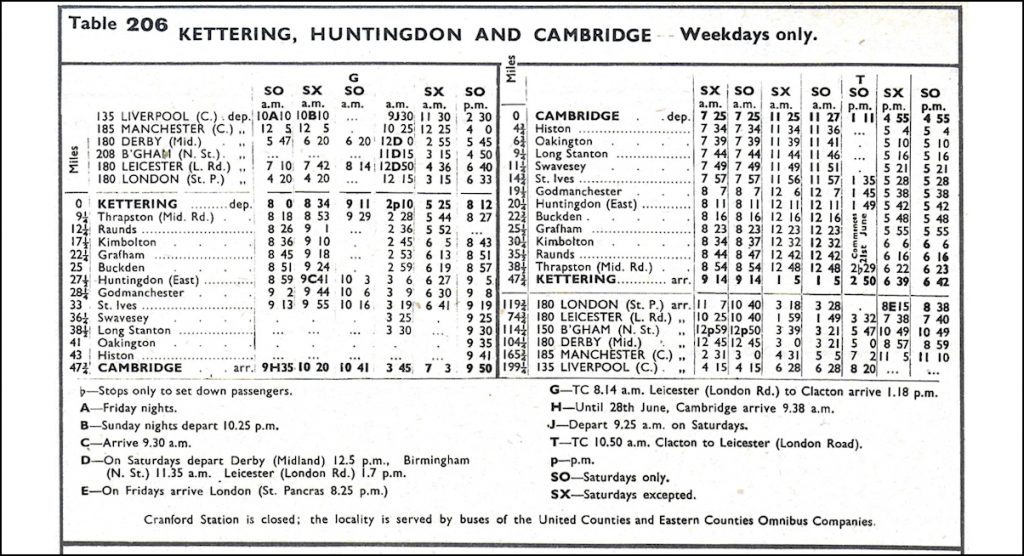
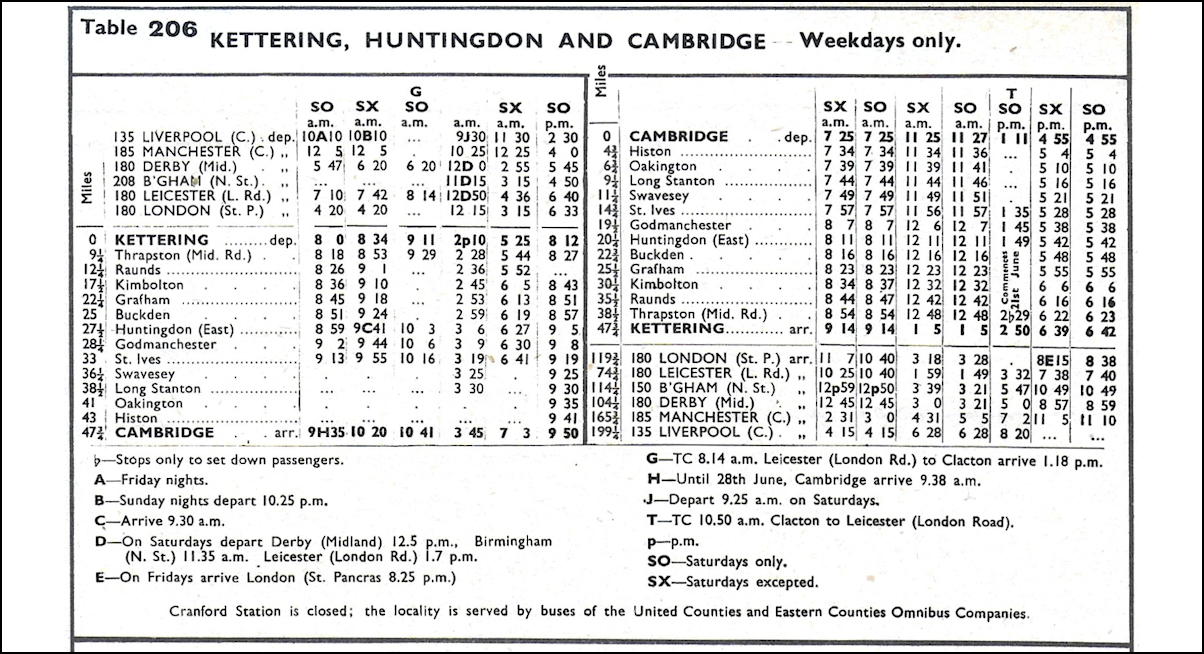
- Summer 1958 BR LMR Timetable – the last full Summer of operation of the Branch. The pattern of service is unchanged from when the Leicester-Clacton Summer Saturday working was introduced in 1954
-
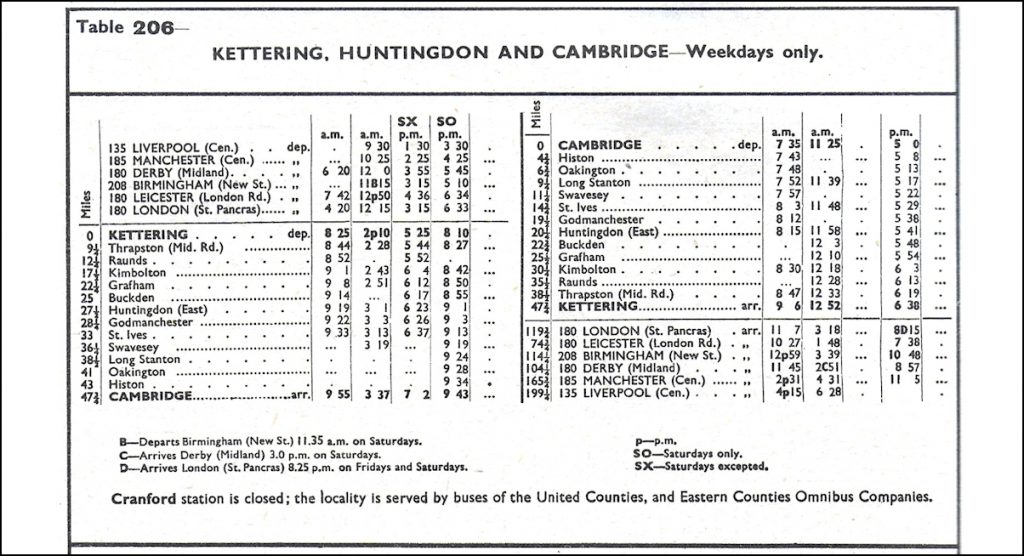
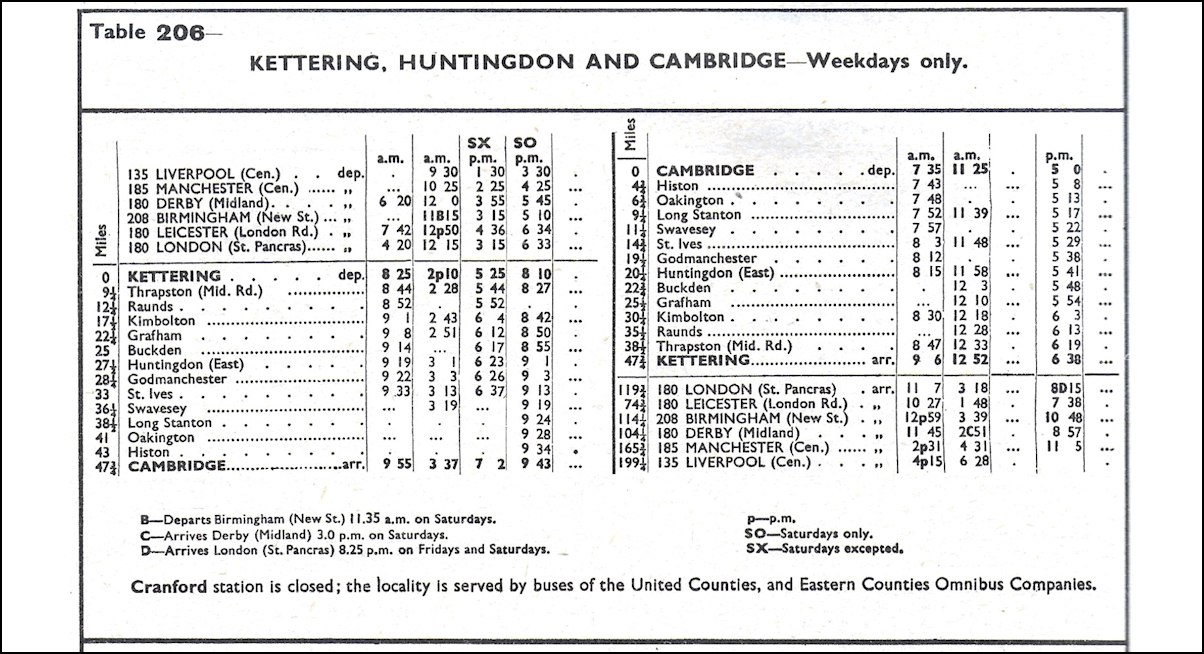
- Winter 1958-59 BR LMR Timetable – the last timetable for the Branch, whose last day of operation was Saturday 13th June 1959. The last 5.0 pm from Cambridge was pulled by Kettering’s Ivatt Class 2 No. 46496 and the last 8.10 pm from Kettering was pulled by Cambridge’s 46467. Photo: Alan Jones.
-
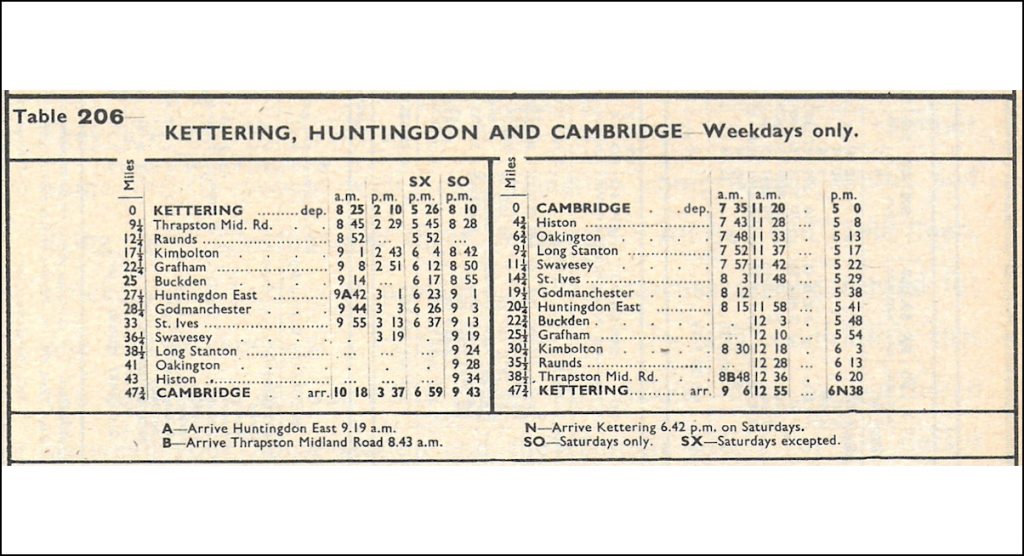
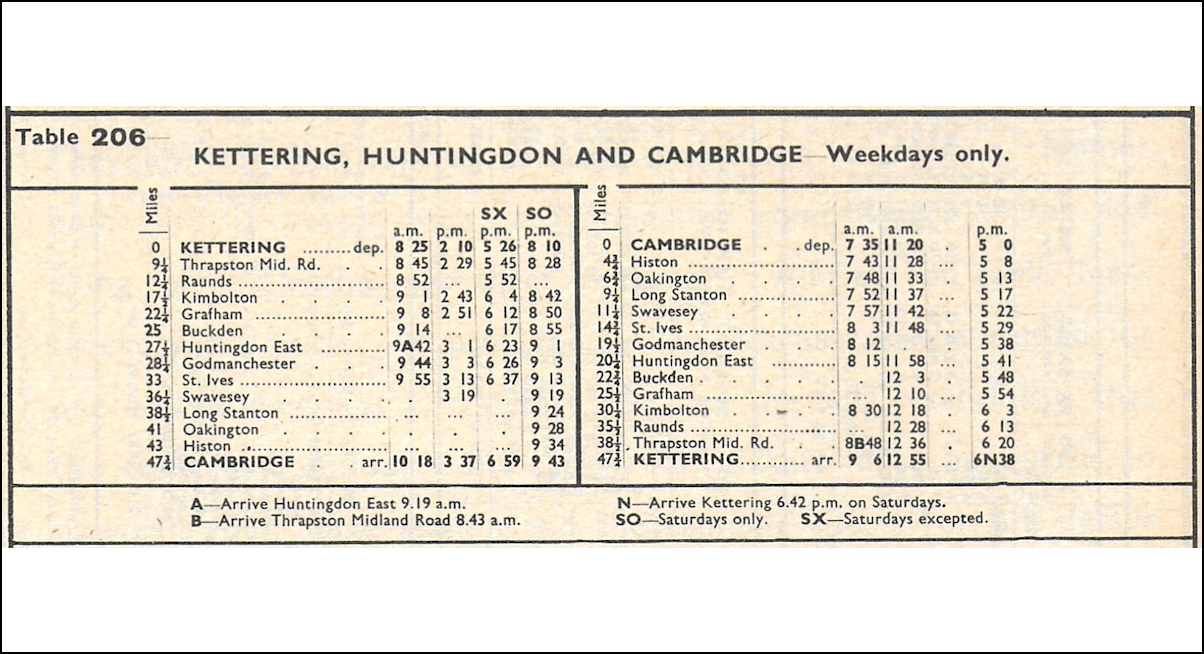
- Summer 1959 BR LMR Timetable – the timetable that never was. Although the last passenger train on the Branch ran on Saturday 13th June 1959 at the end of the 1958-59 timetable, the next BR LMR timetable, commencing Monday 15th June 1959, contained this entry for the Branch. It is very much a standard Winter timetable and gives the impression of being included just in case the service had to continue into the new timetable. Sadly it didn’t. Photo: Alan Jones.
-
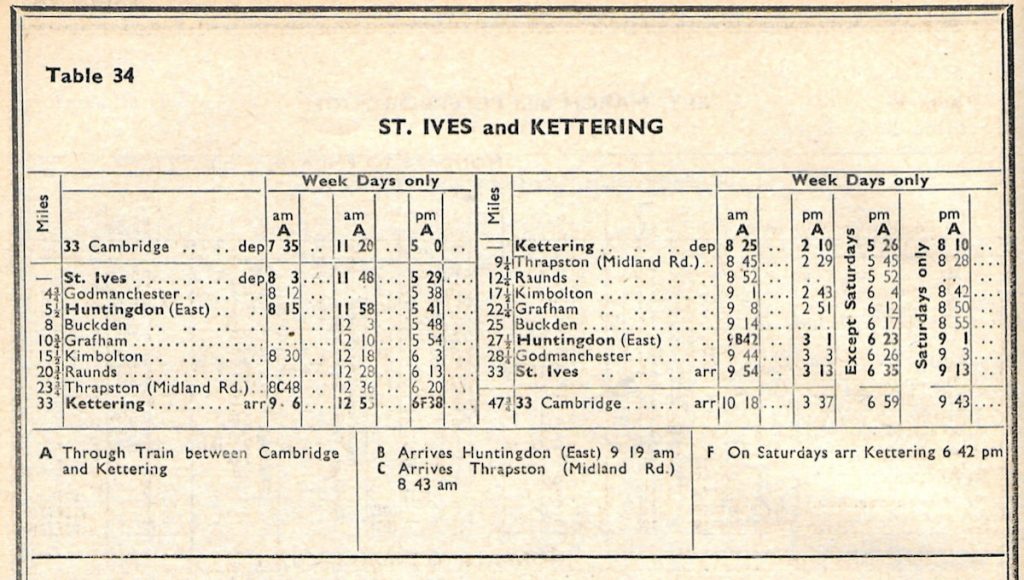
- Summer 1959 BR Eastern Region Public Timetable showing the ‘fallback’ service between Cambridge and Kettering that would have been implemented had the line stayed open beyond its closure date of 13th June, 1959. Photo: Alan Jones.
-
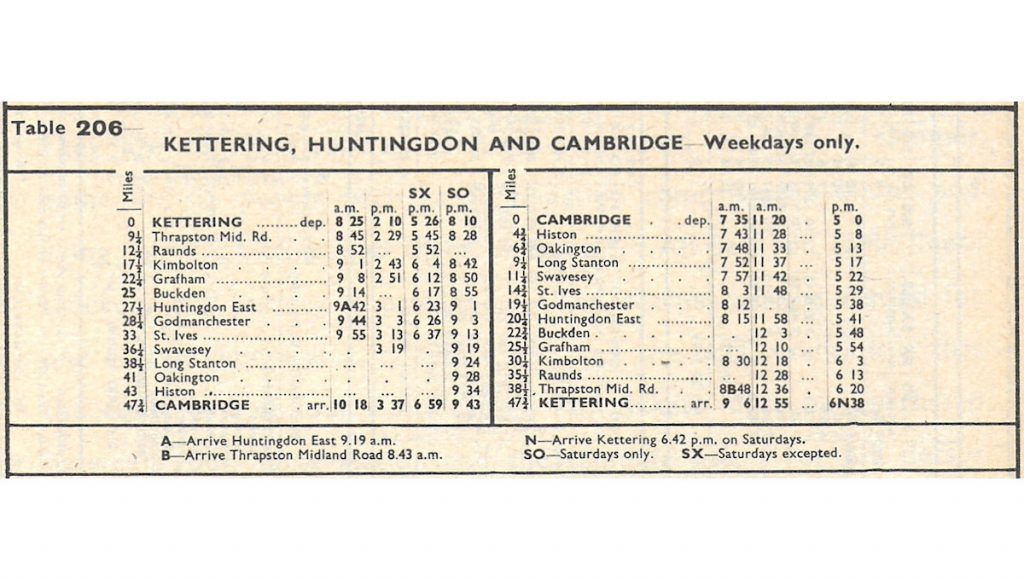
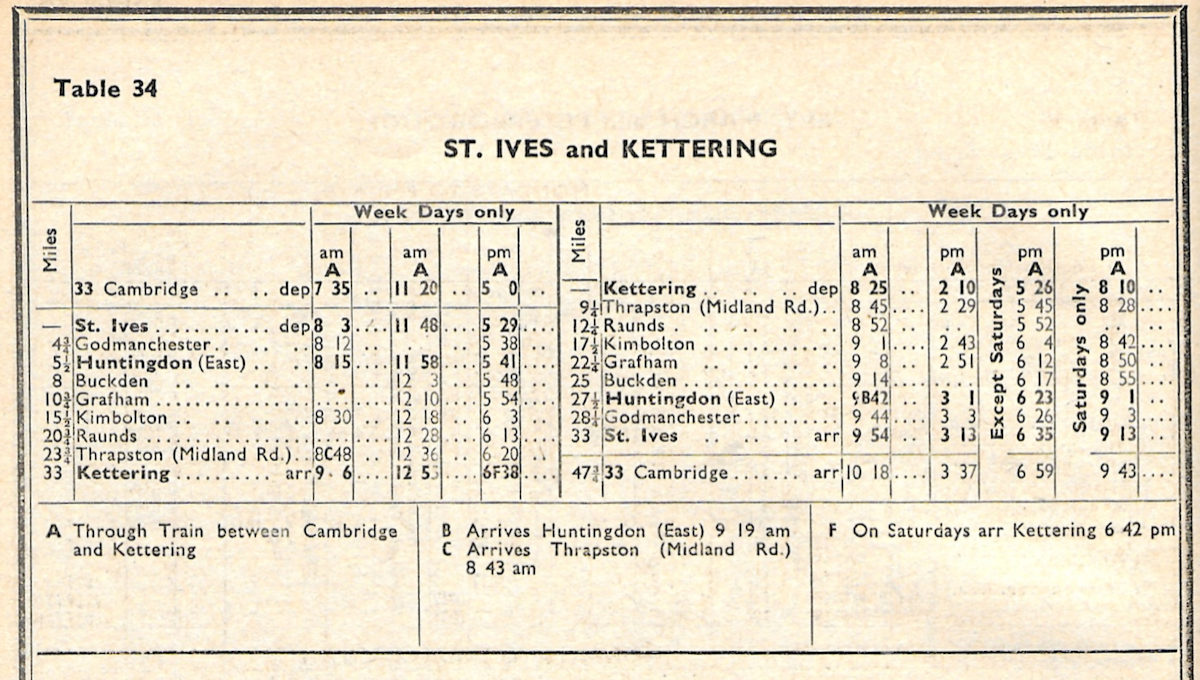
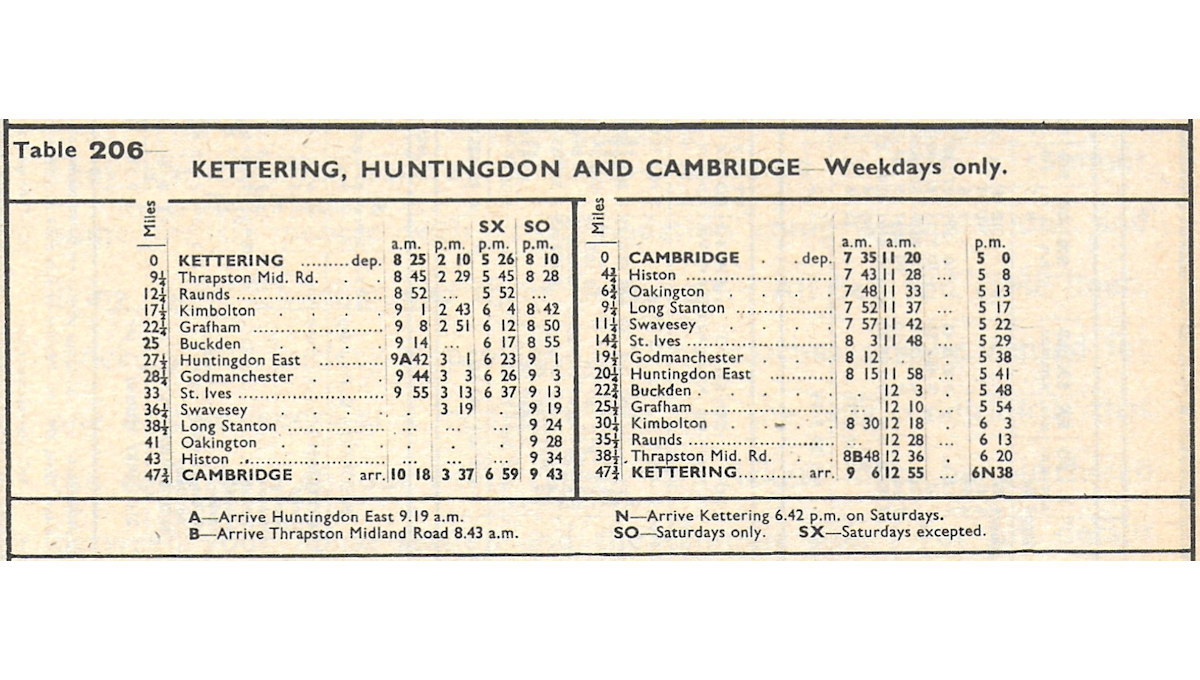
- Summer 1959 BR London Midland Region Public Timetable showing the ‘fallback’ service between Cambridge and Kettering that would have been implemented had the line stayed open beyond its closure date of 13th June, 1959. Photo: Alan Jones.
-
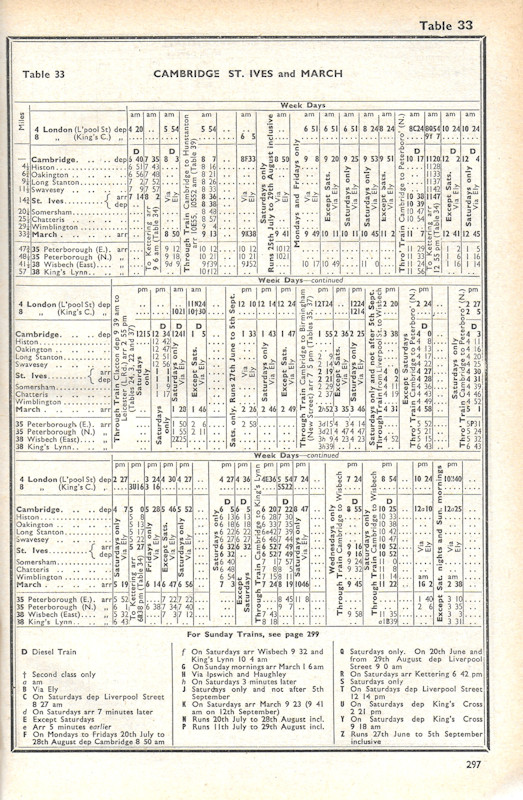
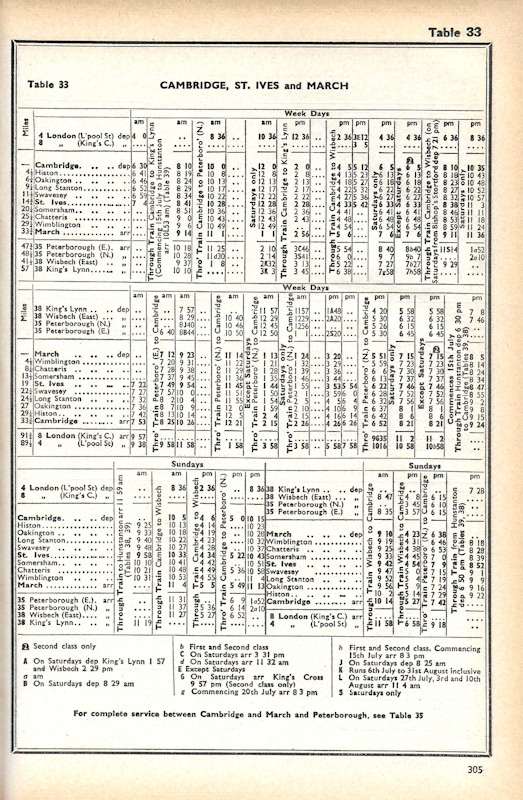
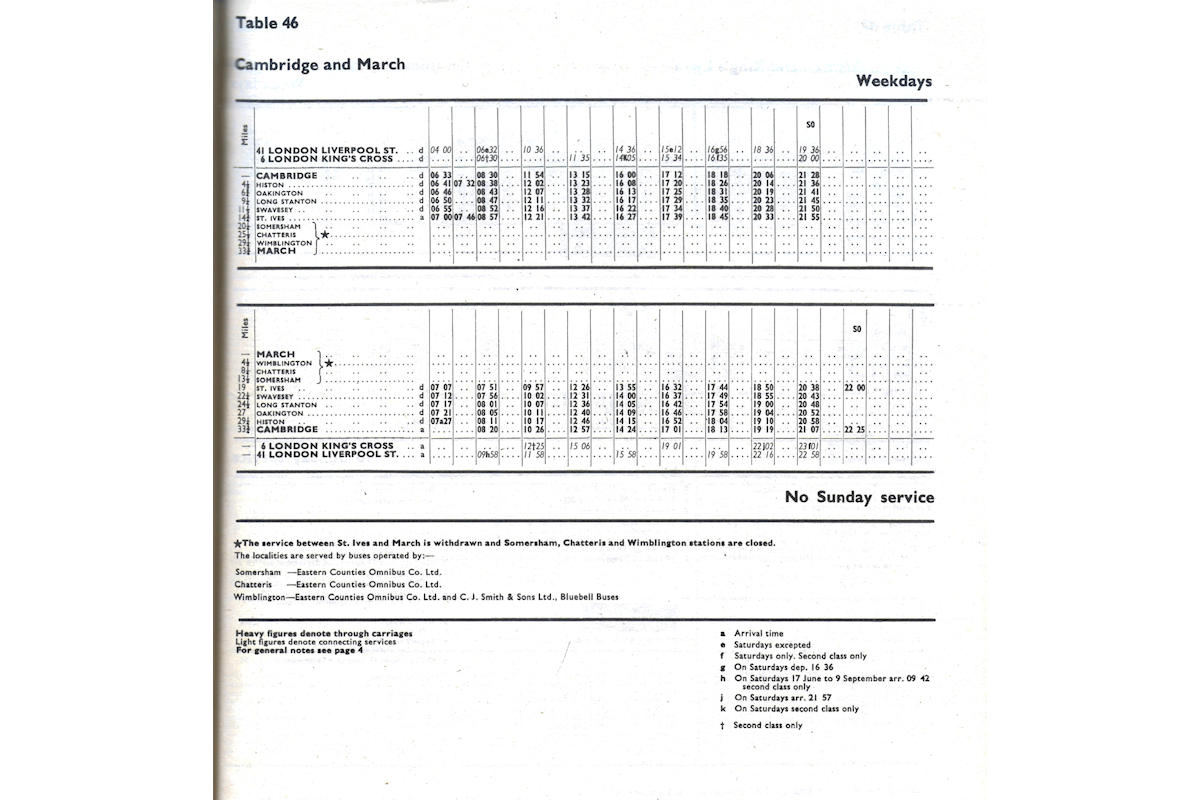
- Summer 1959 BR Eastern Region Passenger Timetable – Cambridge to March via St Ives, Weekdays. Photo: Alan Jones
-
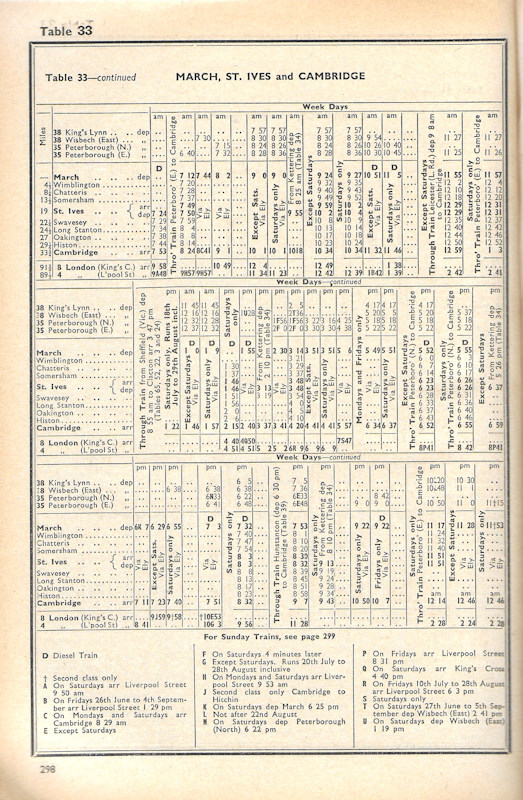
- Summer 1959 BR Eastern Region Passenger Timetable – March to Cambridge via St Ives, Weekdays. Photo: Alan Jones
-
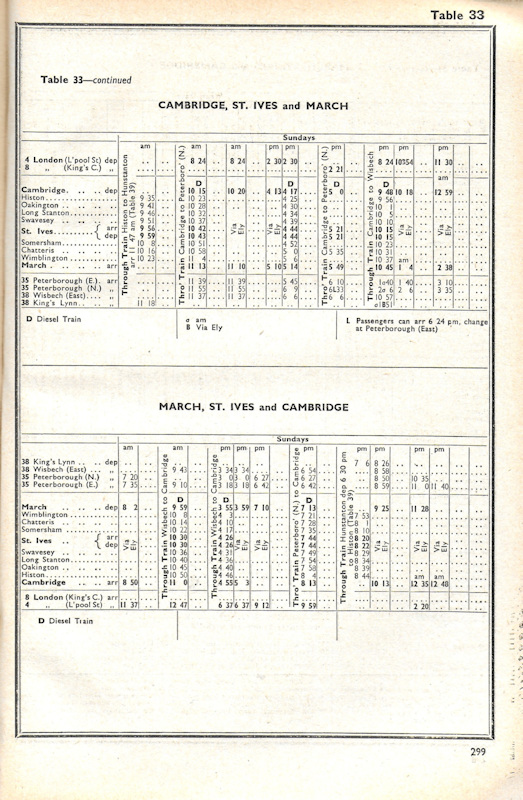
- Summer 1959 BR Eastern Region Passenger Timetable – Cambridge to March and March to Cambridge via St Ives, Sundays. Photo: Alan Jones
-
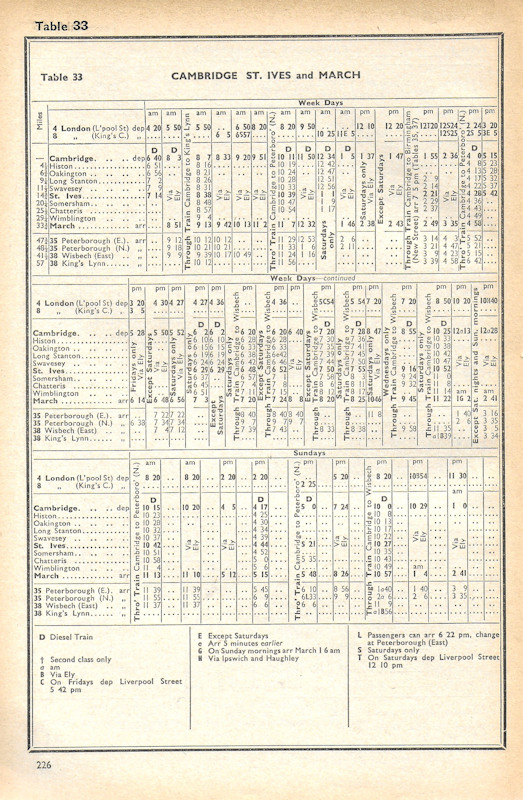
- Winter 1959/60 BR Eastern Region Passenger Timetable – Cambridge to March via St Ives, Weekdays and Sundays. Photo: Alan Jones
-
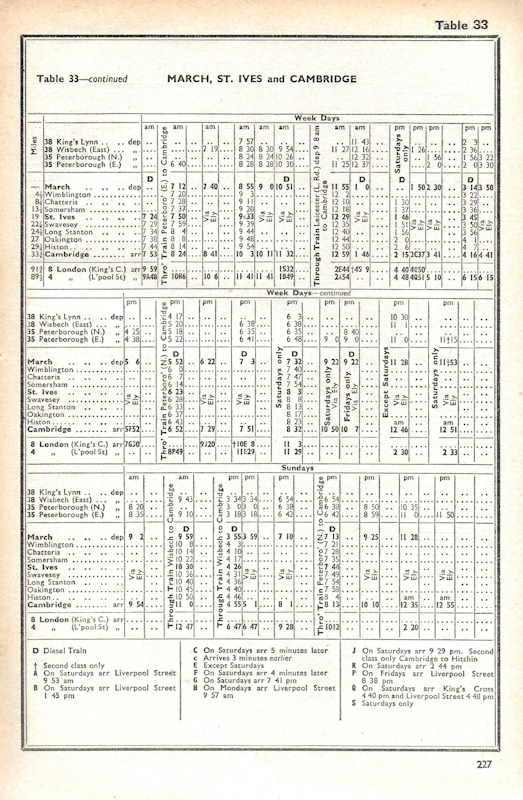
- Winter 1959/60 BR Eastern Region Passenger Timetable – March to Cambridge via St Ives, Weekdays and Sundays. Photo: Alan Jones
-
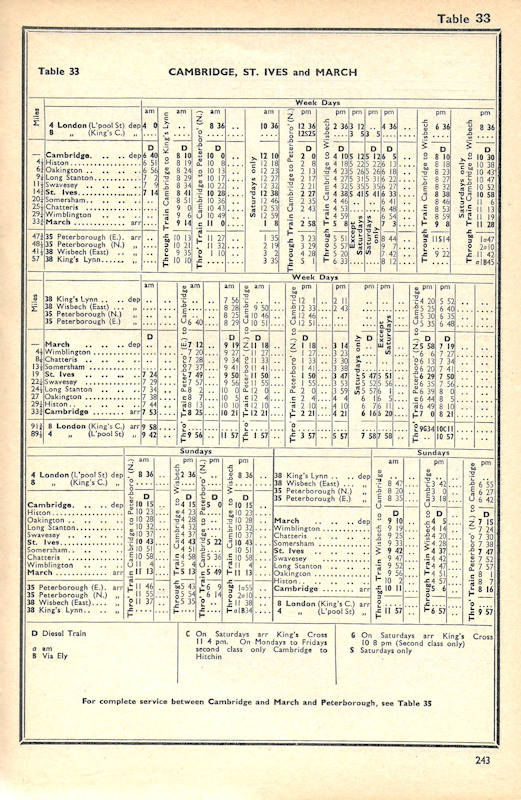
- Winter 1961/62 BR Eastern Region Passenger Timetable – Cambridge to March and March to Cambridge via St Ives, Weekdays and Sundays. Photo: Alan Jones
-
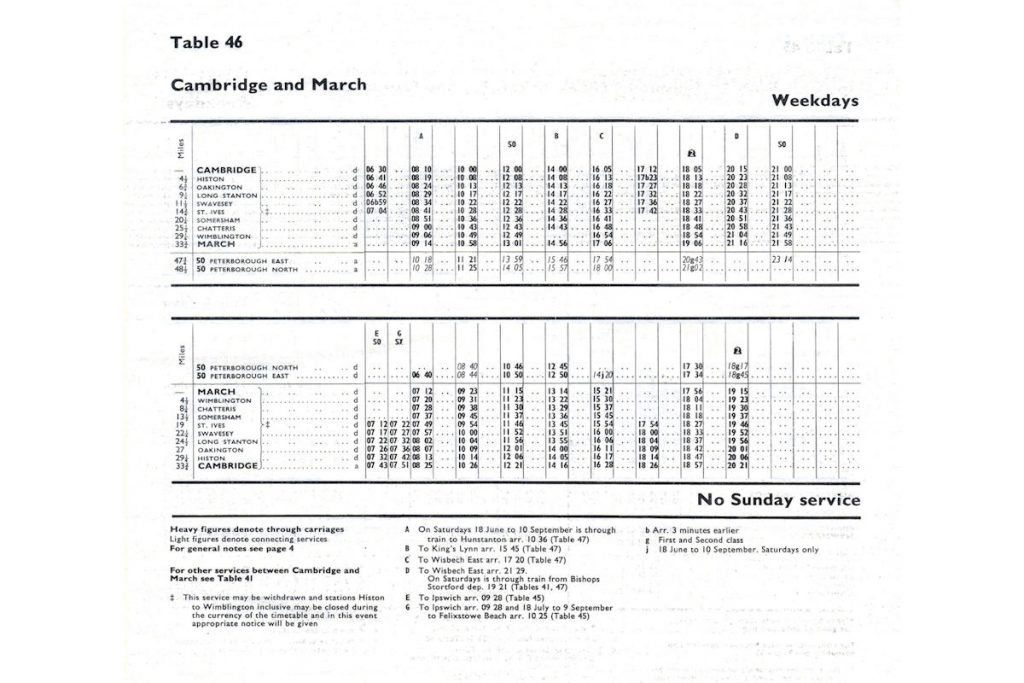
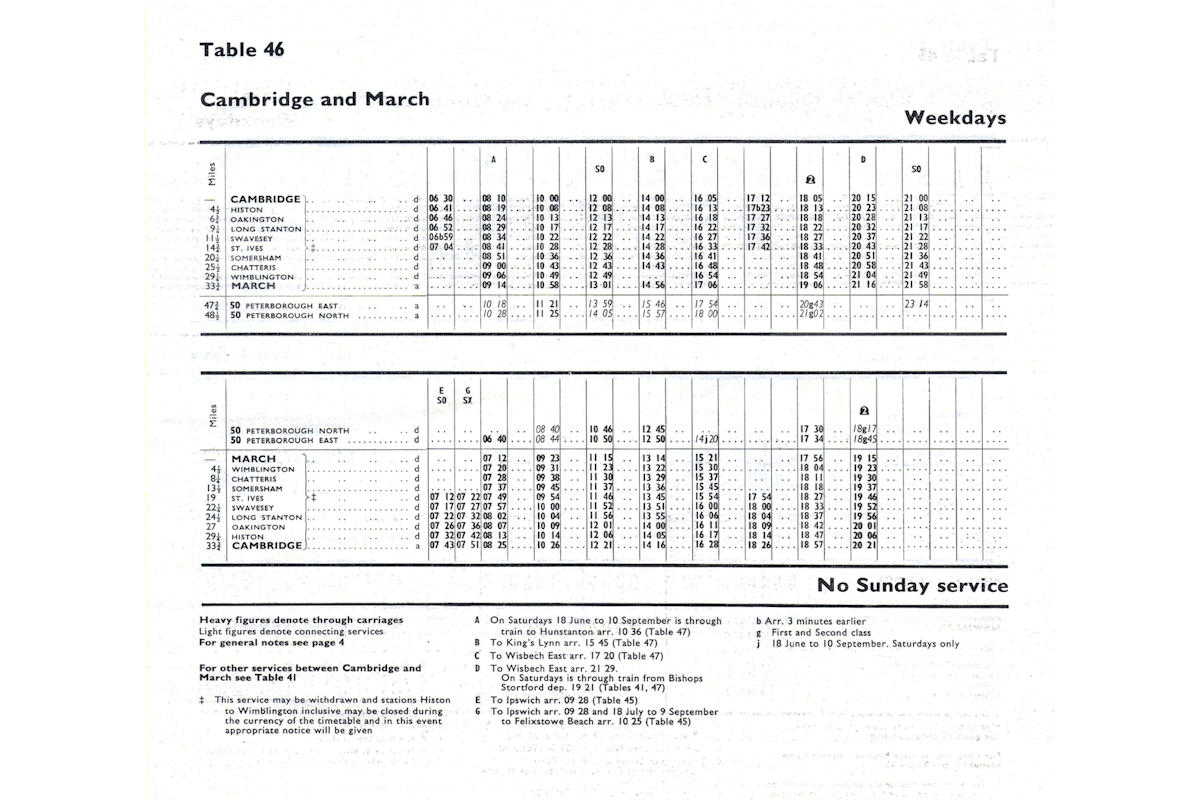
- Summer 1963 BR Eastern Region Passenger Timetable – Cambridge to March and March to Cambridge via St Ives, Weekdays and Sundays. Photo: Alan Jones
-
- Goods traffic between St Ives and March was withdrawn in 1966 and the passenger service ceased on 6th March 1967. This is the final timetable (April 1966-March 1967) for the through route. Photo: Alan Jones.
-
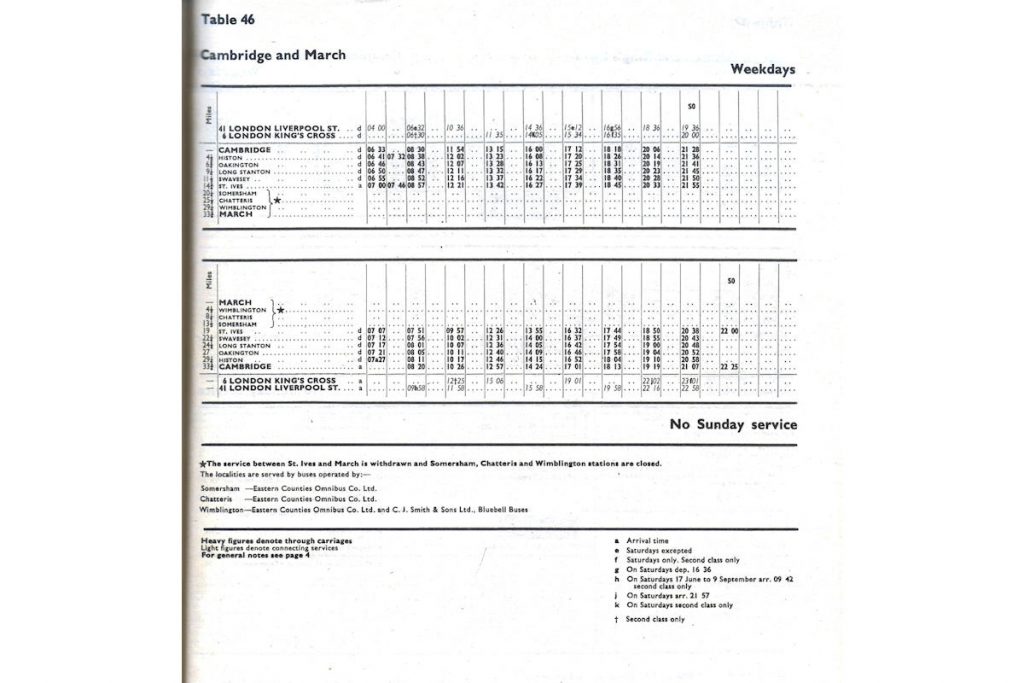
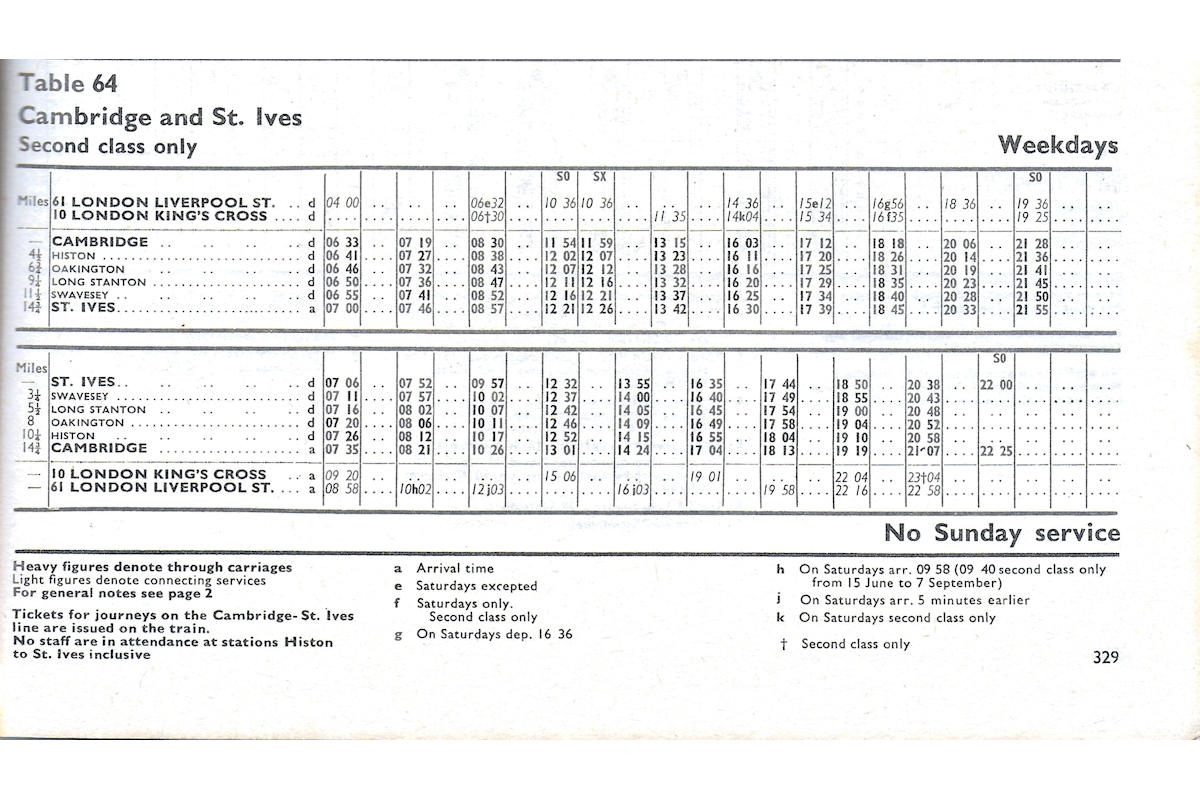
- Following closure of the through route from Cambridge to March via St Ives in March 1967, a short-lived service from Cambridge to St Ives was introduced as shown in the March 1967-May 1968 timetable. Notice the curious termination of the first train from St Ives at Histon, followed by a fast run back to St Ives for a return to Cambridge at peak time. These were clearly difficult times. Photo: Alan Jones.
-
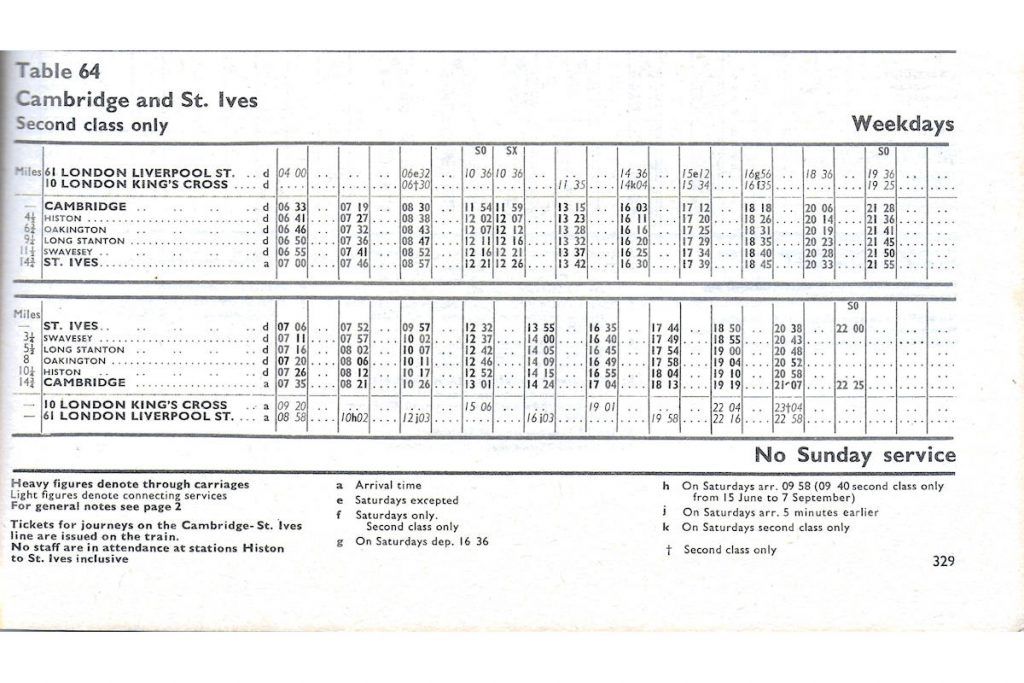
- Early morning workings from St Ives were in better shape by 1968. Photo: Alan Jones.
-
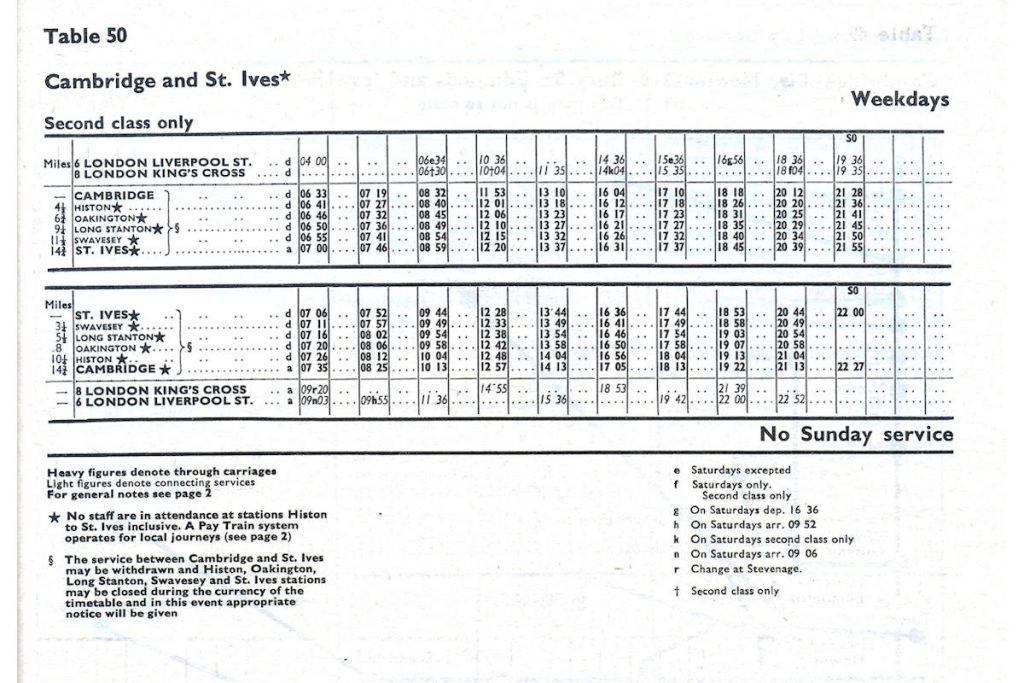
- Along with much of East Lincolnshire, the St Ives branch finally succumbed on 5th October 1970, bringing to an end the last remains of passenger travel between Kettering and Cambridge. The final timetable, from May 1970 to May 1971, sets out the stark reality of the situation. Photo: Alan Jones.

-
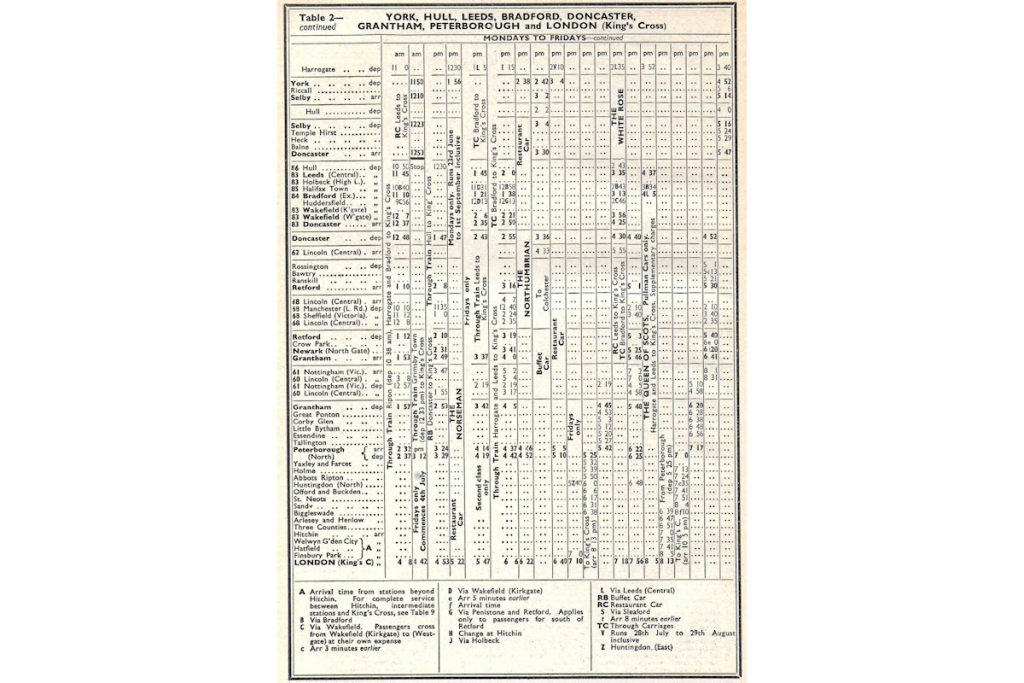
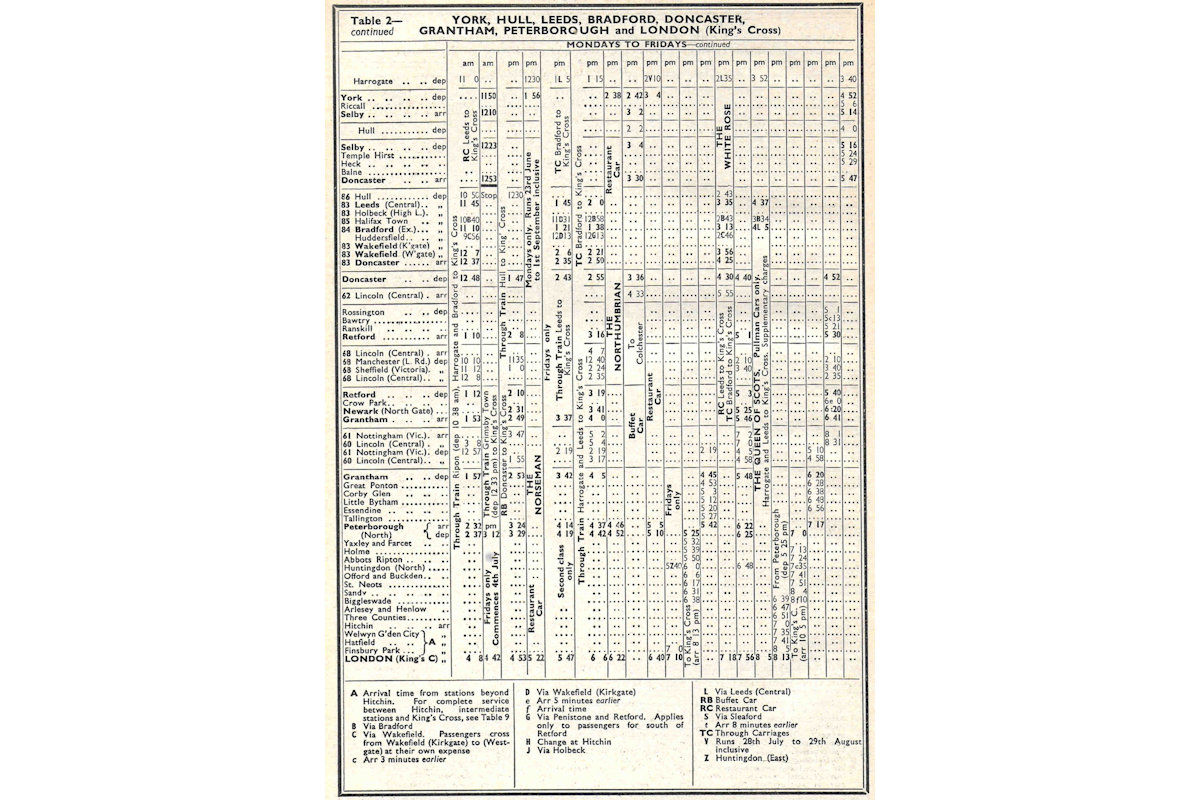
- Summer 1958 BR ER Timetable – a curiosity at Huntingdon was the Friday Only 5.40 pm fast service to Finsbury Park and Kings Cross, seen in the tenth column from the left on this timetable. It was often hauled by an L1 2-6-4T locomotive. It left from the Joint Line platforms at Huntingdon East (platforms 1 and 2) and was largely for the benefit of Service personnel from the surrounding air bases taking weekend leave. Photo: Alan Jones.
-
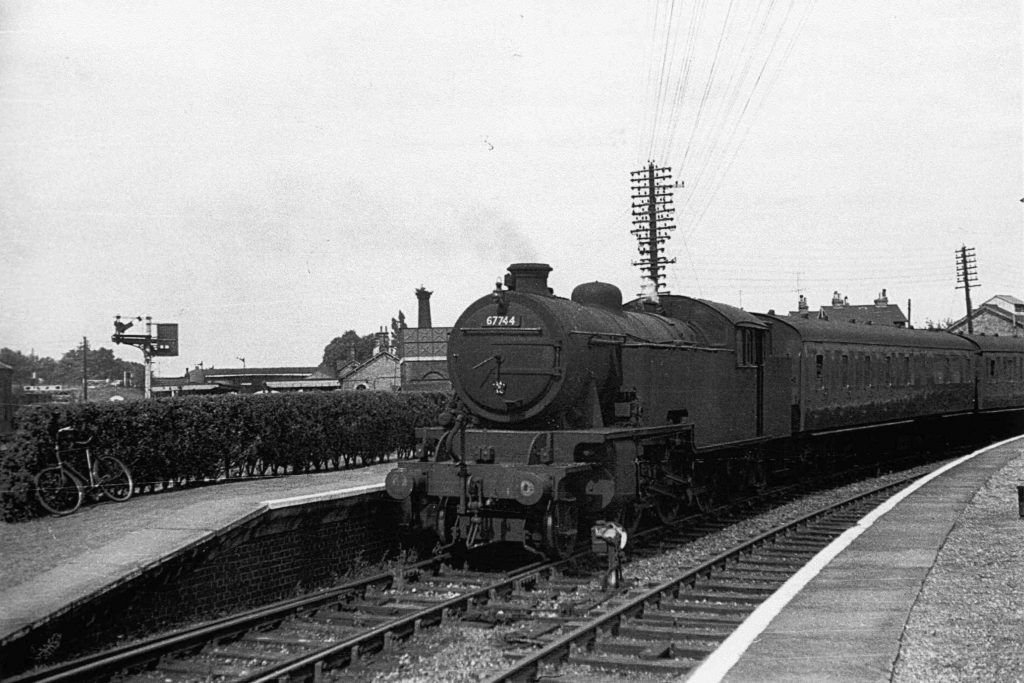
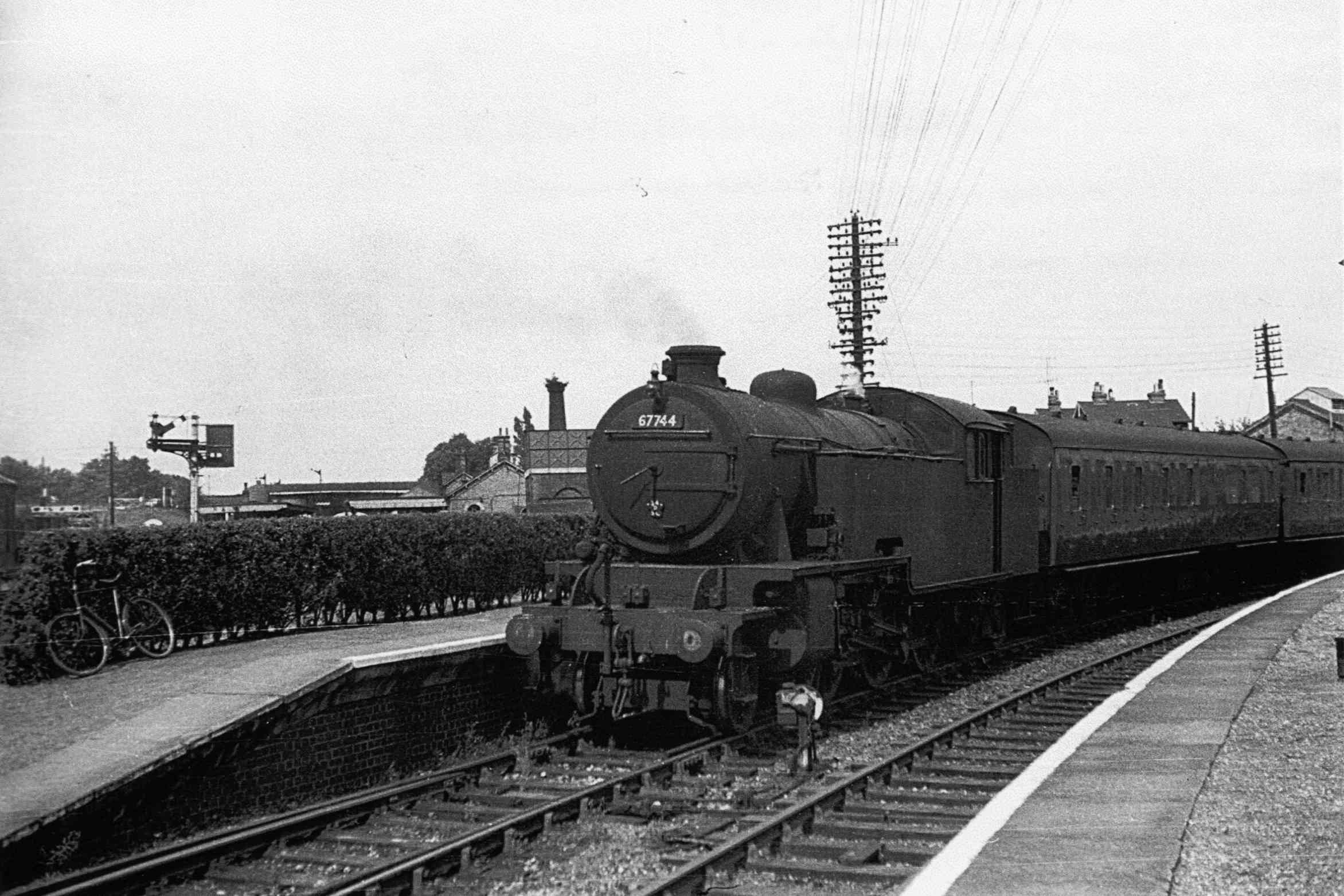
- LNER Class L1 2-6-4T No. 67744 stands at the Joint Line platforms at Huntingdon East with the previously-mentioned Fridays Only working to Kings Cross. The Great Northern main line station canopies can be seen over the top of the hedgerow, with ‘off’ signals on the Up and Down main lines. Date unknown, Photo: Robin Cullup Collection.
-
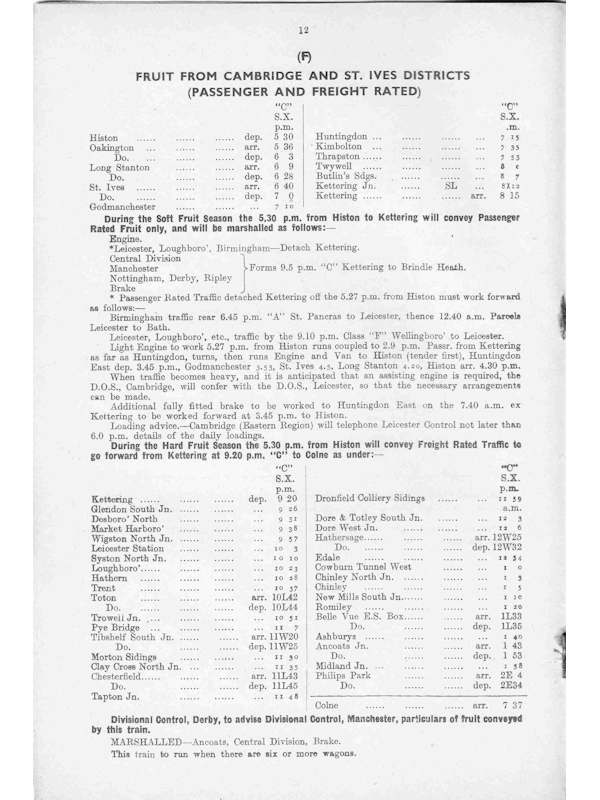
- Summer 1955 Fruit and Vegetable Notice. The engine for the 5.30pm Class C fruit train from Histon to Brindle Heath or Colne travelled out from Kettering at the front of the 2.09pm departure as far as Huntingdon East. It came off there, turned on the turntable, ran tender-first with brake van at 3.45pm to Histon then came back at 5.30pm stopping at Oakington, Long Stanton and St Ives for 20-30 minutes at each station to pick up, before a non-stop run to Kettering. It departed Kettering at 9.5pm (Brindle Heath) or 9.20pm (Colne) for a fast run North on the Midland Main Line to Manchester, stopping at Hathersage to take water shortly after midnight. Photo: Robin Cullup Collection.
-
- The Histon to Manchester Class C Fruit Train is seen behind Ivatt 2-6-0 Class 2 No. 46401 on the approach to Huntingdon East on August 10th 1954. The perishable nature of fruit traffic meant that the punctual running of this train was of the highest priority. Photo: E.H. Sawford – Robin Cullup Collection.
-
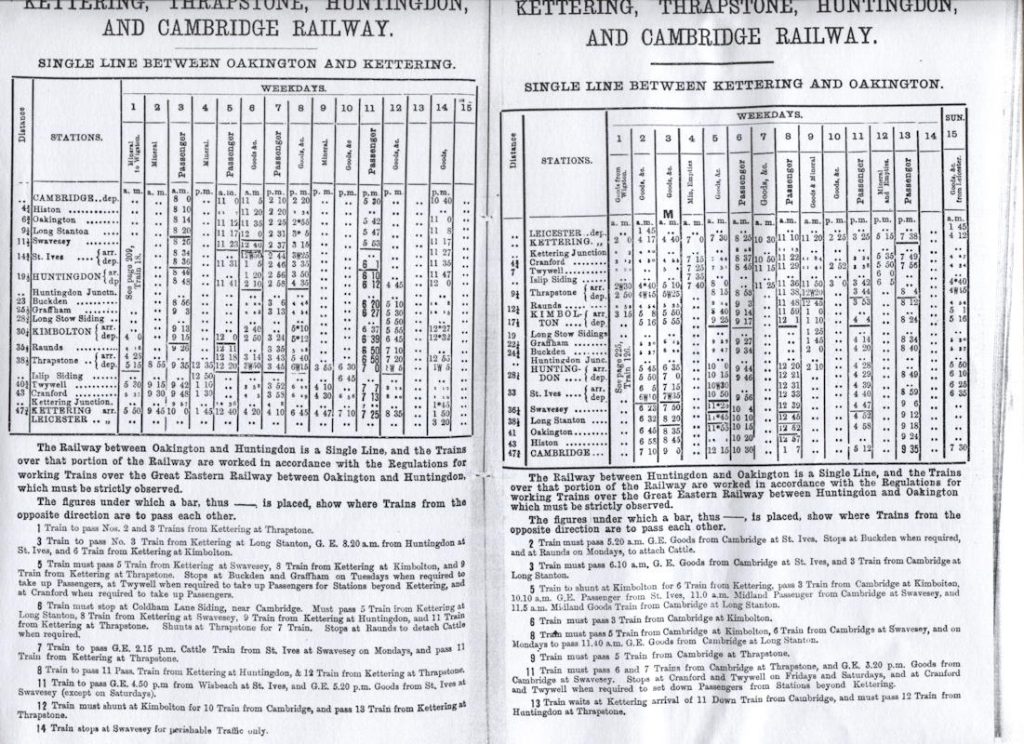
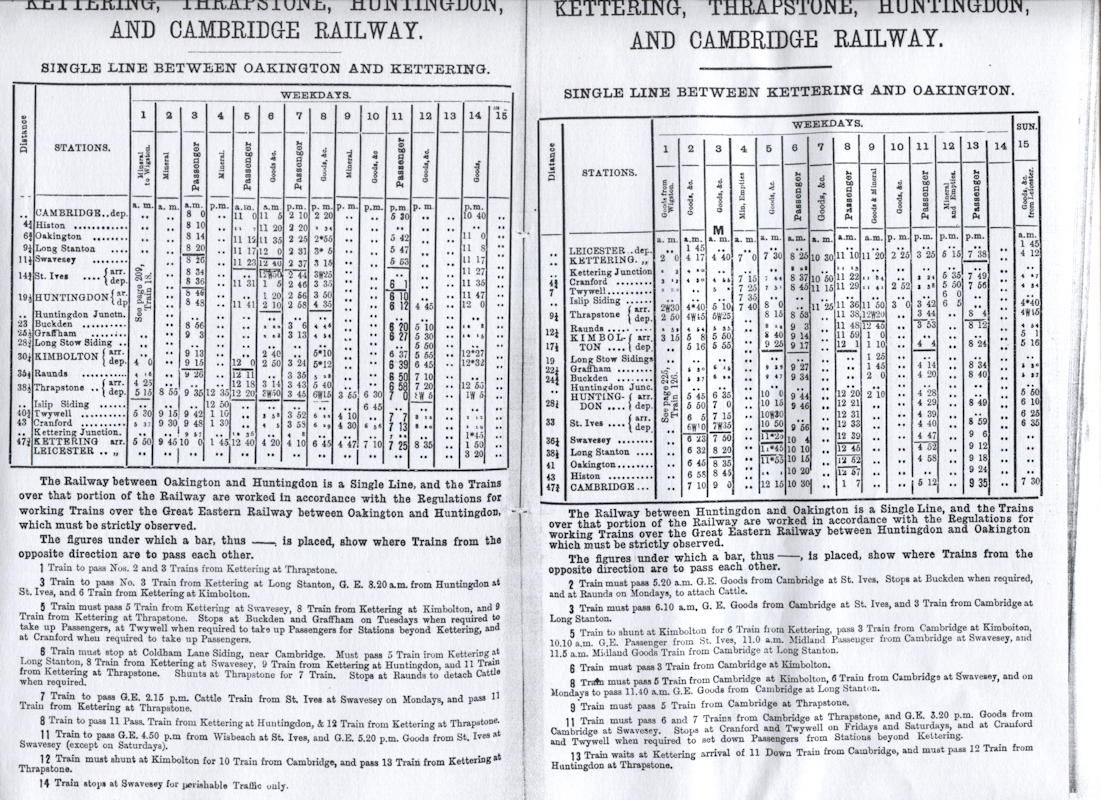
- A fascinating 1876 Midland Railway Working Timetable, showing four passenger workings, four trips to Thrapstone (then with an “e”) which would have served Islip furnaces, an overnight Goods to Kimbolton, three through Goods workings and an afternoon out-and-back Goods from Kettering to Huntingdon. The footnote detail is remarkable showing, for example, how train 2 stops at Raunds on Mondays to attach cattle. Photo: Robin Cullup Collection.
-
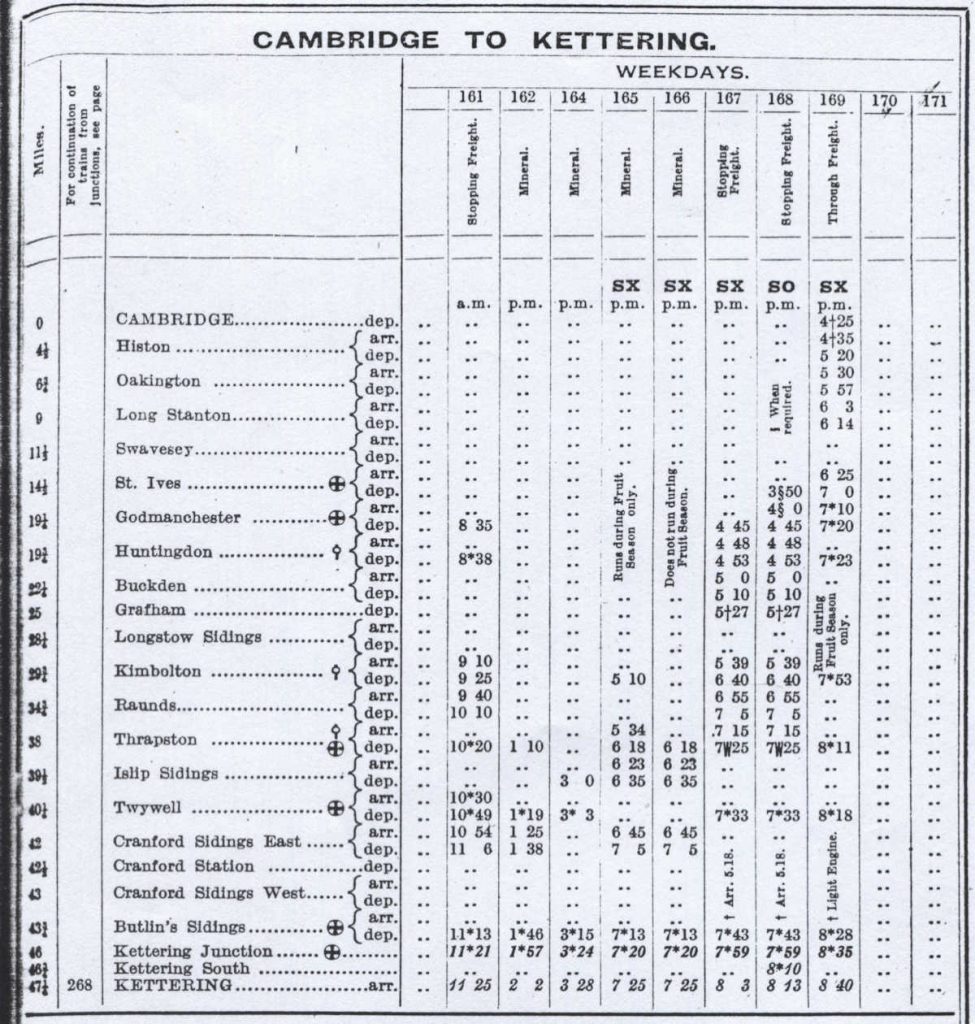
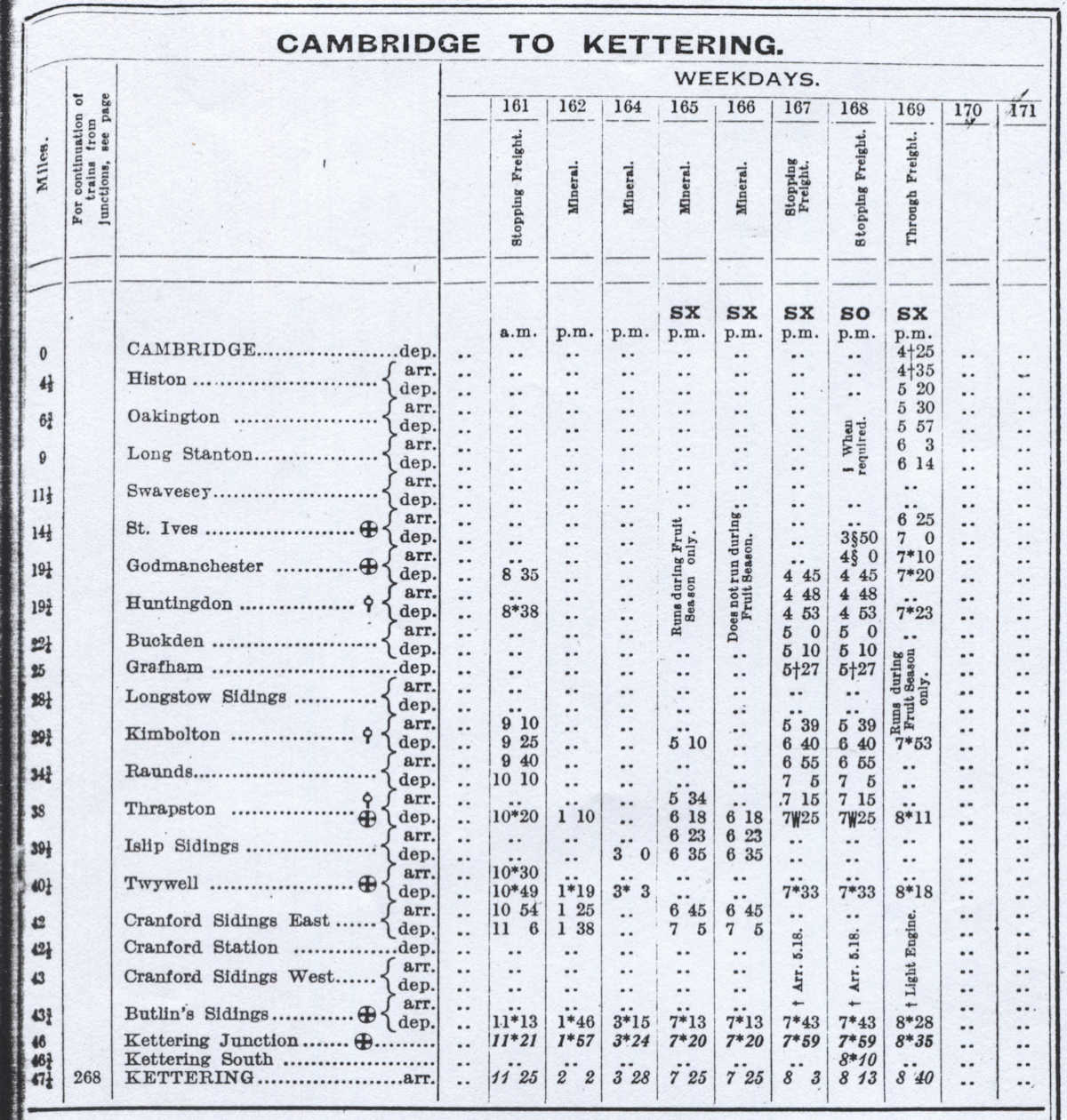
- May 1937 Freight Timetable – Cambridge to Kettering. Photo: Robin Cullup Collection.
-
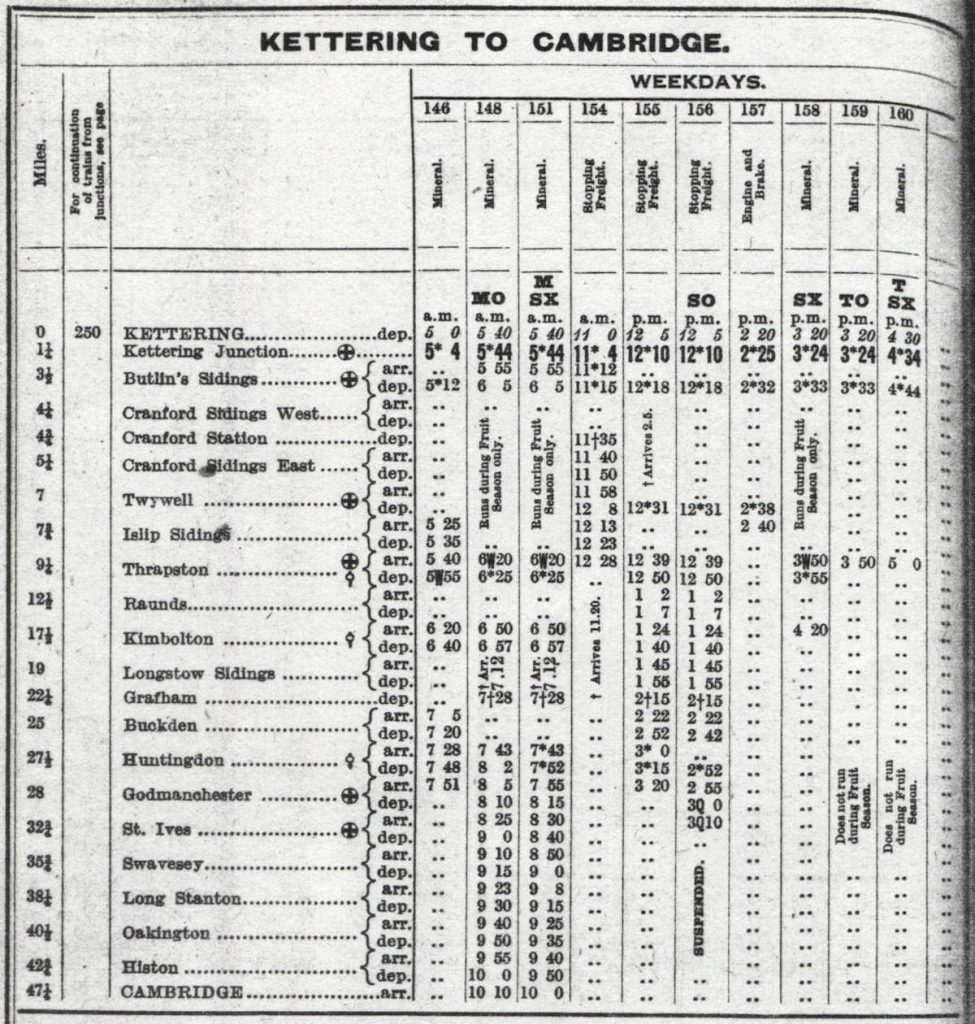
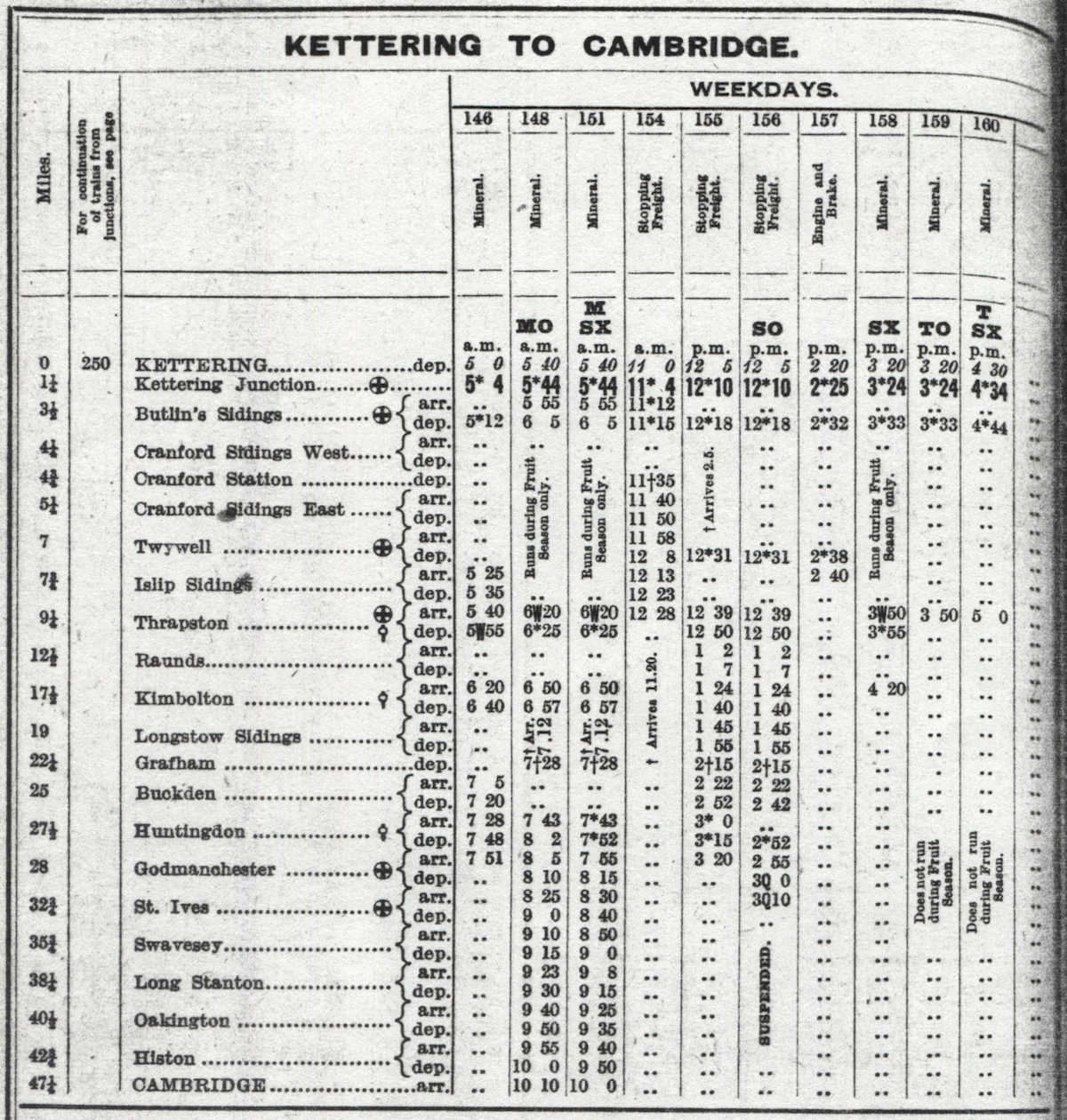
- May 1937 Freight Timetable – Kettering to Cambridge. Photo: Robin Cullup Collection.
-
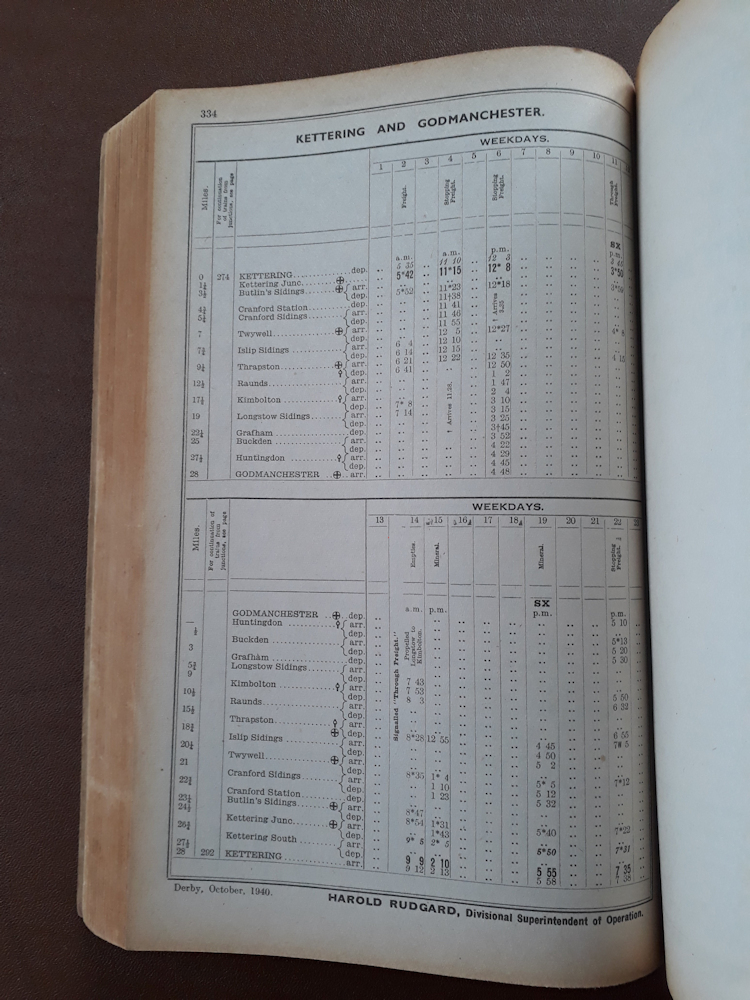
- October 1940 LMS Freight Timetable, showing two return workings from Kettering to Thrapston, one to Godmanchester and one to Longstow Sidings which, interestingly, propelled back to Kimbolton before returning to Kettering. Photo: Alan Jones.
-
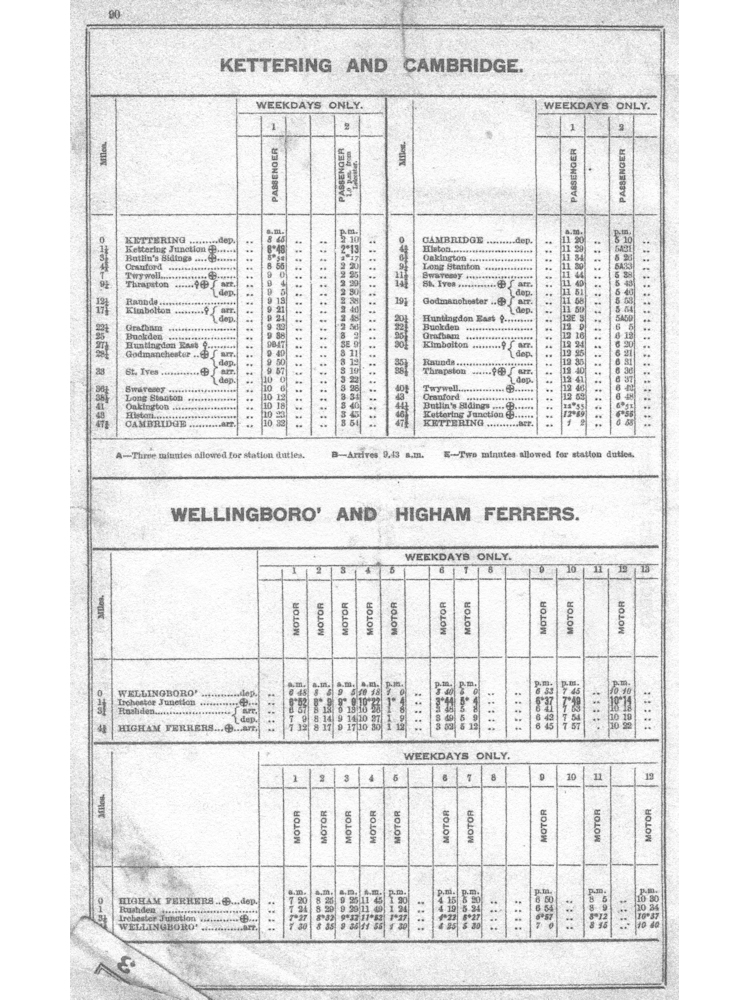
- Wartime austerity in 1942 with the passenger service reduced to two return trips from Kettering to Cambridge. Photo: Robin Cullup Collection.
-
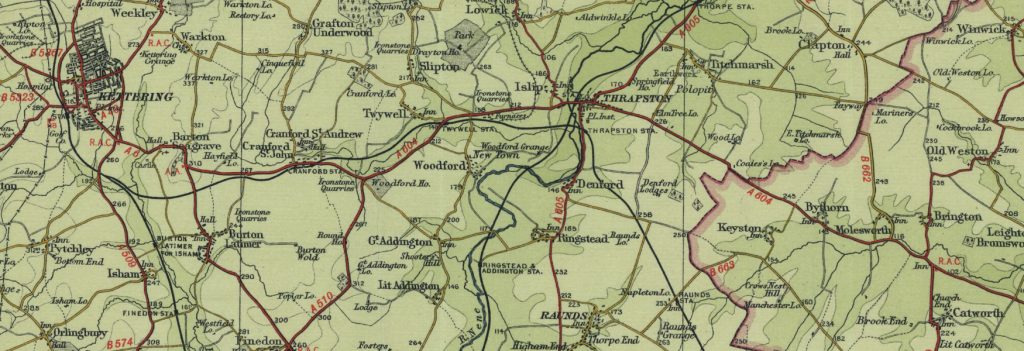
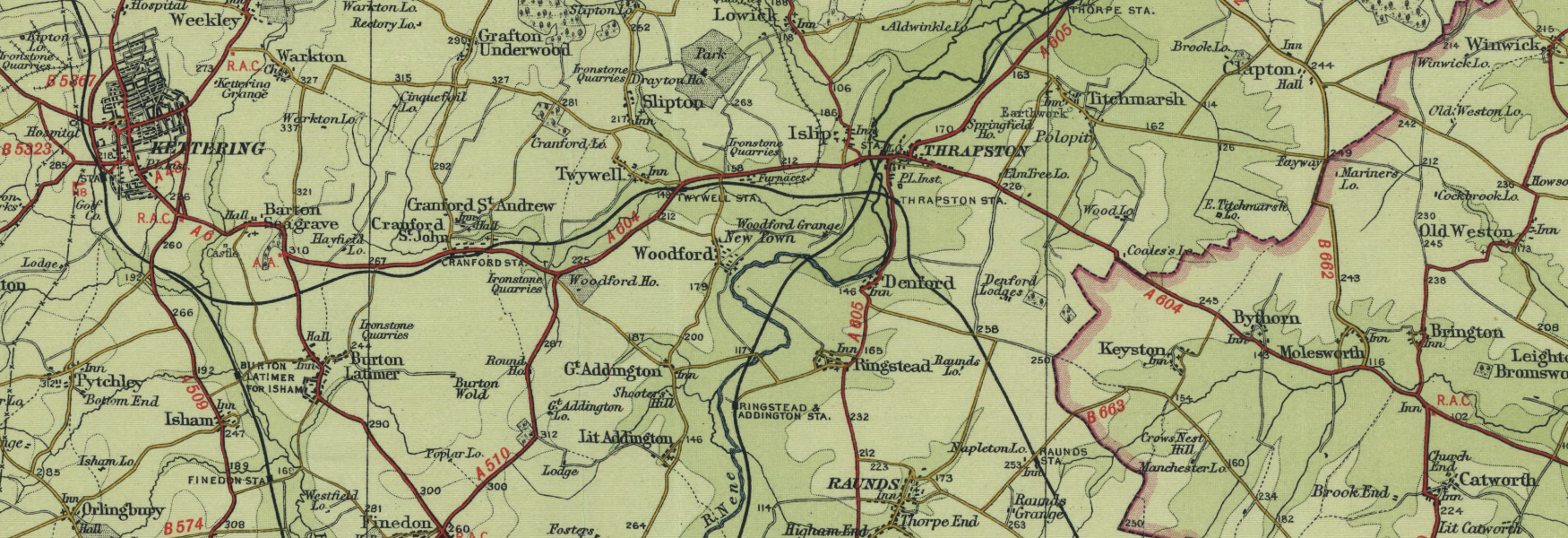
- 1940 Map of the Kettering to Raunds section of the Branch. Reproduced with the permission of the National Library of Scotland https://maps.nls.uk/index.html
-
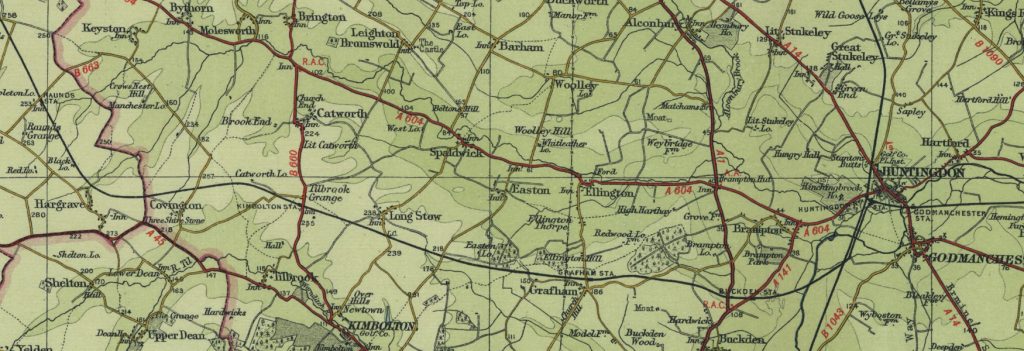
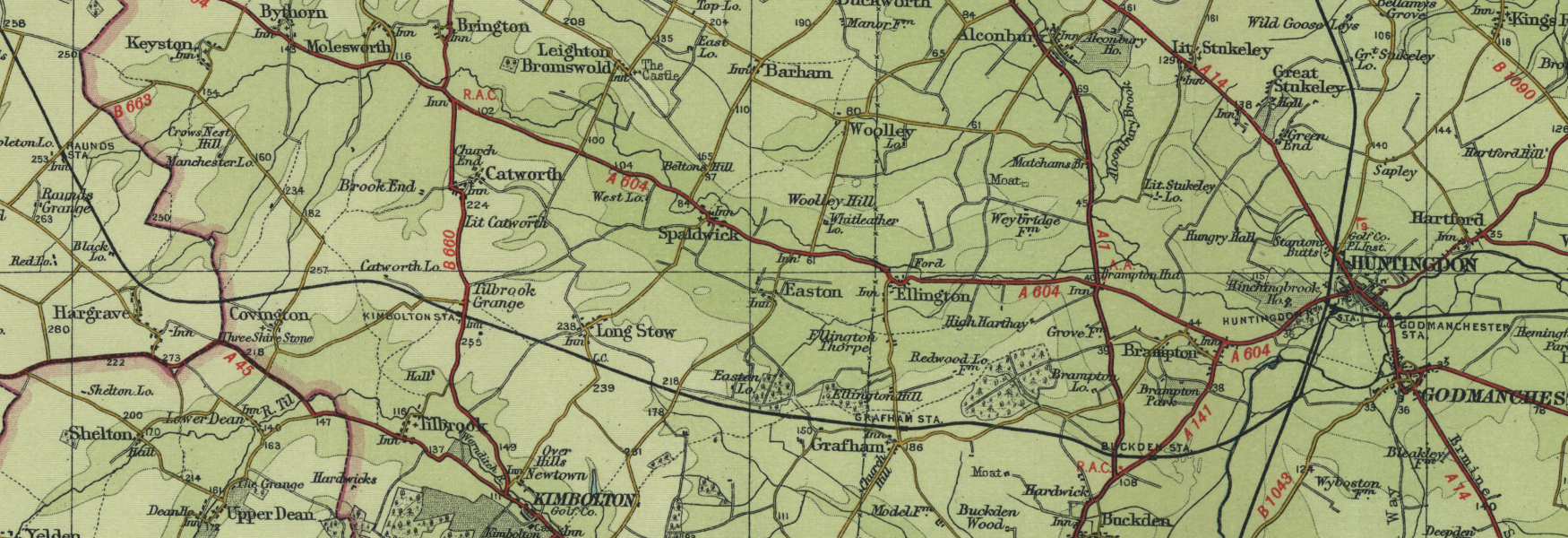
- 1940 Map of the Raunds to Huntingdon section of the Branch. Reproduced with the permission of the National Library of Scotland https://maps.nls.uk/index.html
-
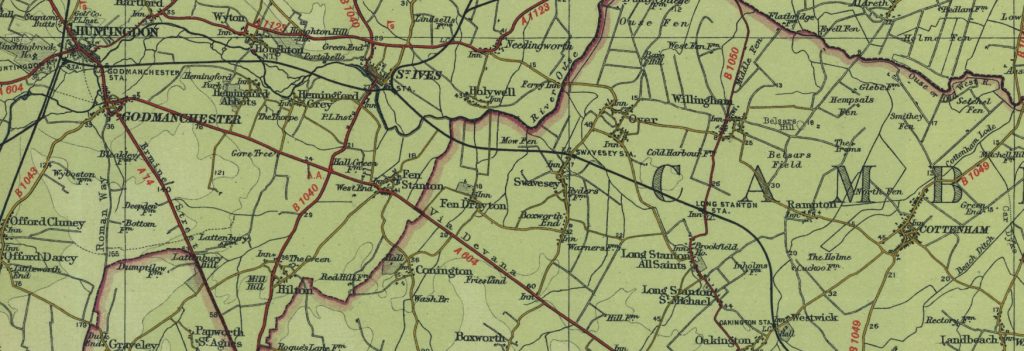
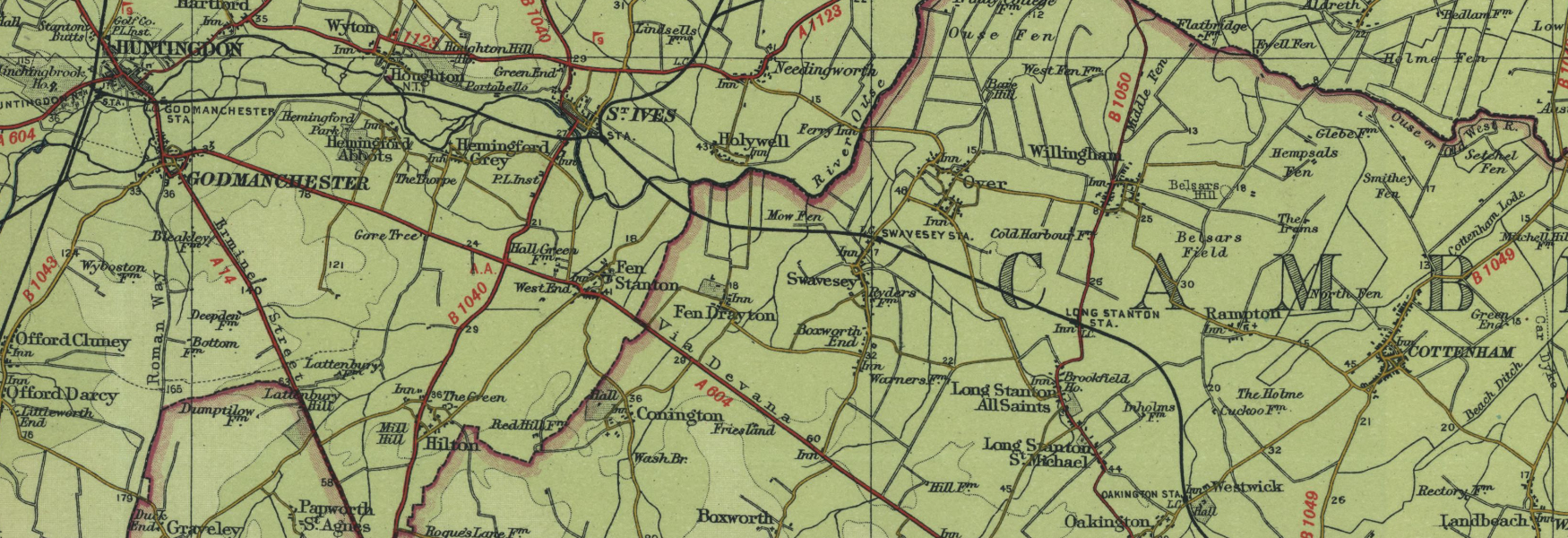
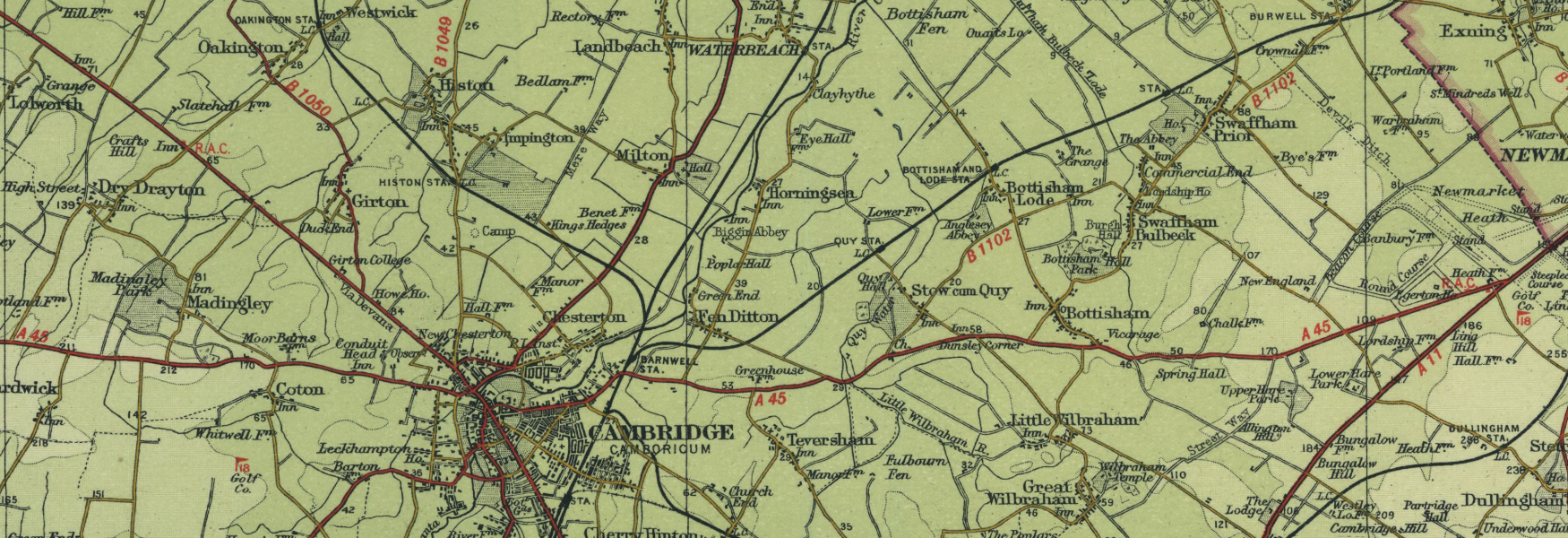
- 1940 Map of the Huntingdon to Oakington section of the Branch. Reproduced with the permission of the National Library of Scotland https://maps.nls.uk/index.html
-
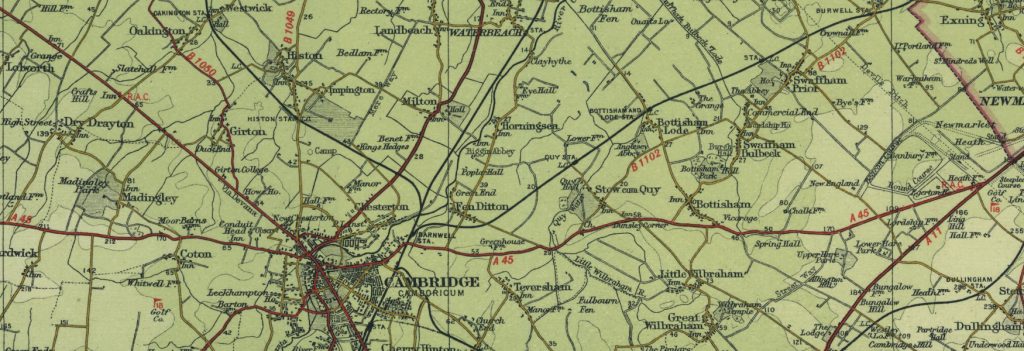
- 1940 Map of the Oakington to Cambridge section of the Branch. Reproduced with the permission of the National Library of Scotland https://maps.nls.uk/index.html
-
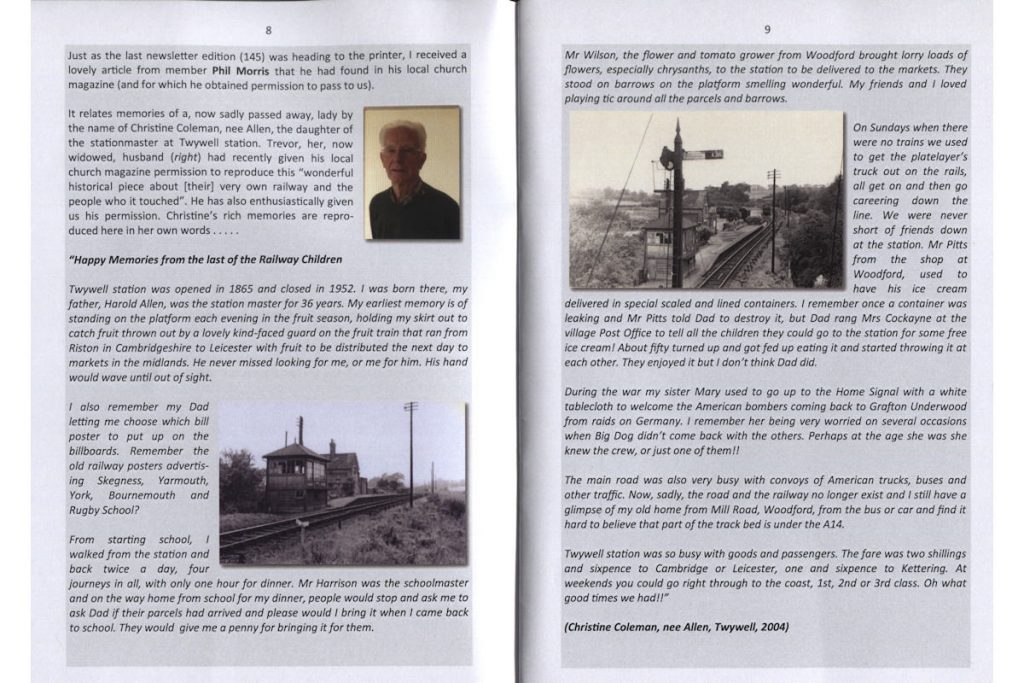
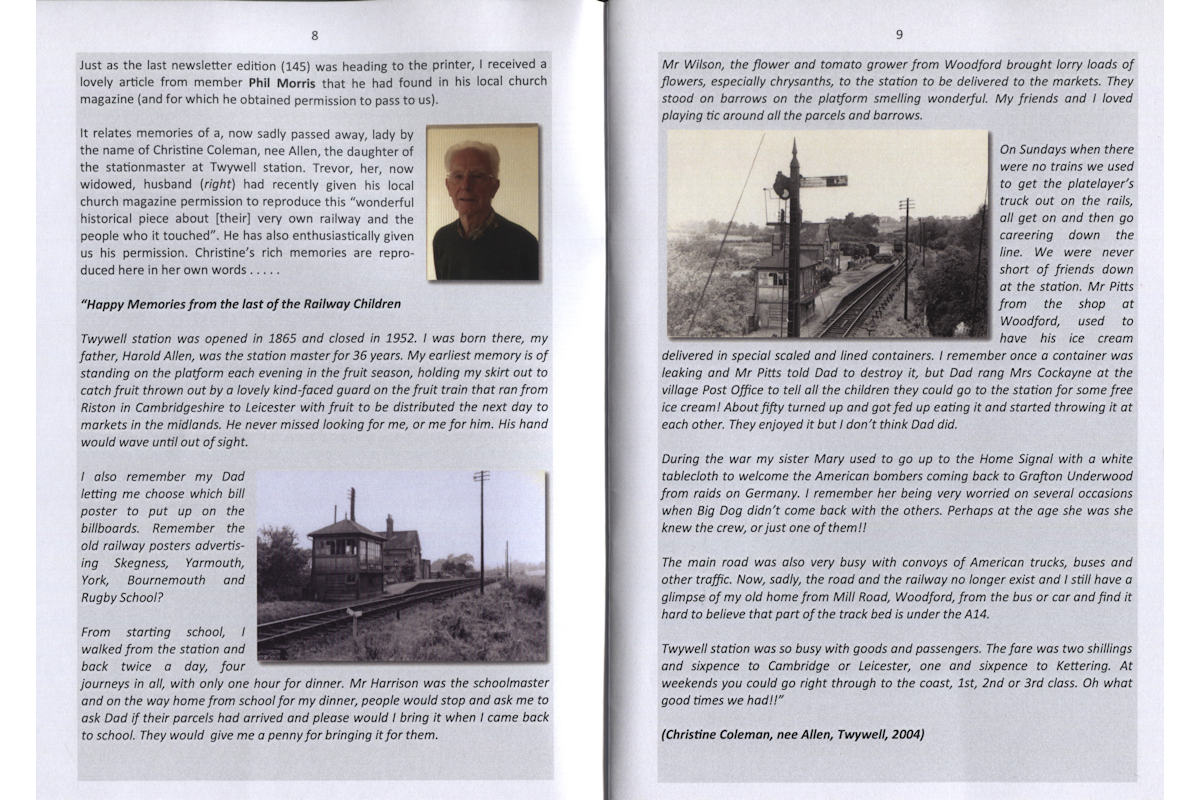
- Memories of Twywell station, recounted by Christine Coleman and published in the Midland Society Newsletter. Photo: Robin Cullup collection.
-
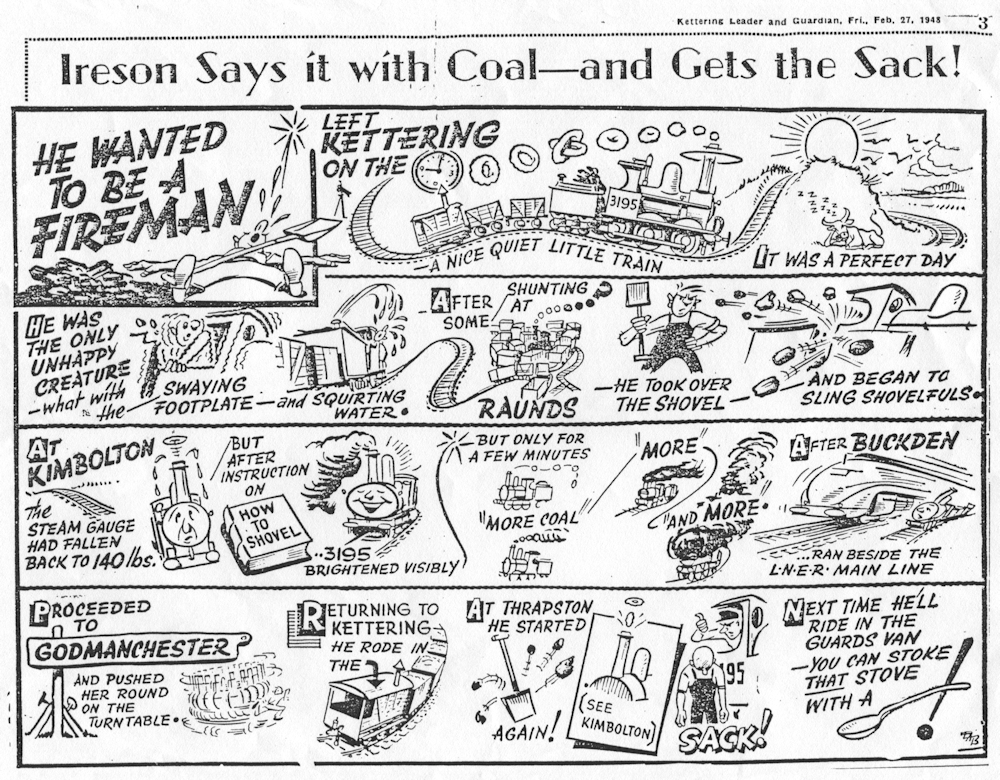
- A cartoon from the 27th February 1948 edition of the Kettering Leader and Guardian, featuring the unfortunate Ireson’s experiences as a fireman on the Branch. Apart from the turntable being at Huntingdon East rather than Godmanchester, the detail is remarkably accurate, even down to the locomotive number of 3195. Photo: Robin Cullup Collection.
-
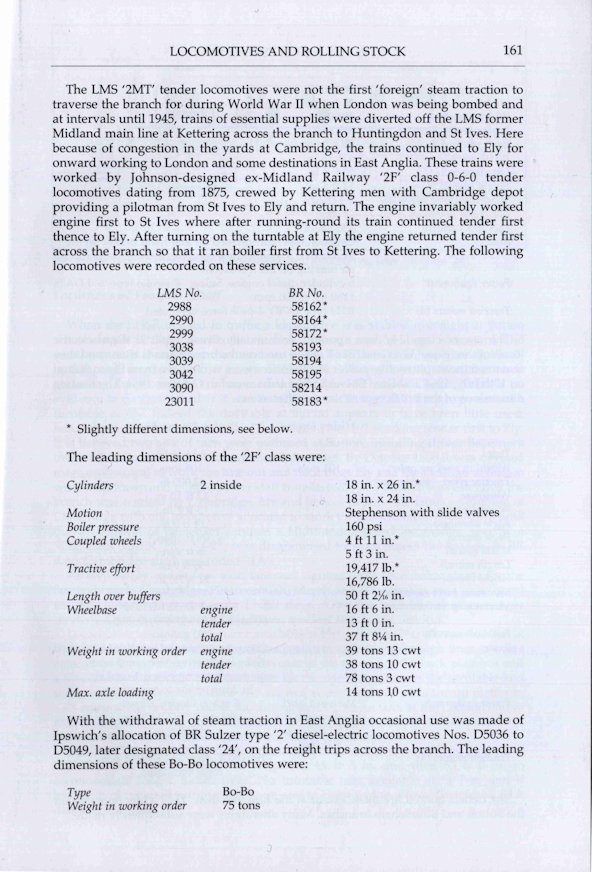
- A fascinating insight into the use of the Kettering-St Ives route and the St Ives-Bluntisham-Ely route to handle wartime freight traffic. Photo: Robin Cullup.
-
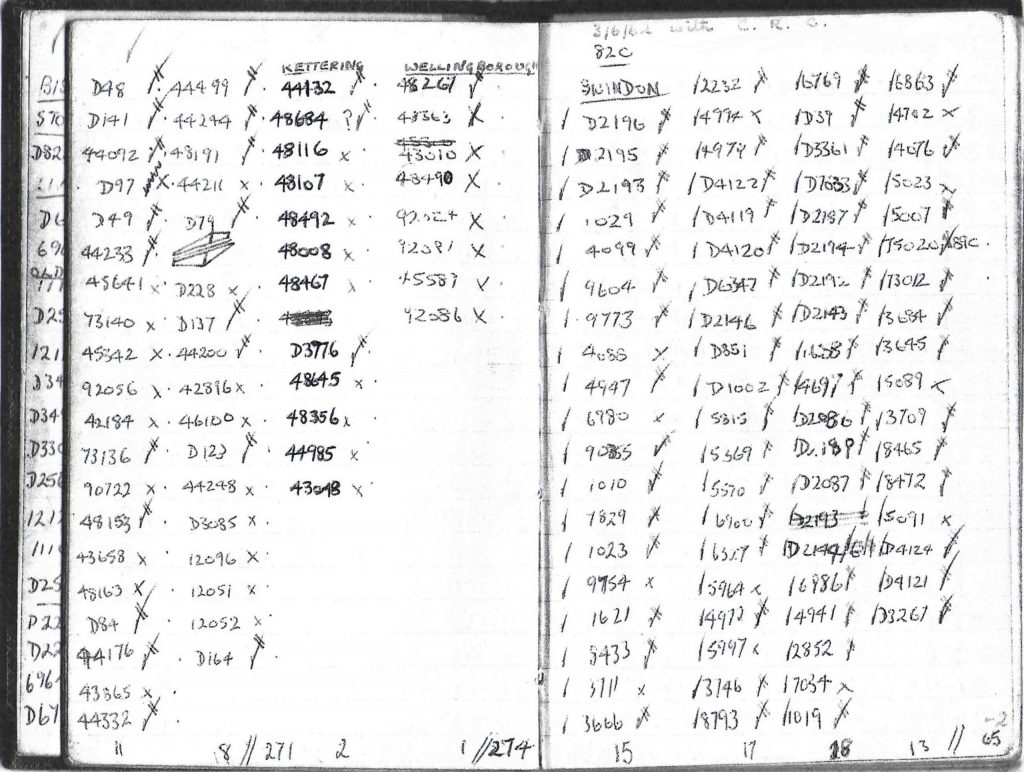
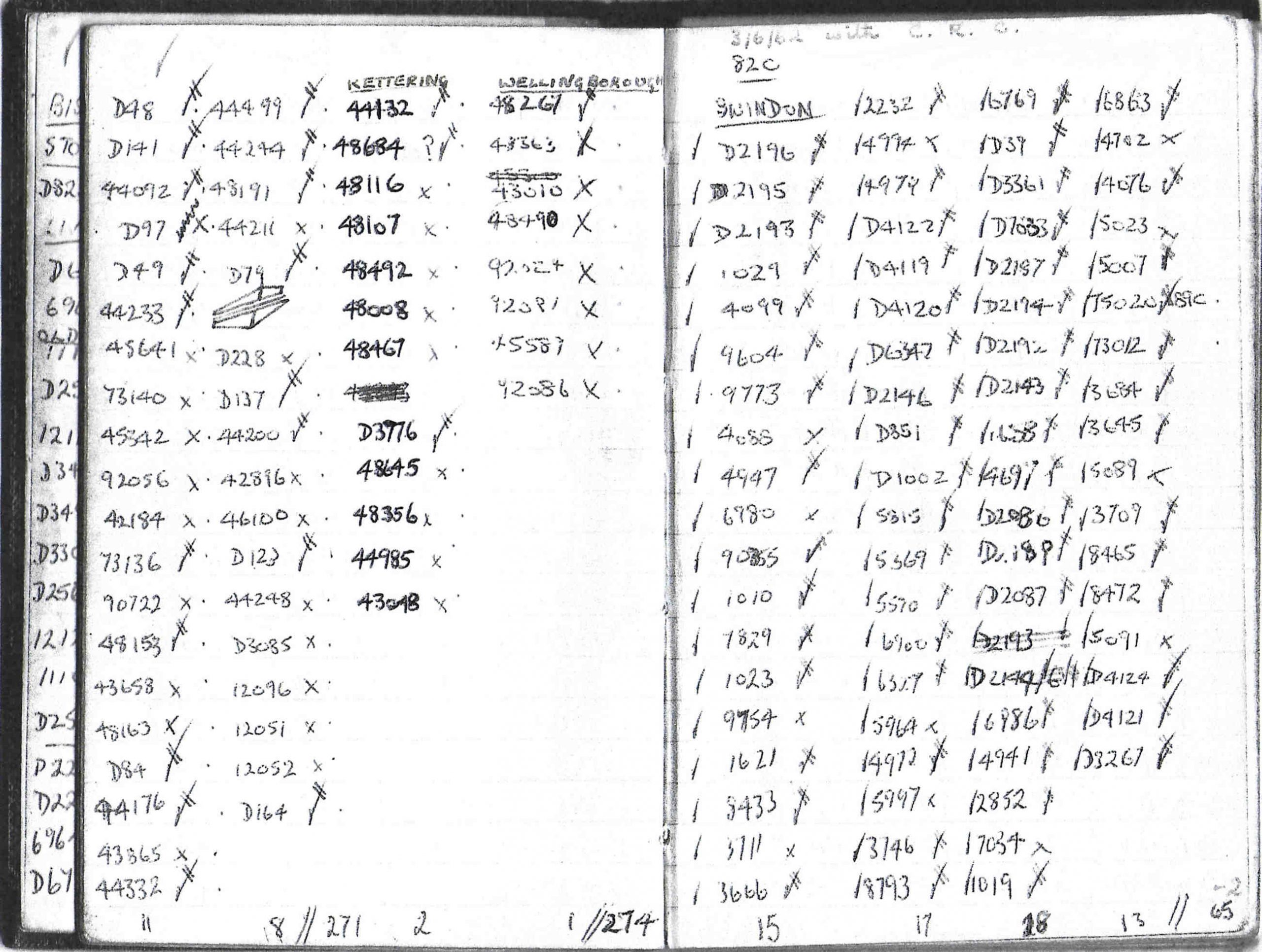
- Cambridge Branch member Keith Crossley has shared some of his log books from visits to Kettering Shed in the 1960s. This one, from 20th May 1962, shows mainly 8Fs and 4Fs, along with a single Ivatt 4MT (43048) and a Class 08 shunter (D3776, subsequently 08609). Photo: Keith Crossley.
-
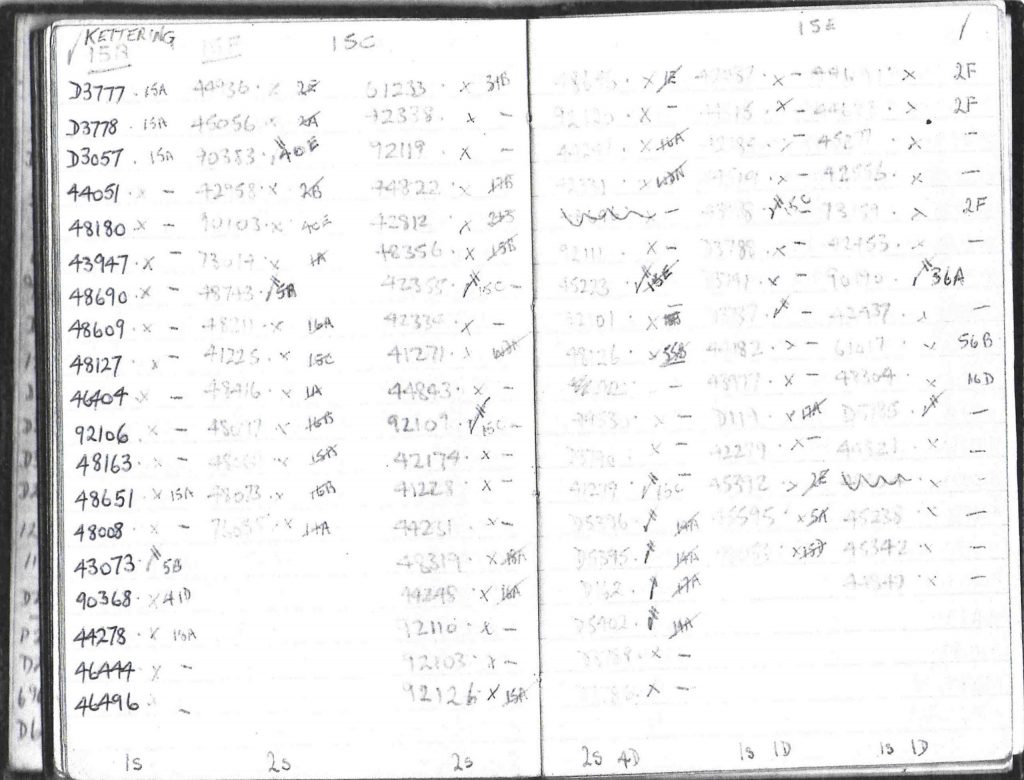
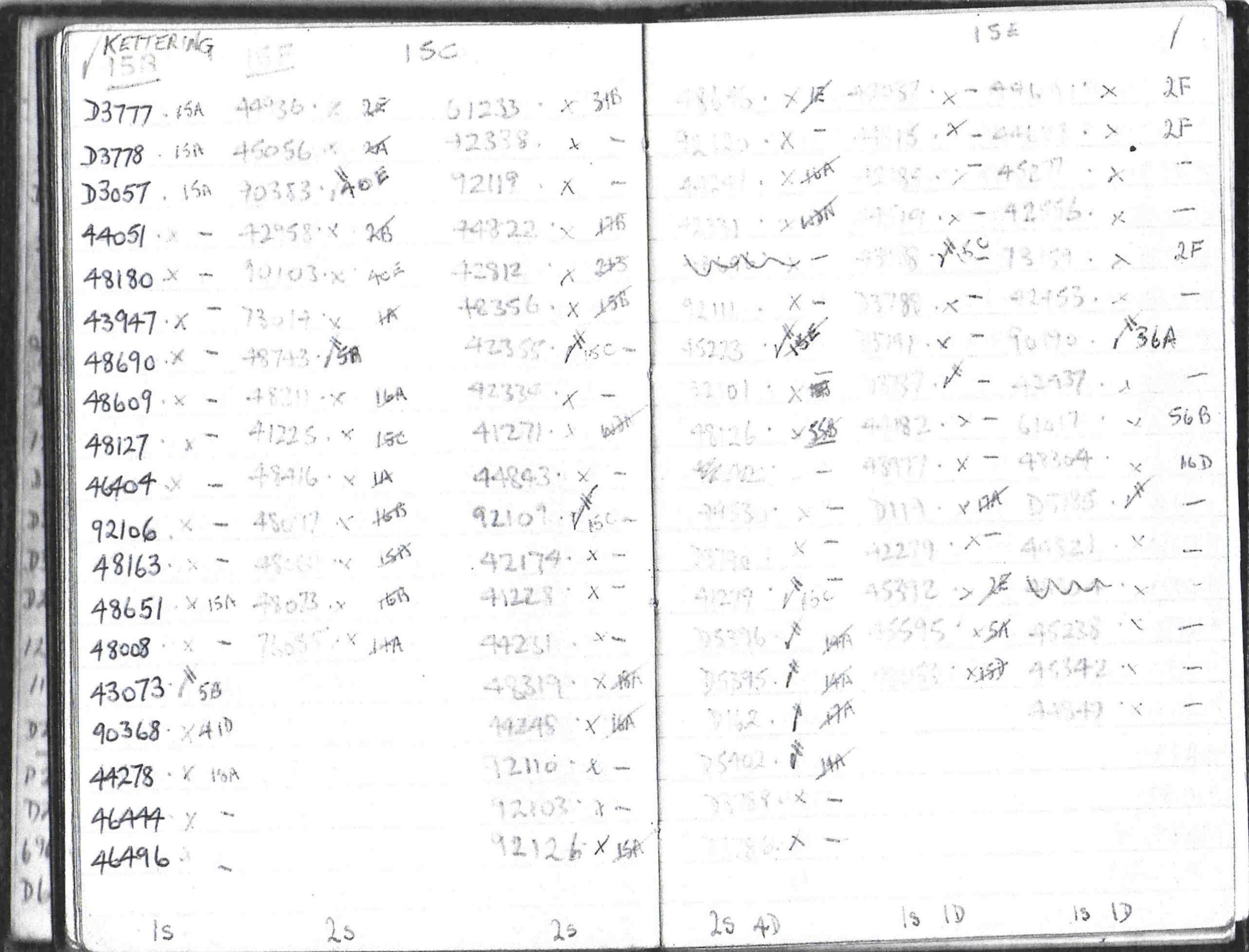
- A second visit, on February 24th 1963, shows three Ivatt 2MTs (46404, 46444 and 46496), a 4MT (43073), a good number of 8Fs again, some Midland 4Fs, a WD 8F (90368) and a BR 9F (92106) – along with three Class 08 shunters (D3777, D3778 and D3057 which became 08 610, 08 611 and 08 044 respectively). Photo: Keith Crossley.
-
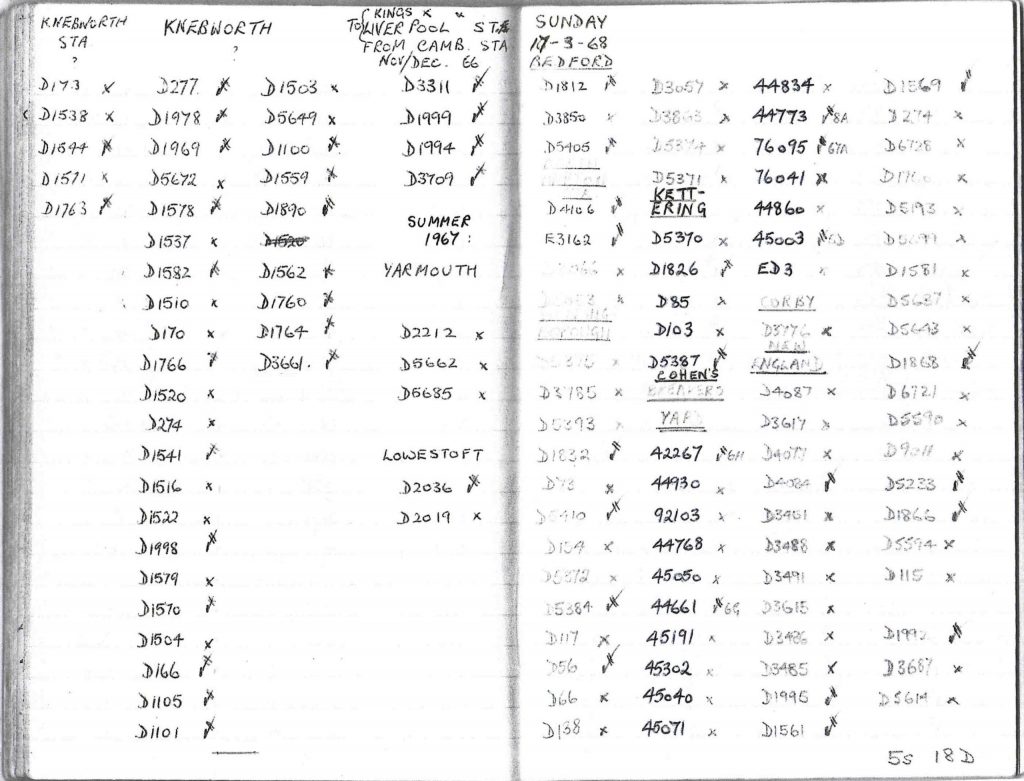
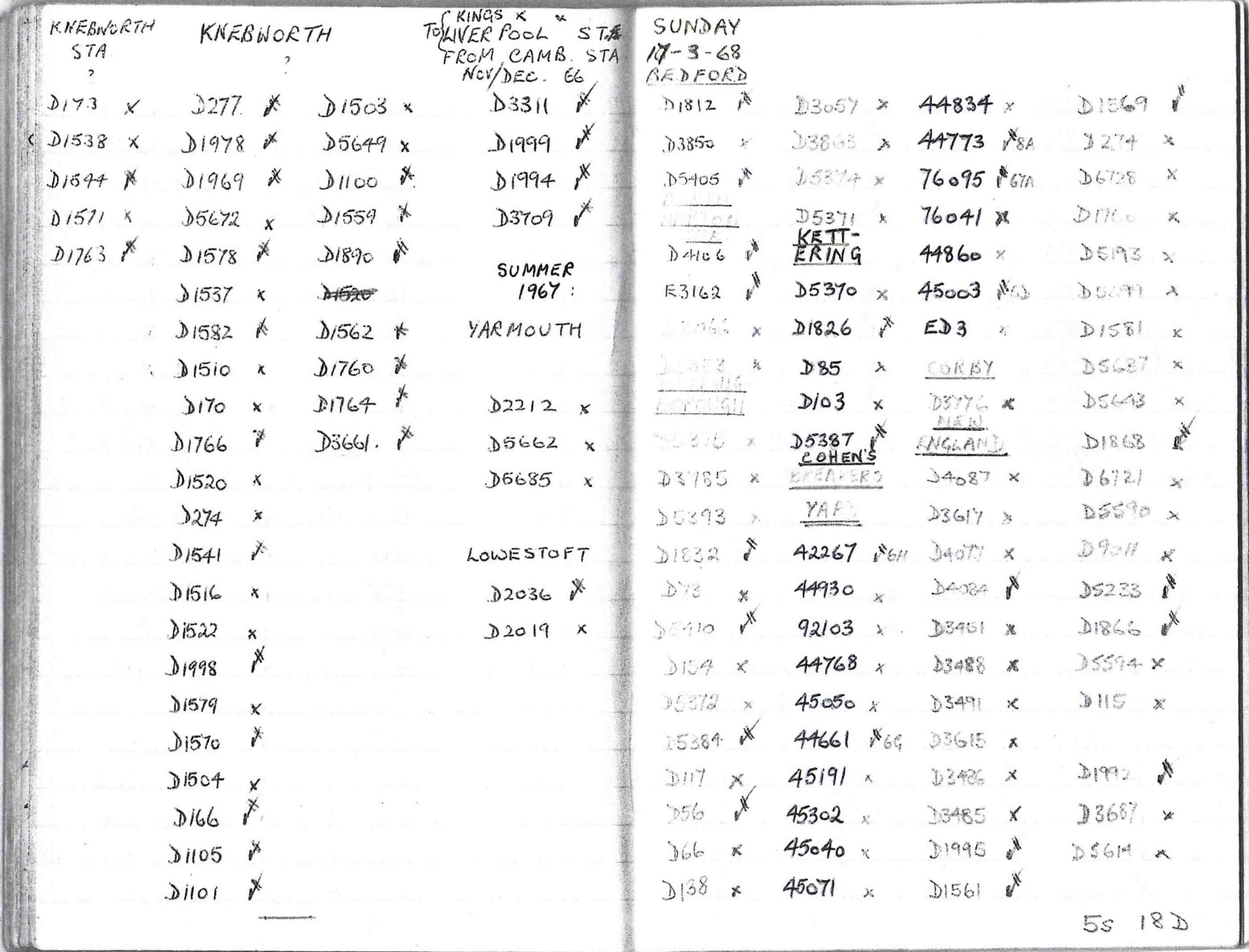
- Keith’s final visit, on March 17th 1968, gives a valuable insight into the scale of the withdrawal of steam locomotives in 1968. The Shed now holds just a handful of diesels, but Cohen’s scrapyard has sixteen locomotives, including 9F No. 92103 which had been in service for just over ten years (and contrasts with Fowler 0-4-0 diesel-mechanical shunter ED3 from 1936!). Photo: Keith Crossley.